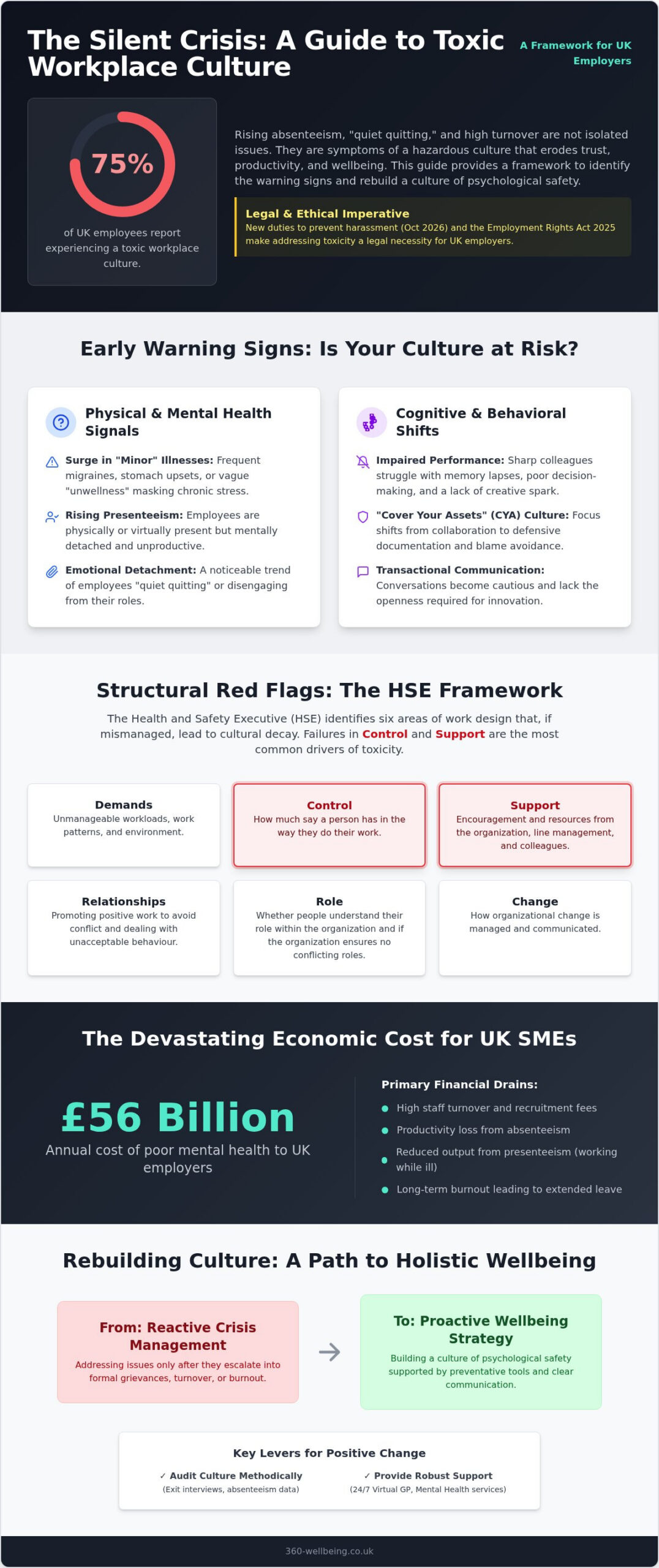
Did you know that 75% of UK employees report having experienced a toxic workplace culture? It’s a staggering figure that highlights a silent crisis within our professional landscape. If you’ve noticed rising absenteeism or the unsettling trend of “quiet quitting” within your teams, you aren’t alone. Identifying the specific signs of a toxic work culture uk is the first step toward safeguarding your people and your business. With the implementation of the Employment Rights Act 2025 and new duties to prevent harassment arriving in October 2026, understanding these red flags is now a legal and ethical necessity.
We understand the weight of responsibility you feel for your team’s wellbeing and the frustration of seeing talent leave. You want a workplace where people thrive, not just survive. In this guide, we’ll provide a clear checklist to validate your concerns and a clinical framework to restore harmony. We’ll explore 12 critical indicators of toxicity, from subtle micro-aggressions to overt systemic failures, and show you how to build a culture rooted in psychological safety and durable health. It’s time to move toward a proactive vision of workplace vitality where every employee feels protected and empowered.
Key Takeaways
- Learn how to differentiate between healthy high-pressure environments and the hazardous signs of a toxic work culture uk that impact long-term sustainability.
- Identify “early warning” physical and mental health signals in your team, including rising presenteeism and frequent minor illnesses that often mask chronic stress.
- Uncover the structural red flags within your leadership and communication styles, specifically addressing the “digital silos” that can isolate hybrid and remote workers.
- Master a methodical auditing framework using exit interview data and departmental absenteeism patterns to pinpoint exactly where your cultural health requires intervention.
- Discover a structured path to rebuilding trust by moving from reactive crisis management to a proactive strategy supported by tools like 24/7 Virtual GP and Mental Health Support.
Defining Toxic Work Culture in the UK: More Than Just “Bad Days”
Every workplace experiences the occasional high-pressure week or stressful project. However, there is a fundamental distinction between a challenging environment and one that is clinically hazardous. A toxic culture exists when negative behaviours, such as bullying, exclusion, or chronic overwork, are no longer exceptions but have become the accepted norm. Understanding what is a toxic workplace involves looking beyond the surface of a busy office to see the underlying erosion of trust and safety. In 2026, these signs of a toxic work culture uk are often subtle. They manifest as digital gaslighting in messaging apps or exclusionary practices where hybrid workers are left out of vital informal decision-making processes.
UK employers hold a legal “Duty of Care” to protect the psychological health of their staff. This isn’t just a suggestion; it’s a regulatory requirement that has gained even more weight with the phased implementation of the Employment Rights Act 2025. When toxicity is allowed to fester, it creates a workplace where employees feel perpetually on edge, leading to a breakdown in both individual wellbeing and collective productivity. We view workplace harmony as a professional necessity and a human entitlement, not a luxury that can be sidelined during busy periods.
The HSE Management Standards Framework
The Health and Safety Executive (HSE) identifies six key areas of work design that, if poorly managed, lead to cultural rot: demands, control, support, relationships, role, and change. In our experience, failures in “Control” and “Support” are the most frequent drivers of toxicity. When employees feel they have no say in how they work or lack the necessary support from leadership, stress levels skyrocket. The UK regulatory landscape has shifted decisively from focusing solely on physical safety to prioritising psychological safety. Employers must now proactively manage these six areas to prevent their culture from becoming a clinical hazard to their workforce.
The Economic Cost of Toxicity to UK SMEs
For small and medium-sized enterprises, the financial impact of a broken culture is often devastating. Poor mental health costs UK employers approximately £56 billion annually, much of which is driven by high staff turnover and recruitment fees. Toxicity also fuels the absenteeism crisis that many businesses currently face. Presenteeism is the act of employees showing up for work while they are mentally or physically unwell, resulting in a significant loss of productivity and a higher risk of long-term burnout. By addressing the root causes of toxicity, you protect your bottom line and ensure the long-term durability of your most valuable asset: your people.
The Physical and Mental “Early Warning” Signs in Your Team
A toxic culture often reveals itself through the bodies and minds of your employees before it ever appears in a formal grievance or an HR report. When identifying the signs of a toxic work culture uk, look for a surge in “minor” sick days. Team members might frequently cite migraines, stomach upsets, or vague “unwellness” that actually masks the heavy weight of chronic stress. This trend often coincides with rising presenteeism. You’ll see staff members logged on at all hours or physically present at their desks, yet their actual output stalls as they become emotionally and mentally detached from their roles.
Cognitive performance is another early casualty of a hazardous environment. You might notice usually sharp colleagues struggling with memory lapses, poor decision-making, or a sudden lack of creative spark. This isn’t a lack of talent; it’s a physiological response to a high-cortisol environment. As trust erodes, the team dynamic shifts from collaborative innovation to a defensive culture of “CYA” (Cover Your Assets). Communication becomes transactional and cautious. People spend more time documenting why a mistake wasn’t their fault than working together to solve it, creating a stagnant atmosphere where growth is impossible.
Clinical Symptoms: What Virtual GP Data Suggests
Chronic exposure to a hazardous environment has a measurable impact on employee health. Many workers report physical symptoms of stress such as persistent tension headaches, insomnia, and recurring digestive issues. Over time, these aren’t just minor inconveniences. They are clinical precursors to cardiovascular strain and potential long-term disability. Access to a 24/7 Virtual GP allows your workforce to address these physiological red flags early. This proactive approach helps identify health trends before they escalate into serious medical leave or permanent burnout.
The “Sunday Scaries” and Psychological Erosion
One of the most telling signs of a toxic work culture uk is the prevalence of the “Sunday Scaries.” This is a form of anticipatory anxiety that leaves employees feeling physically ill or emotionally drained as the working week approaches. Chronic anxiety of this nature leads to deep psychological erosion, eventually culminating in a complete breakdown of trust in leadership. Specialised Mental Health Support sessions provide a vital, confidential outlet for employees to navigate these feelings safely. Fostering a space for honest reflection helps repair the psychological safety that toxicity destroys. If you’re concerned about your team’s vitality, exploring a holistic support platform can help you identify and address these issues with clinical expertise.
Structural Red Flags: Leadership, Communication, and Hybrid Friction
Structural toxicity isn’t always loud; it’s often built into the very framework of how a company operates. Identifying these structural signs of a toxic work culture uk requires looking at how power and information flow through the business. A primary red flag is leadership that prioritises “results at any cost” over human sustainability. When the bottom line is the only metric of success, employee wellbeing is viewed as a hurdle rather than a professional necessity. This mindset creates an environment where hard work is met with silence, yet minor mistakes are subjected to public scrutiny, leaving staff feeling undervalued and perpetually anxious.
In our modern landscape, the “Digital Silo” has become a significant source of friction. This occurs when remote or hybrid workers are excluded from informal decision-making that happens in the physical office. Being “ghosted” on messaging platforms or left out of spontaneous corridor conversations creates a two-tier system where remote talent feels like second-class citizens. When roles and responsibilities aren’t clearly defined, this isolation fuels a “blame culture.” Without clear boundaries, internal friction grows as teams spend more energy defending their territory than collaborating on shared goals.
The Micromanagement vs. Neglect Paradox
Many UK professionals find themselves caught between excessive control and a total lack of guidance. Micromanagement signals a fundamental lack of trust, while total neglect leaves employees feeling adrift and unsupported. Both extremes are toxic. This is often exacerbated by “always-on” expectations in a 24/7 digital world, where a late-night Slack message is seen as a test of loyalty rather than an intrusion. We’ve found that Life Coaching can be a transformative tool here. It helps managers transition from a controlling or distant style to a supportive one, fostering the durability and foresight needed for modern leadership.
Communication Red Flags: Gaslighting and Exclusion
Passive-aggressive communication in digital spaces like Slack or Teams is a clear indicator of cultural rot. Whether it’s the pointed use of ellipses or “cc-ing” a senior manager on a minor disagreement, these behaviours erode psychological safety. Closely linked to this is the rise of “cliques,” which actively work against diversity and inclusion efforts by keeping information within a small, favoured circle. An Employee Assistance Programme (EAP) is essential in these scenarios. It provides a confidential, neutral reporting line and support system for employees who feel targeted by these subtle, yet damaging, exclusionary practices.
Auditing Your Culture: A Framework for UK Managers
Identifying the signs of a toxic work culture uk is a vital first step, but restoring health requires a methodical and data-driven approach. We recommend moving beyond “gut feelings” by conducting a structured audit of your current environment. Start by reviewing exit interview data from the past 12 to 24 months. Look for recurring themes of management failure or specific mentions of exclusionary behaviour. If a high percentage of departing talent cites the same departmental issues, you’ve found a clear clinical indicator of where the cultural rot is concentrated.
Analysing absenteeism patterns is equally revealing. Are specific teams taking “minor ailment” sick leave more frequently than others? This data often highlights localised toxicity that hasn’t yet reached the level of a formal grievance. To get a complete panoramic view, you must measure psychological safety through anonymous employee engagement surveys. Benchmarking these findings against the ISO 45003 standards for psychological health and safety allows you to move the conversation from subjective opinions to internationally recognised wellbeing criteria.
Conducting a Wellbeing Audit
A successful audit identifies the gap between your stated company values and the actual lived experience of your workforce. It’s often helpful to integrate financial support tools during this process to see if external stressors, such as personal debt, are compounding workplace friction. Anonymous feedback is the only way to get the truth in a toxic culture because it removes the fear of retaliation that otherwise forces employees into silence. Once you have this honest data, you can begin to build a durable strategy for improvement.
Implementing ISO 45003 Principles
ISO 45003 provides a robust framework for managing psychosocial risks. One effective strategy is appointing “Mental Health Champions” who act as cultural barometers, providing leadership with real-time insights into the team’s emotional temperature. This helps shift the organisation from a “blame” culture to a “learning” mindset when projects fail. For this to work, leadership must establish and respect clear boundaries for work-life balance. When managers model healthy behaviours, it signals that wellbeing is an essential human entitlement rather than a luxury. If you’re ready to transform your workplace, you can explore our holistic audit and support tools to begin the healing process.
Rebuilding Culture: From Toxicity to Holistic Wellbeing
Once you’ve identified the signs of a toxic work culture uk through a methodical audit, the focus must shift from diagnosis to restoration. Rebuilding trust isn’t a one-off event; it’s a steady process of proving that employee health is a professional necessity rather than a luxury. By integrating a comprehensive benefits platform, you create a foundation where every team member feels seen and supported. This transition signals a move away from reactive crisis management toward a proactive strategy of human sustainability and long-term durability.
Providing immediate access to tools like a 24/7 Virtual GP and Mental Health Support demonstrates a genuine commitment to your workforce’s vitality. It moves the conversation beyond empty promises and offers practical, clinical support for the stress-related illnesses that often follow a period of cultural friction. To balance this clinical support with positive reinforcement, 360 Rewards plays a vital role in rebuilding morale. Tangible appreciation through rewards counters the neglect that often characterises toxic environments, fostering a sense of completeness and balance within the team dynamic.
The Role of the EAP in Cultural Recovery
An Employee Assistance Programme (EAP) acts as a critical safety net during the recovery phase. It provides a confidential outlet for staff who may still feel the psychological weight of past toxicity. By offering legal support and Financial Support & Debt Advice, you help reduce the “total load” on your employees, addressing the outside stressors that can often bleed into the workplace. Physical health is equally important in this panoramic approach. Access to Physiotherapy ensures that the physical toll of chronic stress, such as musculoskeletal tension, is addressed with the same urgency as mental wellbeing.
Leading with Empathy and Expertise
The most successful cultural transformations occur when managers adopt a “caregiver” model of leadership. This doesn’t mean lowering standards; it means using expert tools to support teams through a lens of empathy and foresight. By utilizing the 360 Wellbeing platform, leaders can maintain a panoramic view of their team’s health, ensuring that mental, physical, and social wellness are treated as a unified narrative of total wellness. This proactive partnership is the hallmark of a modern, forward-thinking workplace that values its people as an essential human entitlement. Discover how 360 Wellbeing can transform your workplace culture today.
Cultivating a Culture of Durability and Vitality
Recognizing the subtle and overt signs of a toxic work culture uk is the essential first step toward a healthier, more productive workforce. We’ve explored how physical symptoms like chronic stress and structural issues like digital silos can erode the foundation of your business. By moving from a reactive stance to a proactive audit based on ISO 45003 standards, you can begin to restore the psychological safety your employees deserve. This shift isn’t just about compliance; it’s about honoring wellbeing as a fundamental human entitlement and a professional necessity.
True cultural restoration requires tangible support that goes beyond simple policy changes. Providing your team with 24/7 access to UK-registered Virtual GPs, confidential Mental Health Support, and a robust EAP signals a deep, human commitment to their long-term vitality. Including holistic financial and legal advice ensures you’re addressing the total load your staff carries in their daily lives. You have the power to turn toxicity into harmony. Protect your team with a comprehensive 360 Wellbeing platform and build a workplace where everyone can flourish. Your journey toward a more balanced and supportive environment starts today.
Frequently Asked Questions
What are the most common signs of a toxic work culture in the UK?
The most common signs of a toxic work culture uk include systemic bullying, exclusionary cliques, and a persistent lack of psychological safety. You’ll often see communication that is passive-aggressive or transactional rather than collaborative. When leadership prioritises results over human sustainability, it creates a “blame culture” where employees spend more time defending themselves than innovating. These indicators suggest an environment where negative behaviours have been normalised rather than corrected.
How does a toxic workplace affect an employee’s physical health?
A toxic workplace triggers a chronic stress response that manifests in persistent headaches, digestive problems, and severe insomnia. When the body stays in a state of high alert, the resulting cortisol spikes can lead to long-term cardiovascular strain. These physical symptoms are clinical indicators that the environment is hazardous. Access to a Virtual GP helps employees address these physiological red flags before they escalate into serious health conditions or permanent burnout.
Can a toxic work culture be fixed without changing leadership?
Fixing a broken culture is possible without changing personnel if leadership is willing to adopt a supportive, caregiver-led management style. This transformation often requires external Life Coaching to help managers move away from controlling or micromanaging behaviours. By implementing new frameworks like the HSE Management Standards, leaders can rebuild trust. Success depends on a genuine commitment to transparency and a shift from a “results at any cost” mindset.
What is the difference between a high-pressure job and a toxic workplace?
A high-pressure job is defined by demanding tasks and deadlines, while a toxic workplace is defined by hazardous interpersonal behaviours. In a healthy high-pressure environment, teams feel supported and share a sense of purpose. Conversely, toxicity involves gaslighting, exclusion, and fear. High pressure challenges an employee’s skills, but toxicity attacks their fundamental psychological safety and sense of self-worth. One is a professional hurdle; the other is a clinical hazard.
What legal rights do UK employees have in a toxic work environment?
UK employees are protected by the Health and Safety at Work Act 1974, which requires employers to ensure a safe environment, including psychological health. Under the Employment Rights Act 2025, there are enhanced protections against harassment and stronger whistleblower rights. If a culture becomes intolerable, employees may have grounds for constructive dismissal claims. As of October 2026, the time limit for bringing most employment tribunal claims has increased to six months.
How can I support my team if I suspect the culture is becoming toxic?
Support your team by fostering psychological safety through anonymous feedback loops and modelling clear work-life boundaries. Providing access to specialised Mental Health Support sessions gives employees a confidential space to navigate their concerns. You should also appoint Mental Health Champions to act as cultural barometers within the team. By treating wellbeing as a professional necessity rather than a luxury, you signal a proactive commitment to their long-term vitality and success.
What role does an EAP play in addressing workplace toxicity?
An Employee Assistance Programme (EAP) serves as a confidential reporting line and a comprehensive support system for staff facing toxicity. It provides access to counselling, legal support, and financial advice to reduce an employee’s total stress load. This neutral channel is essential for identifying the signs of a toxic work culture uk without putting the employee at risk of internal retaliation. It offers a safe space for recovery and professional guidance.
Is high staff turnover always a sign of a toxic culture?
High staff turnover isn’t always toxic, but it’s a major indicator that requires a panoramic audit of your workplace health. While some attrition is natural, recurring patterns of resignation in specific departments usually point to leadership or cultural failures. You should analyse exit interview data to distinguish between career progression and a desire to escape a hazardous environment. Consistently high turnover is an expensive symptom of a deeper cultural rot.