
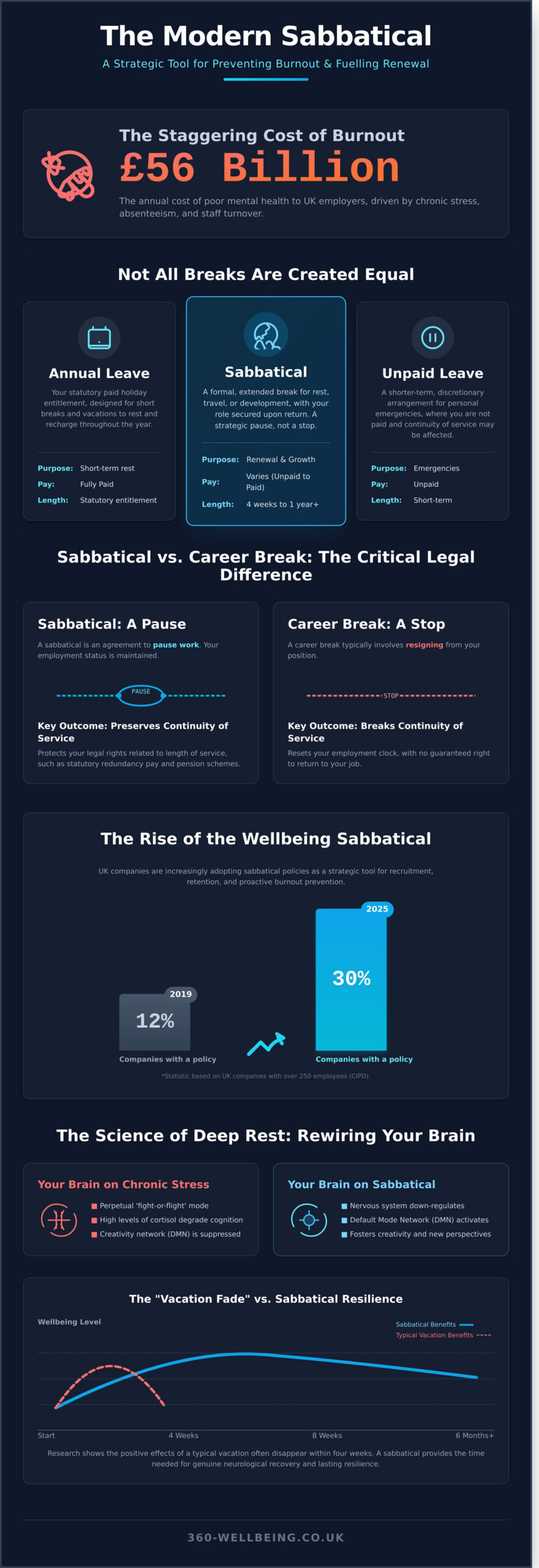
Poor mental health is now costing UK employers up to £56 billion each year, with chronic stress a primary driver of both absenteeism and staff turnover. You’ve likely felt this pressure yourself or seen its effects in your team. The constant ‘on’ culture can feel unsustainable, and the idea of ‘quiet quitting’ has become a quiet reality for many who feel trapped between burnout and financial necessity.
This guide is designed to transform that conversation, moving the concept of a leave sabbatical from a vague aspiration into a concrete, strategic tool for personal and professional renewal. We will show you precisely how to structure, request, and manage a career break to prevent burnout, all while safeguarding your financial wellbeing and career progression. We’ll explore everything from your legal rights and contractual entitlements in the UK to building a compelling business case for a sabbatical policy that boosts both morale and your bottom line.
Key Takeaways
- Understand the crucial differences between a formal sabbatical, annual leave, and unpaid time off to frame your career break effectively.
- Discover how to build a compelling business case for your leave sabbatical, turning your request into a mutually beneficial proposal for professional growth.
- Learn why, despite no statutory right to a sabbatical in the UK, a clear company policy is a strategic asset for both employees and employers.
- Explore the science behind deep rest and how an extended break can rewire your brain for enhanced creativity and resilience against burnout.
What is Sabbatical Leave? Defining the Modern Career Break
The idea of a sabbatical has evolved far beyond its academic roots. In the 2026 UK workplace, it’s no longer a rare privilege but a vital, strategic tool for personal and professional rejuvenation. It’s a structured, employer-approved period of extended time away from your job, designed for rest, travel, study, or personal development, with the security of knowing your role is waiting for you upon your return. This formal arrangement sets it apart from simply taking a long holiday or an unplanned break.
Understanding the distinction between different types of absence is crucial. While all offer time away, their purpose, structure, and impact on your employment status differ significantly. A formal leave sabbatical is a pre-negotiated benefit, distinct from your standard entitlements.
- Annual Leave: This is your statutory paid holiday entitlement, typically used for short breaks and vacations throughout the year to rest and recharge.
- Unpaid Leave: Often a shorter-term, discretionary arrangement for personal emergencies or specific circumstances, where you are not paid and your continuity of service may be affected.
- Sabbatical: A longer, planned break, typically lasting from four weeks to a full year. The terms are formally agreed in advance, covering aspects like pay (it can be paid, part-paid, or unpaid) and the conditions of your return.
What began as a tradition in universities for professors to pursue research has become a powerful corporate benefit. If you’re wondering What is a sabbatical? at its historical core, it was an investment in intellectual refreshment. Today, that principle is being applied to the modern workforce as a proactive measure against burnout. A 2025 survey by the Chartered Institute of Personnel and Development (CIPD) revealed that nearly 30% of UK companies with over 250 employees now offer a sabbatical policy, a dramatic increase from just 12% in 2019.
Sabbatical vs. Career Break: Key Differences
The critical distinction lies in your employment status. A sabbatical preserves your ‘continuity of service,’ which is a key legal concept in UK employment law affecting rights like statutory redundancy pay and pension schemes. It’s a pause, not a stop. In contrast, a career break typically involves resigning from your position, breaking your continuity of service, with no guarantee of re-employment when you decide to return to the workforce.
The Rise of the ‘Wellbeing Sabbatical’ in 2026
Post-pandemic shifts have cemented wellbeing as a non-negotiable part of the employer-employee contract. As a result, the ‘wellbeing sabbatical’ has emerged as a powerful recruitment and retention tool. Companies are recognising that offering extended, proactive rest is more effective than reacting to burnout. We’re now seeing a trend towards shorter, more frequent sabbaticals-perhaps four to eight weeks every five years-to maintain mental health resilience. At its heart, a sabbatical is a contractual agreement to pause work for personal growth.
The Science of Rest: Why Sabbaticals Prevent Burnout
In our always-on work culture, it’s easy to view a sabbatical as a luxury. The truth is far more profound. An extended break is a powerful, proactive tool for biological and psychological recovery. Chronic workplace stress isn’t just a feeling of being overwhelmed; it’s a physiological state that floods your nervous system with cortisol, keeping you in a perpetual ‘fight-or-flight’ mode. This sustained pressure degrades cognitive function, dampens creativity, and is the primary driver of burnout. A well-planned leave sabbatical isn’t an escape, but a strategic intervention to restore your most valuable professional asset: your wellbeing.
We’ve all experienced ‘vacation fade’. You return from a two-week holiday feeling refreshed, but within a month, the stress and fatigue have crept back in. Research published in the Journal of Happiness Studies confirms this, finding that the positive psychological benefits of a typical vacation often completely disappear within four weeks. This happens because short breaks don’t provide enough time to truly down-regulate a chronically stressed nervous system. A sabbatical, as defined within formal employment policies and explored in the Acas guidance on career breaks, offers the depth of time required for genuine neurological and emotional healing, moving beyond a temporary patch to create lasting resilience.
The Neurobiology of Disconnecting
When you finally step away from daily deadlines and demands, your brain chemistry begins to shift. Your brain’s ‘Default Mode Network’ (DMN), responsible for self-reflection, creative thought, and long-term planning, gets the space it needs to activate. During periods of intense work, the DMN is suppressed. A sabbatical allows it to flourish, fostering the ‘aha!’ moments and fresh perspectives that are impossible to find when you’re buried in tasks. This extended rest also helps re-regulate key hormones. Cortisol levels drop, reducing anxiety, while the brain’s dopamine system, which governs motivation and reward, has a chance to reset. Recognising the signs of chronic stress is the first step, and our comprehensive Mental Health Support services can help you and your employer identify when a break isn’t just beneficial, but medically necessary for long-term health.
Personal Growth and Skill Acquisition
A sabbatical offers a unique opportunity to invest in yourself beyond your job title. This period of intentional disengagement from your primary career can be a powerful catalyst for personal and professional development. Many use this time for ‘upskilling’ through immersive language courses, volunteering for a cause they believe in, or pursuing a certification. This isn’t just about adding a line to your CV; it’s about nurturing other parts of your identity. Exploring your role as a student, a traveller, or a volunteer builds immense psychological flexibility and confidence. By setting clear intentions for this time, you can ensure it becomes a period of structured growth. Our holistic approach to wellbeing can help you map out a plan for your time away, ensuring you return with new skills and a renewed sense of purpose.
The return on investment for both the employee and the organisation is undeniable. A landmark report from the TIAA Institute found that individuals returning from a leave sabbatical reported a staggering drop in stress levels, from 75% pre-sabbatical to just 19% upon their return. They don’t just come back rested; they return with higher engagement, revitalised creativity, and a deeper commitment to their role. This demonstrates that granting time for deep rest isn’t a cost, but a powerful investment in a resilient, innovative, and thriving workforce.
Sabbatical Rights and Policy: A Framework for UK Employers
For UK businesses, offering a sabbatical is a powerful, discretionary benefit rather than a legal obligation. Unlike statutory leave such as maternity or sick pay, there is no automatic right for an employee to take a sabbatical. This distinction makes a formal, written Sabbatical Leave Policy an essential tool for any forward-thinking employer, particularly small and medium-sized enterprises (SMEs).
A clear policy ensures fairness, manages expectations, and protects the business from potential claims of discrimination. It transforms an informal perk into a structured, strategic asset for talent retention and employee wellbeing. Crafting this document requires careful thought, and for a robust framework, the CIPD guide to sabbatical policies offers comprehensive guidance for UK businesses. A well-structured policy should proactively address three core areas: eligibility, logistics, and payment.
- Eligibility Criteria: Define precisely who can apply. This typically includes a minimum length of service, often between three to five years. It’s also common to link eligibility to performance, requiring that the employee has a consistent record of meeting or exceeding expectations in their annual reviews.
- Frequency and Duration: The policy should state how often an employee can take a leave sabbatical, for instance, one sabbatical per seven years of service. Durations can range from four weeks to a full year, depending on business needs.
- Logistics: Clarify how benefits are handled. While salary may be paused, what happens to pension contributions, private healthcare, or a company car? A strong policy provides clear answers, preventing confusion down the line.
Paid vs. Unpaid Sabbaticals: What’s Fair?
The financial arrangement is often the biggest question. For most SMEs, an unpaid sabbatical is the most viable option, offering the employee job security while they take a career break. However, paid models are a significant competitive advantage. A partial pay model, such as offering 50% of salary for three months, can be a manageable middle ground. Even during an unpaid break, continuing to cover ‘benefit-in-kind’ perks like a £600 annual private healthcare plan demonstrates a powerful commitment to employee welfare. Another innovative approach is the ‘loyalty bonus’ model, where employees ‘earn’ paid leave; for example, accumulating two weeks of paid sabbatical for every five years of dedicated service.
Legal Protections and Contractual Clauses
A sabbatical agreement is a formal variation to an employment contract, and it must be handled with legal precision. The agreement for the leave sabbatical should explicitly state that the employee’s ‘continuity of employment’ is preserved. This is vital, as it protects their statutory rights linked to length of service, such as redundancy pay. The agreement must also clarify the right to return. While the goal is often to return to the exact same role, providing the right to an ‘equivalent’ position offers the business crucial flexibility, especially after a long absence. Should a redundancy situation arise while an employee is away, they must be consulted and included in the process just like any other colleague; their absence does not shield them from fair organisational changes.
How to Request and Plan Your Sabbatical Leave
Transitioning the dream of a sabbatical into a reality requires more than just good intentions; it demands a thoughtful, strategic approach. A well-structured plan not only significantly increases your chances of approval but also ensures your time away is genuinely restorative, paving the way for a seamless return. It’s about presenting your absence as a strategic investment in your long-term value to the company.
The Employee’s Roadmap to Approval
Your proposal for a leave sabbatical should be framed as a business case, not just a personal request. Begin the conversation with your manager at least six to twelve months in advance, especially for longer periods. This demonstrates respect for the team’s workflow and allows ample time for planning. With nearly 20% of UK employers now offering a sabbatical policy according to a 2022 Unum report, a professional approach is key. Follow these steps to build a compelling case:
- Step 1: Define Your Purpose & Timing. Be specific about your ‘why’. Are you aiming to complete a professional certification, recover from burnout (which the HSE reports accounted for 17 million lost working days in 2021/22), or immerse yourself in a new culture to gain a global perspective? Clearly state your proposed start and end dates.
- Step 2: Highlight the Business Benefit. Connect your sabbatical goals directly to your role. Explain how new skills, a refreshed mindset, or a broader worldview will translate into tangible benefits for the company, such as improved innovation, leadership, or resilience.
- Step 3: Propose a Comprehensive Coverage Plan. Don’t leave your manager to solve the puzzle of your absence. Proactively outline how your responsibilities will be managed. Suggest specific colleagues for key tasks and offer to create detailed handover documents and lead training sessions before you depart.
Alongside your professional plan, you must also manage your personal logistics. Create a detailed budget for your time away, accounting for any reduction in income, which could be significant if you’re planning an extended trip costing upwards of £10,000. Proactively managing your health is equally critical. A period of rest is most effective when you have the tools and support to truly disconnect and recharge, ensuring you don’t carry workplace stress with you.
The Reintegration Phase: Returning to Work
Returning to the office after an extended break can trigger ‘re-entry shock’, a documented feeling of disorientation and stress. Mitigate this by planning a phased return, perhaps working a three-day week initially, and blocking out time in your first week for catch-up meetings rather than diving straight into projects. Insist on a ‘return-to-work interview’. This isn’t a performance review; it’s a supportive, structured conversation to discuss your experiences and align your renewed energy with the company’s current goals. Before you step back into a demanding role, ensuring you’re physically and mentally prepared is crucial. A consultation through Virtual GP services can provide a comprehensive health check-up and peace of mind, confirming your fitness for a successful return.
A successful sabbatical is a holistic journey, encompassing professional planning and deep personal wellbeing. By thoughtfully managing your departure and return, you transform an extended absence into a powerful catalyst for growth. To ensure your team is fully supported before, during, and after a leave sabbatical, explore how our comprehensive occupational health services can build a resilient and thriving workforce.
Building a Culture of Vitality with 360 Wellbeing
A sabbatical should be a journey of growth, not a desperate escape from burnout. The challenge for modern businesses isn’t just to offer extended leave, but to cultivate a workplace environment where employees thrive, making a sabbatical a proactive choice for enrichment rather than a reactive measure against exhaustion. The Health and Safety Executive (HSE) reported that 875,000 workers in Great Britain suffered from work-related stress, depression, or anxiety in 2022/23. A comprehensive wellbeing strategy directly addresses these risks, reducing the need for emergency sabbaticals and fostering genuine resilience.
With a holistic platform like 360 Wellbeing, you build a foundation of continuous support. This proactive framework ensures that when an employee does decide to take a leave sabbatical, they do so from a position of strength. It transforms the conversation from “I need a break before I break down” to “I’m ready for a new chapter of personal and professional development.”
This support system offers tangible benefits at every stage of the sabbatical journey:
- Reducing Burnout Risk: By providing accessible mental health support, stress management resources, and physical wellness tools, you empower your team to manage their wellbeing daily. This dramatically lowers the chance of them reaching a crisis point.
- Easing Financial Concerns: Through our 360 Rewards programme, employees can save an average of £600 annually on everyday expenses. This provides a practical way for them to build a sabbatical fund, making an extended break a more achievable financial goal.
- Ensuring Peace of Mind: Our 24/7 Virtual GP service means your staff have access to a UK-based doctor from anywhere in the world. This vital support gives both you and your employee complete reassurance while they are away.
Proactive Health Support for Sabbatical-Takers
A successful sabbatical doesn’t end when the employee walks back into the office. The re-integration period is critical. Our platform provides tailored support, including expert Life Coaching to help individuals translate their experiences into renewed focus and purpose at work. Confidential mental health therapy offers a vital bridge, helping them navigate the transition from a period of freedom back to the structure of the daily grind. For those taking unpaid leave, we also provide access to impartial financial support and debt advice, alleviating a major source of stress.
Next Steps for Business Leaders
To truly become an ‘Employer of Choice’, your sabbatical policy must be more than a document; it needs to be an integrated part of your culture. The first step is to embed it within your wider Employee Wellbeing Platform, signalling a genuine, long-term commitment. You can then measure the impact directly. According to CIPD analysis, organisations with well-supported flexible leave policies often see a significant improvement in staff retention rates, sometimes by as much as 15-20%, protecting your most valuable asset: your people.
Ready to build a workplace where your team can truly flourish?
Book a demo to see how 360 Wellbeing supports your team’s long-term health.
Embrace Rest as Your Most Powerful Growth Strategy
A well-planned leave sabbatical is far more than an extended holiday; it’s a powerful, proactive tool for preventing burnout and reigniting the professional passion that drives innovation. For UK businesses, establishing a clear policy isn’t just about compliance. It’s a strategic declaration that you value long-term employee vitality over short-term output, fostering a culture where people can truly flourish.
Building this kind of resilient, forward-thinking culture requires a comprehensive approach. This is where a true 360-degree perspective on wellness makes all the difference. Imagine providing your team not just with policies, but with proactive support like 24/7 access to UK-registered Virtual GPs, holistic mental health and life coaching, and benefits tailored specifically for UK SMEs. It’s about creating an ecosystem of care.
Empower your team with a 360-degree wellbeing strategy today. It’s time to invest in your people’s potential and watch your entire organisation thrive.
Frequently Asked Questions About Sabbatical Leave
Is sabbatical leave a legal right in the UK?
No, there is no statutory right to a sabbatical in the UK. It’s a discretionary benefit offered by an employer, not a legal entitlement. While some organisations, particularly in the public and academic sectors, have established sabbatical policies, most private companies offer them on a case-by-case basis. Your eligibility and the terms of the leave will be detailed in your company’s policy or your individual employment contract, so it’s vital to check there first.
Can an employer refuse a request for sabbatical leave?
Yes, an employer can refuse a request for a sabbatical. Because it isn’t a legal right, your employer is not obligated to approve it. They might decline your request for various business reasons, such as operational demands, project deadlines, or the difficulty of finding adequate cover. A fair process is expected, and the decision shouldn’t be discriminatory. Proposing a well-structured plan that outlines the benefits to the company can often improve your chances of approval.
Do you get paid during a sabbatical?
Whether you get paid during a sabbatical depends entirely on your employer’s policy. Sabbaticals can be fully paid, partially paid, or completely unpaid. Paid sabbaticals are less common and are often linked to specific professional development that benefits the company. Most often, UK employees on sabbatical receive partial pay, around 25-50% of their salary, or take the time unpaid. Always clarify the payment terms in your written agreement before you begin your leave.
Does a sabbatical count as continuous employment?
Yes, a formal sabbatical should count towards your period of continuous employment. This is one of its key advantages. Maintaining your continuity of service protects important statutory rights that are dependent on your length of service, such as the right to claim unfair dismissal after two years or your entitlement to redundancy pay. Your sabbatical agreement should explicitly state that your employment remains continuous throughout your time away from the business.
What is the difference between a sabbatical and a career break?
The main difference is your employment status. A sabbatical is an extended period of leave from your current job with the agreement that you will return, and your employment contract remains active. In contrast, a career break typically involves resigning from your position, which severs the employment relationship. With a sabbatical, you maintain continuous service and have a role to come back to, which isn’t guaranteed after a career break, offering much greater job security.
How long can a sabbatical last in the UK?
Sabbatical length is determined by company policy but typically ranges from four weeks up to one year. The most common duration offered by UK companies is between three and six months. Often, the length of leave you are eligible for is linked to your years of service. For example, a policy might grant one month of sabbatical for every four or five years you’ve worked for the company. Check your internal HR policies for these specific details.
Can I take a sabbatical to work for another company?
This is usually not permitted and could breach your employment contract. Most sabbatical agreements contain a clause that explicitly prohibits you from undertaking paid work for another organisation, especially a competitor. The purpose of a sabbatical is typically for rest, travel, study, or personal growth. If you wish to gain experience elsewhere, a formal secondment may be a more appropriate route to explore with your employer, as it’s a structured, temporary placement.
Will my job be safe while I am on sabbatical leave?
Your job, or a comparable role, should be secure if you have a formal agreement for your leave sabbatical. This written agreement is crucial as it should outline the terms of your return, guaranteeing your position or an equivalent one with the same salary and seniority. While this protects you from being unfairly replaced, it doesn’t provide immunity from genuine company-wide changes like a redundancy situation. However, the agreement offers significant security for your return.