
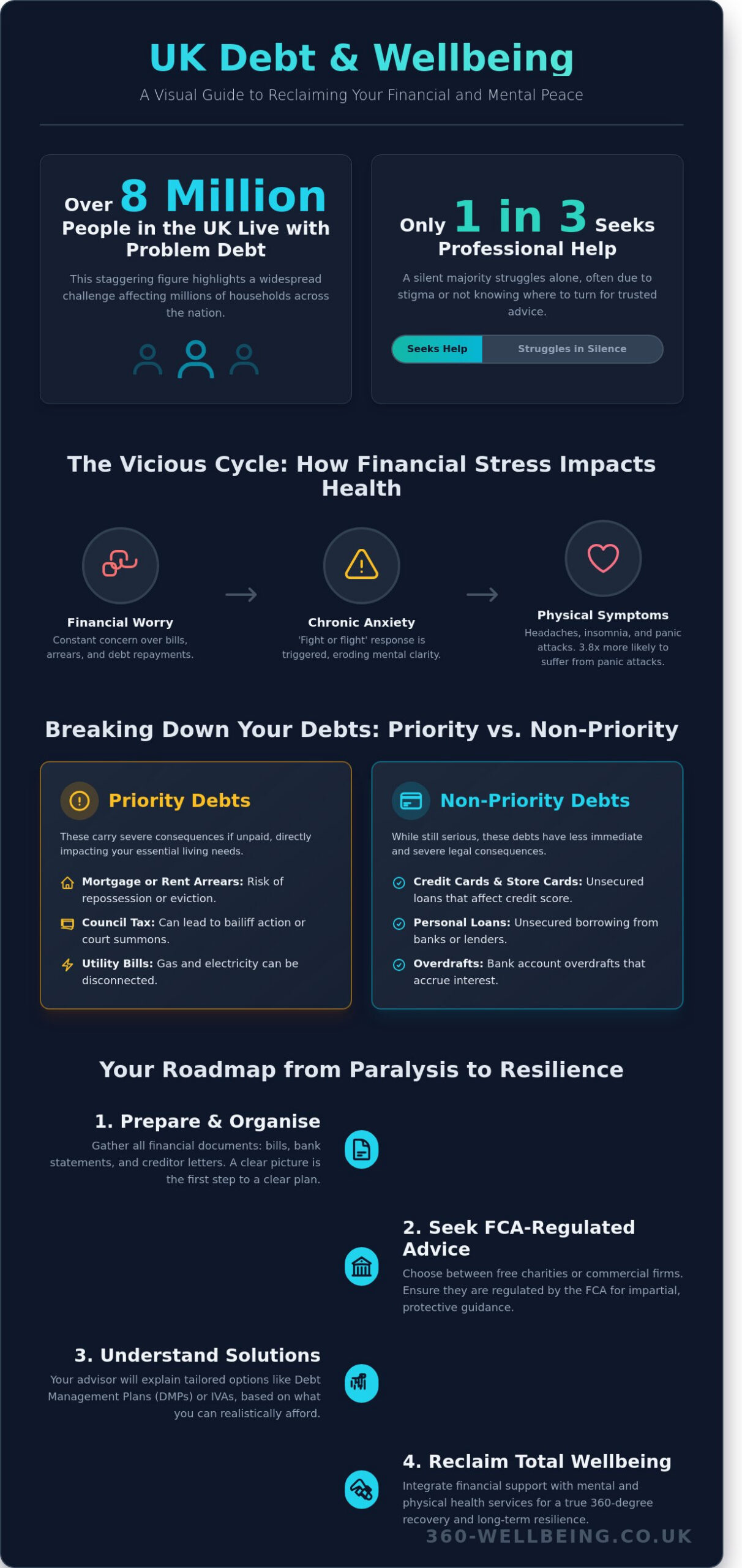
Did you know that according to 2024 data from the Money and Pensions Service, over 8 million people in the UK are living with problem debt, yet only one third of them reach out for professional debt advice? It’s a staggering figure that highlights a silent epidemic of financial anxiety affecting our collective wellbeing. You likely feel that heavy, “fried brain” exhaustion that comes from juggling spreadsheets and avoiding the letterbox, all while trying to maintain a brave face for your family. It’s exhausting to carry the fear of bailiffs alone, especially when you feel like you’re drowning in options you don’t fully understand.
We believe that financial health is a fundamental pillar of your total wellness. This article provides a clear roadmap to help you move from a state of paralysis to one of proactive resilience. You’ll discover how to access tailored support, understand the difference between varied debt solutions, and finally reclaim your mental peace. We’ll explore a 360-degree approach to managing your liabilities that prioritises your sleep and your future. Your journey toward a balanced life starts with understanding that your worth isn’t defined by your balance sheet.
Key Takeaways
- Understand the profound link between financial strain and mental health, and how breaking the “vicious cycle” is the first step toward reclaiming your resilience.
- Navigate the complex landscape of UK debt solutions, from IVAs to Debt Management Plans, with a clear understanding of how FCA regulation protects your interests.
- Learn how to distinguish between commercial firms and non-profit charities to ensure you receive the most cost-effective debt advice tailored to your unique circumstances.
- Discover practical steps to organise your financial documents and prepare for a consultation, ensuring a stress-free experience that prioritises your long-term stability.
- Explore how a 360-degree approach integrates financial support with mental health therapy and 24/7 Virtual GP access to restore your total wellbeing.
The Link Between Debt Advice and Mental Wellbeing
Professional debt advice is far more than a simple budgeting exercise. It’s a comprehensive service where qualified specialists evaluate your total income, essential expenditure, and outstanding liabilities to create a sustainable path forward. This process often includes credit counseling to help you understand the legal and financial mechanisms available to protect your assets and your future. It’s a clinical-style evaluation of your financial health that provides a structured map out of uncertainty.
In the UK, the link between financial health and mental wellbeing is undeniable. Data from the Money and Pensions Service indicates that 24% of adults in the UK have less than £100 in savings, leaving them vulnerable to sudden shocks. This vulnerability fuels a vicious cycle. Constant worry about arrears triggers chronic anxiety, which eventually erodes physical health. When your brain is constantly scanning for financial threats, it stays in a state of “fight or flight,” making it impossible to find the mental clarity needed to solve the problem.
Seeking help early is vital to prevent long-term workplace absenteeism. Statistics from the Centre for Mental Health show that financial distress costs UK employers £6.6 billion annually. By 2026, professional debt advice will be viewed as a strategic asset for personal resilience. It’s a tool that empowers you to maintain focus and vitality despite external economic pressures, ensuring that a temporary financial dip doesn’t become a permanent health crisis.
Recognising the Physical Signs of Financial Stress
Money worries don’t stay in your bank account; they manifest in your body. You might find yourself lying awake at 3 am or suffering from persistent tension headaches that won’t shift. Some people experience digestive distress or a racing heart when a bill arrives. These aren’t just minor inconveniences. They are biological responses to long-term pressure. At work, this translates to “presenteeism,” where you’re at your desk but your mind is elsewhere. Research suggests that employees with high financial stress are 3.8 times more likely to suffer from panic attacks. If these symptoms persist, talking to a Virtual GP is a vital first step. They can provide a clinical perspective on your physical health while you work with a debt specialist to solve the underlying financial puzzle.
Breaking the Stigma of Debt in the UK
Society often attaches a sense of shame to debt, but this is a dated perspective that ignores reality. Most debt in the UK today stems from systemic issues, such as the 11.1% peak inflation rate recorded in late 2022, or unexpected life events like illness and redundancy. It’s not a moral failing. Confidential, non-judgmental support is the most effective way to dismantle “debt shame.” When you talk to a professional, you’ll find that your situation is manageable and common. Reframing the act of seeking help as a proactive health decision is transformative. It’s about taking control of your future rather than being a victim of your past. This shift in mindset moves you from a state of paralysis to one of empowerment, which is essential for long-term workplace harmony and personal peace.
Navigating Debt Solutions: From IVAs to Debt Management Plans
The UK financial landscape is often difficult to traverse alone. Individuals frequently feel overwhelmed by competing demands from creditors, which is why the Financial Conduct Authority (FCA) strictly regulates the sector. Any organisation providing debt advice must adhere to rigorous standards, ensuring that the guidance provided is impartial and prioritises the individual’s long-term stability. This regulatory oversight prevents predatory practices and ensures that repayment plans are based on what a person can realistically afford after essential living costs are met.
Distinguishing between priority and non-priority debts is a fundamental step in regaining control. Priority debts carry the most severe legal consequences if they aren’t settled. These include council tax, mortgage or rent arrears, and utility bills. Failure to address these can lead to home repossession, disconnection of services, or even court summons. Non-priority debts, such as credit cards, store cards, and unsecured personal loans, are still serious but don’t carry the same immediate threat to a person’s safety or liberty. A tailored approach is essential because a solution that works for a single person in rented accommodation might be entirely unsuitable for a homeowner with a family.
Understanding IVAs and Debt Management Plans (DMPs)
An Individual Voluntary Arrangement (IVA) is a formal, legally binding agreement between a debtor and their creditors. It typically lasts five to six years. During this time, the individual makes a single monthly payment that is distributed among creditors. Once the term ends, any remaining debt included in the IVA is legally written off. While this provides a clear end date, it’s a significant commitment that will appear on a credit file for at least six years, making future borrowing more difficult and expensive.
For those seeking a more flexible, informal route, Debt Management Plans offer a way to manage non-priority debts. Unlike an IVA, a DMP isn’t legally binding and doesn’t involve the courts. It allows a person to pay back what they owe at a more manageable pace by negotiating lower monthly instalments. It’s a practical choice for those who can afford to pay their debts but need more time. However, creditors aren’t always required to freeze interest or charges, which can sometimes extend the length of the repayment period.
Debt Relief Orders (DROs) and Bankruptcy
On 6 April 2024, the UK government implemented significant changes to Debt Relief Orders (DROs) to support low-income households. The debt limit for a DRO increased from £30,000 to £50,000, and the £90 application fee was abolished. This route is specifically designed for people with little disposable income and assets worth less than £2,000. It provides a fresh start by freezing debt for 12 months, after which the debts are usually discharged if the person’s financial situation hasn’t improved.
Bankruptcy serves as the final resort for those with no other viable way to clear their liabilities. It costs £680 to apply online and involves a court-appointed official taking control of assets to pay off creditors. This process can have a profound impact on certain professions and may result in the sale of a family home. Accessing professional debt advice is the only way to determine if these legal pathways align with an individual’s specific assets and career requirements. Providing employees with comprehensive financial wellbeing tools ensures they have the support needed to make these life-changing decisions with confidence and clarity.
Free vs. Commercial Debt Advice: Making an Informed Choice
Choosing where to turn for help is a pivotal moment for any employee facing financial strain. The landscape of debt advice in the United Kingdom is split between non-profit charities and commercial companies. While both might offer similar-sounding solutions, their motivations differ fundamentally. Commercial debt management firms often charge fees for their services, which can be deducted from the monthly payments intended for creditors. This means it takes longer to clear the debt. In contrast, non-profit organisations provide their expertise for free, ensuring every pound your employee can spare goes directly toward reducing their balance.
Identifying commercial firms requires a vigilant eye. Red flags often include high-pressure sales tactics or social media advertisements promising total debt write-offs through “government-backed” schemes. The Financial Conduct Authority (FCA) reported in 2023 that some firms were failing to provide balanced advice, leading individuals into unsuitable Individual Voluntary Arrangements (IVAs). These commercial products can have long-term impacts on credit ratings and may not always be the most resilient path forward. Proactive support starts with helping staff recognise these traps before they sign a contract that adds more weight to their shoulders.
The emotional burden of financial struggle is profound. Understanding The Link Between Debt Advice and Mental Wellbeing is essential for any employer who views their staff as more than just a resource. When an employee feels trapped by rising interest rates or aggressive collection letters, their cognitive bandwidth shrinks. Providing a clear, safe path to reputable help isn’t just a kind gesture; it’s a strategic investment in workplace harmony and individual resilience.
The Role of UK Debt Charities
Organisations like StepChange and National Debtline are the gold standard for free support. They operate through funding from the banking industry and government grants, which allows them to offer tailored repayment plans without charging the debtor a penny. These charities have established protocols with major UK banks to freeze interest and charges, a vital step that prevents debt from spiralling out of control. Citizens Advice offers a broader, holistic approach. They help individuals manage debt while simultaneously addressing legal issues or housing instability. This ensures that the root causes of financial distress are treated with the same care as the symptoms.
The Advantage of Employer-Provided Support
While charities provide excellent service, they’re often overstretched. In 2023, some national debt helplines reported record call volumes, leading to long wait times that can discourage someone in crisis. This is where an Employee Assistance Programme (EAP) becomes a vital asset. An EAP acts as a private first port of call, offering immediate access to specialists who can triage the situation. By integrating debt helplines with legal support and mental health counselling, you provide a 360-degree solution. This comprehensive approach ensures that an employee doesn’t just get a budget plan, but also the psychological support needed to stick to it. It’s a faster, more personal way to restore balance to their lives.
How to Prepare for Your Debt Advice Consultation
Taking the first step to seek professional debt advice is an act of proactive resilience. It marks the moment you move from being overwhelmed to being in control. This initial conversation usually lasts approximately 45 minutes, providing a structured space to untangle complex financial threads. You aren’t being interrogated; you’re partnering with an expert who views your financial health from a 360-degree perspective. According to the Money Advice Trust, 12.8 million UK adults were struggling with bills in 2023, so you’re certainly not alone in this journey.
During this fact-finding call, your advisor will help you build a comprehensive picture of your situation. It’s vital to be honest about your spending, including those “favourite” non-essentials. Whether it’s a £12 monthly streaming subscription or a £5 weekly treat, these items provide emotional balance. A recovery plan that strips away every small comfort is often unsustainable and can lead to burnout within 3 months. By being transparent, you allow the advisor to build a tailored budget that’s actually liveable.
The Essential Debt Checklist
Organisation reduces stress and speeds up the support process. You’ll need your bank statements from the last 90 days and all recent credit card or loan agreements. Document every income source, including your salary, Personal Independence Payment (PIP), or Universal Credit. Don’t forget essential living costs like your rent, groceries, and utility bills, which averaged £180 per month for many UK households in early 2024. Having these figures ready ensures your 45-minute window is used for strategy rather than searching for paperwork.
Questions to Ask Your Advisor
Empowerment comes from clarity. Ask how a specific solution might affect your ability to rent a home or renew a mortgage in the next 2 to 5 years. Inquire if creditors will stop their contact immediately once a plan is active. You should also confirm the status of essential assets. For instance, many people worry about their transport, so ask directly: “Can I keep my car if it’s essential for my commute?” Understanding these details provides the reassurance needed to move forward confidently.
Setting realistic goals is the final piece of the preparation puzzle. Recovery isn’t an overnight event; it’s a methodical journey toward stability. Your advisor will help you distinguish between “priority debts” like council tax or rent arrears, which carry heavier legal consequences, and “non-priority debts” like store cards. By categorising these, you create a logical path that protects your home and your peace of mind first. This strategic approach transforms a mountain of debt into a series of manageable steps.
If you’re ready to start this process, you can explore our comprehensive financial wellbeing services to find the support you need. We believe that financial health is a fundamental right, and our experts are here to help you regain your vitality and focus.
The goal of this preparation is to replace anxiety with a sense of safety. When you enter the consultation with the right data and a clear set of questions, you move from a position of uncertainty to one of strength. It’s about more than just numbers; it’s about reclaiming your time and mental energy for the things that truly matter in your life and career.
Proactive Financial Health: The 360 Wellbeing Approach
True resilience doesn’t happen by accident. It’s built through a structured, 360-degree approach that treats financial stability as the foundation of physical and mental health. We don’t just provide a phone number; we integrate specialist debt advice with professional mental health therapy to address both the balance sheet and the emotional toll of arrears. Statistics from the Money and Pensions Service in 2023 showed that 80% of people with debt problems also experience mental health issues. By merging these services, we ensure that when an employee reaches out, they’re met with a comprehensive plan rather than a temporary fix. It’s about looking at the whole person, not just a single symptom of stress.
Physical health often suffers when money is tight. Our 24/7 Virtual GP access allows staff to consult a doctor about stress-related symptoms, such as chronic insomnia or tension headaches, without waiting the typical 14 days for a local surgery appointment. This immediate clinical support works alongside our 360 Rewards marketplace. This platform enables employees to reduce their everyday living costs by up to £1,200 per year through discounts at major UK retailers like Sainsbury’s, Boots, and Marks & Spencer. It’s a proactive way to increase disposable income before a financial dip turns into a full-blown crisis. Empowering staff to save on their weekly shop or utility bills provides a tangible sense of control over their monthly outgoings.
Empowerment is the core of our philosophy. We provide the tools for employees to take action early. Instead of waiting for a final demand letter, staff can access budgeting tools and life coaching sessions that build financial literacy. Our data shows that when employees engage with proactive wellness tools, workplace productivity increases by 15% because the “mental load” of financial worry is lifted. We aren’t just a safety net; we’re a launchpad for a more stable and vibrant life.
A Unified Narrative of Total Wellness
We believe every worker deserves financial security. It’s a fundamental right that underpins workplace harmony. Our platform creates a powerful synergy between life coaching and debt management, helping individuals in Oxford and across the UK build long-term resilience. Data from our 2023 impact reports indicates that companies using our holistic model see a 12% increase in overall staff retention. We move beyond reactive care, helping employees view their wellbeing as a strategic asset they can actively manage. This unified approach ensures that physical, mental, and social health are never treated in isolation.
Getting Started with 360 Wellbeing
Accessing help is straightforward and discreet. Employees simply use their unique staff login on the 360 Wellbeing app or web portal to find the debt advice section. Confidentiality is our absolute guarantee. Your employer never sees your personal data, the services you access, or the details of your financial situation. They receive anonymised, high-level usage reports that help them understand general workforce trends without ever compromising your privacy. Taking that first step today means you aren’t walking the path to recovery alone; you have a team of experts standing right beside you.
Empowering Your Path to Financial Resilience
Navigating the complexities of personal finance requires more than just a spreadsheet; it demands a strategy that protects your mental health alongside your bank balance. Whether you’re exploring IVAs or preparing for your first session, accessing professional debt advice is the most proactive step you can take towards long-term stability. By 2026, the integration of physical and financial health has become a fundamental pillar of workplace harmony and individual vitality. Our comprehensive Employee Assistance Programme (EAP) provides a 360-degree safety net, offering confidential debt helplines and 24/7 access to UK-registered GPs to manage the physiological stress that financial pressure often creates. We believe that true resilience is built through tailored care and reliable expertise rather than one-off fixes. You don’t have to face these challenges in isolation when expert guidance is readily available to help you reclaim your peace of mind. Take the first step toward a balanced, healthier future today.
Discover how 360 Wellbeing supports your team’s financial health
Frequently Asked Questions
Is debt advice confidential when accessed through work?
Yes, seeking debt advice through a workplace wellness programme is entirely confidential. Your employer won’t receive any specific details about your financial situation or the conversations you have with advisors. Under the UK General Data Protection Regulation (GDPR) 2018, your personal data is protected and cannot be shared without your explicit consent. This privacy ensures you can proactively manage your financial health while maintaining your professional reputation and personal boundaries.
Can debt advice stop bailiffs from visiting my home?
Professional debt advice can stop bailiff action through legal protections like the Debt Respite Scheme, commonly known as Breathing Space. This government initiative provides a 60-day period where most enforcement action, including bailiff visits and interest charges, is paused. According to the Insolvency Service, over 70,000 people utilised this protection in 2023. It gives you the necessary time to create a structured repayment plan without the immediate pressure of home visits or aggressive collection tactics.
How much does professional debt advice cost in the UK?
High-quality debt advice is available for free through UK charities like StepChange or Citizens Advice. While some private firms charge fees, often up to 15% of your monthly payment for certain plans, you don’t need to pay for expert guidance. These charitable organisations provide comprehensive support funded by the banking industry. Accessing free services ensures that every pound you have goes directly toward resolving your balances rather than paying for avoidable administrative costs.
Will seeking debt advice affect my job or future employment?
For 95% of UK employees, seeking debt advice has no impact on current or future employment. Your employer won’t even know you’ve sought help unless you choose to tell them. However, if you work in the financial services sector regulated by the FCA or hold high-level security clearance, you must check your specific contract requirements. Proactively managing your finances is actually seen as a sign of resilience and responsibility by most modern HR departments.
What is the difference between an IVA and a Debt Management Plan?
An Individual Voluntary Arrangement (IVA) is a legally binding agreement approved by a court, typically lasting 5 to 6 years, where remaining debt is written off at the end. In contrast, a Debt Management Plan (DMP) is an informal, flexible arrangement where you pay back the full amount at a reduced rate. While an IVA offers a structured path to total debt cancellation, a DMP provides a simpler way to manage monthly payments without formal legal proceedings.
How do I know if a debt advice company is legitimate?
You can verify a company’s legitimacy by checking the Financial Conduct Authority (FCA) register. Every firm providing debt advice in the UK must be authorised and regulated by the FCA to ensure they meet strict standards of conduct. Avoid companies that ask for upfront fees or use high-pressure sales tactics. Legitimate providers will always give you a clear, written summary of your options and won’t rush you into making life-changing financial decisions.
Can I get debt advice if I am self-employed or a sole trader?
Yes, self-employed individuals and sole traders can access tailored debt advice through specialised services like Business Debtline. Managing business debts involves different legal frameworks than personal consumer credit, so it’s vital to speak with experts who understand tax liabilities and trade creditors. In 2023, Business Debtline helped thousands of small business owners navigate complex financial challenges. This support helps you protect both your personal wellbeing and the future of your professional enterprise.
What happens if I cannot afford to pay anything toward my debts?
If you have no disposable income, a Debt Relief Order (DRO) might be the most suitable path forward. As of April 2024, the UK government removed the £90 fee for DROs, making them more accessible for those in severe hardship. This process freezes your debts for 12 months and then writes them off entirely if your situation hasn’t improved. It’s a proactive solution designed to provide a fresh start for individuals with minimal assets and low monthly income.