
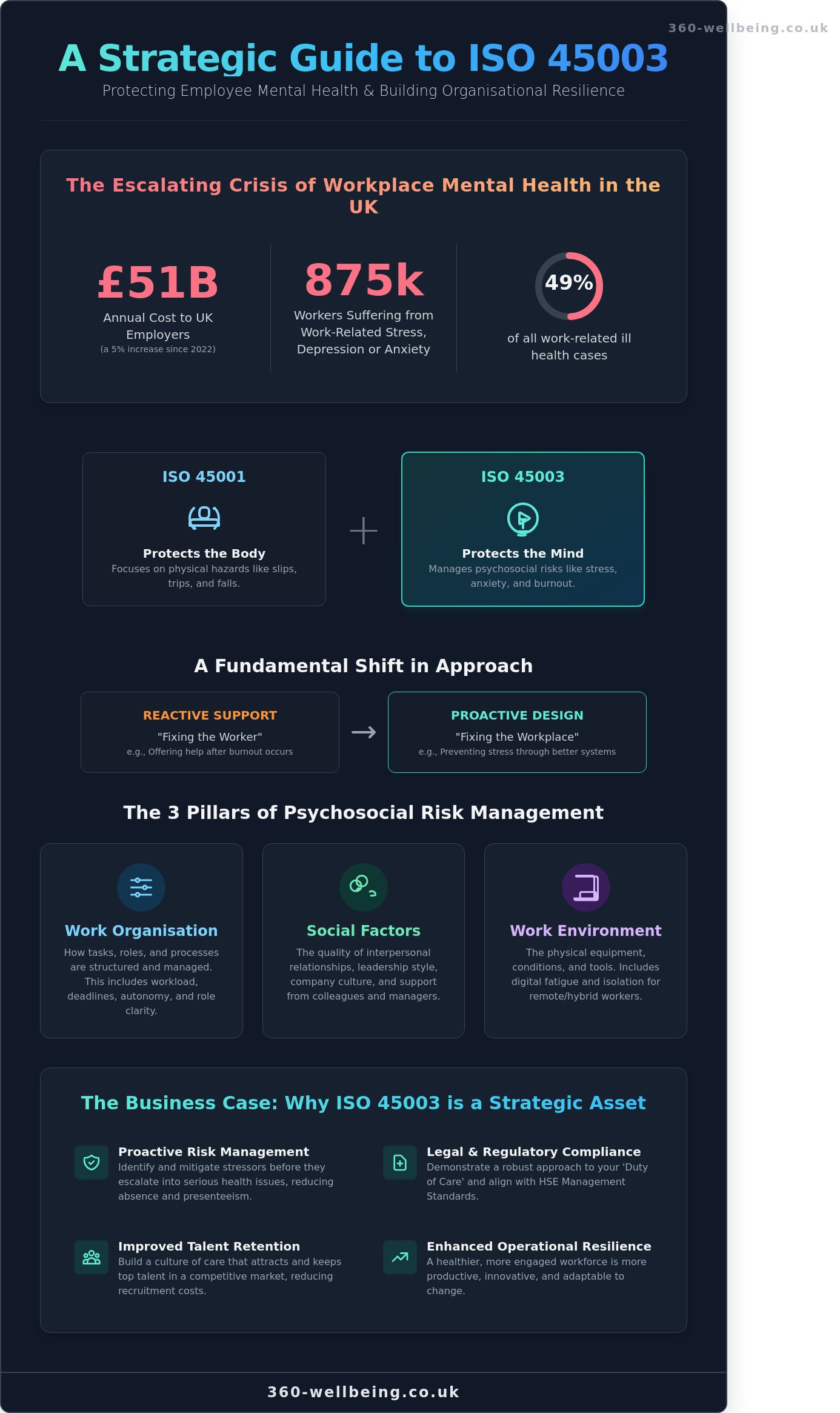
According to Deloitte’s 2024 report, poor mental health now costs UK employers approximately £51 billion annually, a 5% increase since 2022. This data makes it clear that managing psychological risks through iso 45003 isn’t just a compliance exercise; it’s a vital investment in your people. You’ve likely felt the pressure of rising burnout or the confusion of navigating legal duties while trying to support a struggling colleague. It’s natural to worry about getting it wrong, especially when the stakes for your team’s health are so high.
We’re here to help you bridge that gap with a proactive, 360-degree approach to workplace harmony. You’ll learn exactly how to implement this global standard to protect your staff and boost organisational resilience. We’ll provide a clear, methodical roadmap that transforms mental health from a source of anxiety into a pillar of your company’s success, ensuring your recruitment and retention remain stronger than ever.
Key Takeaways
- Understand how iso 45003 provides the first global framework for managing psychosocial risks, ensuring mental health is treated with the same rigour as physical safety.
- Identify the three core pillars of workplace risk-organisation, social factors, and environment-to proactively protect your employees from psychological harm.
- Explore the strategic business case for mental wellbeing, focusing on how reducing absenteeism and staff turnover can significantly boost your organisational resilience.
- Learn the essential steps for successful implementation, from conducting baseline staff audits to securing the leadership commitment required for lasting cultural change.
- Discover how integrating proactive support tools and 24/7 clinical access can help your business meet international standards while fostering a healthier, more productive workforce.
What is ISO 45003? Defining the Global Standard for Wellbeing
Psychological safety isn’t just a corporate buzzword; it’s a measurable framework for business health. iso 45003 stands as the first international standard to offer specific, actionable guidance on managing psychosocial risks at work. It doesn’t replace your existing safety protocols. Instead, it acts as a vital companion to ISO 45001, which traditionally focuses on physical hazards like slips, trips, and falls. While the earlier standard keeps the body safe, this guidance protects the mind.
This standard recognises that a person’s mental wellbeing is just as critical as their physical safety. Whether you’re a local florist or managing a FTSE 100 firm with 10,000 employees, these guidelines provide a structured way to identify where stress, anxiety, and burnout might stem from within your business operations. It represents a fundamental shift in culture. We’re moving away from reactive support, like offering a therapy app after someone burns out, and moving toward proactive organisational design. It’s about fixing the workplace, not just the worker.
At 360 Wellbeing, we see this as an essential part of a comprehensive health strategy. iso 45003 provides the tools to build resilience from the ground up. It isn’t a pass/fail certification in the traditional sense. It’s a set of best practices that help leaders understand that workplace stress is often a systemic issue rather than an individual weakness. By integrating these principles, you’re creating a workplace where people feel safe to speak up, take risks, and bring their whole selves to work without fear of judgment.
The Origins and Purpose of the Standard
The International Organization for Standardization released this guidance in June 2021. It arrived at a critical moment. In 2023, the World Health Organization reported that 15% of working-age adults live with a mental disorder. The standard creates a universal language for psychological health. It focuses on how work is organised, such as workload and deadlines; social factors, including workplace relationships; and the physical work environment. Its purpose is to standardise how we identify these “hidden” risks before they lead to long-term absence.
Why ISO 45003 Matters for UK Employers in 2026
For UK businesses, the stakes are high. Deloitte’s 2024 Mental Health Report found that poor mental health costs UK employers £51 billion every year. Aligning with this standard helps you meet the Health and Safety Executive (HSE) Management Standards and your legal ‘Duty of Care’ under the Health and Safety at Work etc. Act 1974. With 44% of UK staff now working in hybrid or remote patterns, managing digital fatigue and isolation is no longer optional. This framework offers strategies to keep distributed teams connected and psychologically secure.
- Proactive Risk Management: Identifying stressors before they escalate into clinical issues.
- Legal Compliance: Demonstrating a robust approach to the HSE’s stress management standards.
- Talent Retention: Building a culture of care that attracts and keeps top talent in a competitive market.
- Operational Resilience: Reducing the £51 billion drain on the UK economy caused by presenteeism and absence.
Adopting this 360-degree perspective ensures that mental health is treated as a strategic asset. It’s a commitment to a future where workplace harmony isn’t a luxury, but a fundamental right for every employee. When you focus on the system, you protect the person.
Understanding Psychosocial Risks: The Core of the Standard
Psychosocial risks are elements of work design, management, and social context that have the potential to cause psychological or physical harm. While traditional health and safety focuses on physical hazards like trips or machinery accidents, iso 45003 shifts the gaze toward the invisible dangers that erode employee health. These risks are not just about “feeling stressed”; they’re factors that can lead to cardiovascular disease, musculoskeletal disorders, and severe mental health conditions. The Health and Safety Executive (HSE) reported that in 2022/23, 875,000 workers in Great Britain suffered from work-related stress, depression, or anxiety. This represents 49% of all work-related ill health cases across the country.
The standard categorises these hazards into three specific pillars:
- Work Organisation: How tasks, roles, and processes are structured and managed.
- Social Factors: The quality of relationships, leadership style, and company culture.
- Work Environment: The physical equipment, lighting, and digital tools used to complete tasks.
Employers must look beyond obvious signs of burnout. Hidden risks like presenteeism, where staff turn up for work despite being mentally or physically unwell, cost UK businesses approximately £28 billion every year according to Deloitte’s 2022 Mental Health Report. Similarly, “quiet quitting” often signals a lack of engagement caused by poorly managed psychosocial hazards. This practical framework for implementing ISO 45003 helps leaders move from reactive fixes to proactive prevention, ensuring these hidden costs don’t drain the business’s vitality.
Work Organisation and Job Design
Job design covers the way tasks are structured and the level of control an employee has over their day. High pressure often stems from excessive workloads or a total lack of autonomy. Role ambiguity, where a significant portion of staff feel unclear about their daily responsibilities, creates a constant state of low-level panic. Poorly managed change, such as sudden restructuring without consultation, can shatter mental stability and trust. The rise of digital connectivity means many feel they can’t “switch off,” leading to technostress. This digital fatigue is a primary driver for the 17.1 million working days lost to stress in the UK annually, making it essential to define clear boundaries between work and home life.
Social Factors and Workplace Relationships
The social fabric of a company determines its resilience during difficult periods. Negative behaviours like bullying, harassment, or social isolation act as toxins within a team. Creating psychological safety is the only effective antidote. It’s a state where staff feel they won’t be punished or humiliated for making a mistake or speaking up with a new idea. Empathetic leadership is vital here. When managers transition from “bosses” to “coaches,” they foster a culture where vulnerability isn’t a weakness. Investing in holistic wellbeing support can bridge the gap between policy and practice. This ensures that every team member feels seen, heard, and valued, which is the cornerstone of a psychologically healthy workplace under the iso 45003 guidelines.
The Business Case: Why Compliance Is a Strategic Asset
For too long, corporate health and safety focused almost entirely on physical hazards like trips, falls, or machinery accidents. While these remain vital, the modern UK workplace faces a different kind of risk that is often invisible but equally damaging. Adopting iso 45003 isn’t about adding another layer of bureaucracy or simply ticking a box to satisfy a regulator. It’s a fundamental shift toward viewing employee mental health as a core driver of operational excellence. When leaders treat psychological safety as a strategic asset, they move from a reactive “crisis management” mode to a proactive culture that sustains high performance.
Deloitte’s 2022 analysis of mental health in the workplace revealed that the annual cost to UK employers has risen to approximately £56 billion. This isn’t just a figure on a spreadsheet; it represents a drain on the energy and creativity of your workforce. By integrating the framework of iso 45003, organisations can identify the root causes of stress, such as poor communication or unrealistic workloads, before they manifest as burnout. This proactive stance ensures that your team feels supported and valued, which is the bedrock of long-term loyalty.
Quantifying the ROI of Psychological Safety
Measuring the impact of wellbeing initiatives requires looking beyond simple attendance records. Presenteeism, where employees are physically present but mentally disengaged due to stress or ill-health, costs UK businesses roughly £28 billion every year. This is double the cost of actual absenteeism. Data from the London School of Economics suggests that for every £1 spent on evidence-based mental health interventions, companies see an average return of £5.30 through increased productivity and reduced staff turnover.
The wellbeing dividend is a measurable business metric that tracks the financial gains achieved by reducing psychosocial risks and improving employee engagement through structured, compassionate support. High wellbeing scores correlate directly with profitability. Oxford University research from 2019 found that workers are 13% more productive when they are happy. These aren’t just “soft” benefits; they are hard numbers that dictate the resilience of your company in a fluctuating economy.
Legal and Ethical Responsibilities
Compliance with international standards provides a robust shield in an increasingly litigious environment. Under the Health and Safety at Work Act 1974, UK employers have a legal duty to protect the “health, safety and welfare” of their staff. This mandate explicitly includes mental health. For guidance on implementation, the BSI guide to ISO 45003 offers a clear framework for identifying these specific workplace hazards and managing them effectively. Following this standard helps demonstrate that you’ve taken all reasonable steps to protect your people, significantly reducing the risk of costly legal claims or tribunal payouts.
Beyond the courtroom, there’s a powerful ethical imperative that defines your brand in the eyes of the public. A 2023 CIPD report found that 60% of UK employees consider wellbeing support a non-negotiable factor when choosing a new employer. In a competitive labour market, a “people-first” culture is your strongest recruitment tool. It’s about building a partnership with your team where they know their mental health is respected. This transparency doesn’t just attract talent; it builds a community of advocates who are proud to represent your organisation.
Viewing the implementation of these standards as an investment rather than a cost is the hallmark of a forward-thinking leader. It’s a commitment to the 360-degree health of the business. By addressing psychological risks today, you’re not just preventing future problems; you’re actively building a more vibrant, creative, and profitable future for everyone involved.
A Practical Framework for Implementing ISO 45003
Implementing a framework for psychological health requires a methodical approach that prioritises human experience alongside operational efficiency. You can’t fix what you haven’t measured. Begin with a comprehensive baseline audit. This involves using anonymous staff surveys to pinpoint existing psychosocial hazards within your specific work environment. According to a 2023 Deloitte report, poor mental health costs UK employers approximately £56 billion annually; identifying these risks early is a financial and moral necessity.
Adopting iso 45003 requires directors to actively participate in the dialogue, moving beyond policy signatures to visible advocacy. Leadership commitment is the heartbeat of this process. Without ‘top-down’ support, cultural change remains a surface-level exercise. This ensures that wellbeing isn’t treated as a peripheral HR project but as a core business objective that influences every decision from the boardroom to the shop floor.
Integration is your next priority. Rather than creating a separate, siloed wellbeing document, embed these principles into your existing Health and Safety (H&S) policies. This holistic approach signals to your team that psychological safety is just as vital as physical protection from machinery or fire risks. Training managers to recognise early signs of stress, such as withdrawal or irritability, transforms them from task-masters into supportive mentors who can intervene before a crisis occurs.
Step 1: Planning and Hazard Identification
Effective planning relies on hard data. Review your Employee Assistance Programme (EAP) usage and absenteeism reports to spot recurring trends. If a specific department shows a 15% higher absence rate, it’s a clear signal to investigate. Consult with employees directly to understand daily pressures. This dialogue helps you identify vulnerable groups, such as those with caregiving responsibilities, who may require tailored support to thrive.
Step 2: Implementation and Support Tools
Practical tools bridge the gap between policy and reality. Introducing professional Mental Health Support provides your team with immediate, confidential help when they face challenges. Organise regular wellbeing workshops and structured ‘check-ins’ to keep the conversation alive. Appointing Mental Health Champions is a powerful way to bridge the gap between staff and management, ensuring that no one feels they have to struggle in silence.
The final stage is establishing a continuous improvement loop. The world of work changes rapidly, so you must review, refine, and repeat your processes annually. This proactive cycle ensures your iso 45003 strategy remains relevant and effective even as your business grows. By treating psychological health as a living part of your organisation, you create a resilient culture where everyone feels seen, heard, and protected.
Ready to transform your workplace culture? Explore our comprehensive wellbeing solutions to start your journey today.
How 360 Wellbeing Facilitates ISO 45003 Alignment
Aligning your organisation with the iso 45003 framework requires more than just a policy update; it demands a practical shift in how you protect your team’s mental health. Our platform serves as a proactive engine for this transition. According to the Health and Safety Executive, 914,000 workers suffered from work-related stress, depression, or anxiety in 2022/23. We provide the digital and human infrastructure to ensure your staff don’t become part of that statistic. By identifying psychosocial hazards early, we help you build a culture where psychological safety is a measurable reality rather than an abstract goal.
Our comprehensive Employee Assistance Programme (EAP) is designed to mitigate risks at every level of the business. We focus on four core pillars of support that directly address the requirements of the standard:
- 24/7 Virtual GP Access: Uncertainty regarding physical health is a major driver of workplace anxiety. With the average UK wait time for a routine GP appointment now exceeding 10 days, our 24/7 access provides immediate reassurance and reduces health-related absenteeism.
- Mental Health Therapy and Life Coaching: We offer direct access to qualified clinicians and coaches. These professionals address individual risks, such as burnout or low resilience, before they manifest as long-term sickness.
- Financial and Legal Support: External pressures often bleed into the workplace. Since a 2023 study indicated that 67% of UK employees feel financial anxiety impacts their productivity, our expert helplines provide the practical advice needed to stabilise these “off-site” stressors.
- Proactive Risk Mitigation: Our platform includes tools that allow employees to self-manage their wellbeing, providing a first line of defence against the psychosocial hazards identified in your audits.
A Holistic Approach to the ISO Standard
True psychological safety requires a 360-degree view of every staff member. We don’t just treat symptoms; we provide the data insights necessary for successful iso 45003 audits. By monitoring anonymised usage trends, we help you identify systemic issues within specific departments. This allows you to support managers with targeted resources, empowering them to lead with the empathy and resilience required to maintain a healthy work environment. It’s about turning wellbeing into a strategic asset for the entire company.
Getting Started with 360 Wellbeing
We believe expert care should be accessible to everyone, from large corporations to sole traders in Oxford and across the UK. Our tailored packages ensure that even the smallest teams can benefit from high-level clinical support. Onboarding is a streamlined process, designed to integrate seamlessly with your existing workflows so that every staff member feels supported from day one. You can book a demo to see how we can support your ISO 45003 journey and discover how a partnership with us can transform your workplace culture into one of vitality and balance.
Transforming Your Workplace Culture Through ISO 45003
Prioritising mental health isn’t just a moral obligation; it’s a fundamental pillar of a thriving UK business. Adopting iso 45003 allows you to move beyond reactive fixes and build a proactive culture where psychosocial risks are managed with the same rigour as physical hazards. According to the Health and Safety Executive (HSE), stress, depression, or anxiety accounted for 49% of all work-related ill health in 2022/23. By implementing this global standard, you’re protecting your team while securing a strategic asset that drives long-term productivity.
Our comprehensive EAP provides the practical tools needed to align with these standards effortlessly. We offer 24/7 access to UK-registered GPs and BACP-accredited mental health therapy, ensuring your staff receive professional support the moment they need it. This holistic approach bridges the gap between corporate policy and tailored, real-world care. It’s about creating a sustainable environment where people feel seen and valued.
Discover our 360-degree wellbeing platform today
You don’t have to navigate these complex health landscapes alone. Let’s work together to create a workspace where every individual feels safe, supported, and truly empowered to flourish.
Frequently Asked Questions
Is ISO 45003 mandatory for UK businesses?
No, ISO 45003 isn’t a legal requirement under UK law. It’s a voluntary international standard that provides a best-practice framework for managing psychological health. While it’s not mandatory, the Health and Safety at Work etc. Act 1974 requires employers to ensure the health, safety, and welfare of staff. This includes mental wellbeing. Adopting these guidelines helps you meet your legal duty of care while building a more resilient, proactive workforce.
What’s the difference between ISO 45001 and ISO 45003?
ISO 45001 is the overarching requirements standard for general Occupational Health and Safety, whereas iso 45003 is a supporting guidance standard specifically focused on psychological health. Think of 45001 as the foundation for physical safety and 45003 as the specialised toolkit for mental wellbeing. You don’t get certified to 45003 on its own; instead, it’s used to enhance your existing 45001 management system with a 360-degree perspective on health.
How much does it cost to get ISO 45003 certification?
Costs for a UK small business typically range from £1,500 to £4,500 for the initial assessment and audit process. This figure varies based on your headcount and the number of sites being audited. You should also budget for the standard itself, which costs approximately £140 from the BSI shop. Investing in this framework often pays for itself by reducing the £51 billion annual cost of poor mental health to UK employers.
Can a small business implement ISO 45003 without a consultant?
Yes, you can implement the standard independently if you have a dedicated internal lead with strong organisational skills. The BSI provides comprehensive guidance documents that outline the necessary steps for identifying psychosocial risks. However, 65 percent of small firms find that a consultant speeds up the process by providing tailored templates and expert gap analysis. It’s about balancing your internal capacity with the need for a thorough, supportive approach to safety.
How does ISO 45003 help with employee retention?
Implementing iso 45003 reduces staff turnover by fostering a culture where people feel heard and protected. According to Deloitte’s 2024 report, UK companies see an average return of £4.70 for every £1 invested in mental health interventions. When you actively manage risks like burnout and workplace bullying, employees are 3 times more likely to stay long-term. This creates a stable, harmonious environment where talent feels truly valued rather than just managed.
What are examples of psychosocial risks in an office environment?
Common office risks include excessive workloads, lack of role clarity, and poor communication from management. A 2023 HSE report identified that 49 percent of work-related ill health in the UK is caused by stress, depression, or anxiety. In a typical office, this might manifest as “always-on” digital cultures or isolation during intensive projects. Identifying these specific pressures allows you to create a more supportive, balanced atmosphere for your entire team.
Who should lead the ISO 45003 implementation: HR or Health & Safety?
The most successful implementations involve a partnership between HR and Health & Safety teams. While H&S professionals understand the risk assessment frameworks, HR teams often have the vital data on absence rates and employee engagement. We recommend a collaborative committee that includes representatives from both departments. This ensures the strategy is both technically sound and deeply empathetic to the human experience of your staff, providing a complete view of workplace harmony.
Does ISO 45003 cover remote and hybrid workers?
Yes, the standard explicitly covers the psychological risks associated with working from home or hybrid arrangements. It addresses unique challenges like social isolation, the blurring of work-life boundaries, and the lack of ergonomic support. Since 44 percent of the UK workforce now operates in a hybrid model, these guidelines are essential. They help you ensure that your duty of care extends beyond the physical office walls to every home workspace in a consistent, reliable way.