
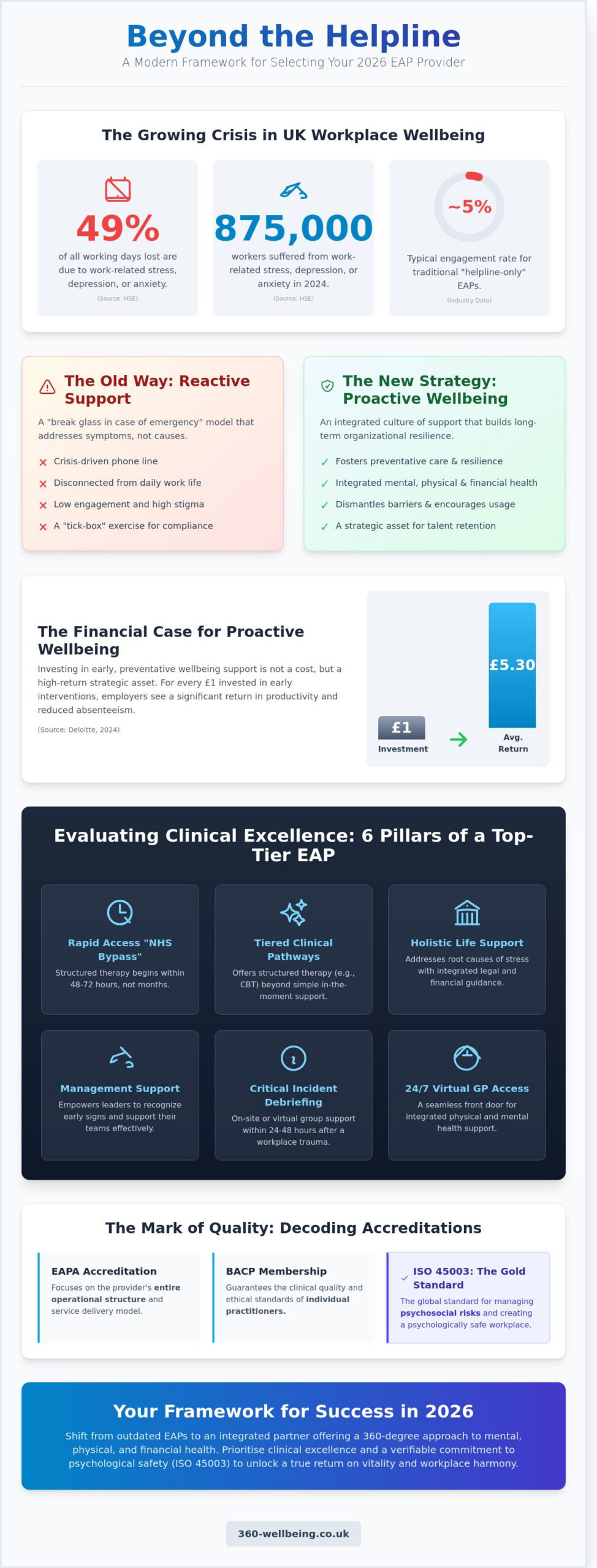
Did you know that 49% of all working days lost in Great Britain are now attributed to stress, depression, or anxiety? This recent data from the Health and Safety Executive highlights a growing crisis that traditional, reactive support systems often fail to address. Many organisations find that their current eap providers uk act as little more than a “break glass in case of emergency” phone line, which often results in engagement rates as low as 5% across the workforce.
It’s likely you recognise that a truly effective wellbeing strategy should do more than just manage crises after they’ve already taken hold. It’s frustrating to invest in a service only to see absenteeism rise while the support sits underutilised and disconnected from your team’s daily reality. We’ll help you move beyond basic tick-box exercises by providing a robust selection framework for 2026. You’ll learn how to identify partners that truly integrate mental, physical, and financial health into a proactive culture that reduces staff turnover.
This guide compares top-tier providers against EAPA and BACP standards to ensure your investment delivers a 360-degree return on vitality and workplace harmony.
Key Takeaways
- Shift your strategy from reactive crisis management to a proactive wellbeing model that fosters long-term resilience across your entire organisation.
- Master the criteria for clinical excellence, ensuring your team benefits from rapid access to specialists through a vital “NHS bypass” framework.
- Navigate the complex landscape of eap providers uk with a practical selection framework tailored to the specific needs of both SMEs and enterprise-level teams.
- Uncover the industry secrets behind low engagement rates and learn how to dismantle the barriers of stigma and complexity that often hinder employee support.
- Discover how an integrated 360-degree approach, featuring 24/7 Virtual GP access, creates a seamless and supportive front door for all aspects of employee health.
The Landscape of EAP Providers in the UK: Beyond the Helpline
The traditional image of an Employee Assistance Programme (EAP) as a dusty phone number hidden in a staff handbook is dead. For HR professionals, understanding What is an Employee Assistance Programme? means looking at a holistic ecosystem designed to support the whole person. Modern eap providers uk have transitioned from being reactive safety nets for occasional crises to becoming proactive partners in workplace harmony. This shift is essential; 2024 data from the Health and Safety Executive (HSE) revealed that 875,000 workers in the UK suffered from work-related stress, depression, or anxiety. This represents a significant portion of the workforce requiring more than just a helpline.
By 2025, the demand for comprehensive support surged as 75% of UK employees reported they would leave their current role for an organisation with better mental health benefits. Leading the charge for quality, the UK Employee Assistance Professionals Association (EAPA) remains the primary body ensuring these services meet rigorous standards. They provide the framework that prevents the “helpline-only” model from failing employees when they need deep, sustained intervention. Selecting the right eap providers uk involves auditing their alignment with these evolving standards to ensure a genuine return on investment.
The current market environment prioritises resilience over simple recovery. Deloitte’s 2024 report on mental health in the workplace highlighted that for every £1 spent on early intervention, UK employers see an average return of £5.30. This financial reality has moved wellbeing from a “nice-to-have” benefit to a strategic asset. A 360-degree perspective on health doesn’t just treat the symptom; it addresses the environmental and personal factors that lead to burnout in the first place.
Core Components of a UK EAP
A robust programme must offer a tiered approach to mental health, moving seamlessly from initial telephone triaging to structured face-to-face or video counselling. It’s not just about the mind, though. True support includes legal and financial guidance to address the root causes of workplace stress, such as debt or family disputes. Additionally, management support is vital. Training leaders to recognise early signs of struggle ensures that the EAP is a proactive tool rather than an emergency exit.
The Evolution of EAP Accreditations
Understanding the difference between EAPA accreditation and individual BACP membership is crucial for clinical safety. While BACP ensures practitioner quality, EAPA accreditation focuses on the provider’s entire operational structure. As we move into 2026, clinical governance and the adoption of ISO 45003 have become the benchmarks for excellence. ISO 45003 provides the first international standard for managing psychosocial risks, making it a vital requirement for any organisation prioritising a psychologically safe work environment.
Evaluating Clinical Excellence: What Separates Top-Tier Providers?
Selecting from the vast array of eap providers uk businesses have access to requires looking far beyond a glossy brochure. True clinical excellence is defined by the depth of the practitioner network and the speed at which an employee moves from a point of crisis to a structured recovery plan. With NHS mental health waiting lists reaching a record 7.6 million people in late 2023, the “NHS bypass” factor has become a primary driver for corporate investment. A high-quality provider doesn’t just offer a listening ear; they provide a rapid clinical pathway that often sees employees starting structured therapy within 48 to 72 hours of their initial call.
Distinguishing between “in the moment” support and structured therapy is vital for HR leaders. While a 24/7 helpline offers immediate emotional regulation, it isn’t a substitute for a planned course of Cognitive Behavioural Therapy (CBT) or counselling. Top-tier providers manage complex cases, such as domestic abuse or acute bereavement, with a dedicated case management approach. They also offer Critical Incident Stress Debriefing (CISD), providing on-site or virtual group support within 24 to 48 hours of a workplace trauma to prevent the onset of PTSD. Meeting your employer’s duty of care requires this level of robust, proactive clinical intervention.
The Clinical Infrastructure
The choice between in-house and outsourced networks impacts consistency. In-house teams often ensure tighter adherence to specific brand values, while vast affiliate networks provide better geographic coverage for face-to-face sessions. Digital therapy has seen a 35% increase in adoption since 2020, yet the best eap providers uk wide maintain a hybrid balance. This ensures that an employee in a rural location has the same quality of care as someone in a city centre. All interactions must be underpinned by ISO27001 standards and strict GDPR compliance to protect sensitive medical data. You can explore our clinical standards to see how we prioritise these safety protocols.
Specialist Support Streams
Modern workplaces require more than generic counselling. Leading providers now integrate trauma-informed care and specific support for neurodivergent employees, recognising that a one-size-fits-all approach fails 15% to 20% of the population who may think or learn differently. Integration with 24/7 Virtual GP services allows for a holistic triage process where physical symptoms, like chronic fatigue or headaches, are assessed alongside mental health concerns. This 360-degree view ensures that the root cause of an absence is addressed rather than just the symptoms.
Clinical governance is the bedrock of EAP safety, ensuring that every intervention is evidence-based, monitored for quality, and delivered by practitioners who are held to the highest ethical standards.
- Accreditation: Ensure all counsellors are registered with the BACP or UKCP.
- Response Times: Look for providers that guarantee an initial assessment within 4 hours for urgent cases.
- Reporting: Demand anonymised, granular data that identifies departmental stress trends without compromising privacy.
The Engagement Challenge: Why Most EAPs Fail (and How to Choose One That Doesnt)
For too long, the industry has relied on a low-utilisation model that benefits the provider’s bottom line rather than your employees’ health. Many eap providers uk report average engagement rates of just 5%. This figure is a “dirty secret” that suggests a fundamental failure in care. It means 95% of your workforce is not benefiting from the investment you’ve made in their resilience. This happens because traditional models are reactive; they wait for a crisis to occur instead of fostering a culture of proactive wellness.
Barriers to usage often stem from three main areas: stigma, complexity, and a lack of awareness. Employees frequently worry that seeking support will impact their career prospects or that the process of getting help is too cumbersome. If an individual has to navigate a complex phone menu while experiencing a mental health crisis, they will likely give up. Modern, high-performing providers overcome this by prioritising app-based accessibility. Instant chat functions and digital booking tools remove the friction of the initial contact, making support feel like a natural extension of an employee’s daily digital life.
To ensure your EAP is actually used, look for providers that advocate for “wellbeing champions.” These are members of your own staff trained to signpost colleagues toward support. When a peer recommends a service, it carries more weight than a corporate email. This human-centric approach, combined with proactive outreach, transforms the benefit from a safety net into a tool for daily growth.
Turning Passive Benefits into Active Assets
A premium EAP should never be a static document hidden on your company intranet. It requires a dynamic communication strategy. Your partner should provide regular, high-quality content that keeps the service top-of-mind. This includes everything from webinars on financial resilience to guides on physical nutrition. By offering 360-degree support that covers legal, financial, and physical health, you address the root causes of stress before they manifest as mental health issues.
Data is your most powerful tool in this partnership. Leading eap providers uk offer anonymised, granular reporting that allows HR teams to see exactly which challenges are affecting their workforce. If data shows a 20% spike in stress-related queries in a specific department, you can intervene with targeted workshops. This transforms the EAP from a silent insurance policy into a strategic asset that shapes your wider HR roadmap.
Addressing the ROI Question
The financial case for a high-engagement EAP is backed by rigorous data. Presenteeism, where staff are physically present but mentally disengaged, costs UK businesses approximately £28 billion annually according to Deloitte’s 2022 Mental Health Report. A premium service targets this hidden drain on productivity. For every £1 you invest in proactive mental health support, you can expect an average return of £5.30 through improved retention and lower recruitment costs.
The impact on sickness absence is equally clear. Early intervention ensures that minor issues are resolved before they escalate into long-term leave. One UK-based professional services firm reported a 12% reduction in insurance premiums after just two years of partnering with a proactive EAP. They achieved this by focusing on early clinical intervention, proving that a compassionate approach to staff wellbeing is also the most fiscally responsible one.
Steps to Selecting Your EAP Partner: A Practical Framework
Selecting a partner for your staff’s wellbeing is a strategic decision that goes far beyond ticking a box. A 2023 Deloitte report highlighted that for every £1 spent on workplace mental health, employers see a £5 return through reduced presenteeism and turnover. To capture this value, you must start with a rigorous audit of your internal landscape. Don’t guess what your team needs; use existing data like sickness absence records or your latest engagement survey. If 40% of your absences are stress-related, your search for eap providers uk should focus on clinical depth rather than just lifestyle perks.
When you move to the demo stage, look past the shiny sales deck. You need to see the platform through two lenses: the employee’s journey and the HR manager’s dashboard. Ask the provider to show you exactly how a staff member books a session at 11:00 PM on a Sunday. If the interface isn’t intuitive, your engagement rates will likely stall below 5%. For the admin side, demand real-time, anonymised reporting. You need to see which departments are struggling with burnout so you can intervene proactively before a crisis occurs.
The “extras” often define the daily value of the service. While 24/7 counselling is the foundation, lifestyle rewards and discount marketplaces offer immediate support during the current cost-of-living challenges. A 2024 survey found that 62% of UK workers feel more valued when their employer provides practical financial perks. Finally, scrutinise the contract for “hidden cost” traps. Some providers lead with a low per-head price but add significant fees for trauma response or “fit-to-work” reports. Look for transparent, flat-fee structures that allow for annual reviews rather than locking you into rigid three-year deals with 8% yearly escalations.
The SME Selection Criteria
Small and medium enterprises in competitive hubs like London or Oxford often thrive with “off-the-shelf” packages. These solutions are designed for rapid deployment, often going live in under 72 hours. Since SME HR teams are usually lean, prioritising a provider that handles all onboarding and communication is vital. Look for high-value practicalities such as will-writing services or legal helplines; these are frequently the most utilised features in UK small businesses, offering peace of mind that extends beyond traditional therapy.
The Enterprise Evaluation Process
Large organisations with 500+ staff require a more complex, integrated approach. Scalability is the primary concern here. You need to ensure the provider can support multi-site operations across the UK without a dip in service quality. Integration is equally critical. Your EAP should talk to your existing HRIS platforms, like Workday or HiBob, to automate the leaver and joiner process. For industries with high-stress roles, such as healthcare or emergency services, ensure the provider offers tailored clinical pathways that address specific occupational risks.
Ready to build a more resilient workforce? Explore our comprehensive EAP solutions to find the perfect fit for your organisation.
The 360 Wellbeing Difference: Integrated Care for Modern UK Teams
Traditional “break glass in case of emergency” models often fail to address the root causes of workplace absence. While many eap providers uk focus solely on crisis management, 360 Wellbeing builds a foundation of daily resilience. We’ve moved beyond the limited scope of standard counselling to create an integrated ecosystem where physical, mental, and financial health coexist. This proactive approach sets us apart from many traditional eap providers uk that only react when a crisis occurs.
The 24/7 Virtual GP acts as the definitive front door to health. Instead of waiting weeks for a local appointment, your team can speak with a GMC-registered doctor within hours. This immediate access reduces anxiety and prevents minor issues from escalating into long-term sick leave. We also recognise that mental health doesn’t exist in a vacuum. A 2023 study by the Money and Pensions Service found that 1 in 4 workers lose sleep over money worries. By integrating financial guidance and legal aid alongside psychological support, we provide a truly 360-degree safety net for your staff.
Supporting the UK SME market is a core part of our mission. With SMEs making up over 99% of the UK business landscape, these teams often lack the massive budgets of multinationals. We’ve designed our pricing to be accessible, ensuring that a 15-person start-up receives the same premium clinical care as a FTSE 100 firm. We believe that high-quality wellbeing support is a fundamental right, not a corporate luxury reserved for the few.
A Proactive Partnership
Our expert caregiver approach means you aren’t just buying a platform; you’re gaining a dedicated wellbeing partner. We don’t believe in “set and forget” software. Your account manager works closely with you to interpret usage data and suggest targeted interventions. This partnership simplifies the health journey for your staff, removing the friction often found in complex insurance products. The 360 Rewards marketplace ensures your staff engage with the platform daily, not just when they’re in distress. By offering savings on weekly groceries or gym memberships, we turn a health benefit into a lifestyle essential that adds value every single day.
Ready to Transform Your Workplace Culture?
Every organisation has a unique health profile. We begin with a tailored wellbeing audit to identify the specific stressors affecting your team, whether that’s burnout in the city or physical strain in manufacturing. Our onboarding process is designed for speed and simplicity. We can get your entire team live and protected in just 48 hours, providing instant peace of mind. You don’t have to wait months for a complex rollout to start seeing results. Discover how 360 Wellbeing can support your team and begin your journey toward a more resilient, vibrant workplace today.
- Rapid Onboarding: Go live in as little as 48 hours.
- GMC-Registered Doctors: Access to UK-based clinicians 24/7.
- Financial & Legal Aid: Holistic support for life’s practical challenges.
- Data-Driven Insights: Regular reporting to help HR make informed decisions.
Future-Proofing Your Workforce Wellbeing Strategy
The landscape for eap providers uk is shifting from reactive helplines to integrated ecosystems that treat health as a strategic asset. By 2026, the most successful organisations will be those that prioritise clinical excellence and genuine engagement over simple tick-box exercises. You’ve seen how a 360-degree approach bridges the gap between physical health and mental resilience; it ensures your team doesn’t just survive but thrives in a demanding market.
At 360 Wellbeing, we’ve built a platform that delivers on this promise through proactive, tailored care. Our members benefit from 24/7 access to UK-registered Virtual GPs, ensuring clinical support is always available. We pair this with comprehensive mental health services and life coaching to build lasting resilience. To provide total security, we also offer complimentary will writing and financial support. It’s time to move beyond traditional services and embrace a partner invested in your people’s long-term vitality.
Book a demo of our integrated wellbeing platform today to see how we can transform your workplace culture. Your team’s health is your greatest investment, and we’re here to help you protect it every step of the way.
Frequently Asked Questions
What is the average cost of an EAP provider in the UK?
The average cost of an EAP provider in the UK typically ranges from £5 to £15 per employee per year. This price varies based on your total headcount and the depth of the clinical support your team requires. For a firm with 100 staff members, an investment of £1,000 annually provides a comprehensive safety net. We view this as a proactive investment in your workforce’s resilience rather than a mere expense.
How do EAP providers ensure employee confidentiality?
EAP providers ensure employee confidentiality by adhering to strict GDPR regulations and ethical frameworks set by the British Association for Counselling and Psychotherapy (BACP). No personal details or session notes are shared with the employer without explicit written consent. You’ll only receive anonymised, aggregated data reports when at least 10 employees use the service to protect individual identities. This creates a safe space for your team to seek help.
Can an EAP help with workplace legal issues?
Yes, an EAP provides expert guidance on various legal matters, though they typically exclude direct employment disputes against your own company. Most eap providers uk offer 24/7 access to qualified legal professionals who advise on debt management, consumer rights, and family law. Providing this support helps employees resolve external stressors that might otherwise impact their focus and productivity at work. It’s a practical way to support their whole life.
What is the difference between an EAP and Private Medical Insurance (PMI)?
The primary difference is that an EAP focuses on short-term, preventative support while Private Medical Insurance (PMI) covers long-term clinical treatment and diagnostics. An EAP is a low-cost, high-access tool for immediate mental wellbeing or life issues. Conversely, PMI involves higher premiums and focuses on physical surgeries or chronic psychiatric care. Both services work together to provide a 360-degree approach to employee health and long-term vitality.
How quickly can an employee see a counsellor through an EAP?
Employees can typically access immediate telephone support 24 hours a day, with face-to-face or video counselling sessions usually arranged within 5 to 10 working days. This rapid response is vital for preventing minor issues from escalating into long-term sickness absence. Our clinical teams prioritise urgent cases to ensure your staff receive the right care at the exact moment they need it most. It’s about providing reassurance when it’s needed most.
Do EAP providers offer support for family members?
Most comprehensive EAP packages extend support to immediate family members, including partners and children living in the same household. Statistics from the EAPA suggest that roughly 20% of all EAP calls relate to family or relationship concerns. By supporting the employee’s home life, you’re fostering a more stable and resilient workforce. It’s a compassionate way to show you value your team’s entire wellbeing journey, not just their time in the office.
How do I measure the success of my EAP?
You can measure the success of your EAP by tracking anonymised utilisation rates and monitoring changes in your sickness absence data. A healthy target for engagement is between 10% and 15% of your total workforce annually. According to the EAPA ROI calculator, for every £1 spent on eap providers uk, businesses often see a return of £10.82 through reduced presenteeism and improved staff retention. This data helps prove the value of your wellness strategy.
What should I look for in an EAP service level agreement (SLA)?
Your Service Level Agreement (SLA) should specify guaranteed response times, such as answering 80% of calls within 20 seconds. It must also mandate that all counsellors hold professional accreditation with bodies like the BACP or UKCP. Ensure the contract includes quarterly reporting and a dedicated account manager. These clear benchmarks ensure your provider remains a reliable partner in your long-term corporate wellness strategy and maintains the high standards your employees deserve.