
Did you know that poor mental health cost UK employers an estimated £51 billion in 2024? It’s a staggering figure that proves why reactive HR policies aren’t enough to protect your business anymore. When you explore the strategic benefits of an employee assistance programme, you’ll see that a proactive, 360-degree support system is now a commercial necessity rather than a luxury.
You’ve probably noticed that your team is struggling with more than just work tasks. With financial stress and burnout contributing to many of the 17.1 million working days lost to ill health annually in the UK, feeling overwhelmed by the “whole person” needs of your staff is a common challenge for modern leaders. We’ll show you how a modern EAP provides a 10x return on investment by supporting your people through every legal, financial, and emotional hurdle they face. This article outlines the roadmap to a healthier workforce and provides the clear data you need to justify wellbeing spend to your board for 2026 and beyond.
Key Takeaways
- Understand how the modern EAP has evolved from a reactive helpline into a proactive, digital-first wellbeing ecosystem that supports your team 24/7.
- Explore the holistic benefits of an employee assistance programme that addresses the ‘whole’ person, combining mental health support with physical perks like Virtual GP access.
- Discover the evidence-based business case for wellbeing, where every £1 invested can deliver a significant return by slashing absenteeism and boosting staff retention.
- Learn how to eliminate ‘Ghost Benefit’ syndrome and maximise engagement by transforming your EAP from a hidden extra into a highly utilised strategic asset.
- Identify how a 360-degree wellbeing approach creates a scalable, clinical, and lifestyle-focused framework that builds long-term resilience for UK businesses of all sizes.
What is an Employee Assistance Programme (EAP) in 2026?
By 2026, the definition of workplace support has undergone a radical transformation. An EAP isn’t a dusty phone number buried in an employee handbook anymore. It’s a comprehensive, 360-degree wellbeing ecosystem that lives on an employee’s smartphone, ready to provide support at any hour. This digital-first evolution has moved us away from the old model of basic phone support. We’ve entered an era where the benefits of an employee assistance programme are measured by how effectively they integrate mental health, physical vitality, and life admin into a single, seamless experience.
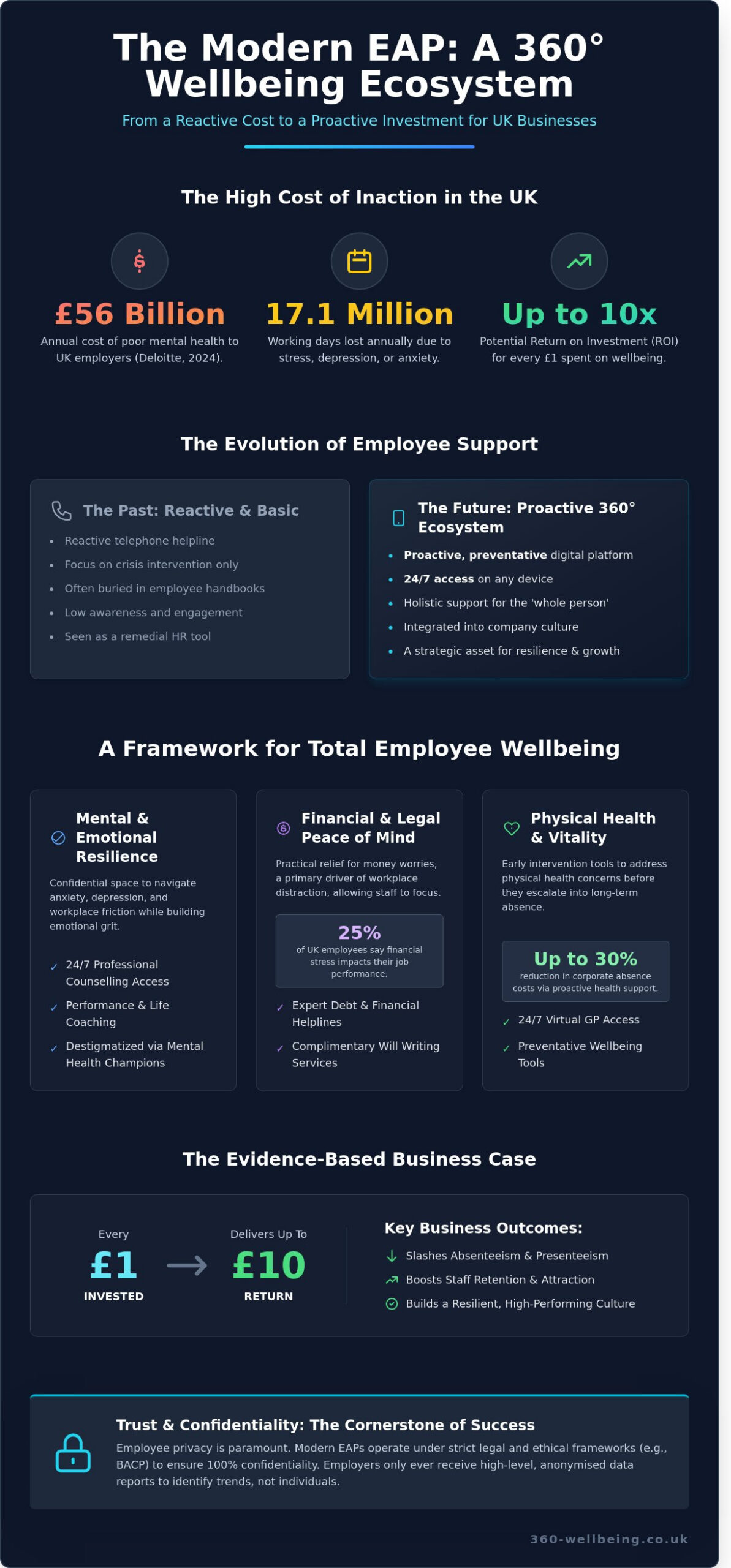
The UK economic climate in 2026 makes this support more vital than ever. With the 2024 Deloitte report highlighting that mental ill-health costs UK employers £56 billion annually, businesses can’t afford to be passive. To understand the foundation of these services, it helps to look at What is an Employee Assistance Programme (EAP)? and how it has transformed from a simple intervention tool into a proactive wellness partner. Today, a modern EAP addresses the “whole person” by offering 24/7 access to clinical experts, legal advisors, and financial coaches, creating a safety net that catches issues before they spiral into long-term sickness.
The shift from reactive to proactive support
Waiting for a crisis to occur is a costly mistake. Modern EAPs focus on preventative wellbeing as a core business strategy. Instead of waiting for an employee to burn out, these platforms use early intervention tools to identify stress triggers early. Access to 24/7 Virtual GPs and mental health specialists ensures that a physical or emotional niggle doesn’t become a month-long absence. This proactive approach can reduce corporate absence costs by up to 30%, making the benefits of an employee assistance programme clear for both the person and the profit margin.
Confidentiality: The cornerstone of EAP success
Privacy is the most common concern for employees. Many worry that their manager will find out about their therapy sessions or financial struggles. To combat this, modern EAPs operate under strict legal and ethical frameworks, such as those set by the British Association for Counselling and Psychotherapy (BACP). Every interaction is totally private. Employers only receive anonymised, high-level data reports. These reports show general trends, like a 15% rise in stress across a specific department, without ever identifying an individual. This ensures a culture of trust where staff feel safe seeking help early.
The 360-Degree Benefits: Supporting the ‘Whole’ Employee
A modern EAP isn’t just a crisis hotline. It’s a proactive framework designed to catch employees before they fall. By addressing the “whole” person, businesses can dismantle the presenteeism trap. This is where staff are physically present but mentally absent due to underlying stress or health concerns. Recent research indicates that presenteeism costs UK employers approximately £28 billion annually. One of the core benefits of an employee assistance programme is its ability to transform this hidden drain into a culture of focused, sustainable productivity. It creates a safety net that lets your team leave their “life admin” worries at the door.
Mental health and emotional resilience
Professional counselling provides a confidential space to navigate anxiety, depression, and workplace friction. It’s about more than just recovery; it’s about growth. We integrate life coaching to help high-performers sharpen their focus and build emotional grit. To ensure these tools are actually used, Mental Health Champions within your team act as vital bridges. They help in destigmatising the act of seeking help. This peer-to-peer support ensures the EAP becomes a living part of the office culture, rather than just a link in a handbook.
Financial and legal peace of mind
Money worries are a primary driver of workplace distraction. Roughly 25% of UK employees report that financial stress impacts their ability to do their job effectively. An EAP offers practical relief through complimentary will writing services and expert debt helplines. These resources provide a sense of security that allows staff to focus on their professional contributions. For a deeper look at these strategies, you can explore our financial support for employees guide. Providing this level of care proves that you value their stability outside the office as much as their output inside it.
Physical health as a workplace priority
Physical vitality is the foundation of professional performance. With 24/7 Virtual GP access, employees can book appointments during breaks. This avoids the typical half-day absence required for a local surgery visit. For those dealing with musculoskeletal issues, rapid access to physiotherapy is essential. This is particularly true for remote workers who might lack ergonomic setups. By Supporting the ‘Whole’ Employee, you create a resilient workforce capable of meeting the challenges of 2026. These benefits of an employee assistance programme ensure that health is treated as a strategic asset. If you’re ready to see how this fits your team, you can view our tailored solutions to begin your journey toward total wellness.
The Business Case: ROI, Retention, and Resilience
Investing in your team’s mental and physical health is no longer a discretionary “perk” for 2026. It is a strategic necessity. When you look at the 360-degree health of an organisation, the financial data reveals a clear pattern. One of the most significant benefits of an employee assistance programme is its ability to transform unpredictable human risks into manageable, proactive support systems. By addressing issues before they escalate, you protect both your people and your profit margins.
Calculating the return on investment (ROI)
The financial logic for wellbeing interventions is robust. Deloitte’s 2024 analysis on mental health in the workplace found that for every £1 spent on support, UK businesses see an average return of £4.70. For proactive tools like EAPs, this ROI often climbs to a ratio of 10:1. Consider the cost comparison: a comprehensive EAP subscription typically costs between £10 and £20 per employee annually. In contrast, the average cost of a single long-term sick leave period in the UK exceeds £3,500 when factoring in sick pay and lost output. “A well-utilised EAP can reduce absenteeism by up to 25% while boosting overall morale.”
Improving retention and the employer brand
Staff turnover is a silent drain on capital. Oxford Economics research indicates that replacing a departing employee costs approximately £30,614 per person, covering recruitment, onboarding, and the “logistical lag” while a new hire reaches full productivity. In a competitive talent market, being an “employer of choice” is a major advantage. Providing a 24/7 lifeline shows your team that you’re an expert caregiver, not just a taskmaster. This empathy builds deep loyalty, helping to combat the “Great Resignation” trends by reducing voluntary turnover by up to 16% in many sectors.
Reducing absenteeism and presenteeism
Presenteeism is the hidden drain where staff are physically present but mentally disengaged due to stress, financial worries, or health struggles. This “working while unwell” costs the UK economy over £28 billion every year, far outstripping the cost of actual absence. One of the core benefits of an employee assistance programme is the provision of “in-the-moment” support. This immediate access to clinicians or counsellors prevents minor anxieties from snowballing into chronic conditions. You can read more about the specific impact on absenteeism costs in our guide for small businesses. By providing a safety net, you ensure your workforce remains resilient, focused, and genuinely present.
Overcoming the Engagement Gap: How to Maximise EAP Value
“We have an EAP, but nobody uses it.” This common frustration often stems from “Ghost Benefit” syndrome, where a service exists on paper but remains invisible to the workforce. In 2024, data from the Employee Assistance Professionals Association (EAPA) UK revealed that for every £1 invested in these services, employers see an average return of £10.85. To realise the full benefits of an employee assistance programme, your strategy must shift from a corporate tick-box exercise to a genuine gift of support.
Successful engagement begins with a multi-channel approach. Different demographics interact with support in unique ways. A Gen Z employee might prefer a confidential web-chat, while a senior manager might value a 24/7 telephone helpline for immediate crisis support. Providing access via a dedicated mobile app, a web portal, and a phone line ensures that no one is left behind. When you launch the service, frame it as a proactive toolkit for life, not just a reactive safety net for work-related stress.
Normalising the conversation around support
Engagement flourishes when leadership models the right behaviour. If a Director mentions using the EAP’s mindfulness resources during a team meeting, it dissolves the stigma instantly. Regular “Wellbeing Wednesdays” or monthly workshops keep the service top-of-mind. Your internal newsletters should highlight specific, relatable features. Instead of general reminders, try focusing on practicalities: “Did you know our EAP includes a debt helpline to help with the rising cost of living?” This makes the support feel tangible and relevant to daily life.
Removing barriers to entry
Accessibility is the bridge between having a benefit and seeing its impact. Statistics show that 35% of EAP calls in the UK occur outside of the traditional 9-to-5 window, making 24/7 access a non-negotiable requirement. For the 6.2 million UK workers in non-desk-based roles, a mobile-friendly platform is essential. Driving daily engagement is easier when you promote the “lifestyle” side of the service. By highlighting retail discounts or gym membership rewards within the app, you encourage staff to log in regularly. This familiarises them with the interface, so they know exactly where to turn when they need more serious mental health or legal support. This proactive familiarity is one of the most significant benefits of an employee assistance programme in a modern workspace.
Integrating a 360-Degree EAP into Your Workplace Strategy
Traditional wellness models often fail because they wait for a crisis to occur. Our 360-degree approach flips this script. It combines clinical precision with lifestyle-focused support to create a proactive safety net. By 2026, the benefits of an employee assistance programme are measured by how well they integrate into the daily lives of staff, not just how many calls they answer. We provide an ecosystem that addresses physical, mental, and social health as a single, unified narrative.
Our platform scales effortlessly to meet your needs. Whether you’re a sole trader looking for personal resilience or a large enterprise managing 5,000 staff, the quality of care remains identical. We act as an expert caregiver and a dedicated partner, rather than a distant vendor. This relationship ensures your business isn’t just buying a service; it’s adopting a long-term strategy for vitality and workplace harmony.
Tailoring the EAP to your specific workforce
A one-size-fits-all approach fails because a construction worker’s needs differ vastly from those of a software developer. In early 2025, data showed that generic EAPs saw engagement rates as low as 2%. We solve this by customising communication to suit your unique culture. Having 24/7 Virtual GPs and mental health support under one roof removes the friction that prevents people from seeking help. Our dedicated account management ensures onboarding is seamless, typically taking a team from sign-up to full platform access in less than 48 hours.
Taking the next step for your business
Implementing a SaaS-based wellbeing platform is a straightforward process that yields immediate results. You should view the EAP as a strategic cultural investment. Research from 2024 indicates that UK firms see an average return of £4.70 for every £1 spent on proactive mental health support. Don’t wait for burnout to impact your bottom line. Start small if you must, but start now to protect your team’s future and build a resilient workforce. You can Explore our 360-degree Employee Assistance Programme today to see how we can support your specific goals.
Future-Proofing Your Business Through Holistic Wellbeing
The workplace landscape of 2026 demands a shift from reactive care to proactive partnership. By integrating the benefits of an employee assistance programme into your core strategy, you’re building a foundation of resilience that protects your most valuable asset. Research from Deloitte in 2024 shows that proactive mental health interventions deliver an average return of £4.70 for every £1 invested. This financial clarity, combined with the 15% increase in staff retention typically seen by firms adopting holistic care, makes the business case undeniable.
Your team needs a comprehensive ecosystem that supports their whole life, from physical health to financial stability. Our platform provides immediate peace of mind with 24/7 UK-registered Virtual GP access and BACP-accredited mental health support. We’ve also included expert financial and legal helplines to ensure every angle of employee life is covered. It’s time to move beyond basic perks and embrace a strategy that fosters genuine vitality and workplace harmony.
Book a demo of the 360 Wellbeing platform and see the benefits for your team
We’re ready to help you create a healthier, more productive future for everyone in your organisation.
Frequently Asked Questions
What exactly is included in a standard Employee Assistance Programme?
A standard EAP includes 24/7 telephone support, professional counselling sessions, and expert advice on legal or financial matters. Most modern programmes provide 6 to 8 sessions of structured therapy per issue to help staff manage personal or professional challenges. These services offer a 360-degree approach to wellbeing, covering everything from mental health support to practical guidance on eldercare or childcare arrangements.
Is an EAP really confidential, and will my employer see what I discuss?
Your EAP is strictly confidential and operates under the Data Protection Act 2018 and UK GDPR regulations. Employers only receive high-level, anonymised reports that show how many people used the service, but they never see individual names or specific details of your conversations. This privacy is a cornerstone of the service, ensuring you feel safe to speak openly with a clinician or advisor without any impact on your career.
How much does an EAP cost per employee in the UK?
A comprehensive EAP typically costs between £5 and £15 per employee per year for most UK businesses in 2026. This represents a high-value investment when compared to the cost of staff turnover or sickness absence. According to Deloitte’s 2024 mental health report, every £1 invested in workplace wellbeing initiatives delivers an average return of £5.30 through increased productivity and reduced presenteeism.
Can an EAP help with my personal financial problems or debt?
Yes, most programmes include access to qualified financial advisors who provide debt management strategies and budgeting support. Accessing these financial tools is one of the key benefits of an employee assistance programme, as it addresses a primary cause of workplace stress. Since 25% of UK workers reported that money worries affected their performance in 2024, these services are essential for maintaining a focused and resilient workforce.
What is the difference between an EAP and Private Medical Insurance (PMI)?
An EAP provides immediate, short-term support for emotional and practical issues, while PMI is designed for the clinical diagnosis and treatment of acute medical conditions. EAPs are proactive and available to your entire workforce from day one at a very low cost. In contrast, PMI often involves higher premiums and focuses on hospital-based care, surgeries, or specialist consultations rather than daily wellbeing and resilience.
How do I encourage my staff to actually use the EAP services provided?
You can increase engagement by making the EAP a central part of your company culture through regular internal communications and leadership endorsements. Data from the Employee Assistance Professionals Association (EAPA) suggests that usage rates rise when managers are trained to spot signs of struggle and recommend the service. Distributing physical wallet cards and digital app links during induction ensures that every team member knows how to access support instantly.
Can small businesses or sole traders benefit from an EAP?
Small businesses and sole traders can access EAPs through tailored “pay-per-head” models or via membership in professional trade bodies. For a company with fewer than 10 employees, an EAP provides an affordable way to offer the same level of care as a large corporation. Sole traders find these programmes particularly useful for accessing 24-hour legal advice and mental health support, which serves as a vital safety net for their business operations.
How quickly can an employee get an appointment with a counsellor or GP through an EAP?
Employees usually gain immediate access to a telephone counsellor, while face-to-face or video appointments are typically arranged within 48 to 72 hours. This rapid response is a major advantage over standard NHS waiting times, which often exceed 18 weeks for mental health referrals. Quick intervention ensures that minor issues don’t escalate into long-term health problems, keeping your team healthy and productive throughout the year.