
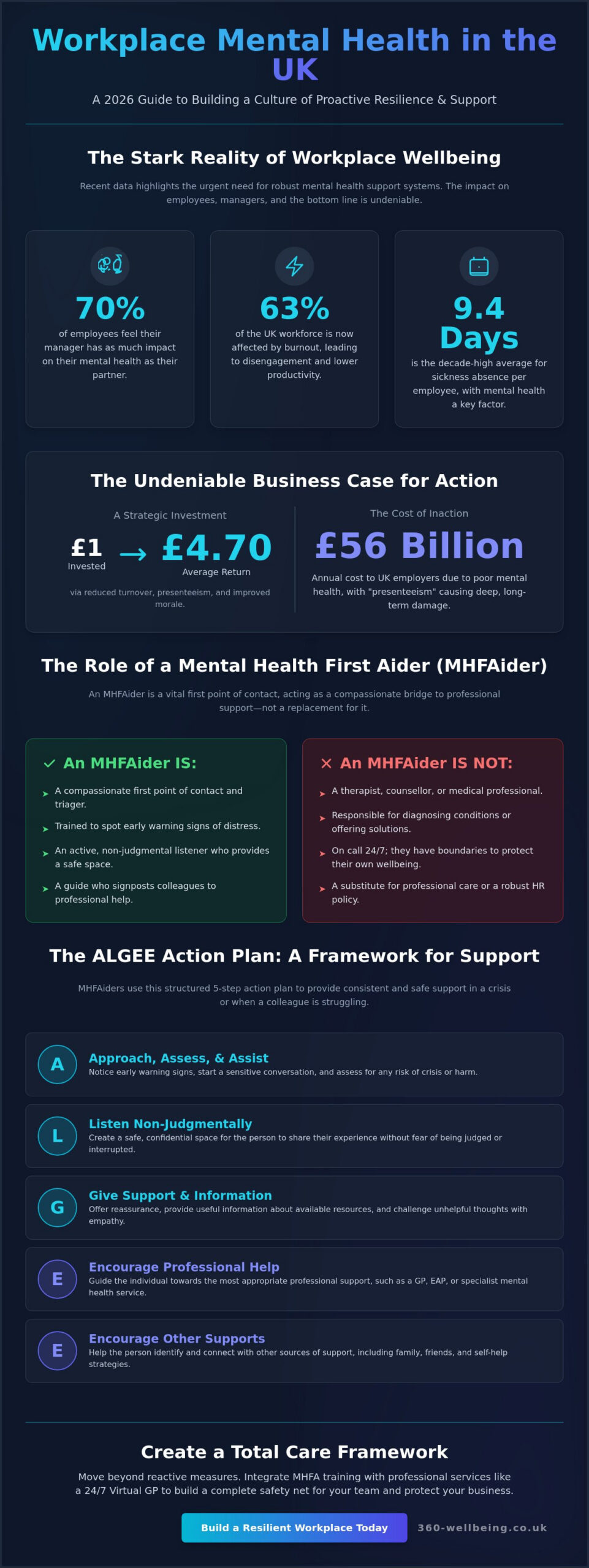
Did you know that nearly 70% of your employees feel their manager has as much impact on their mental health as their partner? It’s a heavy responsibility to carry, especially as you look for the best way to integrate mental health first aid in the workplace uk while sickness absences hit a decade high of 9.4 days. You likely feel the daily pressure of rising burnout, which now affects 63% of the workforce, while worrying about the legal risks of getting your response wrong. We understand that you want to protect your people, but the path between legal duty and compassionate support often feels blurred.
We’re here to help you move from reactive damage control to a culture of proactive resilience. This 2026 guide provides a clear roadmap to help you meet HSE enforcement priorities, reduce workplace stigma, and unlock the £4.70 return on investment that comes with a truly supported team. Together, we’ll explore how to build a safer environment where every employee feels seen and every manager feels empowered to lead with confidence. By the end of this article, you’ll have a practical strategy to turn mental health support into a core strength of your business.
Key Takeaways
- Define the boundaries of the MHFAider role as compassionate triagers to ensure your team provides vital support without overstepping into clinical therapy.
- Learn how to conduct a tailored needs assessment to implement mental health first aid in the workplace uk that truly reflects your company’s size and unique culture.
- Identify the subtle early warning signs of burnout and anxiety to facilitate supportive, non-judgmental conversations before stress-related absences occur.
- Discover how to bridge the gap between initial peer support and professional care by integrating a 24/7 Virtual GP into your wider wellbeing framework.
- Create a robust mental health policy that protects your business while providing your first aiders with the professional resources they need to thrive.
Understanding Mental Health First Aid (MHFA) in the UK Workplace
At its heart, mental health first aid in the workplace uk serves as a vital first point of contact for anyone experiencing emotional or psychological distress. It isn’t a substitute for professional medical intervention; instead, it functions as a supportive bridge. When we look at What is Mental Health First Aid?, we see a framework designed to preserve life, provide comfort, and prevent a situation from becoming a full-blown crisis. By May 2026, the landscape of work has shifted, with average sickness absences reaching 9.4 days per employee. This rise has pushed businesses to move away from reactive “firefighting” toward a model of proactive vitality and resilience.
An MHFAider acts as a trained “triager” rather than a therapist or doctor. Their primary role is to spot the early warning signs of struggle, listen without judgment, and guide the individual toward professional help. This distinction is crucial for both the safety of the employee and the wellbeing of the volunteer. By 2026, the most successful UK firms have integrated this peer-led support into a wider 360-degree wellbeing strategy that treats mental health with the same urgency as physical safety. It’s about creating a culture where people feel safe to speak up before they reach a breaking point.
The Legal and Moral Case for MHFA
The Health and Safety Executive (HSE) has made work-related stress an enforcement priority in 2026, reminding employers that their legal duty of care covers psychological harm just as strictly as physical injury. Under the Health and Safety at Work Act 1974 and the Management of Health and Safety at Work Regulations 1999, you’re required to assess risks to employee health, which includes managing the triggers of burnout and anxiety. Beyond the regulations, there’s a clear moral imperative: every worker deserves to feel as safe in their mind as they do at their desk.
Key Stats: Why UK Businesses are Prioritising Mental Health
The financial impact of poor mental health reached an estimated £56 billion annually for UK employers as of January 2026. While absenteeism is visible, “presenteeism,” where staff are physically present but mentally disengaged, often causes deeper long-term damage to productivity. Data shows that for every £1 you invest in staff wellbeing, you can expect an average return of £4.70 through reduced turnover and improved morale. In a competitive 2026 talent market, a robust mental health first aid in the workplace uk framework is a strategic asset that attracts and retains the best people by showing a genuine commitment to holistic health.
The Role and Responsibilities of a Workplace MHFAider
A Mental Health First Aider acts as the eyes and ears of your organization. In 2026, with 63% of UK employees showing signs of burnout, these volunteers provide the vital early intervention that prevents a bad week from becoming a long-term absence. They aren’t there to fix every problem; instead, they’re trained to notice when a colleague’s behavior shifts. This might look like a normally punctual employee missing deadlines, or a vocal team member becoming suddenly quiet in meetings. By identifying these subtle cues, they can open the door to supportive conversations before a crisis takes hold.
The core of mental health first aid in the workplace uk is the ability to listen without judgment. When an employee feels safe enough to share their struggles, the first aider provides a calm, reassuring presence. They help the individual explore their feelings and, crucially, they guide them toward the right professional resources. Whether that’s an internal Employee Assistance Programme (EAP) or a 24/7 Virtual GP, the goal is to ensure nobody manages their journey alone. You’ll find that integrating professional mental health support alongside your first aiders creates the most reliable safety net for your team.
The ALGEE Action Plan Explained
To keep support structured and safe, first aiders follow the framework developed by MHFA England, known as ALGEE. This involves approaching the person, listening non-judgmentally, giving support and information, and encouraging both professional and peer-based help. In a hybrid 2026 workplace, this often means “approaching” someone via a private video call or a thoughtful direct message when you notice their “camera-off” habit has become a daily occurrence. The “Listen” phase is the most critical part of this process because it builds the trust necessary for the employee to accept further help.
Setting Professional Boundaries
Clarity is kindness when it comes to the limits of this role. A first aider is a triager, not a therapist. They don’t diagnose conditions like clinical depression or provide ongoing counseling. It’s essential that they know how to politely decline a “long-term supporter” role while still showing deep empathy. They should focus on the “hand-off” to professional medical services, ensuring the employee reaches a qualified expert who can provide a diagnosis or treatment plan. This boundary protects the volunteer from secondary trauma and ensures the employee receives the high-level care they deserve.
MHFA vs. Professional Support: Bridging the Gap
Relying solely on mental health first aid in the workplace uk without a professional backup is a risk many employers unknowingly take. Training a team is a powerful first step, but it shouldn’t be the only one. Without a professional safety net, your first aiders are left carrying the heavy emotional weight of their colleagues’ struggles without a clear exit strategy. This often leads to “helper burnout,” where the very people you’ve trained to provide support become overwhelmed by the complexity of the issues they encounter. A robust framework ensures that the moment a peer-led conversation ends, a professional clinical journey can begin.
Speed is the most critical factor in successful intervention. While a first aider can offer immediate comfort, they cannot provide a medical diagnosis or a prescription. This is where the gap typically widens in many UK businesses. While the average wait for some community mental health services can stretch into weeks, a UK-registered Virtual GP can often see an employee within hours. This rapid transition from peer triage to clinical consultation is what prevents a mental health challenge from escalating into a long-term sickness absence. It transforms the role of the first aider from a lonely sentry into a vital link in a 360-degree care chain.
The Critical Hand-off to Clinical Care
Effective implementation requires more than just a certificate on the wall. It involves giving your team practical advice for embedding a mental health first aid network that connects directly to professional tools. When a first aider identifies someone in distress, they should have the ability to signpost them to immediate, 24/7 Virtual GP access or an Employee Assistance Programme (EAP). This professional layer of care removes the pressure from the volunteer and ensures the employee receives expert guidance. We’ve found that addressing the root causes of stress, such as legal worries or debt, through integrated support services provides a much more stable foundation for recovery.
Moving from Triage to Treatment
A comprehensive benefits package is the logical conclusion of any mental health strategy. While first aid handles the immediate moment, proactive tools like life coaching help employees build the resilience needed to stay well in the long term. It’s often the case that workplace anxiety stems from external pressures that feel out of an individual’s control. By using a financial support guide to offer debt advice and fiscal planning, you address the stressors before they manifest as a clinical crisis. This approach ensures that your first aiders are part of a thriving ecosystem rather than an isolated island of support.
How to Implement MHFA in Your UK Workplace
Implementing mental health first aid in the workplace uk begins with a structured needs assessment. You shouldn’t just guess the number of volunteers required; instead, look at your specific workforce size and the unique pressures of your industry. By May 2026, a robust Mental Health Policy is essential to outline the boundaries of the role. This document must clearly state that first aiders are not clinicians, protecting them from legal and emotional overreach while ensuring employees understand what kind of support to expect.
Promotion is the final hurdle. If your team doesn’t know who to call, your framework won’t function. Use digital dashboards, office posters, and regular internal updates to keep support visible across all departments and shifts. Keep in mind that MHFA certification is valid for three years. To remain compliant and effective, you must schedule refresher training to ensure your team stays current with the latest UK safety guidelines and maintains their confidence in handling sensitive situations.
Selecting and Supporting Your MHFAiders
Look for volunteers who naturally exhibit empathy, resilience, and a commitment to diversity. While senior leadership must champion the programme, they aren’t always the best fit for the primary first aider roles. Employees often feel more comfortable sharing sensitive information with peers rather than direct supervisors. Crucially, you must address the question: who supports the supporter? Providing your first aiders with access to professional Mental Health Support or debriefing sessions prevents secondary trauma and ensures your first aid network remains sustainable for the long term.
Creating a Culture of Psychological Safety
A successful rollout serves as a catalyst for a wider shift in company culture. It moves your business away from the stigma of the past and toward a proactive vision of vitality. To lead the market in 2026, integrate your approach with ISO 45003 standards. This international framework focuses on managing psychosocial risks, such as excessive workloads or poor communication, before they lead to burnout. Since 84% of UK employees faced a mental health challenge in the past year, establishing mental health first aid in the workplace uk is now a strategic necessity for every modern employer who values their team’s wellbeing.
The 360 Wellbeing Approach: Total Care Beyond Training
True resilience isn’t built through a single training course. To make mental health first aid in the workplace uk truly effective, it must sit within a broader, 360-degree ecosystem of care. We view wellbeing as a strategic asset rather than a checkbox exercise, where peer-led support is seamlessly integrated with professional clinical intervention. This holistic approach ensures that when a first aider identifies a colleague in distress, they aren’t just offering a kind word; they’re opening a door to a comprehensive suite of tools designed to handle the complexities of modern life.
By May 2026, we’ve seen that mental health rarely exists in a vacuum. It’s often intertwined with physical limitations or financial anxieties. Our platform empowers your team by connecting these dots, offering everything from debt advice to physiotherapy and legal support. This unified narrative moves your business beyond basic health and safety compliance and into a space of genuine, proactive care. When you address the whole person, you reduce the sickness absence rates that have climbed to 9.4 days per employee across the UK.
Empowering Your Team with 24/7 Support
First aiders often feel the weight of responsibility when they don’t have a clear place to send a colleague. By providing 24/7 Virtual GP access and structured mental health support, you remove that burden from their shoulders. Your team can refer with confidence, knowing their peers will receive immediate, high-quality care from UK-registered professionals. Beyond crisis management, tools like life coaching and 360 Rewards help build long-term vitality. This proactive support ensures your workforce stays healthy and engaged, preventing the burnout that currently affects 63% of employees.
Ready to Transform Your Workplace?
Every business is unique, whether you’re a growing SME or a sole trader looking to scale. We recommend a methodical review of your current provision to identify where the gaps in your support network lie. A tailored approach is the only way to ensure your investment in mental health first aid in the workplace uk delivers the average £4.70 return on investment seen by top-performing firms. It’s time to move from a reactive stance to a positive vision of workplace harmony that protects your most valuable asset: your people.
Discover how 360 Wellbeing can support your mental health strategy today.
Building a Future-Proof Culture of Resilience
Establishing a robust framework for mental health first aid in the workplace uk is no longer just a “nice to have” initiative. It’s a strategic necessity that protects your team while fulfilling your legal obligations under the 2026 HSE enforcement priorities. You’ve seen that while first aiders provide vital triage, their success depends on a professional safety net that can handle complex clinical needs. By bridging the gap between peer support and professional care, you ensure that no employee is left waiting when they reach out for help.
Our 360-degree approach provides the completeness your business needs to thrive. We offer 24/7 access to UK-registered GPs, integrated mental health therapy, and proactive life coaching to build lasting resilience. Our comprehensive EAP also includes the financial and legal support required to tackle the root causes of workplace anxiety. When you choose a partner who values holistic health as much as you do, you’re not just managing risk; you’re investing in your team’s long-term vitality.
Explore our comprehensive employee wellbeing platform and see how we can help you transform your workplace into a sanctuary of support and harmony. We’re here to walk this path with you.
Frequently Asked Questions
Is Mental Health First Aid a legal requirement in the UK?
No, Mental Health First Aid is not a standalone legal requirement, but it helps you meet your duties under the Health and Safety at Work Act 1974. The Health and Safety Executive (HSE) updated its guidance on May 3, 2026, to clarify that employers must consider mental health in their first aid needs assessments. Failing to manage psychological risks can lead to enforcement action, just like physical safety failures.
How many Mental Health First Aiders do I need for my business?
You should aim for a ratio that ensures support is always available across all shifts and locations. While there’s no fixed legal number, many UK businesses target one trained first aider for every 10 to 50 employees. If your workplace is high-pressure or has a history of high stress, a higher density of support is recommended to ensure your team’s mental health first aid in the workplace uk remains accessible.
What is the difference between a Mental Health First Aider and a Mental Health Champion?
A Mental Health First Aider is a trained responder who provides immediate support and triage during a crisis or period of distress. In contrast, a Mental Health Champion focuses on cultural change, such as running awareness campaigns or reducing stigma through daily advocacy. While the first aider handles individual interventions, the champion works on the broader environment to make it psychologically safe for everyone.
Can Mental Health First Aid training be done online?
Yes, accredited Mental Health First Aid training is widely available in both online and in-person formats. Online courses typically use live, instructor-led sessions combined with independent learning modules to ensure the same level of depth as traditional classroom settings. This flexibility allows businesses with remote or hybrid teams to train their staff without the need for travel, making the implementation process much more manageable.
How much does MHFA training cost for a UK business?
The recommended price for a public two-day Mental Health First Aider course is £325 plus VAT per person as of May 2026. For businesses booking private groups of 8 to 16 delegates, the cost often starts from £245 plus VAT per person. If you only need a refresher course to maintain an existing certification, the standard price is £150 per person with no VAT applied.
What happens if a Mental Health First Aider gives bad advice?
A first aider’s role is to signpost rather than give clinical advice, which significantly reduces the risk of harmful guidance. If a volunteer follows their accredited training and sticks to the ALGEE framework, they are acting as a peer supporter, not a medical professional. This is why it’s essential to have a clear policy that defines their role as a triager who directs colleagues toward professional services like an EAP or Virtual GP.
How often do MHFAiders need refresher training?
Mental Health First Aid certification is valid for exactly three years from the date of completion. After this period, your volunteers must attend a refresher course to keep their skills sharp and their knowledge up to date with current best practices. Regularly updating this training ensures your mental health first aid in the workplace uk remains a reliable and safe resource for your staff.
Can a small business or sole trader benefit from MHFA?
Small businesses and sole traders benefit immensely from these skills because they often lack the HR infrastructure of larger firms. When you’re a team of five or working alone, the impact of burnout is magnified and can threaten the survival of the business. Learning to spot early signs of stress allows you to intervene early, protecting your productivity and ensuring you have the resilience to handle the unique pressures of running a small enterprise.