
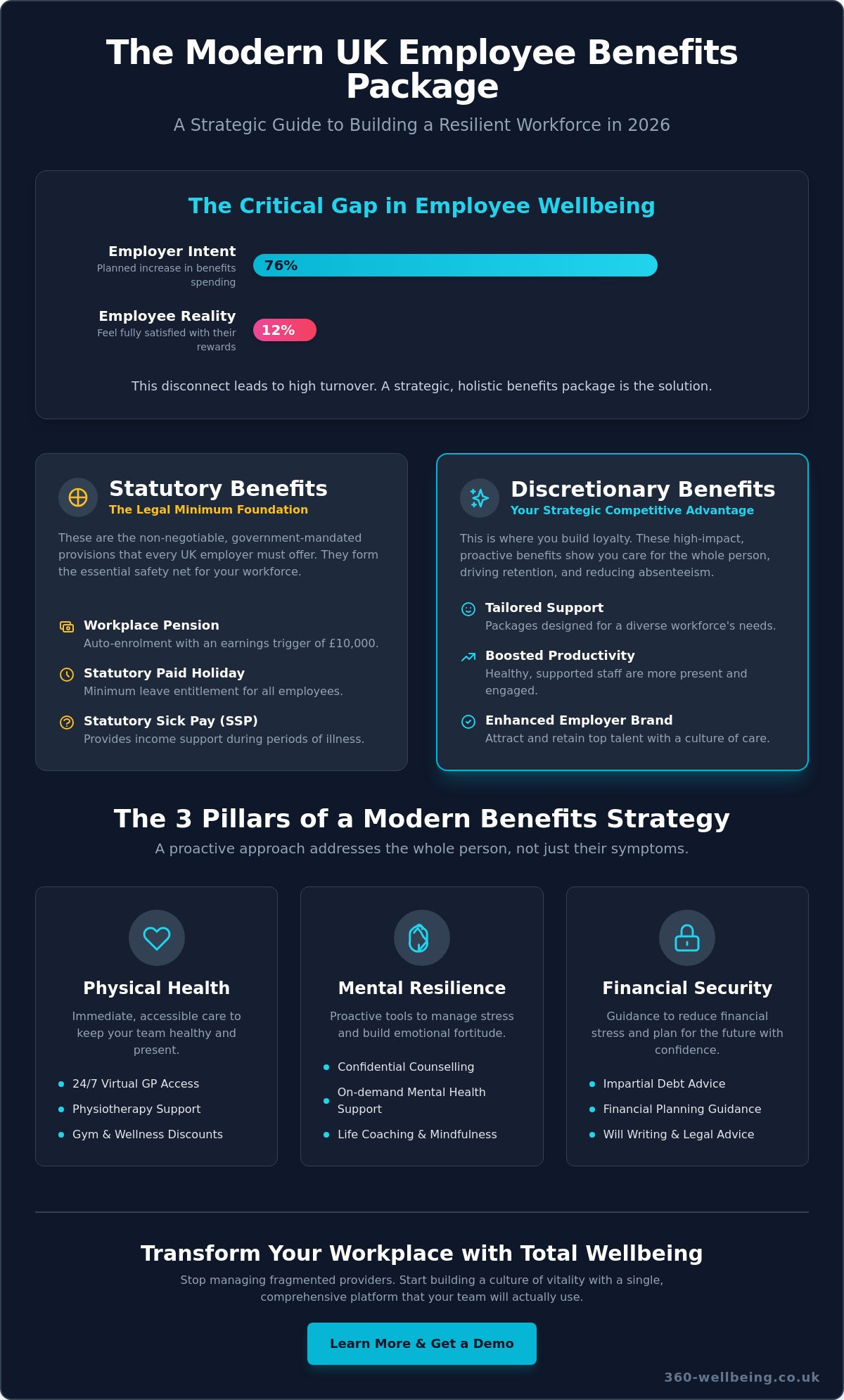
Did you know that only 12% of UK employees feel fully satisfied with their current rewards, despite 76% of employers planning to increase their spending this year? It’s a disheartening gap that often leads to high staff turnover and a constant search for more effective employee benefits package examples uk teams actually value. You want to provide a supportive environment, but rising Private Medical Insurance costs and the complexity of managing multiple providers can make corporate wellness feel like a burden rather than a benefit.
We understand that you need a way to support your staff’s health and happiness without breaking the bank. This guide promises to provide practical, high-impact examples tailored for the 2026 market to help you boost retention and foster a culture of vitality. We’ll explore how to move beyond basic perks to offer a proactive safety net that includes 24/7 virtual GP services, mental health support, and financial guidance. This approach ensures your team stays resilient and productive, providing the comprehensive care they deserve while keeping your strategy manageable and cost-effective.
Key Takeaways
- Learn why modern benefits are no longer just “perks” but a proactive strategic asset designed to build long-term staff resilience.
- Understand the 2026 UK framework for mandatory benefits and how to use discretionary options to gain a distinct competitive advantage.
- Explore high-impact employee benefits package examples uk businesses can adopt to support both immediate health needs and ongoing mental wellbeing.
- Discover how to audit your workforce requirements and lower costs by replacing fragmented providers with a single, comprehensive platform.
- See how providing 24/7 virtual GP access and financial support can transform your workplace into a supportive environment of total vitality.
What is an Employee Benefits Package in the UK?
Employee benefits encompass the various forms of non-wage compensation provided to staff in addition to their normal salaries or wages. In the UK, this traditionally meant a pension and perhaps a company car. However, as we move through 2026, the definition has evolved. It’s no longer just a collection of “perks” or “nice-to-haves.” Instead, a modern benefits package serves as a proactive health and retention strategy. It’s a fundamental right that supports the 360-degree wellbeing of every individual in your organization.
A comprehensive package today rests on three essential pillars: physical health, mental resilience, and financial security. When you look at employee benefits package examples uk companies are currently implementing, you’ll see a shift away from reactive measures. Employers are moving toward tools that prevent issues before they arise. This includes immediate access to virtual GPs, mental health counseling, and debt advice. By addressing the whole person, you create a workplace where staff don’t just survive; they thrive. Instead of waiting for a health crisis to occur, forward-thinking companies provide tools that help employees maintain their vitality every single day.
The days of a single, rigid package are over. Your workforce is diverse, spanning different life stages and personal challenges. A graduate might prioritize mental health and gym discounts, while a senior manager might value will writing or physiotherapy. Forcing everyone into the same box leads to low engagement. In fact, research shows that only 12% of employees are fully satisfied with their rewards when they feel their specific needs aren’t met. Tailoring your approach is the only way to remain competitive.
The Evolution of Employee Expectations in 2026
Staff expectations have shifted dramatically. Office-based perks like “Fruit Fridays” have lost their luster. Today’s talent prioritizes accessible healthcare that fits into their busy lives. With the rise of hybrid and remote working, “virtual-first” benefits are essential. People want to know they can speak to a doctor or a therapist from their living room. This level of support becomes a powerful part of your employer brand, signaling that you truly care about your team’s resilience. It turns wellbeing into a strategic asset.
Why a Strategic Package is Essential for SMEs
For small and medium-sized enterprises, a strategic package isn’t a luxury; it’s a survival tool. You might not have the massive budgets of a global corporation, but you can compete by being more agile and compassionate. By offering tailored support like life coaching or legal advice, you build a culture of care that drives long-term loyalty. This proactive approach also reduces the high cost of absenteeism. When staff have the tools to manage their physical and mental health early, they stay present and productive. It creates a harmonious workplace where everyone feels empowered.
Mandatory vs. Discretionary Benefits: The UK Framework
Building a resilient workforce requires a clear understanding of the line between legal obligations and the strategic support that makes your business a destination for top talent. In the UK, the framework for compensation is divided into two distinct categories. While every employer must adhere to certain statutory employment rights, the most effective employee benefits package examples uk companies use today go far beyond these basics. They address the “Total Wellbeing” triangle: physical health, mental resilience, and financial or legal security.
Bridging the gap between what you “must” provide and what your staff “would like” is where your competitive advantage lives. This isn’t just about adding costs; it’s about shifting from a reactive model to a proactive one. When you layer discretionary support over the legal minimum, you create a safety net that protects both your employees and your bottom line. It’s also vital to consider the tax implications. Many benefits are classified as a Benefit in Kind (BiK), meaning they may attract tax for the employee and National Insurance for the employer. Choosing high-impact, tax-efficient options is key to a sustainable strategy.
Statutory Benefits: The Legal Minimum
As of April 2026, several key changes have updated the mandatory landscape. Workplace pension auto-enrolment remains a cornerstone, with an earnings trigger of £10,000 for the 2026/27 tax year. Statutory Sick Pay (SSP) has seen a significant shift; it’s now payable from the first day of sickness absence at a rate of £123.25 per week. Additionally, parental support rates for maternity, paternity, and adoption leave have risen to £194.32 per week. Remember that paternity leave is now a day-one right, though statutory pay still requires 26 weeks of service. These are the foundations of any UK contract.
Discretionary Benefits: The Differentiators
This is where you can truly support your staff’s vitality without the high price tag of traditional Private Medical Insurance (PMI). Discretionary benefits allow you to offer tailored care that resonates with modern life.
- 24/7 Virtual GP: Provides immediate clinical access, reducing time taken off for appointments.
- Employee Assistance Programmes (EAP): Offers essential mental health support and life coaching to build emotional resilience.
- Financial & Legal Support: Helps staff manage the cost of living with debt advice and complimentary will writing.
By integrating these into a single platform, you make wellbeing accessible and manageable. You can explore how a comprehensive wellness platform simplifies this process, ensuring your team feels valued and secure every day.
3 High-Impact Employee Benefits Package Examples for UK Businesses
Selecting the right framework for your team is about more than just ticking boxes. It’s about creating a safety net that feels personal and responsive to their daily lives. These employee benefits package examples uk employers are using in 2026 demonstrate how to group services into cohesive strategies that drive engagement. By moving away from a long list of disconnected perks, you can offer a unified experience that truly supports staff vitality and resilience.
Tailoring these examples to your specific industry is essential. A construction firm might lean more heavily on physical support like physiotherapy, while a tech startup might find higher value in mental health services and life coaching. The goal is to match the support to the demographic of your workforce, ensuring every pound spent translates into a more supported, productive team.
The Health-First Package (Ideal for SMEs)
This package is designed for businesses that want to tackle absenteeism head-on by providing immediate clinical access. The core features include a 24/7 Virtual GP service, physiotherapy, and mental health therapy. It’s an incredibly effective way to reduce the time staff spend away from work for medical appointments. Instead of waiting weeks for a local GP slot, your team can speak to a UK-registered doctor from their phone at any time. This proactive approach ensures minor health concerns don’t escalate into long-term issues. Using a single digital platform makes implementation seamless, giving employees a one-stop shop for their physical health needs.
The Holistic Life Package (Focus on Resilience)
Modern workplaces are increasingly aware of the deep link between financial stress and mental wellbeing. This package focuses on building resilience through life coaching, financial debt advice, and complimentary will writing. When an employee is worried about debt or legal matters, their focus and productivity naturally decline. By providing a financial support pillar, you’re offering more than just a benefit; you’re providing peace of mind. This type of support builds a deep sense of loyalty, as staff feel their employer cares about their life outside the office walls.
The Total 360 Package (Maximum Retention)
For larger teams or those in highly competitive sectors, a comprehensive safety net is the gold standard for retention. This package combines clinical health and mental support with a high-street rewards marketplace. By including 360 Rewards, you help employees’ salaries go further, directly offsetting the rising cost of living with daily discounts. Adding legal support helplines provides an extra layer of security for complex life events. It creates a total wellness narrative where physical, mental, and social health are all protected within a single, supportive ecosystem.
How to Implement a Benefits Programme Without High Costs
Designing a meaningful support system shouldn’t feel like a financial gamble. Many businesses worry that providing high-quality care requires a massive budget, but the most effective employee benefits package examples uk companies use are built on smart consolidation rather than high spending. By following a structured approach, you can provide a comprehensive safety net that feels premium to your staff while remaining sustainable for your business.
First, audit your workforce needs. Don’t assume you know what they want; use anonymous surveys to identify their real pain points. Second, compare the cost of individual providers against an all-in-one platform. Managing separate contracts for mental health, rewards, and legal advice is often much more expensive than a unified solution. Third, focus on high-frequency, low-cost benefits like 24/7 Virtual GPs. These provide immediate value and are used far more often than niche perks. Finally, launch with a clear plan. High adoption is the only way to ensure a return on your investment.
PMI vs. Wellbeing Platforms: A Cost Comparison
Private Medical Insurance (PMI) is becoming unsustainable for many UK SMEs as premiums continue to climb. In 2026, while 31.5% of employers offer it, many are looking for alternatives that provide clinical access without the heavy price tag. A wellbeing platform uses a predictable, per-employee monthly subscription model. This makes budgeting simple and transparent. Because these platforms offer proactive support, they can actually help reduce long-term insurance premiums by catching health issues early. It’s a smarter way to manage your team’s vitality and keep your overheads predictable.
Communicating Benefits to Your Team
Communication is the bridge between a benefit and a felt experience of support. Adopt an “Expert Caregiver” approach by framing these services as a fundamental right to health and security. Use digital onboarding to ensure every new hire knows how to access support from their first day. To keep engagement high, regularly highlight a “Benefit of the Month.” Whether it’s debt advice or physiotherapy, these reminders ensure your team remembers the safety net is there when they need it most. You can start building your cost-effective programme today to see the difference proactive care makes for your staff retention.
Transforming Your Workplace with 360 Wellbeing
Choosing the right partner is the final step in turning these employee benefits package examples uk into a lived reality for your team. At 360 Wellbeing, we’ve designed a platform that integrates physical, mental, and social health into a single, unified experience. By housing every service within one intuitive app, we remove the friction that often leads to low engagement. Your staff don’t have to navigate a maze of different providers; they simply open the app to find the support they need at that exact moment.
The heart of our offering is immediate clinical access through our 24/7 UK-registered Virtual GP service. In a climate where traditional appointments are increasingly difficult to secure, this provides a vital lifeline for your workforce. Alongside this, we offer professional mental health therapy and life coaching without the long waiting lists that often delay recovery. This proactive approach ensures that your employees feel truly cared for, allowing them to focus on their roles with a clear and resilient mindset. When your team knows they have 360-degree support, their loyalty and productivity naturally flourish.
We also understand that a benefits package needs to provide value every day, not just during a crisis. That’s why our 360 Rewards marketplace is such a critical component of our strategy. It helps your team’s income go further by offering significant discounts on daily essentials and high-street brands. This keeps the package “live” in their minds, reinforcing the value you provide as an employer every time they save money on a weekly shop or a family outing. It turns a static benefit into a daily reminder of your support.
A Partner in Your Employees’ Success
We believe in moving away from the cold, transactional nature of traditional insurance models. Instead, we offer a warm, empathetic support system that acts as a natural extension of your own corporate culture. Our 360-degree perspective ensures that no aspect of wellbeing is left to chance. Whether it’s legal support for a complex life event, physiotherapy for a physical limitation, or debt advice to ease financial pressure, we’re here to guide your staff through their challenges. You can see how 360 Wellbeing can support your business and help you build a more harmonious, proactive workplace.
Getting Started: Onboarding Your Team
Implementing our platform is designed to be as simple as possible for busy UK employers. Our SaaS model allows for rapid deployment, meaning you can start supporting your team’s vitality almost immediately. You’ll also have the support of a dedicated account manager who will help you launch the programme and ensure it remains a success through clear communication and high adoption. We don’t just provide a one-off service; we build a partnership invested in your long-term success. The 360 Wellbeing platform is a comprehensive, all-in-one health and rewards solution designed specifically to help UK SMEs foster staff vitality and retention in 2026.
Building a Resilient Future for Your Team
Creating a workplace where people feel truly supported requires a shift from viewing benefits as mere perks to seeing them as a vital safety net. We’ve explored how the most effective employee benefits package examples uk companies use today focus on proactive health and financial security. By balancing your legal obligations with strategic, discretionary support, you can reduce absenteeism and build a culture of genuine care. It’s about providing the right tools at the right time, ensuring your staff have the resilience to face life’s challenges with confidence.
Your team deserves a 360-degree approach to wellness that covers every aspect of their lives. With our platform, they gain 24/7 access to UK-registered GPs and holistic support for their mental, financial, and legal health. Plus, with thousands of high-street discounts available through 360 Rewards, your support feels “live” and valuable every single day. It’s a manageable way to transform your corporate culture without the unsustainable costs of traditional insurance models.
Are you ready to foster a more harmonious and productive workplace? Build your bespoke 360-degree benefits package today and start your journey toward a healthier, more engaged workforce. We’re here to partner with you every step of the way.
Frequently Asked Questions
What are the most common employee benefits in the UK?
The most frequent benefits offered by UK employers in 2026 are homeworking (45.8%) and flexible working hours (43.1%). Other widely provided options include a casual dress code (35.8%), private health insurance (31.5%), and dedicated learning and development budgets (30.7%). These choices show a clear trend toward supporting work-life balance and professional growth alongside traditional health measures.
How much do employee benefits cost per employee in the UK?
Benefit costs depend on whether you are providing statutory or discretionary support. Mandatory costs include the National Living Wage at £12.71 per hour and Statutory Sick Pay at £123.25 per week. For discretionary perks, many SMEs opt for a per-employee monthly subscription model through a wellbeing platform, which provides a more predictable and manageable way to budget for comprehensive staff care.
What are the best employee benefits for small businesses?
Small businesses often see the highest impact from benefits that offer immediate clinical or financial value without high premiums. Effective employee benefits package examples uk small firms utilize include 24/7 Virtual GP access, mental health support through an EAP, and high-street reward schemes. These tools provide a robust safety net that helps smaller teams compete with the recruitment power of much larger corporations.
Are employee benefits taxable for the employee?
Most discretionary benefits are classified as “Benefits in Kind” (BiK) and are subject to tax based on their cash value. It is important to stay updated on regulatory changes, such as the UK government’s plan to shift to real-time taxation for most BiKs. This change was originally planned for 2026 but has been moved to April 2027, giving your payroll team extra time to prepare.
Can I offer a virtual GP instead of private medical insurance?
Yes, a 24/7 Virtual GP service is a highly effective and lower-cost alternative to traditional Private Medical Insurance (PMI). It provides your staff with immediate access to UK-registered doctors for consultations and prescriptions without the high premiums associated with PMI. This proactive approach helps reduce absenteeism by allowing employees to resolve health concerns quickly from their home or office.
How do I create an employee benefits package for a small team?
Start by auditing your team’s specific needs through an anonymous survey to identify their biggest health or financial concerns. Instead of managing multiple individual providers, look for a single platform that integrates physical, mental, and financial support. This consolidated approach makes it easier to manage your employee benefits package examples uk staff will actually engage with while keeping administration time to a minimum.
What is a standard employee benefits package for UK office workers?
A standard package typically includes a workplace pension, with 26.2% of employers now offering a 5% contribution. You will also find that 32.9% of employers provide 2 to 4 weeks of fully paid sick pay. Modern office standards have expanded to include hybrid working options and digital health tools, reflecting a 360-degree perspective on employee wellbeing and workplace harmony.
How do I measure the ROI of my employee benefits programme?
You can measure success by tracking changes in your absenteeism rates and staff retention figures over a set period. High engagement with services like physiotherapy or mental health support often leads to a measurable reduction in long-term sick leave. Additionally, regular pulse surveys can help you gauge employee sentiment and ensure your benefits are truly supporting their resilience and productivity.