
Could your approach to pro rata calculations be the very thing holding your recruitment back? Many UK business owners feel a sense of unease when managing employee benefits for part-time staff uk, fearing that a small slip in holiday math or a missed pension threshold could lead to a costly employment tribunal. It’s a valid concern, especially as the 2026 landscape introduces tighter regulations like the removal of sick pay waiting days and a significant jump in the National Living Wage to £12.71 per hour.
We understand that you want to be a fair, supportive employer without overstretching your budget on high-cost traditional insurance. This guide will help you bridge that gap. You’ll learn how to balance legal compliance with competitive recruitment by designing the perfect benefits package for your part-time workforce. We will explore the pro rata principle in detail, clarify the latest statutory requirements for 2026, and show you how modern digital tools can provide a panoramic view of health that empowers every member of your team, regardless of their hours.
Key Takeaways
- Master the legal essentials of employee benefits for part-time staff uk to ensure compliance with parity laws while protecting your business interests.
- Understand why the 2026 labor market requires a shift in perspective, making full access to digital wellbeing tools a strategic necessity for retaining talent.
- Compare traditional pro rata models with digital-first solutions like 24/7 Virtual GPs and EAPs that offer equitable support without the headache of complex premium calculations.
- Follow a clear framework to audit your contracts and align your recruitment strategy with the latest 2026 statutory sick pay and pension thresholds.
- Discover a proactive path toward workplace harmony by integrating mental, physical, and financial health into one accessible, all-encompassing wellness strategy.
Understanding the Legal Rights of Part-Time Workers in the UK
Creating a supportive environment begins with a clear understanding of the legal landscape. In the UK, the rights of your flexible workforce are anchored in the Part-time Workers (Prevention of Less Favourable Treatment) Regulations 2000. This legislation defines a part-time worker as anyone who works fewer hours than a comparable full-time employee in the same organisation. The primary aim is simple: parity. It ensures that every individual feels valued and protected, regardless of how many hours they contribute each week.
The “less favourable treatment” principle acts as your guide here. It means part-time staff shouldn’t receive a lower hourly rate or restricted access to employee benefits for part-time staff uk unless there’s a very specific reason. To check if your policies are fair, the law uses the “comparator” rule. You must compare the part-time worker’s terms against a full-time colleague doing the same or similar work on the same contract type. If a difference exists, you’ll need “objective justification.” This isn’t just a business preference; it’s a legal requirement to show that the difference is necessary to achieve a legitimate business goal, such as a specific productivity target that can only be met through a certain working pattern.
The Pro Rata Principle Explained
Pro rata is the proportional allocation of benefits based on a full-time equivalent. It’s the most reliable way to ensure fairness while managing your budget effectively. For example, all UK workers are entitled to 5.6 weeks of paid holiday. For a full-timer working five days, that’s 28 days. A team member working three days a week is entitled to 16.8 days. This logic extends to monetary perks like car allowances, gym subsidies, or bonuses. If a full-time manager receives a £2,000 performance bonus, their part-time counterpart working 60% of the hours should receive £1,200.
Rights That Cannot Be Diluted
While some benefits are numerical, others are about essential human entitlement. You can’t pro-rata a promotion or a training session. Part-time staff must have equal access to career development and shouldn’t be selected for redundancy purely based on their schedule. True workplace harmony comes from inclusion. Make sure they’re part of company-wide communications and social gatherings. When designing employee benefits for part-time staff uk, remember that fostering a sense of belonging is just as important as the numbers on a spreadsheet. This holistic approach ensures your team feels like a single, unified whole.
Why Benefits for Part-Time Staff are a Strategic Necessity in 2026
The UK labor market has undergone a profound transformation. In 2026, part-time roles are no longer viewed as secondary or “fill-in” positions. Instead, they are strategic choices made by highly skilled professionals, including parents, carers, and semi-retired experts who value their time as much as their career progression. As the National Living Wage rises to £12.71, simply meeting the pay floor is no longer enough to secure top talent. Employers who view employee benefits for part-time staff uk as a professional necessity rather than a luxury are the ones building the most durable teams.
When you provide comprehensive support, you’re investing in the long-term vitality of your business. Proactive health care reduces absenteeism by addressing physical and mental challenges before they lead to long-term sick leave. This is particularly vital now that Statutory Sick Pay is payable from the very first day of illness. By offering a proactive vision of health, you move away from reactive crisis management and toward a panoramic culture of wellness. Aligning your strategy with the UK government guidance on part-time worker rights ensures you meet the legal baseline, but true competitive advantage lies in exceeding it.
Recruitment and Retention in a Flexible World
High-skilled workers often choose flexibility to maintain balance in their lives. If your SME offers a robust package that includes mental health support and life coaching, you immediately differentiate yourself from larger competitors who may only offer the bare legal minimum to their part-time cohorts. This emotional investment creates a sense of being “seen” and valued. It’s a powerful retention tool. The cost of replacing a specialist far outweighs the modest investment in a comprehensive wellbeing subscription that supports every individual regardless of their hours.
Fostering Workplace Harmony and Inclusion
A “two-tier” workforce is a significant risk to company culture. When full-time staff receive extensive perks while part-time colleagues are excluded, resentment can quietly erode productivity. True workplace harmony requires an empathetic approach that treats every person as an essential human entitlement. Providing equal access to an Employee Assistance Programme (EAP) or financial support ensures that your part-time staff feel like full members of the team. This inclusive mindset doesn’t just prevent legal friction; it builds a unified narrative of total wellness that strengthens your entire organisation from the inside out.
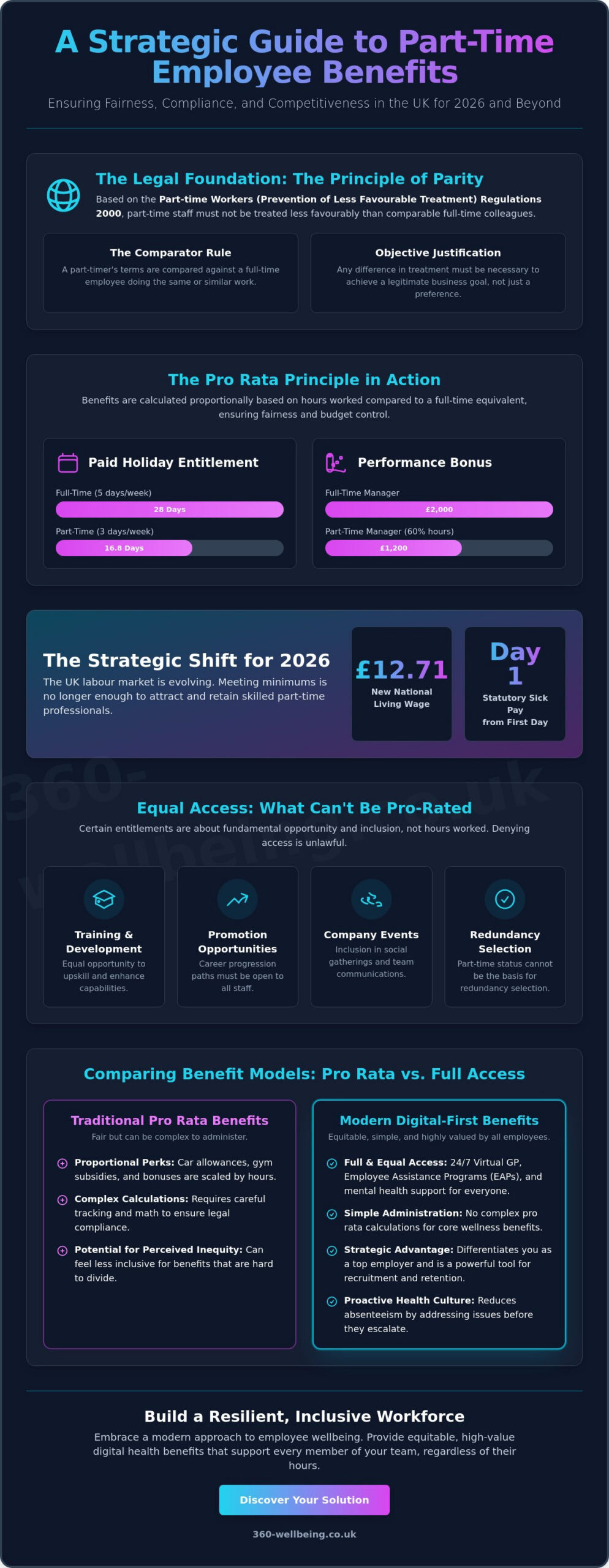
Comparing Benefit Types: Pro Rata vs. Full Access
Choosing how to distribute employee benefits for part-time staff uk often presents a fork in the road. On one side, you have traditional, high-cost perks that require complex pro rata math. On the other, modern digital solutions offer a more inclusive, panoramic approach. Finding the right balance is essential for maintaining both legal safety and workplace harmony.
Statutory requirements like pensions provide a clear framework. For the 2026/27 tax year, the earnings trigger for auto-enrolment remains at £10,000. If your part-time staff earn above this, you must enrol them. Even if they earn between the £6,240 lower limit and the trigger, they have the right to join. Bonuses and commissions should also be handled with care. To ensure fairness, these are typically calculated on a pro rata basis, rewarding performance relative to the hours contributed. This methodical approach prevents resentment and ensures everyone’s contribution is scientifically grounded and fairly rewarded.
The Challenge of Traditional Private Medical Insurance
Traditional health schemes often create an accidental “two-tier” system. Because premiums for private medical insurance are usually fixed rather than proportional, many SMEs find it difficult to justify the cost for staff working only a few hours a week. This exclusion can lead to “less favourable treatment” claims. Managing tiered schemes adds a heavy administrative burden to your HR team. Instead of struggling with complex insurance math, many forward-thinking leaders look for alternatives that provide clinical expertise and reassurance without the prohibitive price tag or the risk of leaving team members behind.
The Advantage of Subscription-Based Wellbeing Platforms
Digital-first benefits act as the great equaliser in the modern workplace. Platforms that offer a 24/7 Virtual GP, physiotherapy, and mental health support usually operate on a flat fee per employee. This makes your budgeting simple and transparent. It ensures that a part-time worker has the same level of care as their full-time colleagues, which is a powerful statement of value. It moves away from the coldness of traditional services toward a persona that is genuinely compassionate and inclusive.
These tools remove the barrier of working hours. A staff member who only works Tuesdays and Wednesdays can still access life coaching or an Employee Assistance Programme (EAP) on a Saturday night. This round-the-clock availability mirrors a commitment to all-encompassing care. Modern platforms also integrate financial support and debt advice. By providing these essential human entitlements to everyone, you create a sense of safety and order that benefits your entire organisation.
A Step-by-Step Guide to Implementing Part-Time Benefits
Implementing a fair and sustainable strategy for employee benefits for part-time staff uk requires a methodical approach that balances clinical precision with human empathy. Your first step is a thorough audit of current contracts to identify “comparators.” This involves finding full-time colleagues in similar roles to ensure your part-time team isn’t receiving less favourable treatment without objective justification. This foresight protects your business and establishes an immediate partnership of trust with your workforce.
Auditing for Compliance and Fairness
Hidden groups like term-time only or zero-hours workers often fall through the cracks during standard audits. It’s vital to remember that restrictive part-time rules can sometimes lead to indirect sex discrimination, as women statistically hold a higher percentage of part-time roles in the UK. If you find a legal reason to differentiate certain benefits, you must be prepared to provide a written statement of reasons to the employee within 21 days if they request it. This transparency creates a sense of safety and order, showing that your decisions are scientifically grounded and fair.
Consulting your team directly allows you to understand which perks hold the most human value. While you might assume a gym discount is a priority, they may actually value legal support or complimentary will writing. Once you’ve gathered this feedback, calculate the cost-benefit of digital vs. traditional health support. Subscription-based platforms often provide a more durable solution for mixed workforces than high-premium insurance. Finally, update your employee handbook to clearly outline eligibility and pro rata rules. Reviewing this strategy annually is essential to stay ahead of evolving legislation, such as the 2026 changes to sick pay and pension thresholds.
Communicating the Value of the Package
A benefit only has value if your team knows how to use it. Onboarding part-time staff into digital health platforms requires clear, accessible communication. Ensure that remote or flexible workers understand they have 24/7 access to Virtual GPs and mental health support, even outside their scheduled working hours. This reinforces the idea that their wellbeing is a professional necessity, not a luxury tied to their desk time. Showcasing “hidden” perks like 360 Rewards or debt advice can significantly boost morale and loyalty. If you’re ready to build a more inclusive and resilient workforce, you can explore our all-encompassing wellness platform to see how we support teams of all sizes.
How 360 Wellbeing Supports Your Entire UK Workforce
Designing a strategy for employee benefits for part-time staff uk shouldn’t be a source of administrative stress or a legal balancing act. At 360 Wellbeing, we believe that health is a professional necessity and an essential human entitlement, not a luxury reserved for those on full-time contracts. Our platform provides a panoramic viewpoint of health, seamlessly integrating physical, mental, and social support into a single, unified narrative of wellness. By moving away from the cold, reactive nature of traditional services, we offer a proactive vision of vitality that scales with your business while maintaining a warm, human touch.
Our approach is rooted in the language of modern corporate wellness, emphasizing customization and durability. We understand that every team member’s health journey is unique. By providing a platform that includes physiotherapy, mental health support, and debt advice, you’re offering more than just a benefit; you’re offering a partner who is looking out for the long-term interests of your staff. This creates a sense of safety and order, which is essential for fostering workplace harmony in a flexible world.
24/7 Access for Every Schedule
Our 24/7 Virtual GP service is the cornerstone of this approach. For part-time staff who may work irregular shifts or balance multiple roles, the traditional barrier of “working hours” for healthcare access is completely removed. They don’t have to wait for a GP appointment or worry about how their schedule fits with clinic times. Expert clinical advice is available whenever they need it, providing reassurance and reliability. This early intervention is vital for reducing the “presenteeism” trap, where staff struggle through illness because they feel they can’t take time off. Alongside this, our mental health therapy and life coaching provide the emotional durability needed to navigate modern workplace stress, ensuring every individual feels empowered to succeed.
Financial and Lifestyle Rewards
Holistic health extends beyond the clinical. We provide tangible daily value through the 360 Rewards marketplace, giving your team access to discounts and perks that feel personal and relevant to their lives. Our commitment to all-encompassing care also includes legal support and complimentary will writing. These services are often overlooked in traditional packages, yet they provide essential peace of mind. By including these in your employee benefits for part-time staff uk, you demonstrate a deep empathy for the challenges your workers face outside of the office. See how 360 Wellbeing empowers your part-time team today by providing a supportive, empowering, and scientifically grounded wellness strategy that treats every member of your workforce with the respect they deserve.
Building a Unified Narrative of Total Wellness
Providing employee benefits for part-time staff uk is no longer just about meeting pro rata legal requirements; it’s about acknowledging the essential human entitlement to health and support. By moving away from complex, tiered insurance models and embracing inclusive digital platforms, you ensure every team member feels valued. We’ve explored how legal parity, strategic recruitment, and all-encompassing care create a more durable, harmonious workplace for 2026 and beyond. This proactive approach turns your benefits strategy into a powerful tool for retention and vitality.
True vitality comes from a panoramic approach that supports your staff wherever they are. With 24/7 access to UK-registered Virtual GPs and integrated Mental Health and Life Coaching, your workforce gains the clinical expertise they need at any hour. Additionally, the thousands of retail discounts available through 360 Rewards provide tangible daily value that strengthens loyalty and morale. It’s time to move toward a proactive vision of workplace harmony that treats every individual as a priority. Book a demo to see how 360 Wellbeing makes benefits inclusive for every employee. We’re here to partner with you in looking out for the long-term interests of your entire team.
Frequently Asked Questions
Do part-time employees get the same holiday allowance as full-time staff?
Part-time employees are entitled to the same 5.6 weeks of holiday as full-time staff, calculated on a pro rata basis. If a full-time colleague working five days a week receives 28 days of annual leave, a person working three days is entitled to 16.8 days. This ensures that every team member has the necessary time to rest and recharge, fostering long-term vitality and workplace harmony across your entire organisation.
Can I exclude part-time workers from the company pension scheme?
You cannot exclude part-time workers from a pension scheme if they meet the statutory auto-enrolment criteria. For the 2026/27 tax year, the earnings trigger is £10,000 per year. If a staff member earns above this amount and is aged between 22 and State Pension age, they must be enrolled. This legal requirement ensures that financial foresight and security are accessible human entitlements for all workers, regardless of their hours.
Is it legal to offer health insurance only to full-time employees in the UK?
It is generally risky to offer health insurance only to full-time staff because it may constitute less favourable treatment under UK law. While you can sometimes justify exclusion based on high costs, it’s often more sustainable to provide inclusive employee benefits for part-time staff uk through digital platforms. These services offer clinical expertise and reassurance to everyone at a fixed cost, avoiding the administrative burden and legal friction of tiered insurance schemes.
How do I calculate a Christmas bonus for someone working 20 hours a week?
You should calculate a Christmas bonus for a part-time worker proportionally to their hours compared to a full-time equivalent. For instance, if a full-time employee works 40 hours and receives a £500 bonus, a colleague working 20 hours should receive £250. This methodical approach ensures that performance is rewarded fairly and scientifically, maintaining a sense of safety and order within your team’s reward structure.
Do part-time staff qualify for Statutory Sick Pay (SSP)?
Part-time staff qualify for Statutory Sick Pay (SSP) provided their average weekly earnings meet the Lower Earnings Limit of £6,240 per year. A significant update for 2026 is that SSP is now payable from the very first day of illness, as the previous three waiting days have been abolished. This change provides immediate financial support and reassurance, allowing your employees to focus on their recovery without unnecessary financial stress.
What happens if there is no full-time “comparator” for a part-time role?
If no direct “comparator” exists within your business, you should look at industry standards or collective agreements to determine fair treatment. The goal is to ensure the part-time role isn’t treated less favourably than a hypothetical full-time role in the same position. Maintaining this balance requires foresight and a commitment to individualized care, ensuring that every role is integrated into a unified narrative of fairness and respect.
Can I offer better benefits to part-time staff to encourage recruitment?
You can legally offer better benefits to part-time staff if you wish to use them as a recruitment or retention tool. The law prevents “less favourable” treatment, but it doesn’t stop you from being more generous. Offering enhanced employee benefits for part-time staff uk, such as full access to life coaching or physiotherapy, can differentiate your business in a competitive market and demonstrate a proactive vision of workplace harmony.
Are zero-hours contract workers entitled to the same benefits as part-time employees?
Zero-hours contract workers are entitled to the same core statutory benefits as part-time employees, including pro rata holiday pay and the National Living Wage. Because they are often classified as “workers,” they must not be treated less favourably than comparable permanent staff. Providing them with access to an Employee Assistance Programme (EAP) or financial support ensures that even your most flexible workers feel supported and valued as essential members of your team.