
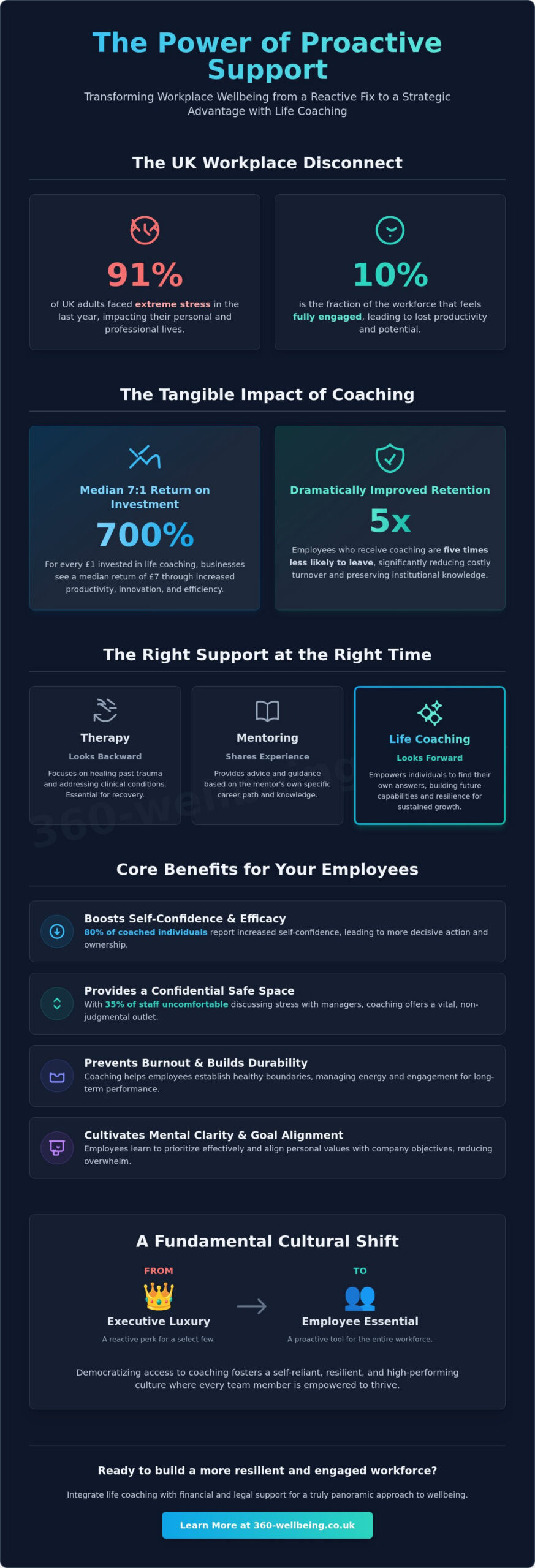
Did you know that while 91% of UK adults faced extreme stress last year, only 10% of our workforce feels fully engaged? You’ve likely seen the impact of this disconnect firsthand, whether it’s through rising absenteeism or the quiet burnout of your most talented team members. It’s frustrating when traditional support feels too reactive, leaving you searching for a more proactive way to foster resilience and durability within your organisation.
We understand that you want more than just a quick fix; you need a strategic partner in your team’s long-term success. This guide explores the tangible benefits of life coaching in the workplace, moving beyond executive luxury to show how it functions as a professional necessity. You’ll discover how coaching delivers a median 7:1 ROI, makes employees five times less likely to leave, and provides a clear framework for measuring holistic wellbeing. We’ll show you how to move away from reactive health warnings toward a positive, empowered vision of workplace harmony that actually lasts.
Key Takeaways
- Understand how future-focused coaching acts as a proactive shield, preventing minor personal hurdles from escalating into larger mental health crises.
- Discover the specific benefits of life coaching in the workplace, including how it builds employee self-efficacy and provides a secure space to navigate life’s complexities.
- Learn how to measure the tangible impact of coaching on your bottom line by reducing costly presenteeism and improving long-term staff retention.
- Gain a clear roadmap for introducing support safely, focusing on clinical-grade privacy and a culture that removes the stigma of seeking help.
- Explore how integrating coaching with financial and legal support creates a unified ecosystem of care that protects your team’s total wellness.
What is Life Coaching in a Workplace Context?
In 2026, the definition of support has evolved. We no longer view employee wellbeing as a reactive safety net to be deployed only when someone reaches a breaking point. Instead, life coaching in a workplace context is a collaborative, future-focused partnership. It aims for both personal and professional growth by providing individuals with the tools to navigate life’s complexities before they become overwhelming. By focusing on foresight and durability, one of the key benefits of life coaching in the workplace is its ability to prevent small hurdles from escalating into full-blown mental health crises. This proactive stance helps maintain a steady rhythm in the office, ensuring that personal challenges don’t derail professional progress.
While Business coaching often focuses on specific corporate KPIs, life coaching addresses the whole person. It covers essential areas like work-life balance, career transitions, and the development of personal confidence. This panoramic approach ensures that employees feel supported not just as workers, but as human beings entitled to vitality and balance. When an individual feels confident in their ability to manage their own life, that stability naturally translates into their work performance and overall contribution to the team.
Coaching vs. Mentoring vs. Therapy: Knowing the Difference
It’s vital to distinguish these roles to provide the right support at the right time. Therapy generally looks backward to heal past trauma or clinical conditions. It is a vital service for recovery. Coaching looks forward to build future capabilities and resilience. While a mentor provides advice based on their own specific experience, a coach empowers the individual to find their own unique answers through guided self-discovery. If an employee is experiencing acute clinical symptoms, they should be guided toward our Mental Health Support or a Virtual GP. However, for those looking to bridge the gap between their current state and their peak potential, coaching is the ideal path. It provides a structured space for growth that is distinct from clinical intervention.
The Shift from Executive Luxury to Employee Essential
The days when coaching was reserved for the C-suite or used as a last resort for underperformers are over. In the modern UK organisation, democratising access to these tools is a cornerstone of an inclusive culture. When support is available to all staff levels, it creates a powerful trickle-down effect. Team morale improves because communication becomes clearer and more intentional across the entire hierarchy. We see coaching as a professional necessity rather than a luxury. It fosters a self-reliant workforce that can manage stress with grace and clarity. By integrating these benefits of life coaching in the workplace, employers move away from a culture of crisis management toward one of proactive, sustainable performance. This shift ensures that every team member has the opportunity to thrive, regardless of their position in the company.
The Core Benefits of Life Coaching for Employees
When an employee feels truly empowered, the entire organisation feels the shift. One of the most significant benefits of life coaching in the workplace is the measurable surge in self-confidence and self-efficacy. Research from the Institute of Coaching indicates that 80% of people who receive coaching report a boost in their self-confidence. This isn’t just a feel-good metric; it’s the foundation of a proactive workforce that takes ownership of their roles without constant second-guessing. When individuals trust their own judgment, they move from a state of hesitation to one of decisive action, which directly impacts the speed and quality of your business operations.
Coaching offers a vital safe space that is often missing in traditional corporate hierarchies. With 35% of UK workers reporting they aren’t comfortable discussing extreme stress with their manager, a coach provides a neutral, non-judgmental environment. In this setting, individuals can untangle personal stressors and develop the personal accountability needed to make clearer decisions. This support is especially effective for preventing burnout. By helping staff establish healthy boundaries, coaching ensures they remain durable and engaged rather than reaching a point of exhaustion. Our Life Coaching services are designed to offer this very level of bespoke, human support, ensuring no one has to navigate these pressures alone.
Cultivating Mental Clarity and Goal Alignment
Mental clarity is the ability to prioritise tasks without emotional overwhelm. Through coaching, employees learn to align their personal values with company objectives, creating a sense of purpose that reduces workplace anxiety. Action-oriented goal setting replaces vague aspirations with concrete steps. This process makes the daily workload feel manageable rather than daunting, allowing staff to focus their energy on what truly matters for their growth and the company’s success.
Enhancing Work-Life Harmony and Resilience
We often talk about balance, but balance is a myth that suggests a static, perfect split. We prefer the term harmony, which describes a sustainable flow between professional duties and personal life. Life coaching builds the emotional durability required to handle organisational change or significant life milestones like parenthood or menopause. It ensures that when life happens, your team has the tools to stay grounded and resilient. This holistic approach helps employees navigate major transitions with confidence, maintaining their performance while protecting their personal health and vitality.
The Business Case: Measuring ROI and Organisational Impact
Investing in your team’s mental durability isn’t just an ethical choice; it’s a sound financial strategy. The median return on investment for companies that embrace coaching stands at 7:1. Research by MetrixGlobal Associates found that coaching delivered a 529% ROI, which surged to 788% when factoring in the long-term impact on employee retention. In an era where poor mental health costs UK employers an estimated £51 billion annually, these figures represent a significant shift from reactive spending to strategic foresight. By focusing on the benefits of life coaching in the workplace, you’re actively protecting your bottom line from the drain of high turnover and lost productivity.
One of the most hidden costs in modern business is presenteeism. This occurs when staff are physically at their desks but mentally disengaged, often due to personal stress or burnout. With only 10% of UK employees feeling fully engaged at work, the cost of lost productivity to the UK economy is staggering, reaching £257 billion a year. Coaching addresses this by helping individuals regain their focus and motivation. Beyond the immediate numbers, offering coaching as a standard perk significantly enhances your Employer Brand. It signals to top talent that you view their wellbeing as an essential human entitlement, making you a more attractive prospect in a competitive recruitment market.
Reducing Absenteeism and Burnout Risks
Early intervention is the key to preventing long-term sick leave. One in five workers took time off last year due to stress-related mental health issues. Coaching acts as a preventative measure, identifying burnout triggers before they lead to absenteeism. It also provides a structured path for those returning to work after an illness, ensuring they feel supported and resilient. This proactive care works in tandem with our Virtual GP and Mental Health Support services, creating a panoramic safety net that reduces the need for reactive medical intervention.
Strengthening the Internal Leadership Pipeline
Coaching is an invaluable tool for nurturing the next generation of leaders. It helps identify high-potential individuals and equips them with essential soft skills like empathy, active listening, and conflict resolution. When your managers adopt a coaching-style leadership approach, team engagement naturally rises. This creates a culture of mutual respect and clear communication, which is vital for handling organisational change. By investing in these benefits of life coaching in the workplace, you’re not just supporting individuals; you’re building a more durable and self-reliant leadership structure for the future.
Strategic Implementation: How to Introduce Coaching Successfully
Implementing a coaching program isn’t just about providing a link; it’s about shifting the internal narrative. To truly reap the benefits of life coaching in the workplace, you must first cultivate a culture of openness. If employees view support as a sign of weakness, they won’t engage. Managers play a pivotal role here. They should frame coaching as a positive development tool for high achievers and those seeking growth, rather than a remedial measure. When leadership openly supports personal evolution, the stigma of seeking help dissolves, paving the way for a more resilient team.
Security is another cornerstone of success. Employees need to know that their sessions are protected by clinical-grade privacy. Without the guarantee of absolute confidentiality, they won’t feel safe enough to explore the personal stressors that affect their professional performance. Providing a low-friction entry point, such as an app-based booking system, ensures that support is always within reach. This ease of access removes the administrative hurdles that often prevent staff from taking that first, vital step. You can view our full suite of support services to see how we simplify this process for your team.
Overcoming Common Barriers to Adoption
Time poverty is the most cited reason for avoiding workplace support. We address this by offering virtual, bite-sized coaching sessions that fit into a busy workday. It’s also essential to distinguish coaching from a “performance improvement plan.” Internal communications should consistently highlight coaching as a premium benefit designed for everyone. Clear, empathetic messaging helps drive platform engagement by showing staff that the organisation is invested in their long-term vitality.
Digital-First vs. Traditional Coaching Models
For many UK SMEs and sole traders, hiring an in-house coach is financially out of reach. Traditional models often lack the scalability needed for a growing business. A digital-first platform provides a diverse pool of coaches and 24/7 access, ensuring that support is available whenever it’s needed. Subscription-based models make the benefits of life coaching in the workplace affordable for smaller organisations, offering the same level of expert care previously reserved for global corporations. This democratised approach ensures that every business, regardless of size, can provide its team with the tools to thrive.
The Panoramic Approach: Why 360 Wellbeing is the Logical Conclusion
True wellness is never found in isolation. While we’ve explored the individual benefits of life coaching in the workplace, its full potential is only unlocked when it’s part of a unified ecosystem. 360 Wellbeing provides this panoramic viewpoint, weaving physical, mental, and social health into a single, cohesive narrative. This approach ensures that an employee’s personal growth is backed by a robust framework of clinical expertise and practical aid. By moving away from fragmented services, you provide your workforce with a sense of completeness and balance that standalone programs simply cannot match.
Coaching often uncovers stressors that require specialised intervention. For example, an employee seeking better focus might actually be distracted by hidden debt or legal worries. Within our platform, life coaching works in tandem with financial support and legal advice. This integration means that as soon as a challenge is identified, the specific path forward is already available. Our expert caregivers are UK-registered professionals, ensuring that every interaction is both scientifically grounded and deeply personal. It’s a steady, calm, and methodical way to manage the complexities of modern life.
A Holistic Ecosystem of Support
The panoramic viewpoint of 360 Wellbeing integrates diverse health disciplines into a single, unified narrative of total wellness. Our 24/7 Virtual GP and Mental Health Support services provide a vital safety net, ensuring that clinical needs are met alongside personal development. Meanwhile, 360 Rewards and our Employee Assistance Programme (EAP) help create a positive, all-encompassing culture. This synergy ensures that support isn’t just a one-off service but a durable part of your organisation’s DNA. One app and one subscription provide your entire team with the tools they need to stay resilient and engaged.
Making Wellbeing Accessible for SMEs and Sole Traders
We’ve intentionally removed the luxury price tag that once made such support inaccessible for smaller firms. Our per-employee subscription model allows UK SMEs and sole traders to maximise the benefits of life coaching in the workplace without overwhelming their budgets. You don’t need a massive HR department to provide world-class care. With dedicated account management and a clear, structured onboarding process, we make it easy to protect your team’s long-term interests. It’s time to treat wellbeing as a professional necessity and an essential human entitlement. Empower your team with 360 Wellbeing today and start building a more harmonious, productive future.
Building a Future-Ready Workforce through Holistic Care
The journey toward a truly resilient organisation begins with a shift in perspective. Moving beyond reactive support toward proactive, future-focused partnerships can transform team dynamics and individual confidence. By integrating these tools into a unified ecosystem, you’re not just offering a perk; you’re establishing a foundation for long-term durability. The benefits of life coaching in the workplace extend far beyond the individual, creating a ripple effect of clarity and purpose that strengthens your entire leadership pipeline.
Whether you’re a sole trader or a large organisation, this all-encompassing approach ensures that every team member is treated as a whole person. Our platform is trusted by SMEs and large organisations across the UK, providing access to UK-registered GPs and clinical experts alongside a comprehensive 360 Rewards marketplace. It’s about providing the right support at the right time, making total wellness an accessible reality for everyone.
Discover how our Life Coaching and Wellbeing Platform can transform your business. We’re here to help you build a culture where vitality and professional success go hand in hand.
Frequently Asked Questions
Is life coaching at work confidential for the employee?
Yes, every session is strictly confidential between the coach and the individual. While employers may receive high-level data regarding platform engagement or general trends, they’ll never have access to the specific details discussed. This clinical-grade privacy is essential for creating the safe space needed for employees to navigate personal stressors without fear of professional judgement.
How is life coaching different from an Employee Assistance Programme (EAP)?
Traditional EAPs are often reactive, focusing on medicalised support or crisis intervention after a problem has already occurred. Life coaching is a proactive, future-focused partnership that builds resilience and self-reliance before hurdles become crises. It’s designed to empower individuals to reach their peak potential, rather than just returning them to a baseline of health.
Can life coaching help with workplace stress and burnout?
Coaching is a powerful tool for identifying burnout triggers and establishing the healthy boundaries needed to stay durable. By fostering mental clarity, employees learn to prioritise tasks and manage their roles without becoming emotionally overwhelmed. This proactive approach is one of the primary benefits of life coaching in the workplace, ensuring your team remains engaged and productive.
Is workplace life coaching worth the investment for a small business?
For UK SMEs, coaching is a highly cost-effective way to provide holistic support without the need for large HR departments. Using a subscription-based model removes the luxury price tag, allowing smaller teams to access the same expert care as global corporations. It protects your bottom line by reducing the high costs associated with absenteeism and staff turnover.
How many coaching sessions do employees typically need?
Most employees find that an initial package lasting two to three months provides enough time to establishment meaningful goals and implement sustainable changes. This steady, methodical rhythm allows for deep self-reflection and the practical application of new strategies. It’s not an indefinite commitment but a structured path toward personal and professional evolution.
What is the difference between a life coach and a mental health therapist?
A therapist typically looks backward to heal past trauma or treat clinical mental health conditions. A life coach looks forward, focusing on personal growth, confidence, and professional development. If an employee requires clinical intervention, they should be guided toward our Mental Health Support or Virtual GP services instead of a coaching session.
Can life coaching improve employee retention in UK businesses?
Yes, employees who receive coaching are significantly more likely to stay with their organisation for the long term. Demonstrating a genuine investment in their personal success builds a deep sense of loyalty and engagement. It transforms the workplace from a simple job into a place where they feel supported as a whole person.
How do I introduce life coaching to my team without it sounding like a performance review?
Frame the service as a premium benefit and a professional necessity for everyone, rather than a remedial tool for underperformers. Emphasise that it’s a voluntary resource for personal evolution and vitality. When leadership presents coaching as an essential human entitlement, it removes the stigma and encourages a positive, proactive culture of wellbeing.