
Did you know that poor mental health is now costing UK employers an estimated £56 billion every year? In a landscape where 22.1 million working days were lost to anxiety and depression in the last year alone, understanding the true cost of workplace stress uk businesses face is no longer just an HR concern; it’s a fundamental financial priority. This massive figure represents a hidden tax on your growth, impacting everything from your bottom line to your company culture.
You likely see the signs in your own office: the empty desks from rising absenteeism, the quiet struggle of presenteeism, and the constant pressure of replacing talented team members in a competitive market. It’s often difficult to quantify the ROI of “soft” benefits when your primary focus is keeping the business moving forward. We understand that you want to support your people, but you also need a clear, professional justification for your wellbeing spend to ensure your business remains durable.
This guide will help you uncover the hidden financial leaks in your organization and show you how a holistic wellbeing strategy can turn these liabilities into a powerful competitive advantage. We’ll explore the latest 2026 data on turnover and productivity, providing you with a clear, steady roadmap to foster a resilient, engaged workforce that feels truly supported.
Key Takeaways
- Understand why the true cost of workplace stress uk has evolved into a major financial liability, surpassing previous benchmarks to impact your bottom line directly.
- Distinguish between the visible impact of sick days and the silent productivity drain of presenteeism to uncover the full scope of your hidden business costs.
- Learn how addressing the root causes of anxiety, including financial and legal pressures, can stop external stress from disrupting your team’s focus and harmony.
- Discover a practical framework for calculating your “Stress Tax” to justify wellbeing spend as a strategic investment rather than a luxury expense.
- Gain insights into building a more resilient workforce by providing accessible, 24/7 care that supports the whole person and improves long-term staff retention.
The Financial Reality of Workplace Stress in the UK (2026)
Viewing employee wellbeing as a “soft” perk is a perspective that modern leaders can no longer afford. In the current fiscal year, we’ve seen workplace stress evolve from a personal challenge into a quantifiable business liability that directly impacts the durability of UK companies. To understand the cost of workplace stress uk employers are absorbing, we must look beyond the individual experience and see it as an operational friction that erodes profit margins silently. Fundamentally, what is workplace stress in a corporate context? It’s a systemic drain on resources that manifests in three distinct ways: absenteeism, high staff turnover, and the pervasive issue of presenteeism.
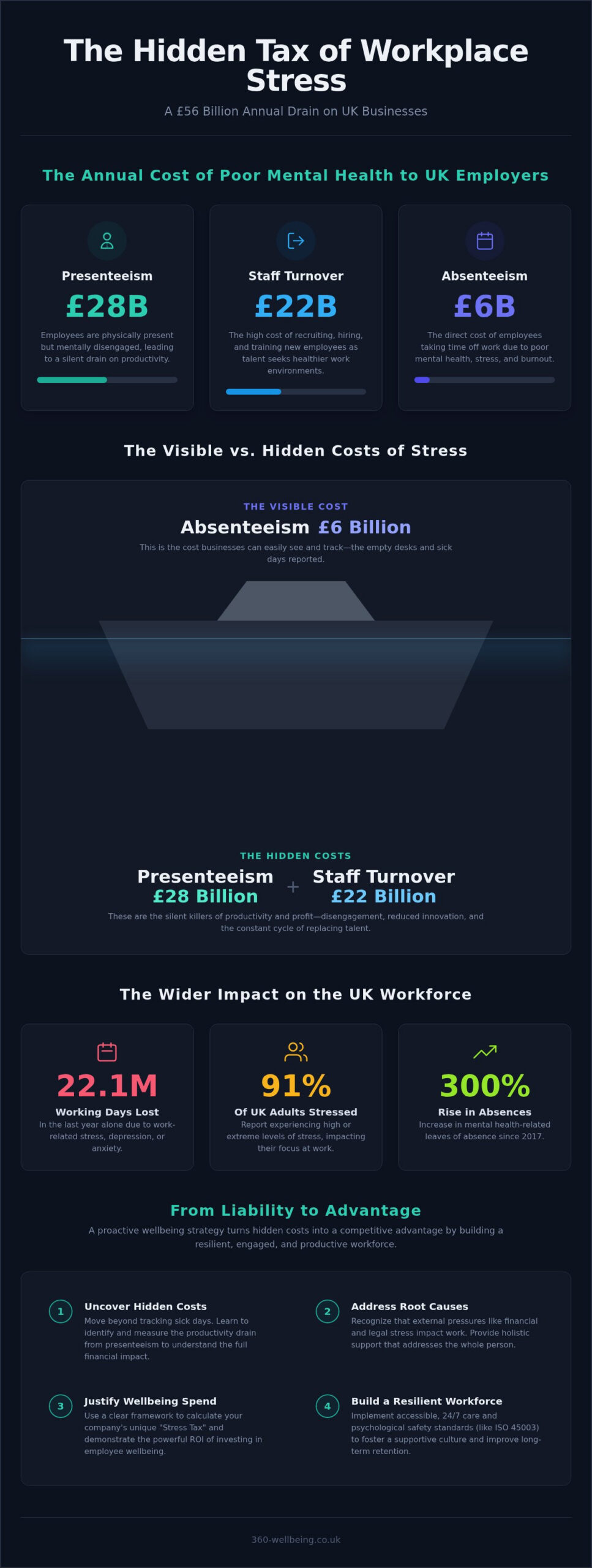
Recent 2026 data reveals the scale of this “Hidden Tax”. While older benchmarks suggested a £51 billion impact, the latest figures from June 2026 indicate that the annual cost of poor workplace mental health has climbed to approximately £56 billion. This includes £6 billion lost to absenteeism and a staggering £22 billion attributed to staff turnover as employees seek healthier environments. The most significant portion, however, comes from presenteeism, where employees are physically at their desks but mentally disengaged, costing businesses £28 billion annually. These figures represent a leak in your company’s financial health that requires a methodical and compassionate response.
The Macro-Economic Impact on UK Businesses
The UK currently faces intensified economic pressures that have sharpened workplace anxiety. With 91% of adults reporting high or extreme stress levels this year, the macro-economic impact is undeniable. We’re seeing a shift where 2026 economic volatility has made employees feel more vulnerable, leading to a 300% rise in mental health-related leaves of absence compared to 2017. Industries like healthcare, finance, and education are reporting the sharpest cost increases, as the cost of workplace stress uk businesses face in these sectors often includes the high price of replacing specialized talent.
Regulatory and Legal Pressures for Employers
Beyond the immediate financial loss, there’s a growing weight of regulatory responsibility. Employers have a clear duty of care under UK health and safety legislation to protect staff from psychological harm. Failing to manage these risks doesn’t just damage morale; it opens the door to costly litigation and employment tribunals. Forward-thinking organizations are now adopting ISO 45003 as a gold standard for psychological safety. This framework provides a structured path for managing psychosocial risks, helping you move from reactive crisis management toward a proactive vision of workplace harmony and legal security.
Unmasking the Hidden Costs: Absenteeism vs. Presenteeism
To truly understand the cost of workplace stress uk businesses are facing, we have to look past the obvious. Absenteeism is the visible tip of the iceberg; it’s easy to track when a desk is empty. However, the invisible costs of presenteeism and “quiet quitting” are far more damaging to your long-term stability. When an employee is struggling, they might still show up, but their capacity to focus, innovate, and connect with colleagues is severely diminished. This creates a silent drain on your resources that often goes unnoticed until it impacts your quarterly results.
According to official workplace stress statistics, 16.4 million working days were lost due to stress, depression, or anxiety in the 2023/24 period alone. While that figure is significant, it only accounts for the days people didn’t show up. It doesn’t capture the millions of hours lost to “brain fog” or the errors made when staff are pushing through burnout. This unmanaged pressure often leads to a cycle of disengagement, where employees do the bare minimum to get by, effectively checking out mentally long before they hand in their notice.
The Presenteeism Productivity Gap
Presenteeism is the silent killer of UK productivity because it’s so difficult to measure. While absenteeism costs UK employers roughly £6 billion annually, presenteeism costs a staggering £28 billion. Stress-induced brain fog isn’t just a minor inconvenience; it leads to missed deadlines and costly administrative errors that can take weeks to rectify. Presenteeism, defined as the loss of productivity when employees work while physically present but mentally unwell, now costs UK businesses £28 billion annually, nearly five times more than the cost of total absence.
The Revolving Door: Turnover and Recruitment Costs
When stress becomes part of the furniture, your best talent will inevitably look elsewhere. In 2026, the cost of replacing an employee can be as high as 30% of their annual salary when you factor in recruitment fees, onboarding time, and the loss of institutional knowledge. A reputation for high stress damages your employer brand, making it harder to attract high-calibre candidates in a tightening market. Investing in a holistic support platform isn’t just about being a kind employer; it’s a strategic move to close the revolving door and protect your most valuable assets. By addressing the cost of workplace stress uk through meaningful benefits, you foster the kind of loyalty that ensures your business remains resilient and competitive.
The Holistic Ripple Effect: Financial and Legal Stress at Work
We often imagine workplace stress as something that begins at 9 AM and ends at 5 PM. The reality is far more complex. Stress doesn’t stop at the office door; it’s frequently imported from an employee’s personal life. In 2026, the ongoing impact of the UK cost-of-living crisis has created a heavy cognitive load for much of the workforce. When a team member is preoccupied with rising household costs or debt, their ability to focus on complex tasks diminishes. This mental preoccupation contributes significantly to the overall cost of workplace stress uk businesses must manage. By viewing financial and legal support as a “pre-mental health” intervention, you can help your people resolve issues before they escalate into clinical anxiety or burnout.
It’s helpful to think of your team’s mental capacity as a finite resource. Every minute spent worrying about a personal legal dispute or a mounting bill is a minute stolen from their professional potential. This isn’t a sign of weakness; it’s a natural human response to pressure. As an expert caregiver for your organization, your role is to provide the tools that alleviate these external burdens. Addressing these “non-work” factors is a professional necessity that protects your company’s durability and ensures a more harmonious environment for everyone.
Debt and Financial Anxiety as Productivity Killers
Personal finances are a major source of distraction in the modern workplace. Research suggests that employees can spend several hours every week worrying about money while at their desks, leading to a significant drop in output. This isn’t just a loss of time; it’s a loss of mental energy that can lead to clinical depression. When you provide Financial Support for Employees, you aren’t just offering a perk. You’re actively reducing the triggers of workplace anxiety. Providing debt advice and financial planning helps clear the “brain fog” that often accompanies financial strain, allowing your team to return to their roles with a sense of security.
Legal Stress and the Need for Reassurance
Legal complications are another frequent, yet overlooked, source of imported stress. Whether it’s a complex housing dispute, a family law matter, or the weight of dealing with probate, these issues demand significant emotional resources. Unresolved legal worries often result in sudden, emergency leaves of absence as employees struggle to navigate systems they don’t understand. Following CIPD guidance on workplace stress suggests that proactive support is key to maintaining a stable environment. Offering access to legal experts and services like complimentary will writing provides immediate peace of mind. This reassurance acts as a protective buffer, ensuring that the cost of workplace stress uk remains manageable by preventing personal crises from becoming professional disruptions.
Strategic Prevention: Calculating the ROI of Wellbeing
Measuring the value of a crisis that never happens is the ultimate challenge for modern leadership. To move from reactive spending to strategic investment, you must first calculate your organization’s specific “Stress Tax”. This isn’t just a line item on a spreadsheet; it’s the cumulative financial weight of every missed deadline, every recruitment fee, and every day lost to burnout. By quantifying the cost of workplace stress uk leaders are currently paying, you can build a robust justification for a proactive care model that protects your bottom line.
The math is often surprising. Consider the predictable cost of a monthly subscription to a holistic wellbeing platform. When you contrast this against the £22 billion UK employers lose annually to staff turnover, the choice becomes clear. Replacing a single mid-level professional can cost up to 30% of their annual salary. One avoided departure or one prevented employment tribunal pays for years of comprehensive support for your entire team. It’s about shifting your mindset toward a “Prevention over Cure” philosophy that prioritizes durability over crisis management.
Benchmarking Your Company’s Wellbeing Health
To start your journey, you need a baseline. We recommend tracking three key metrics to identify your internal stress hotspots:
- Absence Rates: Look beyond the total number of days to identify patterns in short-term vs. long-term leaves.
- EAP Engagement: High usage can indicate a workforce that trusts your support, while very low usage might suggest a lack of awareness or psychological safety.
- Turnover Data: Conduct exit interviews that specifically address workplace pressure and support levels.
The Multiplier Effect of Holistic Care
A fragmented approach to health often yields fragmented results. The highest ROI comes from integrating physical, mental, and financial support into a single, seamless narrative. For instance, providing 24/7 Virtual GP access allows staff to seek clinical reassurance instantly, often preventing a minor physical ailment from escalating into a stress-inducing long-term absence. By addressing health concerns at the earliest possible stage through proactive care, organizations can often negotiate more favorable terms on long-term private medical insurance premiums. This panoramic view of health ensures that your people feel truly seen and supported, fostering the vitality required for a high-performing workplace.
Building a Resilient Workforce with 360 Wellbeing
The challenge for UK employers in 2026 isn’t just identifying the financial drain of employee burnout, but implementing a solution that scales with their business. 360 Wellbeing provides an all-encompassing platform designed to address the modern complexities of the cost of workplace stress uk firms face daily. By moving away from fragmented services and toward a unified narrative of care, we help you create a workplace where health is a professional necessity rather than a luxury. Our approach integrates physical, mental, and social health into a single, accessible experience that supports the whole person.
At the heart of this resilience strategy is our 24/7 Virtual GP service. This cornerstone feature acts as an immediate safety net, allowing your team to consult with UK-registered doctors at any time of the day or night. When an employee can receive clinical reassurance or a prescription within hours rather than weeks, the ripple effect on your business is profound. It significantly reduces medical-related absenteeism and prevents minor health anxieties from escalating into long-term mental health challenges. This proactive care model ensures your workforce remains durable and focused on the path forward.
True wellbeing requires looking at the panoramic view of an individual’s life. This is why our platform uniquely includes financial support, debt advice, and legal assistance alongside traditional health services. We recognize that external pressures, such as the current cost-of-living crisis, are primary drivers of workplace anxiety. To further support your team’s financial health, the 360 Rewards marketplace provides tangible everyday savings. These rewards help offset rising living costs, providing a practical boost to employee morale and further insulating your business from the cost of workplace stress uk economic conditions often impose.
The Power of 24/7 Support in Your Pocket
Modern work requires modern solutions. Digital-first access removes the traditional barriers to seeking help, such as long waiting times or the stigma of requesting time off for appointments. Whether a team member needs life coaching to navigate a professional transition or mental health therapy to manage burnout, support is always just a few taps away. This level of accessibility is particularly vital for SMEs and sole traders, where the impact of a single person’s absence is felt most acutely. Our platform ensures that even the smallest teams have access to the same high-calibre care as major corporations.
A Partnership for Long-Term Growth
We don’t just provide a platform; we act as a strategic partner invested in your long-term success. Onboarding is designed to be methodical and stress-free, ensuring your team can start benefiting from our services immediately without administrative burden. With a predictable, low per-employee monthly cost, our SaaS model offers a clear and manageable alternative to the unpredictable expenses of high staff turnover and lost productivity. Taking this structured path forward creates a sense of safety and order within your organization, allowing you to focus on growth while we look after your people. Protect your business and your people with 360 Wellbeing and transform your approach to corporate health today.
Turning Hidden Costs into Human Potential
We’ve explored how the £56 billion annual loss to UK businesses isn’t just about empty desks. It’s about the silent drain of presenteeism and the external pressures of debt and legal worries that cross the threshold of your office every morning. By shifting from a reactive stance to a proactive model of care, you can effectively mitigate the cost of workplace stress uk and build a more durable organization. Understanding that wellbeing is a professional necessity rather than a luxury allows you to close the financial leaks that threaten your growth.
A resilient workforce requires a panoramic support system. Whether it’s the instant reassurance of a 24/7 UK-registered Virtual GP or the peace of mind provided by professional financial and legal support, providing these essentials is a fundamental human entitlement. These tools empower your team to resolve personal challenges before they impact professional performance, fostering a culture of trust and vitality.
Invest in your team’s future with 360 Wellbeing. Our platform is specifically tailored for UK SMEs, ensuring your people have the tools they need to flourish while you protect your bottom line. We’re here to be your partner in this journey, helping you foster a workplace harmony that lasts for the long term. You have the power to transform your corporate strategy into a vision of health and success.
Frequently Asked Questions
What is the current cost of workplace stress to the UK economy?
As of June 2026, the total annual cost of poor workplace mental health to UK employers is approximately £56 billion. This figure includes £6 billion lost to absenteeism and £22 billion due to staff turnover. The largest portion, however, comes from presenteeism, which now accounts for £28 billion in lost productivity across the country. These numbers highlight why managing the cost of workplace stress uk businesses face is a fundamental financial priority for modern leadership.
How much does presenteeism cost compared to absenteeism?
Presenteeism is nearly five times more expensive than absenteeism for UK organizations. While sick days cost employers roughly £6 billion each year, the hidden drain of employees working while unwell costs £28 billion. This means that for every pound lost when a desk is empty, almost five pounds are lost when staff are present but mentally disengaged. Addressing this invisible productivity gap is essential for maintaining a durable and profitable business.
Is workplace stress considered a legal liability for UK employers?
Yes, employers have a clear statutory duty of care under UK health and safety legislation to protect their team from psychological harm. If an organization fails to manage known psychosocial risks, it may face costly employment tribunals or litigation. Adopting structured frameworks like ISO 45003 is becoming a professional necessity to ensure legal compliance and foster a culture of psychological safety that protects both the individual and the business.
What are the most effective ways to reduce workplace stress costs?
The most effective strategy is shifting from a reactive “crisis” model to a proactive prevention approach. By providing a holistic platform that combines clinical care, such as a 24/7 Virtual GP, with mental health support, you catch issues before they escalate. Reducing the cost of workplace stress uk employers pay requires addressing the whole person, ensuring they have the tools to manage pressure before it leads to burnout or resignation.
How does financial stress affect employee productivity?
Financial anxiety creates a significant cognitive load that directly competes with an employee’s ability to focus on professional tasks. When staff are preoccupied with debt or rising household costs, they often experience “brain fog” and a higher rate of errors. Providing integrated financial support and debt advice helps clear this mental preoccupation. This reassurance allows your team to return their full attention to their roles, protecting your company’s overall output.
Can an Employee Assistance Programme (EAP) actually save my business money?
An EAP is a strategic investment that saves money by reducing the frequency of expensive, long-term leaves of absence. By offering early interventions like life coaching and therapy, you help employees navigate challenges before they become debilitating. This proactive support lowers your staff turnover rates and minimizes the heavy costs associated with recruitment and onboarding in a competitive talent market.
What is the ROI of investing in employee wellbeing platforms?
Studies consistently show that for every £1 invested in workplace mental health support, employers see an average return of £5. This high ROI is achieved through improved retention, reduced absenteeism, and a noticeable boost in daily productivity. For SMEs, this predictable monthly investment is far more manageable than the unpredictable, high costs of replacing a single talented team member who has suffered from burnout.
How does a Virtual GP service help reduce business costs?
A 24/7 Virtual GP service reduces absenteeism by removing the barriers to traditional healthcare, such as long waiting times for local appointments. When employees can consult with a UK-registered doctor from their phone at any time, they receive instant reassurance and prescriptions. This speed of care prevents minor physical or mental health concerns from spiraling into major disruptions, keeping your workforce healthy and consistently present.