
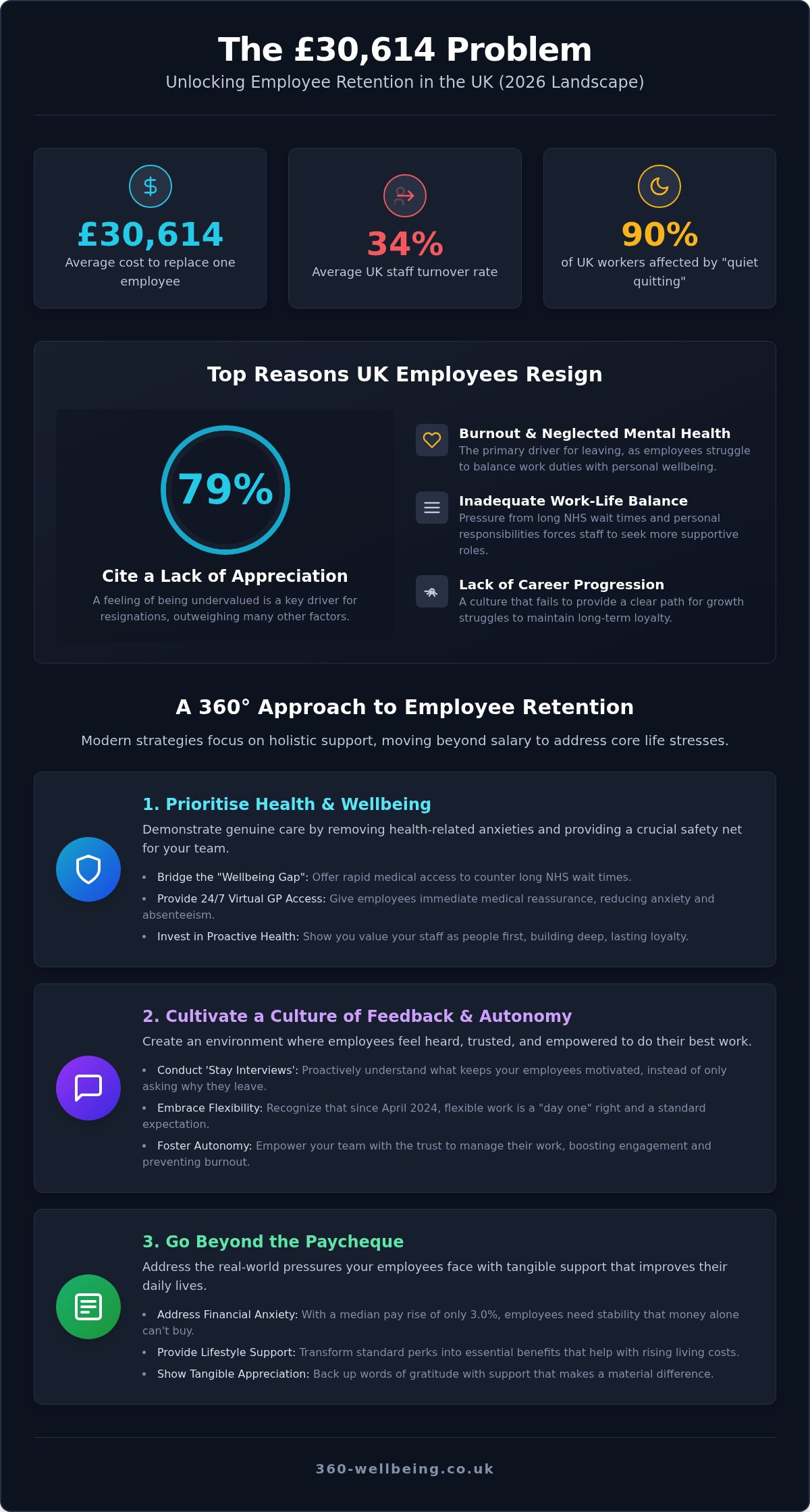
Did you know that replacing a single team member in 2026 costs your business an average of £30,614? With the UK average staff turnover rate sitting at 34%, it’s clear that traditional loyalty is being tested by rising living costs and a healthcare system under pressure. Finding effective employee retention strategies uk leaders can rely on is no longer just about competitive salaries. It’s about demonstrating a genuine commitment to the holistic health and daily stability of your people.
We understand the frustration of losing talented individuals to burnout or seeing productivity dip because of long medical wait times. It’s exhausting to manage a team when “quiet quitting” means employees are physically present but mentally distant. This article provides a clear, structured path to help you master 15 evidence-based strategies that reduce turnover and boost morale. You’ll learn how to remove the life-stresses that force staff to look elsewhere, ensuring your firm earns a reputation as a top UK employer where people feel truly supported and empowered to do their best work.
Key Takeaways
- Discover how rapid medical access can bridge the ‘wellbeing gap’ created by current NHS wait times, helping to keep your team healthy and present.
- Master the latest employee retention strategies uk leaders are adopting to alleviate financial anxiety and transform standard perks into essential lifestyle support.
- Learn why replacing exit interviews with regular ‘stay interviews’ creates a culture of autonomy and feedback that prevents burnout before it begins.
- Gain a clear, structured framework for calculating the ROI of your retention strategy, specifically tailored for the needs of UK SMEs in 2026.
The UK Employee Retention Landscape in 2026: Why Staff Leave
Employee retention in 2026 isn’t just a HR metric; it’s a vital sign of organizational health. In the context of the current UK economy, it represents the strategic effort to keep skilled people within your business while protecting their mental and physical vitality. We’ve moved past the era where a competitive salary was the only hook. Today, we’re navigating a “Great Realignment” where employees prioritize their health, their time, and their peace of mind over a slightly higher paycheque. While the median pay increase for 2026 sits around 3.0%, the cumulative pressure of living costs means workers are looking for stability that money alone can’t buy.
The cost of failing to keep your team is staggering. Research from Oxford Economics suggests the average cost of replacing an employee has reached £30,614. This includes recruitment fees and training time, but it also accounts for the invisible drain on your productivity. When a seasoned team member leaves, they take years of institutional knowledge with them. This often leaves the remaining staff stretched thin, which triggers a cycle of burnout and further resignations. Identifying red flags early, like rising absenteeism or the “quiet quitting” trend currently affecting 90% of UK workers, is essential for any successful employee retention strategies uk firms implement to stay resilient.
Current UK Turnover Statistics and Trends
The UK is currently facing an average staff turnover rate of 34%, according to 2026 CIPD data. To measure your own success, use the standard UK retention rate formula: divide the number of employees who stayed for the entire year by the number of employees you had on day one, then multiply by 100. Beyond the numbers, the landscape is being reshaped by the 4-day work week and remote-first models. Since flexible working became a “day one” right in April 2024, staff now view autonomy as a standard expectation rather than a luxury perk. Businesses that resist this shift often find themselves struggling to maintain a stable workforce.
The Top Reasons UK Employees Resign
Burnout and neglected mental health remain the primary drivers for resignations today. Many employees feel forced to leave because they can’t balance their professional duties with personal health needs, especially as NHS wait times continue to impact daily availability. While some people still hop between jobs for immediate benefits, a staggering 79% of those who quit cite a lack of appreciation as a key factor. A workplace culture that lacks empathy or fails to provide clear career progression will always struggle with loyalty. It’s the human connection and the feeling of being valued that truly anchors a person to their role.
Prioritising Health: Why Rapid Medical Access is the Ultimate Retention Tool
When a team member feels physically unwell or mentally drained, their focus naturally shifts away from their professional goals toward their personal survival. This is a fundamental human response. In 2026, the link between physical health and long term commitment is stronger than ever. If an employee feels their workplace actively protects their vitality, they develop a deep sense of loyalty that a higher salary elsewhere cannot easily break. By integrating rapid health access into your effective employee retention strategies, you demonstrate that you view your staff as people first and workers second.
The current pressures on public health services have created a “wellbeing gap” within UK businesses. When staff face weeks of waiting for a simple GP appointment, their anxiety levels rise and their productivity falls. Providing immediate medical reassurance closes this gap. It offers the psychological safety of knowing that help is always available, which significantly reduces health related absenteeism. Proactive health management ensures that minor issues are addressed before they escalate into long term sickness, keeping your workforce resilient and engaged. Providing your team with rapid medical access through a platform like 360 Wellbeing is a tangible way to show you are looking out for their long term interests.
The Rise of the 24/7 Virtual GP
We’ve found that 24/7 access to UK registered doctors provides a profound sense of relief for working parents and carers. Instead of juggling childcare or eldercare to attend a mid-day appointment, they can consult a professional from home at a time that suits them. This “doctor at hand” service is equally vital for remote and hybrid teams who may feel isolated from traditional support structures. Digital prescriptions and rapid referrals mean that treatment begins almost immediately, ensuring that staff stay healthy and remain in work rather than languishing on waiting lists. This level of care is a cornerstone of modern employee retention strategies uk firms use to build trust.
Mental Health Support and EAPs
True support goes beyond having a few Mental Health First Aiders in the office. To prevent mid career burnout and address deep seated stress, employees need direct access to professional therapy and Life Coaching. Integrating an Employee Assistance Programme (EAP) into daily workflows makes these sensitive services feel accessible and manageable. When mental health support is framed as a professional necessity rather than a luxury, it removes the stigma and encourages staff to seek help early. This holistic approach ensures that mental, social, and physical health are treated as a single, unified narrative of total wellness.
Beyond the Paycheque: Financial Wellness and Lifestyle Rewards
Financial anxiety is a silent thief. It steals focus, sleep, and eventually, your best people. Even as wage growth attempts to keep pace with the 2.6% inflation rate recorded in June 2026, the cumulative pressure of price increases since 2021 remains a heavy burden for many. When employees feel financially strained, they’re far more likely to jump ship for a marginal pay rise elsewhere. This is why the most effective employee retention strategies uk businesses are deploying today focus on removing the life-stresses that make a salary feel inadequate.
We’ve seen a definitive shift from superficial office perks toward essential lifestyle support. In 2026, a ping-pong table doesn’t build loyalty; helping a staff member manage their debt or secure their family’s future does. By offering “peace of mind” benefits like legal support and debt advice, you’re providing a safety net that protects your team from the overwhelming noise of modern life. It’s about looking at the panoramic view of an employee’s wellbeing, recognizing that their social and financial health are inextricably linked to their professional performance.
Holistic Financial Support Strategies
Providing anonymous debt helplines and financial planning tools allows employees to address sensitive issues without fear of judgment. These resources are professional necessities that empower individuals to regain control of their lives. We also see immense retention value in “life-stage” benefits, such as complimentary will writing. It’s a deeply personal gesture that shows you care about their long-term interests and the security of their loved ones. For a deeper dive into these methods, explore our Financial Support for Employees: A Comprehensive Guide for UK Employers in 2026.
360 Rewards: Making Salaries Go Further
A rewards marketplace provides daily, tangible value that helps offset inflationary pressures. Whether it’s a discount on the weekly shop or a reduced price for a family day out, these small wins add up to significant monthly savings. The key is customization; a diverse workforce has diverse needs, and a flexible rewards system ensures every individual finds something that resonates with their lifestyle. Beyond the savings, these platforms foster a “thank you” culture. Using 360 Rewards for instant peer-to-peer recognition turns a simple benefit into a powerful tool for workplace harmony and social connection.
Cultivating a Culture of Autonomy, Recognition, and Feedback
Why wait until an exit interview to discover why your best talent is leaving? By then, the institutional knowledge is already walking out the door. One of the most proactive employee retention strategies uk businesses can adopt is the “Stay Interview.” These conversations allow you to understand what keeps your people engaged and what minor frustrations might eventually lead to a resignation. It’s about foresight and durability. By asking, “What can we do to make your work life better today?” you build a partnership based on mutual respect and long term success.
Trust and autonomy are the most cost effective retention tools at your disposal. When you empower employees to manage their own schedules and workflows, you reduce the micro-stressors that contribute to burnout. This sense of agency is a professional necessity. It transforms the workplace from a site of obligation into a community of shared purpose. However, this culture only thrives when leaders are trained to bridge the “Manager Gap.” We need to move away from cold, traditional oversight and toward a model where managers act as empathetic caregivers who are deeply invested in their team’s holistic health.
Implementing Effective Feedback Loops
Surveys are only valuable if they drive meaningful change. If your staff feels their input disappears into a data vacuum, they’ll stop providing it. Transparent communication from senior leadership is essential here. When you collect feedback, you must close the loop by showing exactly how that input resulted in action. Whether it’s adjusting a policy or introducing a new wellness tool, telling the story of “You said, we did” creates a sense of safety and order. It proves that employee wellbeing is an essential human entitlement within your firm.
Recognition and Career Pathing
A staggering 79% of employees who quit their jobs cite a lack of appreciation as a key factor, according to research from OC Tanner. Consistent, genuine “thank you” gestures are not just nice to have; they are scientifically grounded methods for boosting morale and social health. This recognition must be paired with clear internal progression maps. Every individual should see a clear, structured path forward for their career within your organization. Fostering diversity and inclusion ensures that this path is accessible to everyone, creating a resilient and unified narrative of total wellness. Learn how our Mental Health Support tools can empower your leaders to become expert caregivers who truly value their teams.
Implementing a 360-Degree Retention Strategy for UK SMEs
SMEs often feel they can’t compete with the sprawling benefit packages of multinational corporations. However, in 2026, loyalty isn’t built through volume; it’s built through relevance. A scalable, SaaS-based approach allows smaller firms to provide high-impact benefits like 24/7 Virtual GP access and mental health support without the administrative burden of traditional insurance. This creates a level playing field where your firm can offer a panoramic view of care that feels both scientifically grounded and deeply personal. It’s about choosing tools that mirror the brand’s core philosophy of all-encompassing care while remaining affordable for sole traders and growing businesses alike.
Calculating the ROI of your employee retention strategies uk is essential for long-term sustainability. If the average cost of replacing a staff member in 2026 is £30,614, then reducing your 34% turnover rate by even a small margin pays for a wellbeing platform many times over. We view this investment not as a luxury expense, but as a professional necessity that protects your most valuable asset: your people. By unifying physical, mental, and financial health into a single narrative of total wellness, you create a resilient workforce that feels supported through every life stage, from buying a first home to managing mid-career stress.
Step-by-Step Implementation Guide
- Audit: Begin by identifying your current turnover “leaks.” Are people leaving because of health-related absences or silent financial stress? Use the stay interviews mentioned earlier to uncover these specific pain points.
- Deploy: Launch a unified wellbeing platform like 360 Wellbeing. Consolidating your EAP, rewards, and medical access into one place makes the transition manageable for your team and simplifies your internal operations.
- Communicate: A benefit is only valuable if it’s used. Ensure your staff knows they have 24/7 access to a UK-registered Virtual GP, especially during times when NHS wait times are impacting their daily availability.
- Measure: Track your engagement levels and absenteeism rates over a 12-month period. This steady, methodical approach allows you to see the real-world impact on your bottom line and adjust your strategy as your team grows.
The Future of Retention: Proactive Care
The UK job market is shifting toward predictive HR. Instead of waiting for a resignation letter, forward-thinking businesses use wellbeing data to spot signs of burnout early. This shift from reactive insurance to proactive daily support is the hallmark of an expert caregiver. It’s about looking out for the long-term interests of your employees before a crisis occurs. By providing tools like Life Coaching and debt advice, you create an environment where health is an essential human entitlement. Discover how 360 Wellbeing can transform your retention strategy and help you build a workplace where everyone feels empowered to thrive.
Building a Resilient Workforce for the Years Ahead
The UK job market in 2026 requires a fundamental shift in perspective. To keep your best talent, you must move beyond the paycheque and address the human needs that drive daily engagement. By providing rapid medical access through 24/7 UK registered GPs and offering holistic mental, physical, and financial support, you bridge the wellbeing gap that often leads to burnout. These employee retention strategies uk businesses are now adopting create a sense of safety and order. They prove that you’re a partner in your employees’ long term success, not just an employer.
Trusted by UK SMEs and sole traders, our platform unifies essential services like debt advice, legal support, and lifestyle rewards into a single, manageable journey. This panoramic approach to care ensures your team feels valued and protected, reducing the high costs of turnover while boosting morale. It’s time to transform your workplace into a sanctuary of vitality and professional harmony. Book a demo of the 360 Wellbeing platform to boost your retention and start building a more durable, empowered team today. You have the tools to create a culture where every individual can truly thrive.
Frequently Asked Questions
How do I calculate employee retention rate for my UK business?
To calculate your retention rate, divide the number of employees who stayed for a full period by the total number of staff you had at the start, then multiply by 100. It’s a simple, methodical way to track the durability of your team over a year or quarter. Using this formula consistently helps you identify patterns and evaluate the success of the employee retention strategies uk firms use to maintain stability.
What is a good employee retention rate in the UK for 2026?
A retention rate of 85% or higher is generally considered excellent, given that the average UK turnover rate is currently 34%. While sector-specific benchmarks vary, aiming for this level suggests your workplace culture and benefits are meeting the holistic needs of your people. Maintaining high retention protects your institutional knowledge and prevents the staggering costs associated with constant recruitment.
Can small businesses afford comprehensive employee benefits packages?
Yes, smaller firms can easily provide high-quality support through scalable, SaaS-based platforms. These models allow you to offer essential services like 24/7 Virtual GP access and mental health support for a manageable per-employee fee. It ensures that comprehensive care is an essential human entitlement within your business, regardless of your company’s size or budget.
What are the four pillars of employee retention?
The four pillars are compensation, workplace culture, career development, and holistic wellbeing. Addressing these areas provides a panoramic view of the employee experience, ensuring that people feel fairly paid, valued, and supported in their growth. When these pillars are balanced, you create a sense of safety and order that encourages long term commitment from your team.
How does a Virtual GP service help with staff retention?
A Virtual GP service helps by providing 24/7 access to UK registered doctors, which significantly reduces health related anxiety and absenteeism. It bridges the “wellbeing gap” caused by long NHS wait times, allowing staff to manage their health without the stress of missing work. This proactive care shows you’re an expert caregiver who is genuinely invested in their vitality and daily peace of mind.
What is the difference between employee engagement and employee retention?
Employee engagement measures the emotional commitment and motivation a person feels toward their work, while retention is the metric of whether they actually stay with the firm. You can have high retention due to a lack of outside opportunities, but without high engagement, you may face “quiet quitting.” Effective employee retention strategies uk leaders implement focus on boosting both to ensure a productive, loyal workforce.
How can I improve retention without offering a massive pay rise?
You can improve loyalty by removing the life-stresses that make a salary feel inadequate, such as financial anxiety or health concerns. Providing debt advice, legal support, and discount marketplaces helps employees’ money go further while demonstrating empathy. Focusing on autonomy and flexible working also builds deep trust, which is often more valuable to modern workers than a marginal increase in pay.
What are ‘Stay Interviews’ and how do they work?
Stay interviews are proactive, one-on-one conversations designed to learn what keeps an employee at your company and what might make them leave. Unlike exit interviews, these chats happen while the person is still happy in their role, giving you the foresight to fix minor issues early. They work by establishing a partnership between the leader and the user, fostering a culture of transparent feedback and mutual respect.