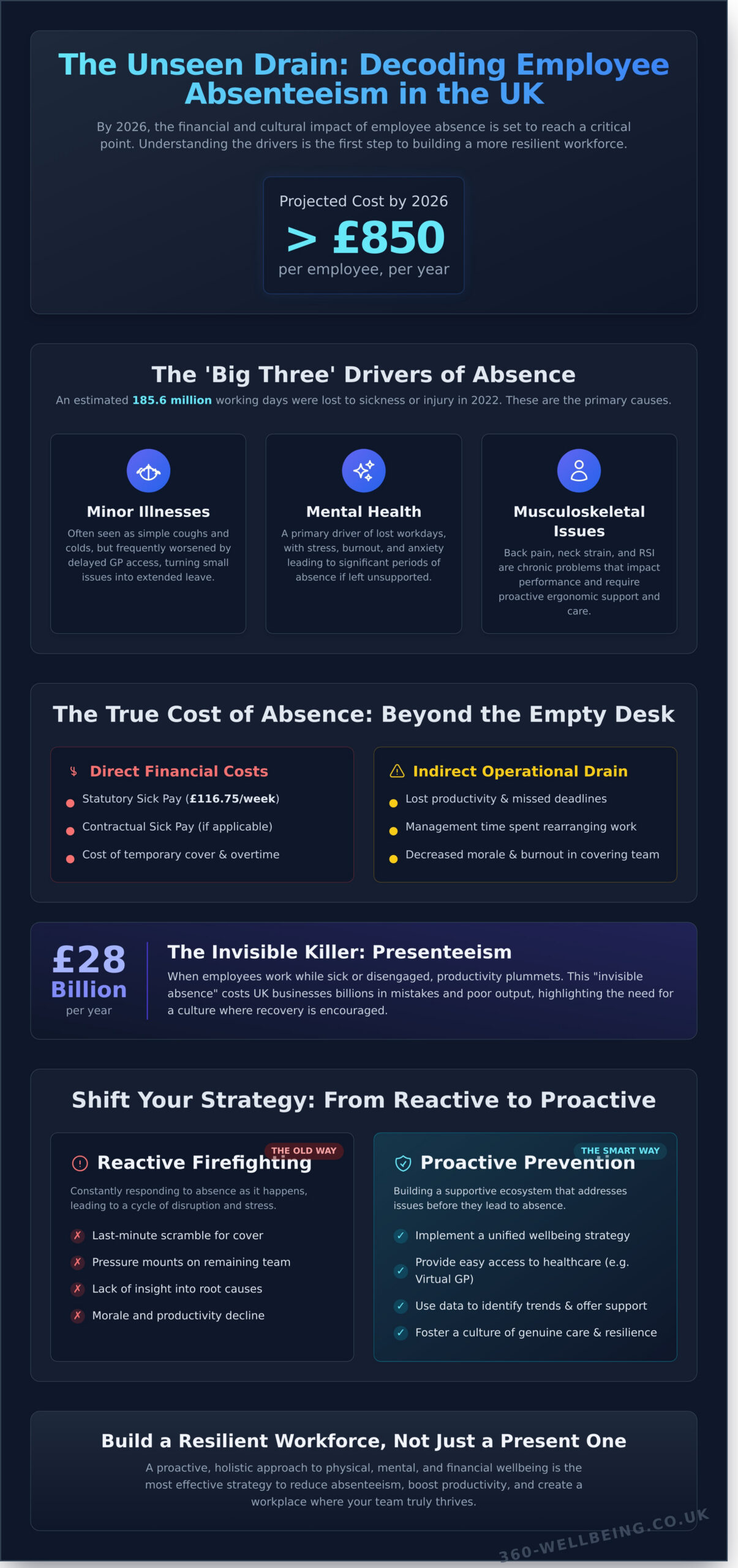
Did you know that by 2026, the cost of employee absence is projected to exceed £850 per employee for UK businesses? That’s a staggering figure, representing far more than just lost productivity. It’s a challenge every leader understands intimately; you feel the financial strain of arranging last-minute cover, see the pressure mounting on your remaining team, and grapple with the difficult task of understanding what’s really driving an employee’s time away from work.
This guide is designed to move beyond reactive measures. We’ll help you uncover the complex root causes of absenteeism, from physical illness and burnout to workplace disengagement, and show you how to build a comprehensive, proactive wellbeing strategy that delivers a clear return on investment. Together, we’ll explore the tailored steps you can take to foster genuine resilience, lower absence rates, and cultivate a workplace where your team doesn’t just show up, but truly thrives.
Key Takeaways
- Understand the “Big Three” drivers of employee absence in the UK-minor illness, mental health, and musculoskeletal issues-to better target your support.
- Uncover the hidden financial impact of absence, from direct costs like Statutory Sick Pay to the indirect drain on management time and team morale.
- Shift from a reactive to a proactive approach by implementing supportive absence policies and structured return-to-work interviews to effectively reduce absenteeism.
- Discover how a unified wellbeing strategy that addresses physical, mental, and financial health can build a more resilient and present workforce.
What is Absenteeism? Defining the Impact in 2026
In the modern workplace, absenteeism is far more than an empty chair or an unanswered email. It represents a habitual pattern of unscheduled absence from work, a recurring issue that disrupts workflow, strains team morale, and directly impacts your bottom line. This is fundamentally different from authorized leave, such as a pre-approved holiday or a scheduled medical appointment, which are planned and accounted for. Unplanned absence introduces unpredictability, forcing teams to constantly adapt and often leading to burnout among colleagues who must cover the shortfall.
To fully grasp its scope, it’s helpful to understand what is employee absenteeism in its formal context, which highlights the critical difference between legitimate, unavoidable time off and chronic patterns that signal deeper issues. The rise of hybrid and remote work since 2020 has added another layer of complexity. An employee might be logged on from home while feeling unwell, blurring the line between presence and absence and introducing a new set of challenges for managers trying to support their team’s wellbeing effectively.
You can’t manage what you don’t measure. Proactively tracking absence patterns is the essential first step toward building a healthier, more resilient workplace culture. It’s not about surveillance; it’s about insight. Consistent tracking allows you to identify trends that may reveal underlying problems, such as departmental stress, inadequate support for chronic conditions, or a need for more flexible health resources. This data is the foundation for a strategic approach to employee wellbeing, turning a reactive problem into a proactive opportunity for improvement.
Absenteeism vs. Presenteeism: The Invisible Productivity Killer
The opposite of an empty desk isn’t always a productive employee. Presenteeism occurs when team members show up for work (either physically or virtually) while unwell, disengaged, or otherwise unable to perform at their best. A 2022 report by Deloitte revealed this phenomenon costs UK employers up to £28 billion annually, primarily through lost productivity and mistakes. Comprehensive 360-degree support addresses both ends of this spectrum, ensuring employees can access care quickly to recover fully, rather than pushing through illness and prolonging their downtime.
The Legal Landscape for UK Employers
For UK businesses, managing absence is guided by a clear legal framework. Your primary obligation is to provide Statutory Sick Pay (SSP), which, as of April 2024, stands at £116.75 per week for eligible employees for up to 28 weeks. When persistent short-term absences or a long-term health issue impacts an employee’s ability to perform their role, it may become a capability issue that requires a formal, structured process. The key to effective management lies in navigating these legal frameworks with genuine empathy, ensuring that support precedes scrutiny.
Root Causes: Why UK Employees Are Missing Work
Understanding why your team members are absent is the first step to reducing that absence. In 2022 alone, the UK lost an estimated 185.6 million working days to sickness or injury, according to the Office for National Statistics. This isn’t just about the occasional cold; it’s a complex picture painted by interconnected physical, mental, and environmental pressures. To truly tackle high rates of absenteeism, we need to look beyond the surface and address the foundational challenges your employees are facing every day.
The reasons for absence consistently fall into three main categories: minor illnesses, mental health conditions, and musculoskeletal issues. While a cough or a bad back might seem straightforward, they are often symptoms of deeper issues. Unchecked workplace stress can manifest as physical pain or a weakened immune system, while burnout directly contributes to long-term mental health struggles. Adding to this, external pressures like the ongoing cost-of-living crisis create a persistent layer of financial anxiety, impacting an employee’s ability to focus and stay resilient. This environment can also lead to disengagement, where employees feel disconnected from their work, making them more likely to take time off for reasons they otherwise might have worked through.
Physical Health Barriers and GP Access
For many UK employees, getting a timely doctor’s appointment has become a significant source of stress. The “8 am scramble” for a slot often means taking time off work just to try and book a consultation, with no guarantee of success. This delay means minor, treatable ailments like a persistent cough or a muscle strain can escalate into more serious conditions requiring extended leave. Quick, early intervention is critical. This is precisely where on-demand virtual GP services provide a powerful solution, offering immediate access to medical advice and diagnosis without the wait.
The Mental Health Crisis in the Workplace
The data is undeniable: mental health is a primary driver of lost workdays. In 2022/23, the Health and Safety Executive reported that stress, depression, or anxiety accounted for 17.1 million days of absence. A persistent stigma often prevents employees from being transparent, leading them to call in with a “migraine” when they truly need a mental health day. Proactive and accessible mental health support creates a culture of trust, giving your team the tools to manage stress before it becomes overwhelming and reducing the need for unplanned “duvet days.”
Ultimately, these factors don’t exist in isolation. They weave together, creating a cycle where poor physical health impacts mental wellbeing, and external anxieties erode an employee’s resilience at work. A disengaged employee struggling with financial stress is far more likely to be affected by a minor illness than a team member who feels supported and secure. By recognising this holistic picture, you can move from a reactive to a proactive stance. Understanding these intricate challenges is the foundation for building a healthier, more present, and more productive workforce. Explore how a comprehensive wellbeing strategy can directly address these root causes and foster a culture of resilience.
The True Cost of High Employee Absenteeism
When an employee is off sick, the initial cost seems simple: their salary for the day. But that’s just the tip of the iceberg. The true financial and cultural impact of persistent absence digs much deeper, creating ripples that can destabilise your entire operation. Understanding these comprehensive costs is the first step toward building a more resilient and productive workplace.
The effects aren’t just logged in an HR system; they’re felt in team morale, project timelines, and even your brand’s reputation. Let’s break down what high absenteeism is really costing your business.
Calculating Direct and Indirect Financial Hits
For a small to medium-sized enterprise, the numbers add up with alarming speed. Research from the CIPD in 2023 revealed that the median cost of absence per employee has climbed to £987 per year. This isn’t just about covering Statutory Sick Pay. Consider the full financial drain from a single day’s absence:
- Direct Costs: This includes sick pay, paying overtime to colleagues who have to cover the extra workload, and potentially hiring temporary agency staff, which can cost upwards of 20-30% on top of a standard salary.
- Indirect Costs: A manager earning £50,000 a year who spends just one hour rearranging work and managing cover has cost the business over £24 in lost time. Multiply that across your management team and over a year, and the figure becomes substantial.
- Lost Momentum: Projects don’t just pause; they lose critical momentum. A key person’s absence can delay a launch or miss a client deadline, impacting revenue and client trust. This unseen cost can often be the most damaging.
When you compare these escalating, unpredictable expenses to the fixed, manageable cost of a proactive wellbeing platform, the choice becomes clear. The cost of doing nothing is a gamble your business can’t afford to take.
Impact on Retention and Recruitment
A high rate of absence is a powerful signal about your company’s culture, and it’s one that both your current team and potential new hires are reading loud and clear. It often points to underlying issues like burnout, high stress, or a lack of support, creating a cycle that’s difficult to break.
When team members are constantly stretched to cover for absent colleagues, their own stress levels rise, leading to burnout and, ultimately, their own departure. This high staff turnover costs an average of £1,750 in recruitment fees and £2,600 in lost productivity for a role with a £25,000 salary, according to a 2022 Oxford Economics report. Prospective candidates can sense a strained environment during interviews and may be deterred from joining. Investing in a comprehensive employee wellbeing programme isn’t just a benefit; it’s a powerful retention tool and a clear statement that you value your people’s health as a core business asset.
Strategic Prevention: How to Reduce Absenteeism Proactively
Reacting to employee absence is necessary, but a proactive strategy is what truly transforms workplace wellbeing and protects your bottom line. Shifting from a punitive to a supportive framework creates an environment where employees feel valued and understood, making them less likely to be absent in the first place. This approach isn’t just about compassion; it’s a calculated investment in your most valuable asset: your people.
A truly effective strategy is built on a foundation of clear communication and genuine support. It involves implementing policies and tools that address the root causes of absence before they escalate. Key pillars of this proactive model include:
- Supportive Absence Policies: Ditch the one-size-fits-all disciplinary approach. Modern policies, as championed by ACAS, should clearly outline procedures while emphasising the support available to employees, from health benefits to phased returns to work.
- Meaningful Return-to-Work Interviews: Frame these conversations not as an interrogation, but as a supportive check-in. They are a crucial opportunity to understand the reasons for an absence, identify ongoing health needs, and make reasonable adjustments to prevent recurrence.
- Flexible Working Arrangements: With nearly one in three working-age people in the UK living with a long-term health condition, rigid 9-to-5 structures are no longer fit for purpose. Offering flexible hours or remote work options can be a lifeline for employees managing chronic illness or caregiving duties, keeping their valuable skills in your business.
Early Intervention with Virtual GP and Physiotherapy
Providing immediate access to healthcare is one of the most powerful tools for reducing short-term sickness. With average waiting times for a routine NHS GP appointment often exceeding two weeks, a 24/7 Virtual GP service allows employees to consult a doctor without taking a half-day off work. Early-stage virtual physiotherapy is equally vital, addressing the musculoskeletal issues that accounted for 5.6 million lost working days in the UK in 2022/23. Immediate medical advice stops minor symptoms from escalating into major health issues and prolonged absences.
Fostering a Culture of Resilience
A resilient workforce is a present and productive one. This resilience is built on a culture that actively prioritises mental and emotional wellbeing. It starts with training your line managers to spot the early physical and behavioural signs of stress, enabling them to offer support before an employee reaches a crisis point. Beyond mental health, external pressures like financial worries or legal troubles are significant drivers of distraction and absence. Integrating comprehensive Employee Assistance Programs (EAP) into your daily operations provides a confidential lifeline, offering expert guidance that helps your team stay focused and engaged.
By investing in these preventative technologies and supportive cultural frameworks, you can significantly reduce rates of absenteeism and build a healthier, more resilient organisation. Explore how our 360-degree wellbeing solutions can help you build a proactive absence management strategy.
The 360 Wellbeing Solution: A Holistic Approach to Attendance
Simply reacting to employee absence is no longer enough. A truly effective strategy addresses the root causes before they lead to a day off work. This is where a comprehensive, 360-degree approach transforms your business culture from reactive to proactive. It’s about understanding that an employee’s physical health is deeply connected to their mental and financial wellbeing. Ignoring one area inevitably impacts the others, creating a cycle of stress, illness, and ultimately, absence.
The 360 Wellbeing platform is built on this principle of interconnected support. We provide a single, unified solution that closes the gap between what your employees need and your corporate goals for productivity and growth. For UK SMEs and sole traders, who form the backbone of our economy, this kind of scalable, powerful support has traditionally been out of reach. We make it accessible, providing the tools to build a resilient workforce that feels genuinely cared for, leading to a measurable reduction in absenteeism.
24/7 Support for a Modern Workforce
Your team’s life doesn’t operate on a 9-to-5 schedule, and their health support shouldn’t either. Our platform provides immediate, on-demand access to a suite of services designed for the realities of modern work and life:
- Virtual GP: Fast, convenient access to a UK-based GP via video call, helping resolve health issues before they escalate and require time off.
- Mental Health Therapy: Confidential sessions with qualified therapists, providing a safe space to manage stress, anxiety, and other challenges that are leading causes of long-term absence.
- Life Coaching: Proactive guidance to help employees set and achieve personal and professional goals, boosting motivation and engagement.
Beyond clinical support, we tackle the everyday pressures that drain energy and focus. The stress from “life-admin” is a significant contributor to presenteeism and burnout. Our platform includes 360 Rewards, offering discounts that can save an average UK family over £1,500 a year, alongside expert financial advice to ease monetary worries. It’s a tool that naturally integrates into the employee lifecycle, offering support from day one and demonstrating your commitment to their total wellbeing.
Measuring Success and ROI
Investing in wellbeing must deliver a clear return. The impact of the 360 Wellbeing platform is not just felt; it’s measured. By tracking metrics like your Bradford Factor score or the average number of absence days per employee, you can see a tangible shift. The CIPD’s 2023 survey reported an average of 7.8 sick days per employee in the UK; our goal is to help you significantly lower that figure for your business.
The long-term value extends far beyond reduced sick pay. A supported workforce is a loyal one. You’ll see improvements in employee retention, a stronger employer brand that attracts top talent, and a more engaged team that drives innovation. It’s an investment in your most critical asset: your people. By nurturing their health, you build a foundation of resilience that protects your business and powers its future success.
Ready to build a healthier, more present, and more productive team? Book a demo to see how 360 Wellbeing can transform your team.
Build a Culture of Presence, Not Just Policy
As we move into 2026, it’s clear that a reactive approach to employee absence is no longer sustainable. The data is stark: with the direct cost of absence potentially exceeding £700 per employee annually, UK businesses must look beyond traditional policies. Tackling the rising tide of absenteeism requires a deeper understanding of its root causes, from mental health challenges to everyday life pressures. The most resilient organisations will be those that build a proactive culture of care.
This is where a comprehensive, 360-degree approach makes a tangible difference. By providing your team with instant, 24/7 access to UK-registered GPs, confidential mental health support, and professional life coaching, you address wellbeing from every angle. It’s a complete support system delivered through an affordable, per-employee SaaS model designed for the modern workplace.
Empower your team with 360-degree wellbeing support today. Invest in their health, and watch your entire organisation thrive.
Frequently Asked Questions
What is the most common cause of absenteeism in the UK?
Minor illnesses are the single most common reason for staff absence in the UK. According to the Office for National Statistics (ONS) data for 2023, minor illnesses like coughs and colds accounted for 29.3% of all sickness absences. Other significant causes include musculoskeletal problems, which were responsible for 15.6% of absences, and mental health conditions such as stress, depression, and anxiety, which are also a primary driver of long-term absence.
How do you calculate the absenteeism rate for my business?
You can calculate your absenteeism rate with a simple formula. Divide the total number of unplanned absence days by the total number of available workdays for the same period, then multiply the result by 100 to get a percentage. For example, if your team of 20 people has 5,000 available workdays in a year and loses 100 days to absence, your rate is (100 / 5,000) x 100 = 2%. This metric is vital for tracking trends.
Is absenteeism the same as taking a sick day?
No, absenteeism is different from an authorised, occasional sick day. While a sick day is a legitimate absence due to illness, absenteeism describes a persistent pattern of being away from work, often without a valid reason. It’s the habitual nature of the absence that defines it. Understanding this distinction is crucial for creating a supportive yet accountable workplace culture and addressing the root causes of frequent time off.
Can an employer dismiss an employee for high absenteeism?
Yes, an employer in the UK can legally dismiss an employee for high absenteeism, but it must be done fairly and as a last resort. You must follow a formal capability or disciplinary procedure, as outlined by ACAS guidelines. This involves investigating the reasons for absence, providing warnings, and considering reasonable adjustments, especially if the absence is related to a disability under the Equality Act 2010. A fair process is non-negotiable.
How does an Employee Assistance Program (EAP) help reduce absence?
An EAP reduces absence by giving your employees immediate, confidential access to support for issues affecting their wellbeing. These programmes typically offer 24/7 access to counselling for stress or anxiety, financial guidance, and legal advice. By providing a proactive outlet for life’s challenges, an EAP can help resolve problems before they escalate into a crisis that requires taking time off work, building personal resilience and supporting your team’s mental health.
What is the difference between chronic and occasional absenteeism?
The core difference lies in the pattern; chronic absenteeism is frequent and repeated, whereas occasional absenteeism is infrequent and isolated. Chronic absence might manifest as a consistent pattern of short-term absences, like regularly taking Mondays off. Occasional absence is typically for a clear, legitimate reason, like a bout of flu. Identifying a chronic pattern is a signal to compassionately investigate for underlying health or morale issues.
How can virtual GP services help SMEs manage staff health?
Virtual GP services empower SMEs to manage staff health by providing rapid access to medical consultations without the long waits. This means employees can speak to a doctor, get a diagnosis, and receive a prescription often on the same day, sometimes without leaving their desks. This convenience removes barriers to seeking early treatment, which helps prevent minor health issues from becoming major problems that cause long-term absenteeism and lost productivity.
What should be included in a return-to-work interview?
A return-to-work interview should be a supportive, structured conversation. It should always start with a warm welcome back, followed by a gentle inquiry into their health to confirm they are fit to resume their duties. It’s also your chance to update them on any key developments and discuss if any temporary support, like a phased return, is needed. This proactive chat helps you identify patterns of absenteeism and shows your genuine commitment to employee wellbeing.