What if your small business could offer a wellbeing package that makes a global corporation’s traditional health insurance look outdated and impersonal? You likely already know that keeping your team healthy is vital for productivity, yet the 14% rise in private medical insurance premiums reported by Mercer in 2024 makes these schemes feel like an impossible luxury. Finding affordable employee benefits for small business shouldn’t mean compromising on the quality of care your people receive or stretching your budget to a breaking point.
We understand the pressure of balancing a compassionate culture with the reality of rising overheads. You deserve a solution that offers a predictable monthly cost without the administrative burden of old-fashioned systems. This guide reveals how to build a high-impact, low-cost benefits package that supports your team’s mental and physical resilience while protecting your bottom line. We’ll explore how to move away from reactive models toward a proactive, 360-degree approach that fosters a loyal, vibrant workforce ready for 2026.
Key Takeaways
- Learn how to navigate the 2026 landscape where rising insurance premiums are making traditional models unsustainable for smaller budgets.
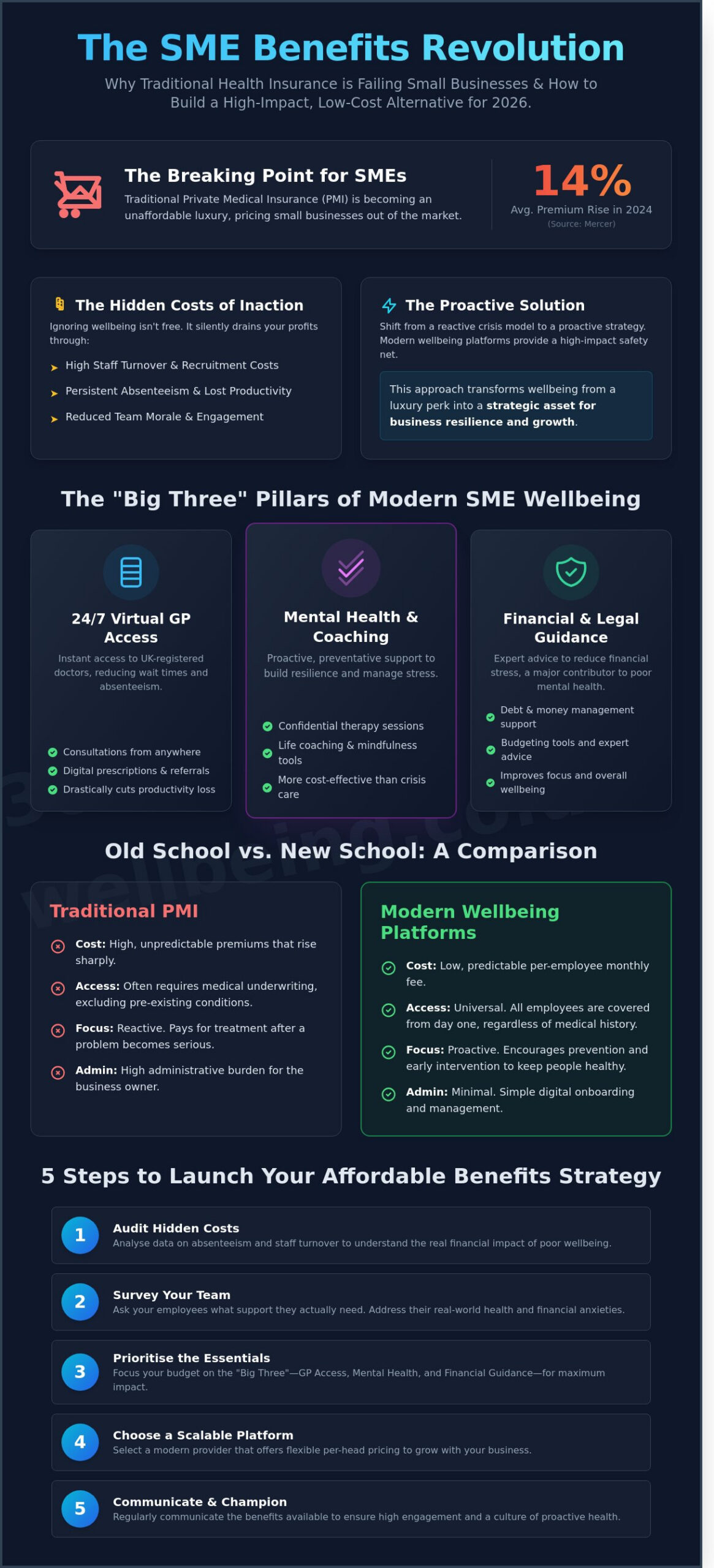
- Identify the “big three” essential pillars—24/7 virtual GP access, mental health support, and financial guidance—that provide the highest impact for your team.
- Discover how to implement affordable employee benefits for small business by choosing modern wellbeing platforms that offer universal access without medical underwriting.
- Master a five-step strategy to audit hidden costs and survey your staff, ensuring your package addresses their real-world health and financial anxieties.
- Understand how a proactive, 360-degree approach transforms employee wellbeing from a luxury perk into a strategic asset for business resilience.
The Challenge of Employee Benefits for UK Small Businesses in 2026
The definition of affordable employee benefits for small business has evolved significantly over the last few years. It no longer refers to stripped-back, low-value perks that sit unused in an employee handbook. Instead, it describes high-utility, low-premium services that offer immediate support, such as 24/7 virtual GP access or rapid mental health triage. These tools provide a proactive safety net for your team, ensuring that health concerns are addressed before they escalate into long-term absence.
By 2026, the gap between traditional Private Medical Insurance (PMI) and SME budgets has widened. With annual premium increases often hitting double digits, many small employers feel priced out of the market. However, ignoring health support creates a different kind of financial drain. High staff turnover and persistent absenteeism are hidden costs that can quietly erode a company’s profit margins. Viewing Employee benefits as a strategic business asset, rather than a luxury, allows you to build a more resilient workforce.
Investing in your team’s vitality is a practical way to safeguard your operations. A supportive culture, backed by accessible health tech, helps you move away from reactive crisis management toward a positive vision of workplace harmony. It’s about creating a partnership where the business thrives because its people are healthy and empowered.
Why SMEs Can No Longer Ignore Workplace Wellness
The strain on the NHS remains a critical factor for UK businesses. With waiting lists for elective care peaking at over 7.6 million in recent years, an employee might wait months for a simple diagnostic test. In a large corporation, a single absence is a statistic; in an SME, it’s a 20% or 50% reduction in your total capacity. Since the shifts of 2020, employees now prioritise health support as a fundamental right. They want to know their employer cares about their physical and mental resilience, especially when public services are stretched.
Scalability: From Sole Traders to Growing Teams
Digital health platforms have levelled the playing field. You don’t need a thousand employees to access corporate-grade support. Modern providers offer per-head pricing models that are just as accessible for a sole trader as they are for a team of 20. This flexibility is vital for finding affordable employee benefits for small business owners who need to scale quickly. You can add or remove members as your team fluctuates without facing complex administrative hurdles. Using an all-in-one hub reduces the burden on business owners, letting you focus on growth while we look after your people.
Essential vs. Luxury: Building a High-Impact, Low-Cost Package
Small business owners often find it difficult to distinguish between “perks” and “benefits.” While lifestyle discounts or free office snacks are pleasant gestures, they rarely address the underlying causes of staff turnover or sickness. In 2026, the most affordable employee benefits for small business focus on health and financial security rather than temporary lifestyle boosts. We identify the “big three” essentials as 24/7 GP access, mental health support, and expert financial advice. These core pillars provide a 360-degree safety net that protects both the individual and the business’s bottom line. By utilising government schemes like the Employment Allowance, SMEs can often offset National Insurance costs to reinvest in these high-impact health solutions.
The Virtual GP: Reducing Absenteeism Overnight
Traditional GP appointments frequently require staff to take half a day off work, contributing to the estimated £1.2 billion lost annually by UK businesses due to health-related productivity gaps. Providing 24/7 access to a UK-registered GP allows employees to book consultations during lunch breaks or from the comfort of their homes. The convenience of digital prescriptions and instant referrals ensures that minor health concerns are addressed before they escalate into long-term absences. A Virtual GP is the cornerstone of modern SME health strategy, offering immediate clinical reassurance and practical medical support without the wait times associated with local surgeries.
Mental Health and Life Coaching
Preventative therapy sessions are significantly more cost-effective than reactive crisis management. Data from Deloitte’s 2024 Mental Health Report suggests that for every £1 spent on workplace wellbeing, employers see an average return of £4.70 through reduced presenteeism and staff churn. Life coaching plays a vital role here, helping employees build the resilience needed to manage workplace stress and personal challenges. Providing confidential, third-party support is essential for sensitive issues that a staff member might feel uncomfortable discussing with a manager. This proactive approach fosters a culture of vitality and workplace harmony.
A truly comprehensive package integrates legal, financial, and physical support into a single, unified narrative of care. This holistic framework ensures that your team feels valued and secure in every aspect of their lives. You can explore how a tailored health package can help you build a resilient workforce that is equipped for the challenges of 2026 and beyond.
Comparing Traditional PMI with Modern Wellbeing Platforms
Traditional Private Medical Insurance (PMI) has long been viewed as the gold standard for corporate health. It acts as a vital safety net for life’s most challenging moments, such as major surgeries or specialist consultations. For a small team, however, the high annual premiums often create a significant financial burden. Modern wellbeing platforms offer a different path by focusing on daily health maintenance rather than just reactive crisis management. They replace high upfront costs with low monthly per-employee fees, making them a cornerstone of affordable employee benefits for small business in 2026.
The difference in usage is stark. While PMI is designed for rare, serious events, digital wellbeing tools are used frequently. Employees might access a virtual GP, a mental health coach, or a physiotherapy plan several times a year. This consistent engagement builds long-term resilience. For many SMEs, a standalone platform or a hybrid approach provides better value than full PMI. It ensures the team stays healthy and productive on a day-to-day basis, rather than just being protected against the unlikely.
- PMI: High annual premiums, medical underwriting, and focus on acute care.
- Wellbeing Platforms: Low monthly fees, immediate access, and focus on preventative care.
- The SME Advantage: A 360-degree approach that covers physical, mental, and social health without the insurance complexity.
Financial Sustainability for the Long Term
Managing cash flow is vital for any growing UK business. Subscription-based wellbeing models provide a predictable cost structure that aligns with monthly budgets. You won’t face the “renewal shock” common with traditional insurance, where a single large claim from one staff member can cause premiums to spike by 15% to 25% the following year. This stability allows for more accurate financial forecasting. To understand how these tools fit into your wider strategy, you can explore our financial support for employees guide, which helps bridge the gap between physical health and fiscal security.
Accessibility and Inclusivity
Traditional insurance often relies on complex exclusions. If an employee has a chronic back issue or a history of anxiety, PMI might not cover those specific needs due to pre-existing condition clauses. Digital platforms remove these barriers. They don’t ask for a medical history before granting access to support services. This creates a culture of equal support where every staff member feels valued, regardless of their role or health history. By providing a platform that welcomes everyone, you act as an expert caregiver for your entire workforce. It’s a proactive vision of workplace harmony that treats health as a fundamental right rather than a luxury reserved for senior management.
Five Steps to Launching an Affordable Benefits Strategy
Building a resilient workforce doesn’t require a corporate-sized budget. By following a structured path, you can implement affordable employee benefits for small business that provide genuine protection and value. This methodical approach ensures your investment addresses the specific pressures your team faces without overstretching your resources.
- Step 1: Audit hidden costs. Look at your expenditure on statutory sick pay, temporary cover, and recruitment. In 2023, the CIPD reported that sickness absence reached a ten-year high of 7.8 days per employee. Reducing this by just one day per person creates an immediate budget for proactive care.
- Step 2: Survey your team. You can’t solve problems you haven’t identified. Ask whether their primary anxieties involve physical health, financial stability, or time management.
- Step 3: Budget per-head. Avoid thinking in large lump sums. A monthly cost per employee, often starting from the price of a few high-street coffees, makes the financial commitment predictable and scalable as you grow.
- Step 4: Select a 360-degree platform. Choose a partner that integrates mental, physical, and financial support. A fragmented approach leads to low usage and higher administrative burdens.
- Step 5: Communicate value. Launch with clarity. If staff don’t understand how to access a GP or claim a discount, the benefit effectively doesn’t exist.
Surveying Your Team Without the Stress
Honesty requires safety. Use anonymous tools like Microsoft Forms or Mentimeter to ask about sensitive topics like mental health or debt stress. This removes the fear of judgment. When you share the results, be transparent about what’s possible. Explain that while you can’t implement every suggestion, you’re prioritising the areas that provide the most significant collective support. Managing expectations early prevents disappointment later.
Driving Engagement: A Benefit is Only Good if Used
Usage is the only metric that truly matters. A mobile-first approach is essential; with 92% of UK adults using a smartphone, support must be available in their pocket at any time. Introduce a “discount marketplace” early in the onboarding process. This provides immediate, tangible savings on weekly grocery shops or fuel, proving the value of the affordable employee benefits for small business before a health crisis even occurs. Regular, bite-sized internal reminders keep the services top-of-mind, ensuring your team feels supported every day of the year.
Ready to build a healthier, more engaged workforce? Explore how our tailored wellbeing solutions can protect your team and your bottom line.
Why 360 Wellbeing is the Logical Choice for Growing SMEs
Small business owners often face a difficult choice between providing high quality support and maintaining a lean budget. 360 Wellbeing removes this conflict by offering a 24/7 Virtual GP, comprehensive mental health counselling, and financial guidance all within one accessible app. This unified platform ensures that your staff can access help whenever they need it, whether they are at their desk or at home. We don’t just provide a digital tool; we offer an “expert caregiver” approach. This means every interaction is grounded in clinical excellence but delivered with a warm, human touch that makes complex health topics feel manageable.
Our 360-degree perspective recognises that health isn’t just about physical symptoms. It’s about the interplay between mental, social, and financial stability. To support this, our platform includes several high value extras that go beyond traditional health insurance:
- Complimentary Will Writing: Providing peace of mind for employees and their families.
- Legal Helplines: Professional advice for personal matters that could otherwise cause workplace stress.
- Financial Support: Practical tools to help staff manage the cost of living and plan for the future.
By 2026, the cost of replacing a single employee for a UK SME is projected to exceed £30,000 when accounting for lost productivity and recruitment fees. Implementing affordable employee benefits for small business is no longer a luxury; it’s a fundamental strategy for stability. We position ourselves as your partner in growth, helping you build a loyal, healthy workforce that feels truly valued.
Tailored Support for the Modern Workplace
The modern UK workplace is no longer confined to a single office. Our platform supports remote, hybrid, and on-site teams with equal efficiency. We’ve designed the administration process to be as light as possible. Busy directors or small HR teams can manage the entire system without getting bogged down in paperwork. This proactive service builds workplace resilience by identifying potential health issues before they lead to long term absence. It’s about creating a culture where vitality is a shared asset.
Ready to Protect Your Team?
Taking a proactive step toward a healthier business culture shouldn’t be a complex process. We offer a “no-barrier” entry for small teams, ensuring that affordable employee benefits for small business are accessible to organisations of all sizes. You can see the platform in action by booking a personalised demo or a consultation with our team. We’ll show you how our structured path to wellness can protect your most valuable assets. Let’s work together to ensure your team remains resilient, healthy, and ready for the challenges of 2026 and beyond.
Future-Proofing Your Workforce Through Proactive Care
Navigating the UK economic landscape in 2026 requires a shift from viewing wellness as a perk to seeing it as a strategic necessity. By prioritising essential support over high-cost luxuries, your company can implement affordable employee benefits for small business that drive genuine resilience. Recent data from the CIPD suggests that proactive health interventions can significantly reduce long-term absence rates, making this a vital investment in your collective stability. It’s about moving beyond reactive insurance to a model that supports your staff every single day.
At 360 Wellbeing, we’ve designed a platform that bridges the gap between clinical excellence and daily human support. Your team gains immediate peace of mind through 24/7 access to UK-registered GPs and comprehensive mental health and life coaching. We’ve also integrated thousands of rewards and financial support tools to help household budgets go further. This holistic approach ensures that your team stays healthy, focused, and valued without overstretching your company’s finances. Explore our affordable employee benefits for your small business and discover how a partnership with us creates a more vibrant workplace. You don’t have to navigate these complex health decisions alone; we’re here to ensure your business and your people thrive together.
Frequently Asked Questions
Is an employee benefits package worth it for a business with only 5 staff?
Yes, absolutely. Small teams rely heavily on each individual. One absence in a team of five represents a 20% drop in productivity. According to a 2023 CIPD report, health-related absence costs UK employers £927 per employee annually. Implementing affordable employee benefits for small business helps protect your most valuable assets and ensures your small team remains resilient and supported.
How much do affordable employee benefits typically cost per month?
You can implement foundational support for as little as £5 to £15 per employee each month. While high-end insurance varies, modern digital health platforms and cash plans provide significant value without a large capital outlay. Investing a small monthly sum ensures your staff can access 24/7 support. This proactive approach prevents minor health issues from becoming long-term absences that disrupt your operations.
Can I offer health benefits without paying for full Private Medical Insurance?
Yes, Health Cash Plans and digital wellbeing platforms are excellent alternatives to traditional Private Medical Insurance (PMI). These options allow employees to claim back costs for dental, optical, and physiotherapy treatments. They offer a 360-degree approach to health at a fraction of the cost. You provide essential care that employees use daily, rather than just covering rare, catastrophic health events.
What are the most popular employee benefits for small businesses in the UK?
Flexible working, Virtual GP access, and Health Cash Plans are currently the most sought-after benefits in the UK. A 2024 survey by Benenden Health found that 42% of employees value health and wellbeing support above a pay rise. Providing affordable employee benefits for small business, such as mental health support and retail discounts, helps you compete with larger corporations for top talent.
Do employee benefits help with staff retention in a small company?
They are a critical tool for retention, as 60% of UK workers say they’re more likely to stay with an employer that cares about their wellbeing. In a small company, the personal bond is stronger, and showing you value their health builds deep loyalty. Benefits create a culture of care that makes employees feel secure and appreciated in their roles.
Are digital health services like Virtual GPs as good as in-person appointments?
Virtual GPs offer high-quality clinical care with the added advantage of speed and convenience. Most digital appointments are available within 24 hours, compared to the average UK wait time of 10 days for an in-person GP visit. While physical exams require a face-to-face meeting, virtual services effectively manage prescriptions, referrals, and initial consultations, giving your team immediate peace of mind.
How do I manage the tax implications of providing employee benefits?
Most non-cash benefits are treated as Benefits in Kind and must be reported to HMRC via a P11D form. You’ll typically pay Class 1A National Insurance on the value of the benefit. However, certain items like annual health checks or eye tests for VDU users are often tax-exempt. It’s best to consult a qualified accountant to ensure you’re maximising your tax efficiency.
What is the difference between an EAP and a full wellbeing platform?
An Employee Assistance Programme (EAP) is primarily reactive, offering crisis counselling and short-term support. A full wellbeing platform provides a proactive, 360-degree strategy that includes fitness tracking, nutritional guidance, and preventative mental health tools. While an EAP helps when things go wrong, a wellbeing platform helps your team stay healthy and resilient every day, preventing issues before they arise.