
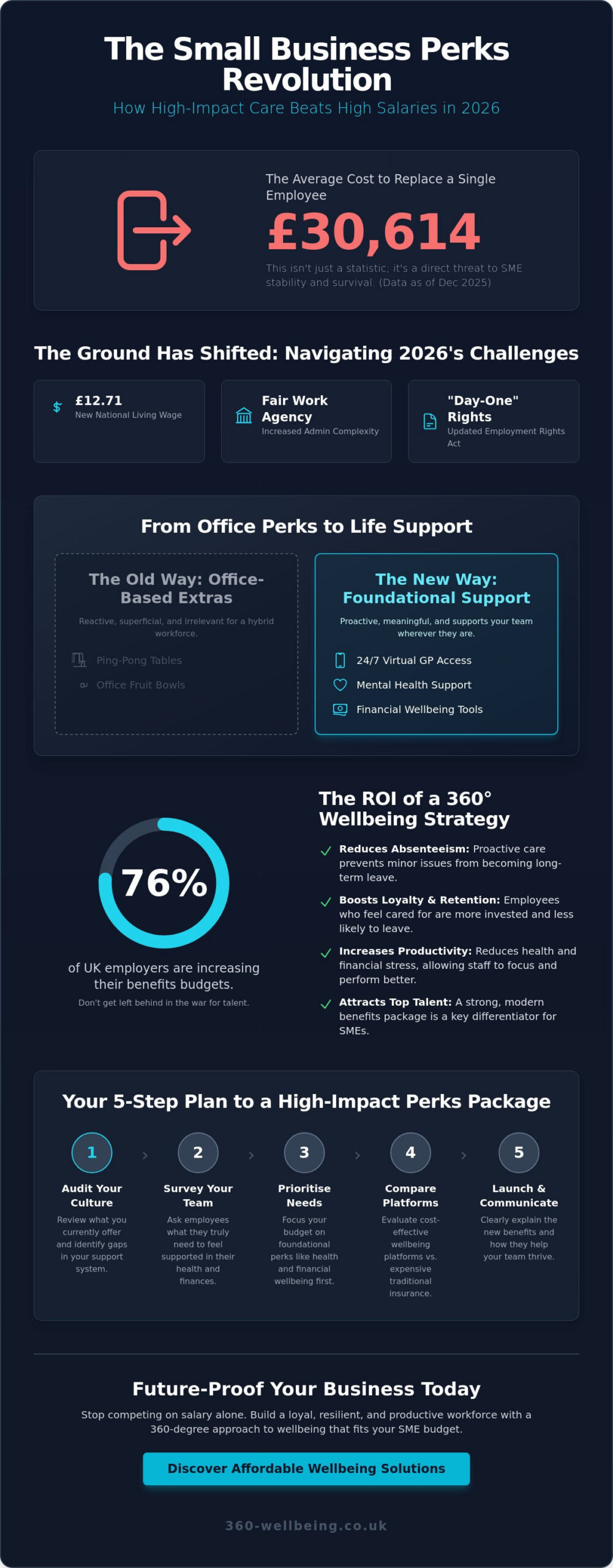
Did you know that the average cost to replace a single employee reached £30,614 by December 2025? For a growing business, losing a talented team member is more than just a recruitment headache; it’s a direct hit to your stability and momentum. Finding the best employee perks for small companies shouldn’t mean trying to outspend global corporations. Instead, it’s about providing the proactive, human support your people actually need to thrive in 2026.
We understand that you’re likely feeling the squeeze of the new £12.71 National Living Wage and the administrative complexities introduced by the Fair Work Agency this April. It’s difficult to stay competitive when you’re also managing “day-one” rights for paternity leave and the updated Employment Rights Act 2025. You want to look after your team’s vitality, but you need a strategy that’s manageable, affordable, and effective.
This guide will show you how to build a high-impact perks package that reduces absenteeism and wins the talent war without a corporate-sized budget. We’ll explore why 76% of UK employers are increasing their benefits budgets and how you can use a 360-degree approach to health and financial wellbeing to create a truly loyal, resilient workforce.
Key Takeaways
- Learn how to pivot your strategy from expensive salary wars toward high-impact care that protects your team’s long-term vitality and loyalty.
- Discover how to identify the best employee perks for small companies by prioritising foundational health and financial support that removes daily friction for your staff.
- Compare the cost-effectiveness of modern wellbeing platforms and Virtual GP services against traditional private health insurance to find a solution that fits your specific SME budget.
- Follow a structured 5-step checklist to audit your existing culture and survey your employees, ensuring your new benefits package addresses their most pressing wellbeing needs.
- Understand how a 360-degree approach to wellness can future-proof your business against rising turnover while simplifying benefits administration for your leadership team.
Why Employee Perks Matter for UK Small Businesses in 2026
The recruitment landscape shifted significantly following the establishment of the Fair Work Agency on April 7, 2026. For many small business owners, the pressure to match the rising National Living Wage of £12.71 while managing “day-one” rights for paternity leave can feel overwhelming. You might find it impossible to compete with the six-figure salaries offered by global corporations. However, your strength lies in your ability to offer a more personal, empathetic work environment. Identifying the best employee perks for small companies is no longer about matching corporate budgets; it’s about matching human needs.
Failing to offer a meaningful benefits package carries a heavy price. As of December 2025, the average cost to replace an employee reached £30,614. For an SME, this isn’t just a statistic; it’s a threat to your business’s survival. When we look at the standard definition of employee benefits, we often see a list of statutory requirements. In 2026, simply meeting the legal minimums like the £123.25 weekly Statutory Sick Pay isn’t enough to secure loyalty. Perks fill the gap where salary hits a ceiling, providing a sense of security and value that money alone cannot buy.
The ROI of a Proactive Wellbeing Strategy
A proactive approach to health is a strategic asset rather than a luxury. By addressing physical and mental health issues before they escalate into long-term leave, you directly protect your bottom line. A 360-degree perspective on wellness fosters resilience, ensuring your team feels supported through life’s challenges. This genuine care boosts discretionary effort, as employees who feel seen and protected are naturally more invested in your company’s success. It’s about moving away from reactive fixes toward a culture of sustained vitality.
Staff Retention in the Post-Hybrid Era
The days of office-based perks like fruit bowls or ping-pong tables are behind us. With 45.8% of UK employers now offering home working as a standard benefit, your perks must be as flexible as your workforce. Modern employees value “anywhere” benefits that support their lifestyle, whether they are working from a home office or a local hub. In a multi-generational workforce, a one-size-fits-all approach fails. You need a tailored strategy that supports the 20-year-old apprentice on £8.00 an hour just as effectively as the senior manager planning for retirement. This adaptability is exactly how smaller firms are outmanoeuvring larger competitors in 2026.
The Best Employee Perks for Small Companies: Lifestyle vs. Foundational
When you’re building a benefits package, it’s helpful to distinguish between the “safety net” and the “cherry on top.” Foundational perks are the essential services that protect your team’s health and financial stability. Lifestyle perks are the extras that make daily life a bit brighter. While both have a place, the best employee perks for small companies in 2026 are those that proactively remove friction from an employee’s life before it becomes a crisis. We’re seeing a definitive shift from reactive “sick care” toward a model of continuous, proactive wellbeing.
The most effective strategy involves moving beyond surface-level rewards. While many businesses still focus on office-based extras, modern employees prioritising their long-term health look for staff perks that please by offering genuine security. This means providing tools that help them manage the complexities of modern life, from health scares to financial planning. It’s about creating a partnership where the employee feels cared for as a whole person, not just a worker.
Foundational Perks Every SME Needs
In 2026, 24/7 access to a Virtual GP has become the primary foundational perk for small teams. It removes the stress of NHS wait times, allowing staff to book consultations during breaks or from home. This immediate access prevents minor ailments from escalating into long-term absences. Mental health support is equally vital, providing immediate access to therapy and coaching rather than leaving staff on months-long waiting lists. Additionally, providing robust financial support helps your team manage debt and plan for the future, which is essential for reducing workplace stress and increasing focus.
Lifestyle Perks That Actually Get Used
Lifestyle perks shouldn’t be expensive to be effective. Discount marketplaces are highly valued in 2026 as they help salaries go further during the ongoing cost-of-living recovery. High-perceived-value items like complimentary will writing or life coaching sessions provide significant peace of mind at a fraction of the cost of a pay rise. Flexible working remains a top priority, acting as a zero-cost perk that directly impacts retention. By combining these with comprehensive health platforms, you can offer a package that feels both luxurious and life-saving, ensuring your small business remains a top choice for talent.
Comparing Affordable Perks: What Can Your Budget Buy?
Building a competitive package doesn’t require a bottomless pit of cash. It requires a strategic focus on high-impact value. For many SMEs, the challenge is balancing the desire to care for their team with the reality of a tight bottom line. While 76% of UK employers plan to increase their benefits budgets in 2026, small firms must ensure every pound spent directly improves staff vitality and retention. The best employee perks for small companies often leverage the “Per-Employee” SaaS model, which provides predictable monthly costs and scales perfectly as your team grows.
A common misconception is that Private Medical Insurance (PMI) is the only way to provide healthcare support. While 31.5% of employers offer PMI, the premiums can be prohibitive for a small team. In contrast, a combination of a Virtual GP service and an Employee Assistance Programme (EAP) often sees much higher utilisation rates at a fraction of the cost. These digital-first solutions provide 24/7 support for mental health and physical ailments, preventing the “life friction” that leads to absenteeism. You can find more details on various options in this comprehensive guide to employee benefits, which highlights how modern perks have evolved beyond traditional insurance.
It’s also vital to consider the administrative burden. “Free” perks, such as casual dress codes (offered by 35.8% of firms) or flexible hours, are excellent but require management time to implement fairly. To stay tax-efficient, many SMEs are turning to salary sacrifice schemes and understanding Benefit in Kind (BIK) implications. These structures allow you to offer high-value items, like electric cars or cycle-to-work schemes, while reducing National Insurance contributions for both the employer and the employee.
High-Impact, Low-Cost Options
Digital wellbeing platforms serve as a holistic support system for a fixed monthly fee. They provide an essential mental health baseline through EAPs, offering immediate therapy access that bypasses lengthy wait times. Peer-to-peer recognition schemes are another low-cost winner. A simple “thank you” or a small reward for a job well done fosters a culture of genuine appreciation, which is often more effective at boosting discretionary effort than a one-off annual bonus.
When to Invest in Premium Perks
There are times when investing in premium perks is the right strategic move. If you’re a high-growth startup, a dedicated learning and development budget can attract ambitious talent who value career progression over immediate salary. Enhanced pension contributions, going beyond the statutory 3% minimum, also serve as a powerful long-term retention tool. While these require more capital, they signal a deep commitment to your employees’ future, creating a more resilient and loyal workforce for the years ahead.
How to Implement a Perks Package: A 5-Step Checklist
Implementing a benefits strategy shouldn’t feel like a second full-time job. For a business with 1 to 10 employees, simplicity and impact are your primary goals. You don’t need a sprawling HR department to offer the best employee perks for small companies; you simply need a methodical approach that identifies where your team needs the most support. Following the establishment of the Fair Work Agency on April 7, 2026, clear communication regarding employee rights and benefits has become a cornerstone of good management.
To build a package that truly resonates, follow this structured path:
- Step 1: Audit your “unspoken” perks. You likely already offer valuable benefits like flexible start times or a supportive culture. Document these so they become part of your formal recruitment value proposition.
- Step 2: Identify life friction. Survey your team to find out what actually causes them stress. Is it the difficulty of booking a GP appointment? Is it financial anxiety? Focus your budget on solving these specific problems.
- Step 3: Centralise your administration. Avoid the nightmare of managing multiple logins and spreadsheets. Choose an all-in-one platform that handles the heavy lifting for you.
- Step 4: Launch with intention. Don’t just send a PDF. Host a short session to explain how these perks protect your team’s vitality and how they can access support 24/7.
- Step 5: Review and refine. Use utilisation data to see what’s actually being used. If your team isn’t using a particular service, move that investment into an area that provides more value.
Surveying Your Team Effectively
In a small, tight-knit team, psychological safety is paramount. When asking for feedback, ensure responses are anonymous so staff feel comfortable being honest about their struggles. Instead of asking “What do you want?”, which often leads to expensive and unrealistic wish lists, ask “What causes you the most stress in your daily life?”. This helps you identify the best employee perks for small companies that will actually reduce absenteeism and boost morale. Manage expectations early by explaining that while you can’t do everything, you’re committed to supporting their core wellbeing.
Selecting a Wellbeing Partner
When choosing a provider, look for a “360-degree” perspective that covers physical, mental, and financial health in one place. Ease of use is non-negotiable; if there isn’t a mobile app for on-the-go access, your team simply won’t use it. Finally, ensure your partner offers robust onboarding support to help you get the team enrolled without adding to your administrative burden. If you’re ready to simplify your approach to staff care, you can book a consultation with our expert team to find a tailored solution for your business.
Future-Proofing Your SME with 360 Wellbeing
Choosing the right partner is the final, most critical step in securing your company’s future. 360 Wellbeing was built specifically to serve the UK SME and sole trader community, acknowledging that you need the same level of clinical expertise as a multinational but with a much more personal touch. We operate with a “Caregiver” philosophy, acting as a knowledgeable authority that remains deeply invested in your team’s success. This isn’t just about providing a service; it’s about establishing an immediate partnership that makes complex health topics manageable. By offering the best employee perks for small companies through a single, unified platform, you remove the administrative burden that often prevents smaller firms from providing comprehensive care.
One of the most significant stressors for employees in 2026 is health anxiety and the difficulty of accessing primary care. Our 24/7 Virtual GP service addresses this directly, providing your staff with the reassurance they need exactly when they need it. This immediate access reduces workplace stress and prevents minor health concerns from spiralling into long-term absence. When combined with our per-employee pricing model, it becomes a predictable, scalable investment that grows alongside your business. You don’t have to worry about complex schemes or hidden fees; you simply pay for the support your people are actually using.
A Complete Wellbeing Ecosystem
Our platform integrates mental health support, physiotherapy, and GP services into a single, intuitive app. This 360-degree perspective ensures that physical, mental, and social health are treated as a unified narrative of total wellness. Beyond clinical care, we provide financial and legal peace of mind, helping your workforce navigate the complexities of the 2026 economic environment. To add even more value, the 360 Rewards marketplace helps your team’s salaries go further by making everyday essentials more affordable, serving as a high-impact lifestyle perk that requires zero extra effort from your side.
Join the Proactive Wellbeing Revolution
The shift from “managing staff” to “empowering people” is the hallmark of a successful 2026 SME. By prioritising vitality and workplace harmony, you create a culture where employees feel like a fundamental asset rather than just a number. It’s time to move away from reactive fixes and embrace a proactive vision of health that builds long-term resilience. We’re here to guide you through this journey with compassion and expertise. If you’re ready to transform your workplace, you can Book a demo or view our SME packages to see how we can support your team’s unique needs and help you provide the best employee perks for small companies.
Empowering Your Team for 2026 and Beyond
Selecting the best employee perks for small companies is a strategic investment in your business’s most valuable asset; its people. By shifting your focus from reactive “sick care” to a proactive, holistic model, you provide the stability your team needs to navigate the complexities of the 2026 recruitment landscape. You’ve learned that a competitive package doesn’t require a corporate budget; it requires a deep understanding of your team’s specific friction points and a commitment to removing them through tailored support.
Whether it’s providing immediate mental health coaching or removing the stress of medical wait times, your role as an expert caregiver for your team has never been more vital. Our platform is designed specifically for the unique challenges of UK SMEs and sole traders, offering a 360-degree perspective that integrates physical, mental, and financial health. With 24/7 UK-registered GP access and a comprehensive rewards marketplace, you can offer a level of care that fosters lasting loyalty and resilience. Discover affordable wellbeing packages for your small business and begin your journey toward a more harmonious workplace today. Your dedication to your team’s vitality is the foundation of your future success.
Frequently Asked Questions
What are the most valued perks for employees in small companies?
Home working and flexible hours are the most valued perks in 2026, with 45.8% and 43.1% of employers offering them respectively. Beyond flexibility, staff highly prize “friction-removing” support like 24/7 Virtual GP access and mental health services. These foundational benefits provide a sense of security that is often more meaningful than traditional office-based rewards.
Are employee perks tax-deductible for UK small businesses?
Yes, most employee perks are considered a deductible business expense for corporation tax purposes. It’s important to differentiate between tax-free benefits, like certain minor perks, and those that attract Benefit in Kind (BIK) charges. Salary sacrifice schemes for cycles or electric cars are particularly effective as they reduce National Insurance contributions for both you and your team.
How much should a small company spend on employee benefits per head?
There is no fixed amount, but 76% of UK employers plan to increase their benefits budgets in 2026 to combat high turnover. For many SMEs, the best employee perks for small companies are delivered through fixed-fee digital platforms. This approach allows you to provide a comprehensive 360-degree support system without the unpredictable costs associated with traditional insurance premiums.
Can a company with only one or two employees offer a benefits package?
Absolutely, modern wellbeing platforms are designed to be accessible for sole traders and micro-businesses. You don’t need a large workforce to access professional clinical support or retail discount schemes. This scalability ensures that even the smallest firms can compete for top talent by offering high-value perks from day one.
What is the difference between an EAP and a wellbeing platform?
An Employee Assistance Programme (EAP) is typically a reactive service that provides counselling and crisis support when an issue arises. In contrast, a comprehensive wellbeing platform offers a proactive, 360-degree ecosystem. It integrates physical health, mental resilience, and financial tools into a single app, helping employees maintain their vitality before they reach a point of crisis.
How do I introduce new perks without increasing my administrative workload?
The most efficient way is to partner with a provider that offers an all-in-one digital solution. Following the establishment of the Fair Work Agency on April 7, 2026, managing compliance and benefits has become more complex. A self-service app handles enrollment and support requests automatically, allowing you to focus on growing your business rather than managing spreadsheets.
What happens if employees don’t use the perks I provide?
Low engagement usually suggests the perks don’t solve your team’s actual “friction points.” If utilization is low, use your platform’s data to identify which services are being ignored and survey your staff anonymously. Redirecting your investment into high-demand areas, like 24/7 GP access or financial support, ensures you aren’t paying for value that isn’t being realised.
Can I offer different perks to different levels of staff in an SME?
You can tailor your offerings, but it’s often more beneficial for morale to provide a universal foundational package. The best employee perks for small companies are those that create a sense of shared care and equality. You might choose to offer additional professional development budgets or enhanced pension contributions for senior roles while ensuring every team member has access to core health support.