
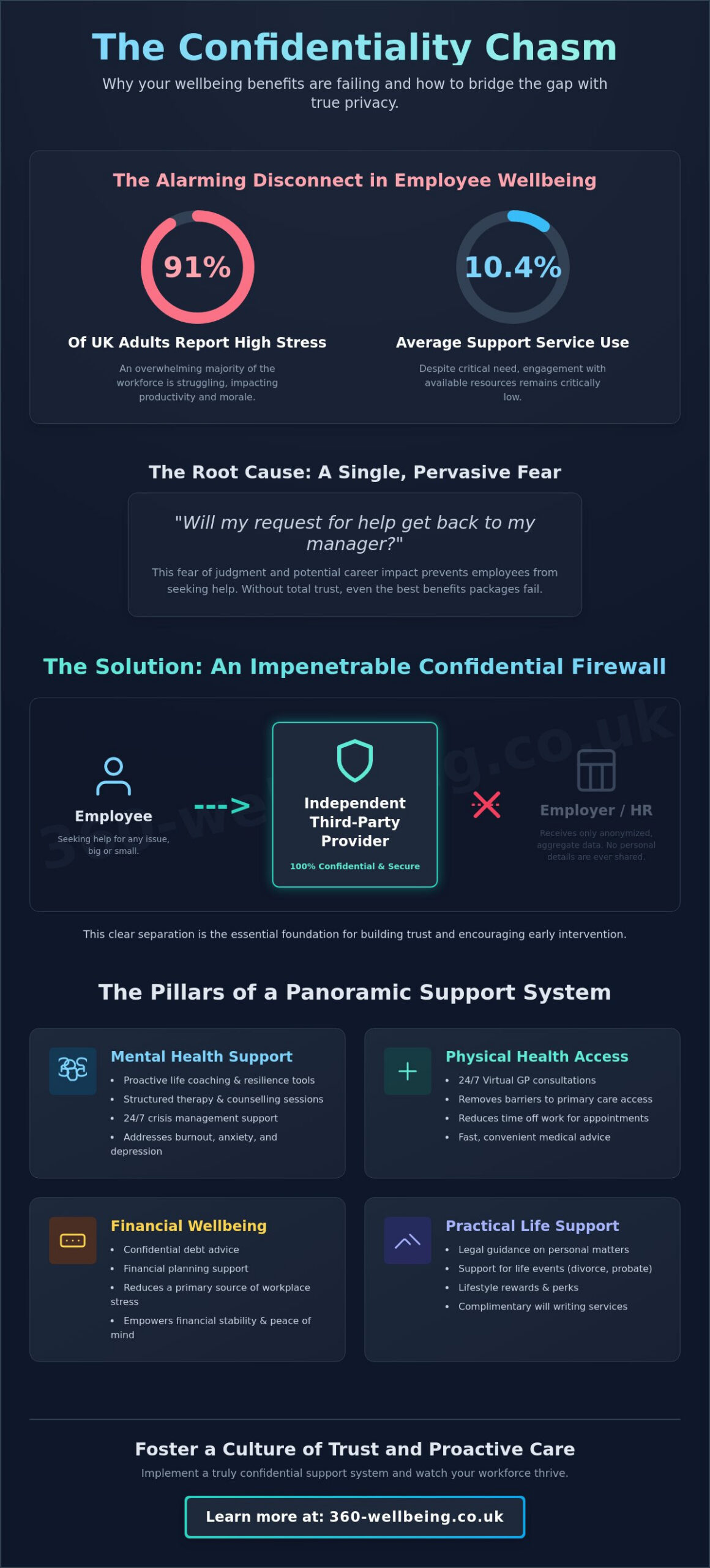
While 91% of UK adults reported high or extreme stress levels in 2026, the average utilization rate for support services remains a mere 10.4%. This gap often stems from a single, pervasive fear: that a request for help will eventually find its way back to a manager’s desk. You likely understand the frustration of seeing high absenteeism and stress-related turnover even when you have benefits in place. It’s clear that without total trust, even the most generous health packages will fail to engage the people who need them most.
Providing truly confidential support for employees is the foundation of a resilient business, ensuring that your team feels safe accessing vital services like an EAP or a Virtual GP. In this guide, we’ll show you how to implement systems that protect privacy while significantly enhancing workplace productivity. We will explore the mechanics of clinical confidentiality and provide a clear roadmap for building a healthier, more loyal workforce through proactive, holistic care.
Key Takeaways
- Learn why a clear separation between internal HR and third-party providers is the essential “firewall” that encourages staff to seek help early.
- Discover how integrating 24/7 Virtual GP access and mental health support creates a proactive safety net that reduces long-term absenteeism.
- Understand the legal and ethical frameworks that ensure confidential support for employees remains truly private, overcoming the fear of workplace judgment.
- Get a step-by-step approach to auditing your current health benefits and selecting a platform that balances clinical expertise with ease of use.
- Explore how a panoramic wellbeing strategy, including financial guidance and lifestyle rewards, fosters a culture where employees feel truly valued.
What is Confidential Support for Employees?
At its heart, confidential support for employees is a secure, third-party framework that allows staff to access professional help without any oversight from their employer. It represents a clear firewall between an individual’s personal challenges and their professional record. While many companies offer internal resources, true confidentiality only exists when the support provider is entirely independent. This independence ensures that whether a team member is seeking mental health guidance or physical health advice, their data remains protected by clinical ethics rather than corporate policy.
The “confidential” label isn’t just a marketing term; it’s the primary reason employees choose to engage with these services. In the UK, employers have a legal duty of care to protect the health and safety of their workforce, but this must be balanced against the individual’s right to privacy. When support is external, employees feel empowered to address issues like burnout or anxiety before they escalate into long-term absence. With poor mental health costing UK employers an estimated £51 billion annually according to Deloitte, providing a safe space for early intervention is both a moral and a financial necessity.
The Core Components of a Support System
A panoramic approach to wellbeing ensures that every facet of an employee’s life is covered. A modern Employee Assistance Program (EAP) typically integrates several vital pillars to provide a complete safety net for your team:
- Mental Health Support: This ranges from proactive life coaching and emotional resilience tools to structured therapy and mental health counselling for crisis management.
- Physical Health Access: Providing a 24/7 Virtual GP removes the logistical barriers to primary care, allowing staff to consult doctors at a time that suits them without taking time off work.
- Practical Life Support: Holistic care includes financial support, debt advice, legal guidance, and even complimentary will writing to reduce the daily stresses that often bleed into the workday.
Why Traditional HR Support Often Falls Short
Internal HR teams are incredibly valuable, but they face an inherent conflict of interest perception. Even the most empathetic HR manager is still a representative of the company. Employees often worry that disclosing a mental health struggle or a physical limitation might impact their career progression or how they’re perceived by leadership. This fear of judgment is a significant barrier that internal support simply can’t overcome.
Clinical expertise is another area where internal teams reach their limits. While a manager can offer a sympathetic ear, they aren’t trained to provide the specialized interventions required for complex issues. External platforms provide a necessary buffer, offering a level of professional distance that makes confidential support for employees feel safe. By moving these sensitive conversations outside the office walls, you create a culture of trust where staff feel supported as human beings, not just as workers.
The Pillars of Modern Workplace Support Systems
Effective confidential support for employees isn’t a single service; it’s an ecosystem. While mental health is a critical component, true resilience comes from addressing the various pressures that impact an individual’s ability to show up fully at work. By providing a broad spectrum of care, employers can move from reactive troubleshooting to a proactive culture of durability. This comprehensive approach ensures that when life becomes difficult, the path to resolution is clear and private.
A modern support system should encompass several key areas of care:
- Mental Health Support: This includes everything from preventative life coaching that builds emotional resilience to crisis therapy for those facing acute challenges.
- Financial Wellbeing: Financial concerns are frequently cited as the primary cause of workplace stress. Providing debt advice and financial support helps clear the mental fog that money worries create.
- Legal Guidance: Life happens outside of office hours. Access to legal support for matters like probate, tenancy disputes, or divorce provides a vital safety net during turbulent times.
- Lifestyle Rewards: Small wins matter. Tangible perks through 360 Rewards help enhance daily life, making the overall benefits package feel relevant even when an employee isn’t in a period of crisis.
Holistic Care: The Panoramic Viewpoint
Physical, mental, and social health are inextricably linked. It’s impossible to treat a physical ailment without considering the mental strain it causes, just as financial instability often manifests as physical exhaustion or anxiety. Our approach focuses on a panoramic viewpoint, ensuring no part of an individual’s wellbeing is left in the dark. For those with long-term conditions or disabilities, integrating these services alongside the government’s Access to Work scheme can provide a truly comprehensive support structure. By bringing these disparate pillars into one accessible platform, you ensure that help is never more than a few clicks away.
Virtual GP: A Revolutionary Benefit
The traditional struggle to secure a doctor’s appointment often leads to delayed treatment and increased absenteeism. A 24/7 Virtual GP removes these barriers entirely, allowing employees to speak with a clinician at a time that fits their schedule. This immediate access facilitates faster recovery through digital prescriptions and seamless referrals to specialists. A 24/7 Virtual GP is the cornerstone of modern benefits, transforming healthcare from a logistical hurdle into a streamlined, supportive experience. To see how these pillars can transform your workplace, consider exploring the integrated solutions available to your team.
Addressing the Privacy Gap: How Confidentiality Drives Engagement
While the pillars of support discussed earlier are essential, they only work if people actually use them. The most common reason for low engagement isn’t a lack of need; it’s a lack of trust. Employees often feel that using company-funded mental health support or a Virtual GP might somehow flag them to management. This hesitation creates a privacy gap that can only be bridged by demonstrating exactly how confidential support for employees is technically and legally ring-fenced from the rest of the business.
The transition into a new era for mental health at work requires moving past generic promises of safety and into the specifics of data protection. When an employee accesses a professional platform, they enter a space governed by medical ethics and strict GDPR protocols. This legal firewall ensures that the details of a consultation remain between the clinician and the individual. By being transparent about these boundaries, you remove the psychological barriers that prevent staff from seeking help.
The Legal Firewall Explained
Clinical confidentiality is the bedrock of any professional health service. Just as a conversation with a local GP is protected by patient privilege, digital consultations follow the same rigorous standards. We utilize ISO-certified data management systems to ensure that sensitive health information is encrypted and inaccessible to third parties, including the employer. At 360 Wellbeing, we never share individual consultation details, diagnosis names, or specific usage patterns with management. This absolute separation is what allows confidential support for employees to remain a trusted resource for those facing sensitive personal or professional challenges.
Anonymised Data: The Employer Advantage
You might wonder how you can measure the success of your wellbeing strategy if you can’t see who is using it. The answer lies in anonymised, aggregate reporting. While individual privacy is sacred, high-level data provides a panoramic view of your organization’s health. For example, a report might show that 15% of your workforce accessed financial support services last month. This insight allows you to identify widespread workplace stressors, such as cost-of-living anxiety, without ever identifying a specific person or their circumstances.
This data-driven approach helps you shape future corporate wellness strategies with precision. You can allocate resources where they’re needed most, ensuring a better return on investment while maintaining the sanctity of individual privacy. When you communicate these protections clearly to your team, you build a culture of trust that encourages staff to engage with their benefits early. This proactive engagement is what eventually leads to a more durable, productive, and loyal workforce.
A Practical Guide to Launching Confidential Support Services
Implementing a system of confidential support for employees shouldn’t feel like a bureaucratic hurdle. It begins with a clear, methodical audit of your current provision to identify where your team is most vulnerable. Many businesses find that while they might have basic mental health tools, they lack the panoramic support needed for legal or financial crises. Identifying these gaps allows you to move away from a fragmented approach and toward a unified strategy that addresses the whole person. This foresight ensures that your benefits package is a durable safety net rather than a collection of underused links.
Choosing the Right Partner for Your SME
Large corporations often have the luxury of dedicated internal teams, but for small and medium enterprises, a per-employee subscription model is far more sustainable and scalable. This approach ensures you only pay for the support you actually need while providing your team with elite-level benefits. When evaluating partners, look beyond the basic label of an EAP. A total platform should offer genuine clinical depth, such as access to UK-registered medical professionals for Virtual GP consultations and physiotherapy. This ensures your staff receives evidence-based care that is both safe and reliable, mirroring the quality of care they would expect from the NHS but with the convenience of digital access.
Communicating the Benefit Effectively
The most sophisticated platform will fail if your team is too nervous to log in. Your rollout strategy must center on the privacy firewall that protects individual users. When crafting your message, be explicit: management cannot see individual data, and usage is never reported back to HR. Use a multi-channel approach to build awareness, combining app notifications and emails with physical reminders like posters in common areas or mentions during team meetings. This consistent, steady rhythm of communication helps normalize the use of support services before a crisis occurs.
Appointing “Wellbeing Champions” within your departments can also bridge the trust gap. These are peers who can speak authentically about the platform’s ease of use and reassure colleagues about its absolute privacy. Success isn’t just measured by high login counts; it’s seen in the cultural impact of reduced stress and a more engaged workforce. With the average ROI for EAPs in the UK reaching £10.85 for every £1 invested according to EAPA 2023 data, the business case for support is as strong as the human one. If you’re ready to bridge the gap in your own organization, you can explore our integrated solutions to start building a more resilient team today.
The 360 Wellbeing Solution: Panoramic Care with Absolute Privacy
Our platform is designed to bridge the trust gap we’ve explored, offering a unified space where privacy is the default setting. Whether you’re a sole trader looking for personal durability or a large enterprise managing a diverse workforce, the need for confidential support for employees remains the same. We’ve built a solution that feels less like a cold corporate tool and more like a knowledgeable partner, guiding your team through the complexities of modern life with a warm, human touch. By centralizing care, we remove the friction that often prevents people from seeking help when they need it most.
A truly holistic strategy must look beyond clinical needs to address the daily pressures that affect performance. This is why we’ve made financial support a core pillar of our wellness narrative. From debt advice to the 360 Rewards marketplace, we provide tangible value that helps an employee’s salary go further. This combination of clinical expertise and practical life support creates a sense of completeness, ensuring your staff feels seen and supported in every aspect of their lives. Getting started is a streamlined process, with our onboarding for UK businesses in 2026 focused on immediate accessibility and clear communication.
Total Wellness in One App
The convenience of having a 24/7 Virtual GP, mental health therapy, and physiotherapy in one place cannot be overstated. It’s about providing a panoramic viewpoint on health that recognizes how physical pain and mental strain often go hand in hand. Our platform also provides long-term security through complimentary will writing and legal support, addressing the “life admin” that frequently causes silent stress. This expert caregiver persona is woven into the very fabric of the app, ensuring that every interaction feels supportive and empowering rather than clinical or distant. We don’t just provide a service; we establish a partnership that looks out for your team’s long-term interests.
Affordable Excellence for Every UK Business
We believe that high-tier health benefits should be a professional necessity, not a luxury reserved for the largest corporations. Our SaaS model delivers elite-level care at a per-staff price point that is accessible for businesses of all sizes. This investment pays dividends through improved staff retention and a noticeable reduction in burnout, creating a more harmonious and productive workplace. By choosing a platform that prioritizes absolute privacy, you’re investing in the foundation of your company’s future success. We invite you to take the next step in your corporate strategy by booking a consultation to see our confidential support for employees in action and discover how we can help your team thrive.
Cultivating a Culture of Trust and Durability
Building a resilient workforce starts with the fundamental understanding that trust is your most valuable asset. We’ve seen how confidential support for employees acts as the essential bridge between a struggling team member and the professional care they deserve. By prioritizing absolute privacy and clinical independence, you remove the psychological barriers that prevent early intervention. This proactive approach doesn’t just protect your people; it secures the long-term productivity and harmony of your entire organization.
Our platform provides a panoramic safety net, including 24/7 access to UK-registered GPs, comprehensive mental health support, and life coaching. We also offer integrated financial and legal support helplines to address the daily pressures that can so easily overwhelm even the most dedicated staff. It’s time to move toward a future where wellbeing is a shared entitlement rather than a hidden struggle. Empower your team with 360 Wellbeing. Book a demo today. We’re ready to partner with you in creating a workplace where every individual feels empowered to thrive.
Frequently Asked Questions
Is confidential support for employees truly private from the boss?
Yes, confidential support for employees is protected by a strict legal and clinical firewall. While the employer pays for the subscription, they never receive individual consultation notes, diagnosis details, or names of those accessing the service. Clinical privilege ensures that the relationship between the provider and the user remains entirely private, mirroring the confidentiality of a traditional NHS appointment.
How does an Employee Assistance Programme (EAP) differ from HR support?
An EAP provides external, professional intervention that is entirely independent of your company’s management structure. While HR support focuses on workplace performance and internal policy, an EAP offers clinical expertise for personal challenges. This essential separation reduces any perceived conflict of interest, making staff feel much more comfortable seeking help for sensitive issues like burnout or family difficulties.
Can small businesses afford to provide 24/7 Virtual GP access?
Small businesses can easily access these services through scalable models that charge on a per-staff basis. Instead of a large upfront cost, employers pay a manageable fee that provides high-tier benefits like 24/7 Virtual GP access and physiotherapy. This approach ensures that even micro-businesses can offer the same level of care as major corporations while benefiting from improved staff durability and reduced absenteeism.
What happens if an employee needs urgent mental health crisis support?
Employees in crisis receive immediate triage through professional mental health support channels. Our platform connects individuals with trained clinicians who can provide stabilization and guide them toward the most appropriate long-term care. This immediate responsiveness ensures that no one has to navigate a mental health emergency alone, providing a vital safety net during their most difficult moments.
Are financial and legal advice sessions also confidential?
Yes, all sessions regarding financial support, debt advice, or legal guidance are strictly confidential. These services are delivered by qualified professionals who adhere to their own industry ethical standards and data protection rules. The employer only sees that the service was used as part of a high-level usage report, never the specific details of an individual’s financial or legal situation.
How do I know if my employees are actually using the support platform?
Employers monitor engagement through anonymised, aggregate reporting that shows general trends rather than individual activity. You’ll see high-level data, such as the percentage of staff accessing confidential support for employees or using lifestyle rewards. This insight allows you to refine your corporate wellbeing strategy and measure impact without compromising the privacy of any single team member.
What is the difference between an EAP and Private Medical Insurance (PMI)?
An EAP is a proactive support service focused on immediate access to mental health, legal, and lifestyle guidance. While Private Medical Insurance typically covers the costs of private hospital treatment and surgery, an EAP focuses on day-to-day wellbeing and preventative care. We specialize in providing these integrated support services and holistic health tools rather than traditional insurance products.
Can family members access the confidential support services as well?
Many core services, such as the Employee Assistance Programme and Virtual GP, are often designed to support the employee’s immediate household. This panoramic approach recognizes that an individual’s wellbeing is frequently tied to the health of their family. Providing support for partners or children helps reduce the external stressors that can impact a staff member’s focus and productivity at work.