
Did you know that coached employees are five times less likely to leave their organisation? In a 2026 UK market where top talent is increasingly mobile, relying on standard perks is no longer enough to keep your best people. You’ve likely noticed that while traditional benefits are appreciated, they often fail to address the deep-seated burnout and low engagement affecting your teams. It’s a common struggle to distinguish between the need for mentoring, therapy, or structured corporate life coaching programs, leaving many leaders unsure of where to invest for the most meaningful impact.
We believe that wellbeing is a professional necessity and an essential human entitlement, not a luxury reserved for the boardroom. This guide takes a panoramic view of employee health to show how corporate life coaching programs can transform your recruitment strategy into a proactive vision of workplace harmony. We’ll clarify the ethical boundaries between coaching and clinical support, explain the tangible ROI of human-centred development, and provide a clear, methodical path for integrating these services into your broader corporate strategy for long-term durability and resilience.
Key Takeaways
- Learn how corporate life coaching programs have evolved from exclusive executive perks into a vital, accessible resource for your entire workforce.
- Gain clarity on when to offer developmental coaching versus clinical therapy to provide the most effective support for individual needs.
- Discover the strategic link between proactive coaching and improved employee retention, helping you maintain a stable and motivated team.
- Understand the importance of digital-first accessibility and professional accreditation in building a coaching program that fits modern hybrid work.
- Explore how a 360-degree approach bundles coaching with medical and mental health support for a truly holistic employee benefit package.
What Are Corporate Life Coaching Programs?
Corporate life coaching programs represent a fundamental shift in how UK businesses view their most valuable asset: their people. Rather than being a luxury reserved for the C-suite, these programs have evolved into a structured professional development benefit accessible to the entire workforce. In 2026, the focus has moved toward a panoramic view of health, where personal growth and professional success are seen as inextricably linked. By providing employees with a dedicated space to reflect on their challenges and opportunities, businesses foster a culture of transparency and mutual respect that pays dividends in long-term loyalty.
The proactive nature of these programs is what sets them apart from traditional, reactive health services. While an Employee Assistance Programme (EAP) or a 24/7 Virtual GP is essential for addressing immediate medical or mental health crises, coaching builds durability before a crisis occurs. It’s about foresight. Business coaching and life coaching within a corporate setting help staff identify potential stressors and career roadblocks early, allowing them to navigate these hurdles with confidence. Because modern programs are often delivered via digital platforms, they offer a level of scalability and flexibility that fits perfectly into the hybrid and remote working models common across the UK today.
The Core Pillars of Workplace Coaching
Effective corporate life coaching programs are built on three essential foundations that support the employee’s journey from their first day to their senior leadership roles:
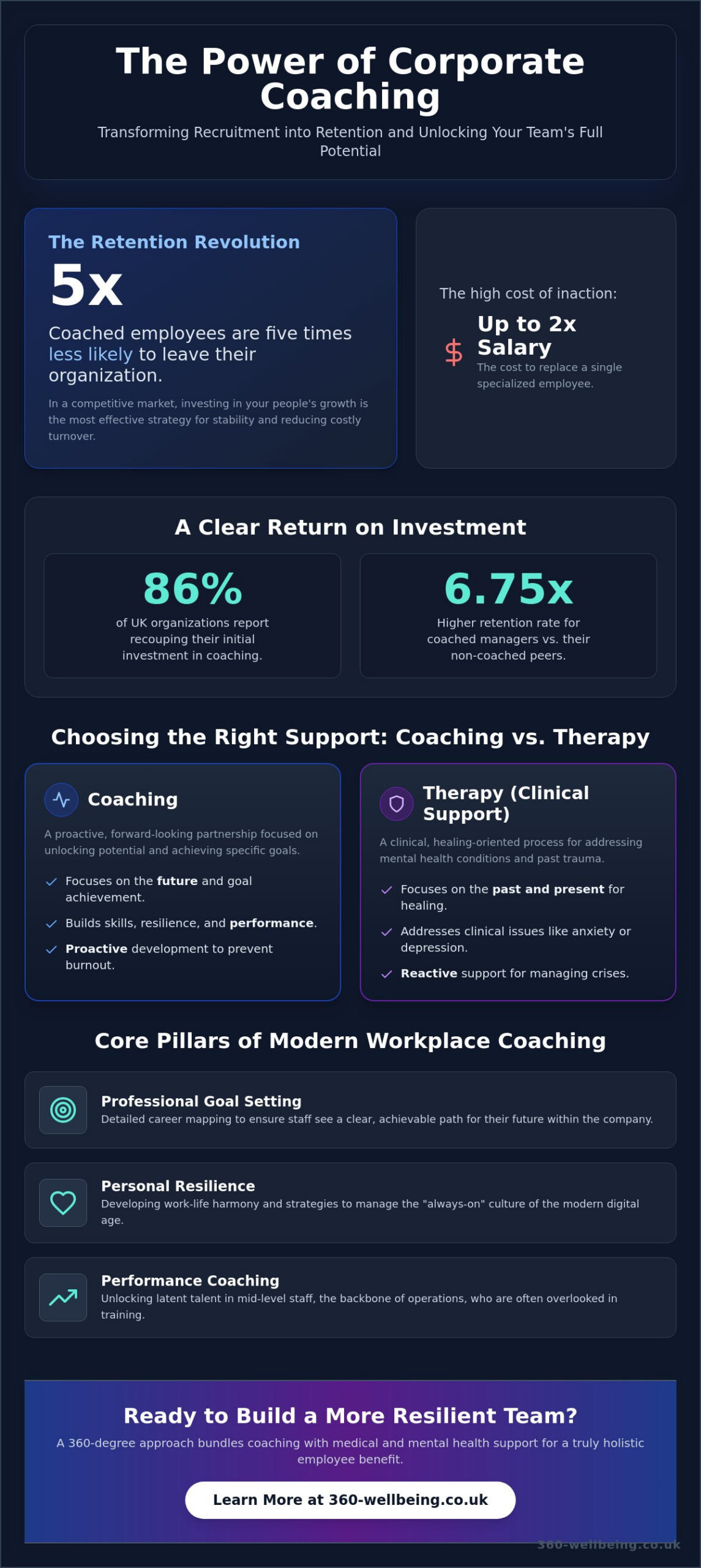
- Professional goal setting: This involves detailed career mapping within the company, ensuring that staff see a clear, achievable path for their future.
- Personal resilience: Coaches work with individuals to develop work-life harmony strategies, helping them manage the “always-on” culture of the digital age.
- Performance coaching: This focuses on unlocking latent talent in mid-level staff, who are often the backbone of operations but may feel overlooked in traditional training models.
Why Demand is Rising in the UK
The UK workforce is navigating a period of intense transformation. Modern work stresses often cloud focus, making it difficult for even the most dedicated staff to perform at their peak without support. For Gen Z and Millennial workers, the desire for self-improvement is a primary driver in their choice of employer. They don’t just want a salary; they want a partner who is genuinely invested in their success and wellbeing. Corporate life coaching programs are a strategic investment in human capital rather than a discretionary expense.
Measuring the ROI: Why Businesses Invest in Coaching
Research shows that 86% of UK organisations report recouping their initial investment in coaching. It’s not just about improving office morale; it’s about the bottom line and long-term organisational stability. Understanding why organizations hire coaches often starts with a desire to sharpen leadership at the top, but the benefits quickly ripple through the entire company structure. When you move beyond seeing coaching as a luxury and start viewing it as a core business driver, the financial logic becomes undeniable.
Reducing Turnover and Recruitment Costs
Staff loyalty is perhaps the most immediate win for any employer. Statistics show that coached employees are five times less likely to leave their organisation, while coached managers show a retention rate 6.75 times higher than their non-coached peers. This is vital in a competitive UK market where the cost of replacing a specialist can be astronomical, often reaching double their annual salary once recruitment fees and onboarding time are factored in. By investing in corporate life coaching programs, you’re telling your team that their growth matters as much as their output. This re-engages those who might otherwise “quiet quit,” turning unmotivated staff back into active contributors who feel truly seen and valued.
Boosting Productivity and Leadership
Productivity often stalls when personal hurdles bleed into the workday. This is known as “presenteeism,” where a person is physically at their desk but mentally elsewhere, often due to stress or a lack of clear direction. Coaching provides the practical tools to manage these distractions through better time management and emotional regulation. It’s particularly useful for “accidental managers,” those promoted for technical excellence who now find themselves needing complex soft skills to lead diverse teams. For every £1 spent on these initiatives, businesses frequently see a median return of seven times their investment. It’s a clear, methodical path to better decision-making and higher accountability across the board. If you’re looking for a way to support your team’s durability, exploring a comprehensive wellbeing subscription can provide the framework you need.
Finally, consider the recruitment advantage. In 2026, a standard salary isn’t always the deciding factor for high-performing candidates. They look for panoramic support that integrates their professional goals with their personal wellbeing. Offering high-value developmental benefits through corporate life coaching programs makes your organisation a standout choice in a crowded marketplace. It signals that you value wellbeing as a professional necessity and a human entitlement, acting as a powerful magnet for top-tier talent who want to build a long-term career rather than just fill a role for a season.
Coaching vs. Therapy: Choosing the Right Support
For any HR manager or business owner, understanding the boundary between clinical intervention and developmental support is essential. While therapy often explores the “why” by looking at past experiences to resolve trauma or psychological distress, corporate life coaching programs are distinctly future-focused. Coaching is about the “how.” It’s a proactive partnership designed to help individuals set goals, build resilience, and unlock their potential. It’s a developmental tool rather than a medical treatment, though both are vital components of a panoramic wellbeing strategy.
There’s also the matter of employee perception. Many staff members engage with coaching more readily because it carries a sense of professional prestige rather than the weight of a clinical diagnosis. By offering support as a developmental benefit, you’re inviting your team to step into their strength. However, a truly effective workforce strategy doesn’t force a choice between the two. It integrates them. Having both pathways ensures that employees receive the right level of care at the right time, whether they’re navigating a career transition or dealing with a mental health crisis.
When to Refer to a Coach
Coaching is the ideal choice when an employee is physically and mentally well but feels stuck or uninspired. It’s particularly effective for navigating specific life stages, such as helping a parent transition back into the workforce after leave or supporting a new manager in finding their leadership voice. You should consider coaching for:
- Career stagnation or a lack of clear professional direction.
- Time management and productivity hurdles.
- Building confidence for public speaking or high-stakes decision-making.
- Proactive stress management to prevent the slide into burnout.
When Therapy is the Necessary Path
Therapy becomes the priority when an individual’s mental health significantly impacts their ability to function. It’s important to recognise signs of clinical depression, severe anxiety, or the effects of trauma, which require the expertise of registered mental health professionals. In the UK, the landscape is shifting; a final report on the statutory regulation of counselling and psychotherapy is expected in the summer of 2026, which will further formalise these professional standards. Our 360 Wellbeing model integrates these pathways seamlessly, ensuring that if a coach identifies a need for clinical support, the employee can be guided toward Mental Health Support or a 24/7 Virtual GP without delay. This ensures a safe, methodical transition from professional development to clinical care whenever it’s required.
Key Features of a Modern Corporate Coaching Program
Modern corporate life coaching programs are no longer defined by heavy binders or infrequent face-to-face meetings. In 2026, the hallmark of a successful deployment is seamless, 24/7 digital accessibility. For the modern UK workforce, which often balances remote and hybrid schedules, the ability to connect with a coach via a mobile app is a game-changer. It ensures that support is available exactly when it’s needed, rather than being scheduled weeks in advance. This digital-first model also allows organisations to democratise the benefit, moving away from the old executive-only approach to ensure that every team member has the tools to thrive.
Quality assurance is another non-negotiable feature. When selecting a provider, looking for accreditation from recognised bodies like the International Coaching Federation (ICF) is essential. It provides a guarantee of clinical-grade ethical standards and professional competence. This professional framework is what builds the necessary trust for employees to engage fully. Confidentiality is the cornerstone of this trust; staff must feel safe speaking to an external coach, knowing their personal hurdles won’t be reported back to their direct supervisor. This psychological safety is what allows for the deep, transformative work that drives real results.
Accessibility and Virtual Delivery
Virtual delivery isn’t just a matter of convenience; it’s a matter of effectiveness. By removing the logistical barriers of travel and office-hour constraints, engagement rates typically soar. Mobile apps provide a steady, methodical way for employees to track their progress and access resources between sessions. This creates a rhythm of continuous growth that fits naturally into a busy professional life, making the benefit feel like a supportive partner rather than an administrative burden. It ensures that the proactive vision of vitality we advocate for is reachable for everyone, regardless of their location or role.
Integration with Broader Wellbeing
A standout feature of the most successful corporate life coaching programs is how they integrate with other health services. When coaching sits on a single platform alongside a 24/7 Virtual GP and mental health support, it creates a panoramic view of employee health. For example, anonymised coaching data can highlight widespread concerns that might inform a wider financial support strategy or physical health initiative. This unified narrative of wellness ensures that no aspect of an employee’s life is left unsupported. You can explore our integrated coaching and wellbeing platform to see how this synergy works in practice for UK employers.
Implementing Life Coaching with 360 Wellbeing
For many UK employers, the historical barrier to launching corporate life coaching programs has been a combination of high costs and administrative complexity. Traditional models often demand significant upfront investment or limit support to a small circle of senior leaders, leaving the wider workforce without the tools they need to thrive. We’ve redesigned this narrative by offering a subscription-based model that makes professional development accessible to everyone. By bundling Life Coaching with essential services like our 24/7 Virtual GP and Mental Health Support, we provide a panoramic safety net that catches health issues before they escalate while simultaneously empowering your staff to reach their highest potential.
The onboarding process is designed specifically with the busy schedules of UK SMEs and sole traders in mind. We don’t believe in overwhelming you with technical jargon or intricate setups that take months to deploy. Instead, our UK-based support team guides you through a methodical implementation, ensuring your workforce knows exactly how to access their new benefits from day one. It’s a partnership rooted in reliability and foresight, allowing you to focus on your core business goals while we look out for the long-term interests and durability of your people.
A Panoramic Approach to Employee Health
A truly all-encompassing strategy recognizes that an employee’s performance is influenced by more than just their workload. It’s the intersection of physical health, mental clarity, and financial stability that determines how well a person shows up for their team. Our platform integrates coaching goals with broader support, such as Financial Support & Debt Advice and Physiotherapy, creating a unified narrative of total wellness. For employers, the fixed per-employee monthly fee removes the guesswork from budget planning. You gain a complete, high-value benefits package without the unpredictable costs often associated with ad-hoc professional services, ensuring your investment remains manageable and effective.
Next Steps for Your Organisation
Transforming your workplace culture begins with an honest evaluation of your current support structures. Are there gaps where proactive development could replace reactive crisis management? We invite you to book a demo to see how our digital-first platform can seamlessly integrate into your daily operations and provide the self-motivation your team needs. This isn’t just about adding another perk; it’s about establishing a professional necessity that honors the human entitlement to wellbeing. By choosing a partner who values customization and expert care, you’re investing in a future of vitality and workplace harmony. 360 Wellbeing is the partner you need to ensure long-term workplace harmony and a resilient, thriving workforce.
Building a Resilient Workforce for the Future
Investing in your team’s growth is no longer a discretionary choice; it’s a strategic necessity for any UK business aiming for longevity. We’ve explored how corporate life coaching programs bridge the gap between basic perks and clinical care, offering a proactive path to higher retention and reduced burnout. By distinguishing between developmental coaching and therapeutic intervention, you ensure every employee receives the precise support they need to flourish. This methodical approach to wellbeing doesn’t just solve immediate hurdles; it builds the long-term durability your organisation needs to thrive in a competitive market.
Our platform is designed specifically for UK SMEs and sole traders, providing a panoramic view of health that integrates mental, physical, and financial support. With 24/7 access to UK-registered GPs and holistic guidance, we help you build a workplace culture rooted in durability and mutual success. Discover how 360 Wellbeing can transform your team with integrated life coaching and take a proactive step toward a more harmonious and productive future. We’re here to partner with you in creating a workplace where every individual feels empowered to reach their full potential.
Frequently Asked Questions
Is corporate life coaching different from an Employee Assistance Programme (EAP)?
Corporate life coaching programs differ from EAPs by focusing on proactive growth rather than reactive crisis management. While an EAP provides immediate support for personal or legal issues, coaching is a structured partnership aimed at unlocking potential and setting future goals. It’s about building durability in your team before a challenge turns into a crisis. Combining both ensures a panoramic support system that covers every stage of the employee journey.
How much do corporate life coaching programs typically cost for UK businesses?
The cost of corporate life coaching programs in the UK varies significantly depending on whether you choose hourly executive sessions or a whole-workforce subscription model. Traditional one-to-one executive coaching often involves high hourly rates that can be unpredictable for budget planning. Subscription models are increasingly popular for UK SMEs because they provide a fixed monthly cost per employee. This approach ensures your benefits package remains sustainable and predictable while offering high-value support to everyone.
Are life coaches in the UK required to have specific qualifications?
There is currently no legal requirement for life coaches in the UK to hold specific qualifications or licenses as the profession remains unregulated. However, most reputable providers ensure their coaches are accredited by professional bodies like the International Coaching Federation (ICF) or the Association for Coaching (AC). These organisations provide a framework for ethical standards and clinical-grade competence. We recommend checking for these credentials to ensure your team receives knowledgeable, professional guidance from an expert caregiver.
Can life coaching help with workplace stress and burnout?
Life coaching is an exceptionally effective tool for managing workplace stress and preventing burnout through proactive intervention. Coaches help employees identify the underlying factors of their stress, such as poor time management or a lack of work-life harmony. By developing practical resilience strategies, staff members feel more empowered and self-motivated. This foresight helps them navigate the pressures of modern work without reaching the point of clinical exhaustion or long-term absenteeism.
How do we measure the success of a coaching program in our company?
You can measure the success of a coaching program by tracking key performance indicators like staff retention rates and internal promotion numbers. Many businesses also see a reduction in presenteeism and short-term absenteeism as employees become more resilient and focused. Anonymised feedback surveys provide a methodical way to gauge employee sentiment and engagement levels. These data points offer a clear view of the return on investment and the program’s impact on workplace harmony.
Is employee coaching confidential from management?
Confidentiality is a non-negotiable pillar of professional coaching, and sessions are kept private from management to ensure a safe environment. Employees must feel they can speak openly about their challenges without fear of it affecting their performance reviews or career progression. While the provider may share anonymised, high-level data on common themes within the workforce, the specific details of individual conversations remain strictly between the coach and the employee.
What is the difference between executive coaching and corporate life coaching?
Executive coaching is traditionally reserved for senior leadership and focuses on high-level business strategy, while corporate life coaching programs are designed for the entire workforce. Life coaching takes a more holistic view, addressing the intersection of personal wellbeing and professional performance. It acknowledges that an employee’s success is tied to their overall sense of balance. This democratisation of support ensures that every team member, from entry-level to management, feels valued and supported.
How long does a typical workplace coaching engagement last?
A typical workplace coaching engagement often lasts between three and six months for specific, goal-oriented outcomes. However, many modern UK employers prefer ongoing access through subscription models, allowing for a more methodical and durable approach to development. This ensures that support is available whenever a new challenge arises, whether it’s a career transition or a shift in personal circumstances. Continuous support mirrors a professional consultation, providing a steady path forward for long-term success.