
Choosing the right virtual GP service for your team can feel like navigating a maze. With a growing number of providers in the UK market, how do you see beyond the marketing noise and select a partner that delivers real value? The risk of investing in a platform that employees don’t use is a genuine concern for many business leaders. This is why a strategic approach to selecting corporate virtual GP services is no longer a luxury, but a necessity for fostering genuine workplace wellbeing and resilience.
This 2026 buyer’s guide is designed to bring clarity to that complexity. We’re moving beyond simple price comparisons to provide you with a comprehensive framework for evaluation. Inside, you will find a practical checklist to compare providers, a clear method for building a compelling business case for leadership, and the confidence to implement a service that your employees will actually value and use. Our goal is to empower you to make a proactive investment in your team’s health, turning wellbeing into your company’s most powerful strategic asset.
Key Takeaways
- Understand the direct financial link between NHS access challenges and your company’s absenteeism rates to quantify the need for a solution.
- Evaluate potential corporate virtual GP services with a 10-point checklist covering essential criteria from clinical governance to UK-based GP qualifications.
- Discover the critical differences between a simple standalone app and an integrated platform to determine which model truly supports long-term employee health.
- Build a compelling business case for leadership with a clear framework to calculate the tangible ROI of a virtual GP service in pounds.
Why Your Business Needs a Virtual GP Service in 2026
In today’s fast-paced business landscape, the health of your team is the bedrock of your company’s resilience. Yet, with continued pressure on the NHS leading to significant waiting times for routine appointments, proactive healthcare is becoming increasingly difficult for employees to access. This delay isn’t just an inconvenience; it’s a direct threat to your operational stability. On average, UK employees can lose multiple workdays each year simply trying to secure and attend a GP appointment for themselves or their families. This is where forward-thinking companies are turning to corporate virtual GP services, reframing employee healthcare not as a reactive perk, but as a strategic tool for business continuity. The evolution of digital health, often referred to by the broader term of What is Telehealth?, has made this level of care both accessible and affordable.
The True Cost of Employee Health Delays
When an employee struggles to get timely medical advice, a minor health concern can quickly escalate into a more serious issue requiring extended time off. Beyond straightforward absenteeism, there is the pervasive issue of ‘presenteeism’-when staff come to work while unwell. While physically present, their focus, productivity, and quality of work are significantly diminished, creating a silent but substantial drain on resources. This also impacts the wider team, as healthy colleagues often bear the extra workload, which can lead to burnout and a decline in overall morale.
A Comprehensive Benefit for Employers and Employees
Integrating a virtual GP service creates a powerful, mutually beneficial ecosystem of wellbeing and performance. It is a clear investment in your most valuable asset: your people.
- For your employees: They gain immediate, 24/7 access to a qualified GP from the privacy of their own home. This convenience removes barriers to seeking care, offering peace of mind and empowering them to manage their health proactively.
- For your business: The returns are tangible. You can expect a marked reduction in absenteeism, a boost in overall productivity, and a stronger employer brand. In a competitive talent market, offering comprehensive corporate virtual GP services is a key differentiator that shows you are genuinely invested in your team’s total wellbeing.
The Ultimate Checklist: 10 Criteria for Choosing a Provider
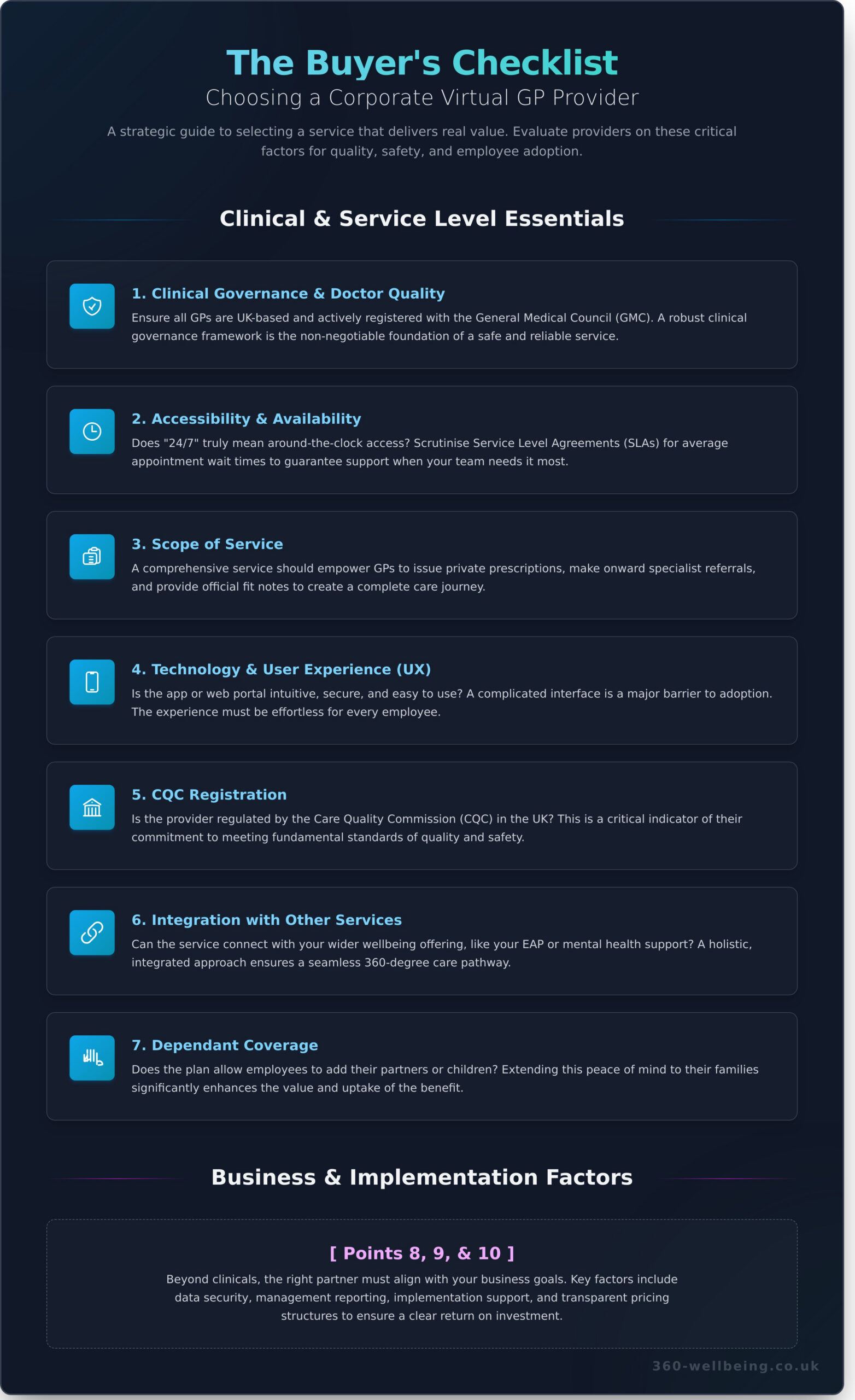
Selecting the right partner for your corporate virtual GP services is a strategic decision that directly impacts employee wellbeing and your return on investment. A truly comprehensive solution goes beyond just offering video calls; it provides a seamless, reliable, and clinically robust healthcare experience. To help you navigate the options with confidence, we’ve developed a definitive 10-point checklist, breaking down the essential criteria into two key areas.
Clinical & Service Level Essentials
These foundational elements guarantee the quality, safety, and effectiveness of the care your employees will receive. They are non-negotiable pillars of a trustworthy service.
- 1. Clinical Governance & Doctor Quality: Are all GPs UK-based and actively registered with the General Medical Council (GMC)? A strong clinical governance framework is the bedrock of a safe and reliable service.
- 2. Accessibility & Availability: Does “24/7” truly mean around-the-clock access? Scrutinise the Service Level Agreements (SLAs) for average wait times for an appointment, ensuring your team can get support when they need it most.
- 3. Scope of Service: A comprehensive service should empower GPs to issue private prescriptions, make onward referrals to specialists, and provide official fit notes, creating a care journey that feels complete.
- 4. Technology & User Experience: Is the platform (app or web portal) intuitive and secure? A complicated interface is a major barrier to adoption. The experience should feel effortless for every employee.
- 5. CQC Registration: Is the provider regulated by the Care Quality Commission (CQC) in the UK? This is a critical indicator of their commitment to meeting fundamental standards of quality and safety.
- 6. Integration with Other Services: Can the service connect with your wider wellbeing offering, such as your Employee Assistance Programme (EAP) or mental health support? A holistic approach ensures a seamless 360-degree care pathway.
- 7. Dependant Coverage: Does the plan allow employees to add their partners or children? Extending this peace of mind to their families significantly enhances the value of the benefit.
Business & Implementation Factors
Beyond the clinicals, the right partner will align with your business goals, offering transparent data, robust support, and a flexible commercial model that grows with you.
- 8. Reporting & Anonymised Data: What level of insight will you receive? High-quality, anonymised data on usage and common health trends can help you proactively shape your wider wellbeing strategy.
- 9. Onboarding & Engagement Support: How will the provider help you launch the service and drive adoption? Look for a partner who offers a dedicated support team and a full suite of communication materials.
- 10. Pricing & Contract Flexibility: Is the pricing model transparent and scalable (e.g., a simple per-employee-per-month fee)? As the inclusion of Virtual GPs in Employee Benefits packages becomes a standard expectation, understanding the total cost of ownership is vital for demonstrating long-term value.
Standalone App vs. Integrated Platform: The Most Critical Decision
As a forward-thinking leader evaluating corporate virtual GP services, you will inevitably face a critical choice. It’s a question we often hear: “Why should we invest in a comprehensive platform when a cheaper, standalone GP app seems to do the job?” While the appeal of a simple, low-cost solution is understandable, it overlooks the fundamental nature of employee health: it is never one-dimensional.
A persistent headache may not just be a physical symptom; it could be the result of mounting financial stress. A bout of insomnia could be rooted in work-related anxiety. A standalone app can only treat the symptom, whereas an integrated platform is designed to support the whole person. Health issues are rarely isolated, and your wellbeing strategy shouldn’t be either.
The Limits of a Standalone GP Service
A standalone GP service operates in a silo. It is an effective tool for reactive care-addressing a physical symptom after it appears-but it stops there. This approach creates a fragmented experience for your team, forcing them to navigate multiple apps, logins, and providers for different aspects of their health. It also places the burden on your HR department to connect the dots between disparate initiatives, trying to build a cohesive wellbeing culture from disconnected parts.
The Power of an Integrated Approach
A truly comprehensive platform transforms this fractured experience into a seamless, supportive journey. With the NHS making virtual consultations a standard, as confirmed by official government data on GP online access, the expectation for digital convenience is set. A superior wellbeing partner meets this expectation and builds upon it, creating a proactive ecosystem of care. This unified model delivers profound, long-term value.
- Seamless Care Journeys: A GP can identify signs of burnout during a consultation and instantly refer the employee to in-house mental health counselling or a financial wellbeing coach, all within the same secure system.
- A Single Source of Truth: Your employees get one trusted, confidential portal for all their wellbeing needs, from medical advice to emotional support, which eliminates confusion and boosts engagement.
- Richer Strategic Insights: By connecting physical and mental health trends, you gain a holistic, anonymised view of your workforce’s health, enabling you to make proactive and data-driven decisions.
- Greater Return on Investment: By addressing root causes rather than just symptoms, an integrated approach fosters genuine resilience, reduces absenteeism, and demonstrates a powerful commitment to your people.
Calculating the ROI: How to Justify the Investment to Leadership
Viewing employee wellbeing as a strategic asset rather than an expense is the first step toward building a more resilient and productive workforce. When presenting the case for corporate virtual GP services, a clear, data-driven approach demonstrates its profound financial value. The return on investment (ROI) extends far beyond the direct cost, creating a compelling business case built on reduced absence, enhanced productivity, and stronger employee loyalty.
Follow this simple framework to build your business case:
- Step 1: Calculate your current annual cost of absenteeism.
- Step 2: Estimate a conservative 10-20% reduction in sick days.
- Step 3: Factor in the significant, often-overlooked gains from improved productivity and retention.
- Step 4: Present the final calculation: (Cost Savings + Value Gains) vs. Program Cost.
Measuring Reduced Absenteeism
Employee absence has a direct and measurable impact on your bottom line. By providing immediate access to a GP, you empower your team to address health concerns proactively, often preventing a full day’s absence for a routine appointment or minor illness. Use this straightforward formula to quantify the cost:
(Average daily staff cost) x (Total sick days per year) = Total Annual Cost of Absenteeism
Worked Example (Company of 50):
- With an average salary of £35,000, the average daily cost per employee is ~£135.
- If employees take an average of 5 sick days annually, that’s 250 total days lost.
- Total Annual Cost: £135 x 250 days = £33,750.
- A conservative 15% reduction through a virtual GP service would save your business over £5,000 annually on absenteeism alone.
Quantifying Productivity and Retention
The ROI of comprehensive wellbeing support goes deeper than attendance records. Consider “presenteeism”-when employees are physically at work but mentally distracted or slowed by health worries. A 15-minute virtual consultation can provide the reassurance or prescription needed to restore focus, directly boosting daily output. Furthermore, in a competitive UK job market, the cost of replacing an employee is substantial. High-value benefits like on-demand healthcare are powerful retention tools. Investing in corporate virtual GP services sends a clear message: you are committed to the long-term health of your most valuable asset-your people.
To see how a tailored wellbeing strategy can deliver a powerful ROI for your organisation, explore our comprehensive corporate solutions.
How 360 Wellbeing Delivers a Complete, Integrated GP Solution
Throughout this article, we’ve established the framework for a truly effective employee healthcare strategy. It’s clear that a standalone virtual GP, while useful, is only one piece of a much larger puzzle. The future lies in a connected, proactive, and holistic system of care. This is precisely where 360 Wellbeing transforms the standard model into a comprehensive solution.
When you revisit the essential checklist for choosing a provider, you’ll find our service not only meets but exceeds each criterion. We’ve moved beyond offering a simple point of contact to building a complete ecosystem for health. Our approach is designed to provide immediate support while proactively addressing the underlying causes of ill-health, creating a resilient and productive workforce.
More Than Just a Doctor: A 360° Approach to Care
Our corporate virtual GP services are built on the principle that true wellbeing requires a connected journey. The initial GP consultation is the crucial first step, acting as a gateway to a full spectrum of expert support.
- Clinical Excellence, 24/7: Your employees gain immediate access to UK-based, GMC-registered doctors anytime, anywhere, ensuring they receive trusted medical advice without delay.
- Seamless In-Platform Referrals: A GP can identify an issue like work-related stress and, within the same platform, make a direct referral to our mental health support team for counselling. Or, if they diagnose a musculoskeletal problem, they can instantly refer the employee for physiotherapy.
- Holistic Support System: We go further by integrating our Employee Assistance Programme (EAP), offering confidential financial and legal guidance to tackle the root causes of anxiety and absenteeism before they escalate.
Your Partner in Employee Wellbeing
Implementing a new benefit is only successful if it’s embraced by your team. We act as a dedicated partner to ensure your investment delivers tangible results. Our onboarding team works with you to launch the service effectively, driving high engagement from day one. Furthermore, our platform provides powerful, anonymised reporting, allowing you to track usage, identify wellbeing trends, and clearly demonstrate the positive ROI of a healthier, more supported team.
Ready to move from fragmented benefits to a single, powerful wellbeing strategy? See how an integrated approach can transform your team’s health and build a culture of care.
Your Strategic Partner in Employee Wellbeing for 2026 and Beyond
As we’ve explored, choosing how to support your team’s health is one of the most critical business decisions you’ll make. The future of workplace wellness in the UK isn’t about standalone perks; it’s about providing a fully integrated ecosystem of care that delivers a powerful return on investment. Selecting the right corporate virtual GP services is the foundational step in building a culture of proactive health and resilience that attracts and retains top talent.
At 360 Wellbeing, we deliver that complete, integrated solution. Trusted by hundreds of UK businesses, our platform provides your employees with 24/7 access to UK-registered GPs, seamlessly connected to comprehensive mental, financial, and legal support. Don’t settle for a fragmented approach to wellbeing. Discover how a truly holistic strategy can empower your team and strengthen your organisation.
Ready to see the future of employee care? Book a demo to see our integrated wellbeing platform in action and take the first step towards a healthier, more productive workforce.
Frequently Asked Questions About Corporate Virtual GP Services
How much do corporate virtual GP services cost in the UK?
The investment in corporate virtual GP services is typically structured on a per-employee-per-month basis, offering a scalable and predictable cost. In the UK, prices generally range from £5 to £15 per employee. This cost can vary depending on the size of your organisation and the comprehensiveness of the plan, such as whether it includes mental health support or family member access. We provide tailored quotes to ensure the service aligns perfectly with your budget and your team’s specific wellbeing needs.
Are virtual GP consultations confidential from the employer?
Yes, completely. All consultations are protected by the same strict patient-doctor confidentiality as an in-person NHS or private appointment. Your employer will never have access to any personal medical information, consultation notes, or diagnoses. We provide businesses with anonymised, aggregated data on service usage to help them understand workforce health trends, but individual privacy is always our paramount concern. This ensures your team can seek support with total confidence and peace of mind.
Can a virtual GP issue prescriptions and sick notes (fit notes)?
Our GMC-registered virtual GPs are fully authorised to provide private prescriptions and issue medically certified fit notes (formerly sick notes). If a prescription is needed, it can be sent directly to your employee’s chosen local pharmacy for convenient collection, often within hours. Similarly, if an employee is deemed unfit for work, the GP can email a digital fit note directly to them, streamlining the process and ensuring they have the official documentation they need without delay.
Is a virtual GP service a replacement for the NHS or Private Medical Insurance (PMI)?
A virtual GP service is designed to be a complementary, proactive healthcare tool, not a replacement for the NHS or PMI. It provides rapid access for everyday health concerns, helping to reduce presenteeism and alleviate pressure on NHS services. For businesses with PMI, it acts as an efficient primary care gateway, often speeding up the referral process for specialist care. It fills a crucial gap by offering immediate, convenient support for non-emergency issues, enhancing your overall wellbeing strategy.
How quickly can an employee get an appointment with a virtual GP?
Speed and accessibility are core benefits of our service. Employees can typically book a video or phone consultation and speak with a GP on the very same day, often within just a few hours. This immediate access removes the long waiting times often associated with traditional appointments, allowing your team to address health concerns proactively. By getting timely advice and treatment, employees can feel better sooner, reducing anxiety and minimising disruption to their work and personal lives.
What is the implementation process like for a business?
We ensure the implementation of our service is a seamless and straightforward process. Your business will be assigned a dedicated account manager to guide you every step of the way, from initial setup to employee onboarding. We provide a comprehensive communications toolkit to help you launch the service effectively to your team, ensuring high engagement from day one. Our goal is to make the entire process effortless for you, so you can focus on the positive impact on your team’s health.
Can employees’ family members be covered by the corporate plan?
Absolutely. We understand that an employee’s wellbeing is intrinsically linked to their family’s health. Many of our corporate plans can be tailored to include an employee’s partner and dependent children, extending this valuable support to their loved ones. This comprehensive approach helps reduce stress and anxiety at home, allowing your team members to be more present and focused at work. It’s a powerful way to demonstrate a genuine, holistic commitment to your employees’ overall quality of life.