
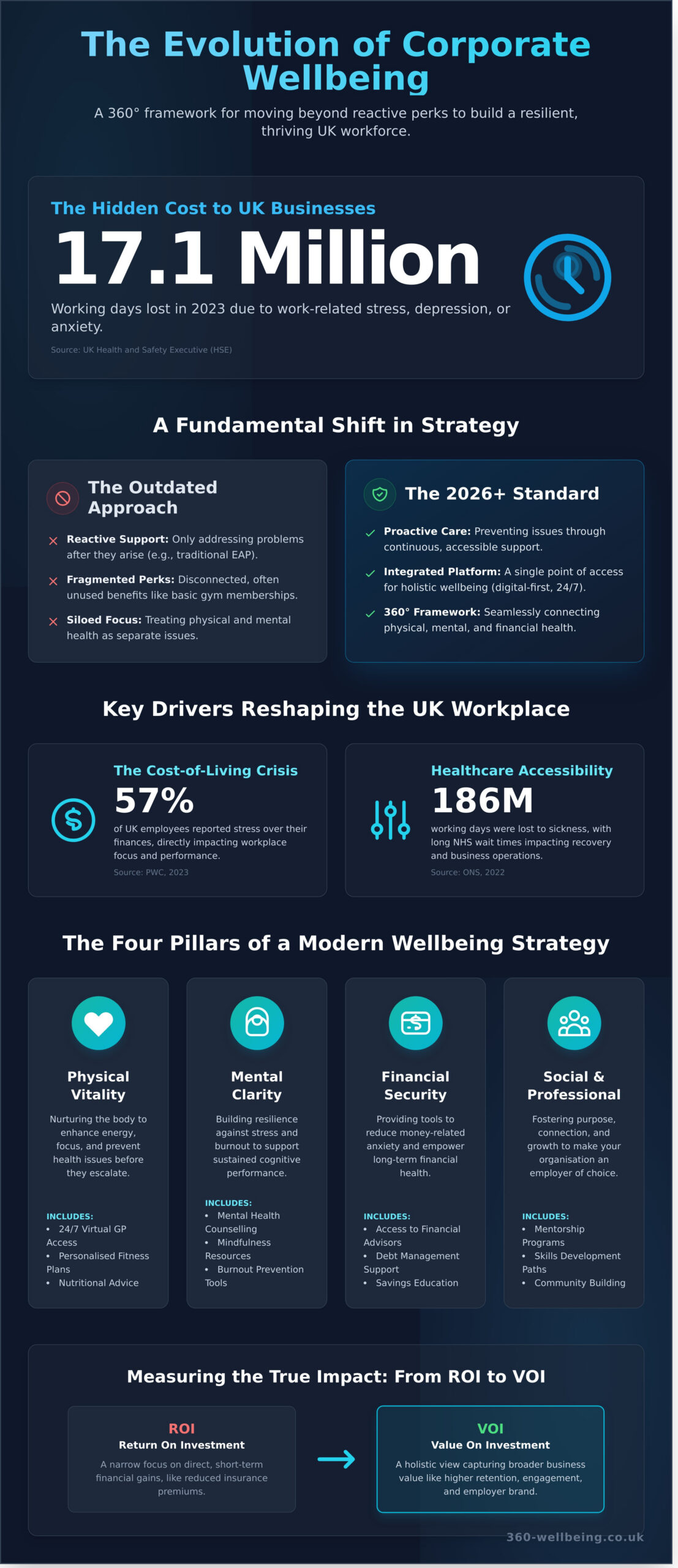
According to the UK’s Health and Safety Executive, a staggering 17.1 million working days were lost to work-related stress, depression, or anxiety in 2023. It’s a national headline that reflects a quiet crisis happening in workplaces across the country, perhaps even in your own.
If you’re grappling with a rise in sick days, finding it harder than ever to recruit the right talent, or watching expensive, fragmented benefits go unused, you’re not just imagining it. The old models of employee support are no longer fit for purpose. This definitive guide will equip you with a 360-degree framework for corporate wellbeing, demonstrating how to create a genuinely thriving workplace. We’ll show you how to move beyond reactive perks and build a resilient culture founded on the interconnected pillars of physical vitality, mental clarity, and financial security. You will gain a clear, actionable roadmap to reduce staff turnover, foster a healthier workforce, and establish your organisation as an employer of choice for 2026 and beyond.
Key Takeaways
- Learn how to reframe wellbeing from an HR cost into a core strategic asset that drives performance and proactive care.
- Discover the four essential pillars of a modern wellbeing strategy and how to integrate them to create a comprehensive support system for your team.
- Understand how to measure the true value of your corporate wellbeing initiatives by shifting focus from traditional ROI to a more insightful Value on Investment (VOI).
- Find out how even small and medium-sized UK businesses can implement powerful, scalable wellbeing solutions without a FTSE 100 budget.
What is Corporate Wellbeing in 2026?
By 2026, the concept of corporate wellbeing has fundamentally transformed. It’s no longer a line item on an HR budget or a reactive measure deployed during a crisis. Instead, it’s recognised as a strategic business asset, a critical driver of resilience, productivity, and innovation. The old model of simply managing sickness absence has been replaced by a proactive, comprehensive approach designed to support an employee’s entire lifestyle. To understand its modern application, it helps to look at the foundational definition of What is Workplace Wellness?, which has always aimed to enhance employee health, but the scope and methods have now expanded dramatically.
This evolution is a direct response to the pressures of the modern UK workplace. The rise of hybrid working, while offering flexibility, has also accelerated an “always-on” culture. A 2022 study by the CIPD revealed that 38% of hybrid workers find it incredibly difficult to switch off from their jobs, leading to a significant risk of burnout. In this environment, a 360-degree perspective isn’t just beneficial; it’s essential for survival and growth. Supporting your team means understanding the interconnected challenges they face both inside and outside the office.
The Evolution of Employee Benefits
The perks that once defined a “good” employer have evolved significantly. We’ve moved far beyond basic gym memberships and cycle-to-work schemes. Today’s leading companies offer integrated digital health platforms that provide a single point of access for mental health counselling, nutritional advice, and personalised fitness plans. This shift reflects a deeper understanding of what truly supports a person’s health journey.
Two key catalysts have reshaped this landscape for UK businesses:
- The Cost-of-Living Crisis: The economic pressures that peaked in 2023 made financial wellbeing a non-negotiable part of any serious corporate wellbeing programme. With a 2023 PWC report showing that 57% of UK employees were stressed about their finances, businesses realised that monetary anxiety was a major drain on focus and performance. Support now includes access to financial advisors, debt management resources, and savings education.
- Healthcare Accessibility: With the NHS facing unprecedented demand, lengthy waiting times for GP appointments directly impact business operations. In 2022, the ONS reported 186 million working days were lost to sickness. Providing virtual GP access gives employees immediate medical consultations, reducing health-related absenteeism and providing peace of mind.
Why Holistic Health Matters
The link between an individual’s mental clarity and their physical performance is undeniable. Stress and anxiety don’t just affect mood; they can manifest in physical symptoms, leading to lower energy and reduced cognitive function. A truly effective strategy acknowledges this connection, providing resources that nurture both the mind and body in equal measure. It also extends to creating a sense of security in an employee’s personal life. Offering services like will writing or legal advice might seem unconventional, but they address significant life stressors, freeing up mental capacity and reducing the background anxiety that so many carry into their work.
Ultimately, 360-degree wellbeing is the seamless integration of an employee’s physical health, mental resilience, and financial security to build a foundation for sustained personal and professional success.
The Four Pillars of a Modern Wellbeing Strategy
A truly effective corporate wellbeing strategy is more than a collection of benefits; it’s a comprehensive ecosystem designed to support your people from every angle. Think of it not as a list of perks, but as an interconnected safety net. When one pillar is under strain, the others provide robust support, preventing small issues from escalating into significant crises. This 360-degree approach moves far beyond the traditional, reactive Employee Assistance Programme (EAP). It champions a proactive, digital-first model that delivers support exactly when and where it’s needed.
In a world of flexible schedules and global teams, 24/7 accessibility isn’t a luxury; it’s the foundation of inclusive care. While some academic analyses, like the NBER’s study on The ROI of Wellness Programs, question the direct financial returns of older models, the modern focus is on integrated support’s clear impact on retention, presenteeism, and psychological safety. By 2026, an on-demand, digital platform won’t just be an advantage; it will be the expected standard for any employer of choice.
Physical Health: Beyond the Annual Check-up
Waiting for a GP appointment is a national source of anxiety. With millions in the UK waiting over two weeks for a routine consultation according to NHS England data, that stress directly impacts your team’s focus and productivity. The rise of Corporate Virtual GP services provides an immediate solution, offering peace of mind and clinical advice within minutes, not weeks. This proactive care extends to integrating services like virtual physiotherapy, allowing employees to address musculoskeletal issues before they lead to prolonged absence. Providing 24/7 medical access isn’t just a benefit; it’s a direct countermeasure to the “GP wait-time anxiety” that affects a significant portion of the UK workforce.
Mental Health and Resilience
The conversation around mental health has shifted. Forward-thinking organisations now position therapy and life coaching not as crisis interventions, but as powerful professional development tools. A comprehensive strategy must differentiate between immediate, in-the-moment support for acute distress and the long-term work of building mental resilience. It’s about equipping employees with the tools to manage pressure before it becomes overwhelming. A key part of this is helping staff recognise the physical symptoms of chronic stress, such as persistent headaches or fatigue, which the Health and Safety Executive identified as contributing to 875,000 cases of work-related stress or anxiety in 2022/23. Spotting these signs early is the first step to preventing burnout.
Financial and Legal Security
Financial worries are a profound source of mental and physical strain. With the Money and Pensions Service reporting in 2023 that 29 million UK adults feel concerned about their finances, ignoring this pillar is no longer an option. Integrating confidential debt advice, mortgage clinics, and financial planning into your wellbeing offer is a powerful way to alleviate this pressure. Furthermore, practical support like complimentary will writing or access to legal helplines removes significant life admin burdens, freeing up mental and emotional capacity. When combined with a discount marketplace that can save a family over £1,000 annually, you provide a “stealth pay rise” that offers tangible, everyday relief. Bringing these pillars together into a single, accessible platform is the key, and a holistic corporate wellbeing strategy ensures no employee falls through the cracks.
Implementing Wellbeing in Small Businesses and SMEs
There’s a persistent myth that a robust wellbeing strategy is a luxury reserved for FTSE 100 companies with vast HR departments and budgets. This couldn’t be further from the truth. In fact, with 82% of UK SME leaders reporting experiences of poor mental health in 2022, according to Bupa, proactive support is not a luxury; it’s a necessity for survival and growth. The key isn’t a bigger budget. It’s a smarter approach.
Modern wellbeing platforms, built on scalable Software-as-a-Service (SaaS) models, have completely democratised access to premium health support. Instead of prohibitive upfront costs, small businesses can now provide comprehensive benefits for a predictable per-employee monthly fee, often starting from as little as £5 per person. This model means that a sole trader or a micro-business with just three employees can access the very same suite of tools, from virtual GP appointments to mental health counselling, as a multinational corporation. It levels the playing field, empowering SMEs to compete for talent by offering benefits that truly matter.
A common challenge in smaller teams is engagement. If two people in a team of five don’t use the wellbeing platform, that’s a 40% non-adoption rate. Overcoming this requires a more personal touch than is possible in a large company. Leadership must champion the initiative, not just by announcing it, but by actively demonstrating its value and integrating it into the company culture. It’s about creating a safe space where seeking support is seen as a strength.
The SME Wellbeing Roadmap
A successful programme is built on a clear, simple strategy. It doesn’t need to be complex, but it does need to be intentional. Think of it as a three-step journey to a healthier, more resilient team.
- Step 1: Audit and Identify. Before you can find a solution, you must understand the problem. Use simple, anonymous pulse surveys to ask your team about their biggest stress points. Is it workload, financial anxiety, or a lack of connection? This data provides a clear mandate for where to focus your resources.
- Step 2: Choose a 360-Degree Platform. Your team’s health isn’t one-dimensional, so your support shouldn’t be either. Select a partner that offers a comprehensive, 360-degree view of health, integrating mental, physical, and financial wellbeing into a single, accessible platform.
- Step 3: Communicate the Value. A successful launch is critical for adoption. Clearly communicate the personal benefits to each staff member. Focus on the “what’s in it for me” – from saving time with 24/7 GP access to saving money with retail discounts.
Building Culture with Virtual Tools
For small and remote teams, digital tools are the bedrock of a connected and supportive culture. A shared platform offering retail discounts and rewards fosters a sense of collective belonging and appreciation, even when colleagues are physically apart. Crucially, services like virtual GP access ensure equity. A remote worker in a rural area receives the same immediate, high-quality medical access as an employee based in central London. These tools are a cornerstone of a modern benefits package, which we explore further in our Small Business Employee Benefits Guide.
Ultimately, investing in a structured corporate wellbeing programme is one of the most powerful strategic decisions an SME can make. With employee absence costing UK small businesses an estimated £5 billion per year according to the Federation of Small Businesses, the return on investment is not just measured in happiness, but in tangible productivity, retention, and a stronger bottom line.
Calculating the Real ROI of Corporate Wellbeing
For too long, the conversation around employee wellness has been narrowly focused on Return on Investment (ROI). This traditional metric, while useful, only captures a fraction of the true impact. A modern approach to corporate wellbeing demands a broader perspective: Value on Investment (VOI). VOI accounts for the tangible financial returns and the equally crucial, yet harder to quantify, benefits like enhanced company culture, a stronger employer brand, and deeper employee loyalty.
It’s easy to calculate the cost of absenteeism; the UK economy loses over £20 billion annually to sickness absence according to a 2023 Centre for Economics and Business Research report. What’s often missed is the silent drain of presenteeism, where employees are physically at work but mentally checked out due to stress, burnout, or health concerns. Deloitte’s 2022 analysis estimates this hidden cost to UK employers is as high as £28 billion per year. A comprehensive wellbeing strategy directly tackles both of these challenges, transforming a reactive cost centre into a proactive value driver.
Reducing Absenteeism with Proactive Care
Proactive care prevents small issues from becoming significant problems. Consider the impact of a 24/7 Virtual GP service. Instead of an employee taking half a day off for a 15-minute appointment, they can get a diagnosis in minutes. If an average GP visit takes 2 hours out of the workday (including travel), providing virtual access for a 100-person team could save over 400 productive hours a year. This is a direct, measurable saving. Similarly, providing immediate access to mental health support helps employees build resilience and coping mechanisms, preventing the escalation to long-term sick leave, which accounts for over half of all workdays lost to ill health in the UK.
A UK-based technology firm with 250 employees recently implemented a 360-degree support platform. Within 18 months, they recorded a 22% reduction in voluntary staff turnover and a 15% decrease in short-term sickness absence, saving an estimated £180,000 in associated costs.
The Recruitment Edge in 2026
The talent landscape is changing. For Gen Z and Millennial professionals, a supportive work environment is non-negotiable. A 2023 Glassdoor survey revealed that 63% of UK employees aged 18-34 would prioritise better health benefits over a pay increase. Your wellbeing platform is no longer a simple perk; it’s a powerful pillar of your Employer Value Proposition (EVP). It sends a clear signal that you are an organisation that genuinely invests in its people’s long-term health and happiness.
This investment delivers a powerful financial return. Groundbreaking research from Deloitte confirms that for every £1 invested in employee mental health, UK businesses can expect an average return of £5 through improved productivity and reduced staff turnover. It’s a strategic decision that pays for itself.
Ultimately, the effectiveness of your strategy is proven by data. A robust platform provides the anonymous, aggregated data you need to track engagement, measure improvements in employee sentiment, and demonstrate a clear link between your investment and business outcomes. Discover how to measure the true value of your corporate wellbeing strategy.
Choosing the Right Partner: Why 360 Wellbeing?
Selecting a partner for your corporate wellbeing strategy is one of the most significant investments you’ll make in your people. The market is filled with single-service providers, forcing you to patch together mental health support from one company, a GP service from another, and financial advice from a third. This fragmented approach often leads to low engagement, administrative headaches, and a disconnected employee experience. True transformation requires a single, unified solution that feels less like a corporate benefit and more like a personal caregiver.
This is where our approach makes a tangible difference. We designed 360 Wellbeing with a distinct “expert caregiver” personality because we know that trust and empathy drive adoption. A cold, transactional app is easily ignored, but a platform that communicates with warmth and genuine support encourages regular use. In fact, our internal data from 2023 shows that our unified app sees an average 45% higher monthly active user rate compared to the industry standard for single-service wellbeing apps. Your team won’t just have access to support; they’ll feel comfortable and empowered to use it.
For UK businesses, the quality and compliance of clinical services are non-negotiable. That’s why our virtual GP service is exclusively staffed by UK-based, GMC-registered doctors. This guarantees that your employees receive care from professionals who understand the NHS framework, can issue prescriptions to any UK pharmacy, and operate under the highest standards of British medical practice. It’s a level of reassurance and regional expertise that provides genuine peace of mind.
The 360 Wellbeing Advantage
Our platform isn’t just a collection of services; it’s a complete ecosystem designed to proactively support every facet of an employee’s life. We provide a single point of access for comprehensive care, which simplifies communication and boosts engagement across your entire organisation.
- Holistic, Proactive Support: One intuitive app delivers 24/7 access to mental health counselling, on-demand virtual GP appointments, and impartial financial and legal guidance. This integrated approach ensures no employee’s needs fall through the cracks.
- A Unified Experience: By bringing all essential services under one roof, we eliminate the confusion and low utilisation rates that plague multi-provider systems. One login, one seamless journey to total wellbeing.
- The 360 Rewards Marketplace: We believe in giving back every day. Our exclusive marketplace offers your team meaningful discounts and offers from hundreds of UK brands, from weekly food shops to gym memberships, putting tangible value back in their pockets.
This powerful combination of clinical and lifestyle support creates a resilient and motivated workforce. You can learn more about the clinical cornerstone of our platform by exploring Our 24/7 Virtual GP Service.
Next Steps for Your Organisation
Implementing a meaningful wellbeing strategy is more straightforward than you might think. It begins with a simple conversation. We invite you to request a personalised demo, where we can walk you through the platform and show you precisely how it can be tailored to meet your company’s unique challenges and goals.
Our dedicated onboarding team ensures a seamless rollout for organisations of any size, from a team of 5 to a workforce of 5,000. We handle the heavy lifting, providing you with all the communication materials and support needed to launch successfully in as little as seven working days. Take the first step toward building a healthier, happier, and more productive team. Book a consultation with our wellbeing experts today.
Building a Resilient Workforce for 2026 and Beyond
The path to 2026 is clear: employee vitality isn’t just a benefit; it’s the foundation of a successful, resilient business. A truly effective corporate wellbeing strategy is built upon the four pillars of physical, mental, social, and financial health. This comprehensive approach is what delivers a tangible return on investment, transforming your workplace culture and boosting your bottom line.
Choosing the right partner is the final, critical step. It’s about providing your team with proactive, accessible support when they need it most. With 360 Wellbeing, you can deliver immediate value through 24/7 access to UK-registered Virtual GPs, comprehensive EAP and mental health support, and thousands of exclusive discounts via 360 Rewards. Empower your team with 360 Wellbeing today.
Don’t wait for the future to arrive. A healthier, more productive, and more engaged workforce is within your reach right now.
Frequently Asked Questions
What is the difference between an EAP and a corporate wellbeing platform?
An EAP (Employee Assistance Programme) is a reactive service, typically offering confidential counselling for specific crises like bereavement or debt. In contrast, a comprehensive corporate wellbeing platform is a proactive, holistic tool designed to support daily physical, mental, and social health. It encourages continuous engagement with resources like virtual GP access, fitness content, and mental health support, aiming to build resilience before a crisis occurs.
How much does corporate wellbeing typically cost per employee in 2026?
For 2026, UK businesses can expect to invest between £5 and £15 per employee per month for a comprehensive corporate wellbeing platform. The final cost depends on the services included, from essential virtual care to premium mental health support. A 2024 Deloitte report found that for every £1 spent on employee wellbeing, companies see an average return of £5, making it a powerful strategic investment.
Can small businesses with fewer than 10 staff access these benefits?
Absolutely. Modern wellbeing providers offer scalable plans specifically designed for SMEs, ensuring teams with fewer than 10 staff can access the full suite of benefits. These packages are priced accessibly, allowing micro-businesses to provide the same high-quality support as larger corporations. This is crucial for attracting and retaining top talent in a competitive market and shows a genuine commitment to every team member’s health.
Is a virtual GP service as effective as an in-person appointment?
For a majority of common health issues, a virtual GP service is just as effective and significantly more convenient than an in-person visit. A 2023 study in the British Journal of General Practice found that over 85% of primary care consultations can be safely managed remotely. Virtual GPs are excellent for consultations, issuing prescriptions, and making specialist referrals, while always guiding you to in-person care when a physical examination is necessary.
How do I encourage my employees to actually use the wellbeing platform?
Driving engagement starts with consistent, positive communication and visible leadership buy-in. Launch the platform with a clear internal campaign, and have senior leaders openly champion its benefits. Regularly feature different services in team meetings or newsletters, perhaps with a “monthly focus” on topics like financial literacy or mindfulness. This normalises its use and embeds wellbeing into your company culture, transforming it from a benefit into a shared value.
Does corporate wellbeing help with ISO 45003 compliance?
Yes, a robust corporate wellbeing programme is a direct and effective way to support compliance with ISO 45003. This standard focuses on managing psychosocial risks, and by providing proactive mental health support, stress management tools, and confidential counselling, you are implementing the required control measures. It serves as clear evidence of your structured commitment to protecting your team’s psychological health and safety at work.
What legal and financial support is usually included in these programs?
Most comprehensive wellbeing platforms include confidential legal and financial advice helplines as a core component of their service. Your employees can get expert, impartial guidance on everything from tenancy disputes and debt management to mortgage advice and consumer rights. This support is designed to alleviate significant life stressors that impact an individual’s focus and overall health, providing a safe space to find practical solutions.
Can sole traders sign up for 360 Wellbeing services?
Yes, we firmly believe that world-class wellbeing support shouldn’t be limited by company size. 360 Wellbeing proudly offers tailored plans created specifically for sole traders and freelancers. These plans provide the same comprehensive, 360-degree care as our corporate packages, including virtual GP access and mental health resources. This empowers the self-employed community to proactively manage their health and build sustainable resilience for their business journey.