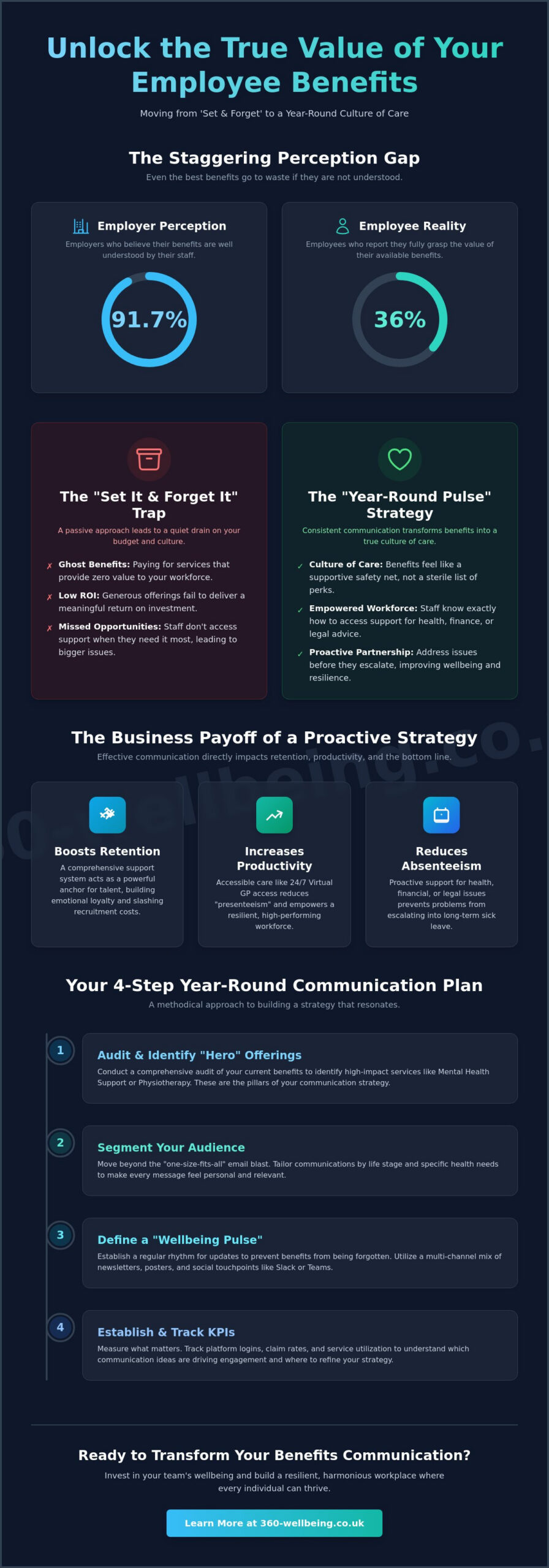
While 91.7% of employers believe their benefits are well understood, only 36% of employees report that they actually grasp the full value of what is available to them. This staggering gap suggests that even the most comprehensive packages, including 24/7 Virtual GP access or mental health support, can easily go to waste without a proactive approach. If you’re feeling overwhelmed by manual updates or frustrated that your team is forgetting about their EAP or life coaching perks, you’re certainly not alone. It’s time to move beyond the static annual enrollment period and explore fresh employee benefits communication ideas that resonate through every season of the year.
We believe that effective communication is an act of care, not just a corporate broadcast. You’ve invested in your team’s wellbeing, and you deserve to see that investment translate into a culture where staff feel truly supported and empowered. By shifting to a year-round pulse strategy, you can ensure your workforce knows exactly how to access financial support, physiotherapy, or legal advice when they need it most. This article provides actionable strategies and creative ideas to boost engagement in 2026, helping you improve benefit ROI while building a more resilient, harmonious workplace where every individual can thrive.
Key Takeaways
- Understand why a “set it and forget it” approach hinders ROI and how consistent messaging fosters a culture of care while reducing absenteeism.
- Learn how to audit your current offerings and segment your audience, ensuring that every communication feels tailored to the individual’s unique health journey.
- Discover ten creative employee benefits communication ideas, such as peer-to-peer testimonials, designed to make complex wellbeing topics feel accessible and engaging.
- Gain insights into phrasing sensitive support for mental health and finance, positioning your EAP as a reliable and confidential safety net for your team.
- Identify how to measure success using both quantitative claim data and qualitative feedback to continuously refine your long-term wellness strategy.
The Business Case for Creative Benefits Communication
Many organizations fall into the trap of the “set it and forget it” mentality. They spend months selecting the perfect employee benefits package, only to announce it once and let it gather digital dust on an intranet page. This approach is a recipe for low engagement. When staff don’t understand or remember what’s available, the business suffers from “ghost benefits”; these are services you’re paying for that provide zero value to your workforce. It’s a quiet drain on your budget. Without a steady stream of fresh employee benefits communication ideas, even the most generous offerings will fail to deliver a meaningful return on investment.
The true value of these services lies in their ability to transform a corporate environment into a genuine culture of care. Instead of a sterile list of perks, your benefits should feel like a supportive safety net. When employees know they have access to financial support or legal advice during a crisis, their stress levels drop. This clarity directly impacts the bottom line by reducing absenteeism. When a team member feels supported, they’re more likely to address health or personal issues before they escalate into long-term sick leave. It’s about moving from a reactive stance to a proactive partnership.
Boosting Retention Through Benefit Awareness
When an employee fully grasps the scope of their package, those benefits act as a powerful anchor for talent. It’s no longer just about the monthly salary; it’s about the comprehensive support system that surrounds them. Moving from a transactional relationship to one of emotional loyalty happens when a staff member realizes their employer is deeply invested in their long-term vitality. Strategic communication effectively slashes recruitment costs by building a protective barrier against headhunters, as the perceived value of staying often outweighs the lure of a slightly higher external wage.
The Productivity Payoff of Accessible Care
Productivity thrives on foresight. By ensuring your team knows how to access a 24/7 Virtual GP long before a health concern arises, you empower them to take proactive steps. This reduces “presenteeism,” where staff are physically at their desks but mentally checked out due to untreated physical or mental health struggles. Promoting regular mental health therapy sessions or physiotherapy helps maintain the durability of your workforce. A healthy, informed team is a resilient one, capable of sustaining high performance without the looming threat of burnout or chronic illness. When care is accessible, work becomes sustainable.
Building Your Year-Round Benefits Communication Plan
Creating a strategy that truly resonates requires a methodical approach that moves beyond the traditional annual enrollment window. You should start by conducting a comprehensive audit of your current landscape to identify your “hero” offerings. These are the high-impact services, such as Mental Health Support or Physiotherapy, that provide the most immediate and tangible relief to your workforce. Once you’ve identified these pillars, you can begin to segment your audience by life stage and specific health needs. This ensures that a junior employee hears about 360 Rewards while a senior manager receives timely information about Complimentary Will Writing. This level of foresight transforms a generic list into a personalized care plan.
To maintain momentum, you need to define a “wellbeing pulse” that dictates the frequency of your updates. This rhythm prevents the silence that often leads to employees forgetting what’s available to them. Your plan should involve a multi-channel mix, combining digital newsletters, physical posters in communal spaces, and social touchpoints like Slack or Microsoft Teams. Utilizing a structured employee benefits communication toolkit can provide the necessary framework to organize these efforts effectively. Finally, establish clear KPIs that track more than just platform logins. Look at actual claim rates and service utilization to understand which employee benefits communication ideas are truly driving engagement and which need refinement.
Segmenting for Maximum Impact
The “one size fits all” email blast is a relic of the past that often leads to message fatigue. If you want your communication to feel like a partnership, you must tailor it to the recipient’s daily reality. Remote workers, for instance, might rely heavily on mobile-app notifications for their 24/7 Virtual GP access, while office-based teams might engage more with QR codes on breakroom tables. By using demographic data, you can highlight relevant services like Life Coaching for those seeking career growth or Financial Support and Debt Advice for staff navigating economic shifts. This personalized touch shows that you’re looking out for their long-term interests.
The “Wellbeing Pulse” Calendar
Consistency is the heartbeat of a healthy culture. By mapping your employee benefits communication ideas to a dedicated calendar, you ensure that wellbeing remains a professional necessity rather than a seasonal afterthought. Aligning your internal messaging with national health awareness days, such as Mental Health Awareness Week, provides a natural hook for your content. You might designate specific themes for each month, such as “Financial Feb” or “Mental Health May,” to provide a clear, structured path forward for your team. If you’re looking to simplify this process, integrating a unified wellbeing platform can help centralize these touchpoints into one accessible hub.
10 Creative Ideas to Engage Your Workforce
To truly bridge the gap between offering a perk and ensuring it’s used, you need to experiment with diverse employee benefits communication ideas. Static PDFs often fail because they lack the human touch that drives action. As suggested by industry leaders to improve benefits communication, variety is essential to reaching different personality types within your team. Implementing these creative strategies doesn’t have to be complex; it just needs to be intentional. Here are five practical ways to bring your offerings to life:
- Benefits Scavenger Hunts: Challenge your team to find specific details within your wellbeing portal, such as the steps to access Complimentary Will Writing. It turns a chore into a game and encourages platform exploration.
- Peer-to-Peer Video Testimonials: Encourage staff to share 30-second clips about how a specific service helped them. This builds trust far faster than a corporate brochure and highlights the power of peer-to-peer support.
- Lunch and Learn Sessions: Invite wellbeing experts to lead informal discussions on topics like debt advice or physiotherapy. It makes complex health topics feel manageable and accessible in a relaxed setting.
- Physical Desk-Drops: Send a tangible item, like a branded tea bag or a “wellbeing kit,” to their home or desk. It cuts through digital noise and creates a physical connection that an inbox simply can’t replicate.
- Onboarding Speed Dating: Give new hires quick, energetic introductions to different benefit categories. It ensures they feel supported from day one and understand their entitlements immediately.
Digital and Social Engagement
Your digital workspace is the ideal environment for fostering a supportive community. You can leverage Slack or Microsoft Teams channels to share “Wellbeing Wins,” where employees celebrate using their 360 Rewards or completing a life coaching milestone. For immediate care, place QR codes on physical posters in communal areas. This allows a staff member to scan for instant Virtual GP access without having to search through their inbox. Gamifying your discount marketplace can also highlight real-world savings, making the value of your package visible in their daily lives and encouraging consistent usage.
Real-Life Storytelling
Empathy is the most effective tool in your communication arsenal. Sharing anonymized case studies about how your Employee Assistance Programme (EAP) supported a colleague through a difficult time can break down barriers. When senior leaders show vulnerability by posting about their own use of mental health support, it signals that it’s safe for everyone to do the same. This is especially vital when promoting financial support during the cost-of-living crisis. By framing these services as a professional necessity rather than a luxury, you create a culture where every individual feels truly seen and cared for.
Communicating Sensitive Benefits: Mental Health and Finance
Addressing topics like mental health and financial stability requires a delicate balance of clinical accuracy and human warmth. It’s not just about listing services; it’s about creating a safe environment where individuals feel empowered to seek help without judgment. When exploring employee benefits communication ideas, your primary goal should be to bridge the gap between corporate policy and personal wellbeing. By framing these offerings as an essential human entitlement rather than a luxury, you signal that the organization is a partner in every employee’s long-term success. This proactive approach helps dismantle the stigma that often prevents people from accessing the care they need.
One of the most effective ways to build trust is by promoting your Employee Assistance Programme (EAP) as a strictly confidential safety net. Many staff members hesitate to use these services because they fear their concerns will reach management. Your communication must explicitly state that these touchpoints are private and separate from HR records. To further humanize these services, consider appointing “Mental Health Champions” within different departments. These are trained colleagues who can disseminate information and guide peers toward the right resources, acting as a relatable bridge between the workforce and clinical support.
Mental Health and Therapy Access
Normalizing the use of therapy and life coaching is a steady, methodical process. Instead of waiting for a crisis, your messaging should encourage employees to use these tools for maintenance and personal growth. Emphasize the 24/7 availability of support, ensuring that your team knows they can reach out at any hour, whether they’re dealing with workplace stress or personal limitations. By creating “safe space” digital communications, such as private newsletters or dedicated portal sections, you respect their privacy while providing a clear, structured path forward. This foresight ensures that help is always within reach before a challenge becomes unmanageable.
Financial and Legal Peace of Mind
Talking about “scary” topics like debt advice, legal support, or Complimentary Will Writing requires a calm and reassuring tone. Instead of focusing on the fear of what might go wrong, frame these benefits as tools for empowerment and life planning. Linking financial wellness to overall stress reduction is vital, as money worries are often a primary driver of mental health struggles. By promoting these services as a professional necessity, you help your team achieve a sense of completeness and balance. If you want to ensure your workforce feels truly cared for in every aspect of their lives, explore our full range of wellbeing services to find the right fit for your organization.
Measuring Success and Refining Your Strategy
To truly understand if your employee benefits communication ideas are working, you must look beyond surface-level metrics like email open rates. While it’s helpful to know who is reading your updates, the real measure of success lies in the transition from awareness to action. You should distinguish between engagement rates and actual claim rates. For instance, if your team is frequently clicking on links for Mental Health Support but not actually booking sessions, there may be a lingering barrier or a lack of clarity in how to take the next step. Analyzing this data allows you to identify “benefit deserts,” which are specific departments or demographics where engagement is unexpectedly low, signalling a need for more tailored outreach.
Gathering qualitative feedback through “Wellbeing Surveys” is equally essential to maintaining a panoramic view of your strategy’s health. Numbers tell you what is happening, but your employees tell you why. By asking direct questions about how easily they can find information on Physiotherapy or 360 Rewards, you gain the foresight needed to adjust your tone or delivery method. This methodical approach ensures that your communication remains a dynamic conversation rather than a static broadcast. Continuous improvement isn’t just a corporate goal; it’s a commitment to the durability and vitality of your workforce, ensuring that the support you provide evolves alongside their changing lives.
The Feedback Loop
Implementing short, frequent “Pulse Surveys” allows you to check benefit understanding in real-time without causing survey fatigue. These quick touchpoints help you stay connected to the workforce’s pulse, identifying if a recent campaign on financial support resonated or missed the mark. To build deep trust, consider launching a “You Said, We Did” communication campaign. This shows your team that their feedback directly influences company policy, whether it’s simplifying the login process for the Employee Assistance Programme (EAP) or introducing new perks they’ve suggested. When staff see their input translated into tangible support, they feel a greater sense of partnership and value.
Scaling with Technology
In a modern corporate environment, manual communication can quickly become an overwhelming burden for HR teams. An integrated platform simplifies this process by centralizing all your employee benefits communication ideas into a single, intuitive hub. This technology allows for the use of “push notifications,” which are invaluable for delivering urgent health updates or timely reminders about Complimentary Will Writing directly to an employee’s device. By automating the rhythm of your updates, you ensure consistent visibility without the risk of human error or oversight. If you’re ready to move toward a more proactive and seamless approach, explore how 360 Wellbeing automates engagement for your team and helps you build a culture where every individual feels truly supported.
Empowering Your Team Through Consistent Care
Transforming your benefits package from a hidden list of perks into a visible, active lifeline requires more than just a single annual email. By implementing consistent, year-round employee benefits communication ideas, you create a workplace where staff feel genuinely seen and supported. We’ve explored how segmenting your audience and utilizing creative digital touchpoints can bridge the gap between having a benefit and actually using it. Success isn’t just about high login numbers; it’s about the tangible peace of mind your team gains when they know exactly how to access care when life feels challenging.
If you’re ready to simplify your strategy and boost engagement, we’re here to help. Our platform provides 24/7 UK-registered Virtual GP access, comprehensive EAP and Mental Health support, and an integrated rewards and discount marketplace designed to enhance your team’s daily life. Book a demo of the 360 Wellbeing platform today to see how we can partner with you to build a healthier, more harmonious workforce. Your commitment to your team’s vitality is the foundation of a thriving business. Let’s work together to make wellbeing a professional necessity that every employee understands and values.
Frequently Asked Questions
How often should I communicate employee benefits to my staff?
You should aim for a monthly “wellbeing pulse” rather than a single annual announcement. Regular touchpoints ensure that high-value services like Physiotherapy or 360 Rewards remain at the forefront of your team’s mind. By mapping your updates to a year-round calendar, you prevent the silence that leads to low engagement. This consistent rhythm builds a culture where support feels like a permanent entitlement rather than a seasonal event.
What is the most effective channel for benefits communication?
There isn’t a single “best” channel, but an integrated wellbeing platform is often the most effective tool. It centralizes everything from 24/7 Virtual GP access to life coaching in one place. Combining this hub with instant messaging tools like Slack or Microsoft Teams allows you to share quick employee benefits communication ideas that reach staff where they already work. A multi-channel approach ensures that no one misses out on vital support.
How do I communicate benefits to a remote or hybrid workforce?
Prioritize digital-first communication methods like mobile app push notifications and QR codes in home-mailers. Since remote workers lack the physical cues of an office environment, they rely on accessible, on-demand resources. You might also host virtual “Lunch and Learn” sessions to explain complex services like Legal Support. Ensuring that your digital portal is mobile-friendly allows staff to access their benefits during their commute or from the comfort of home.
How can I measure if my benefits communication is actually working?
Measure success by tracking the gap between platform engagement and actual claim rates. High click rates on a newsletter about Mental Health Support are a good start, but the real proof of effectiveness is an increase in employees actually booking sessions. You should also use qualitative “Pulse Surveys” to ask staff if they feel confident using their benefits. This data helps you identify “benefit deserts” where more targeted communication is needed.
What should I do if employees are suffering from “email fatigue”?
Shift your focus toward bite-sized, visual content like short peer-to-peer video testimonials or infographics. If your inbox is overcrowded, use your internal social channels to share quick “Wellbeing Wins.” Push notifications through a dedicated app are also highly effective for urgent health updates as they bypass the inbox entirely. This variety keeps your employee benefits communication ideas fresh and engaging without overwhelming your team’s digital workspace.
How do I encourage staff to use sensitive benefits like mental health support?
Emphasize the total confidentiality of your Employee Assistance Programme (EAP) and mental health services. Employees often fear that seeking help will impact their career progression, so you must explicitly state that these services are private. Encouraging senior leaders to share their own experiences with life coaching or therapy can also normalize these conversations. When vulnerability is modeled from the top, it creates a safe space for everyone else.
Can I communicate benefits during the recruitment process?
Yes, you should highlight your benefits package as a core part of your Employee Value Proposition from the very first interview. Candidates in 2026 are looking for more than just a salary; they want to see a commitment to their long-term health and financial stability. Mentioning services like debt advice or Complimentary Will Writing during onboarding shows that you’re a partner in their success. It builds loyalty before their first day even begins.
What are the best ways to explain complex benefits like EAPs or Virtual GPs?
Use real-world scenarios instead of technical jargon to explain how these services work. Instead of describing the “mechanics” of an EAP, tell a story about how it helps a staff member manage stress or access legal advice during a house move. For a 24/7 Virtual GP, focus on the convenience of getting a prescription without leaving the house. Practical application makes complex clinical services feel accessible, manageable, and deeply personal.