
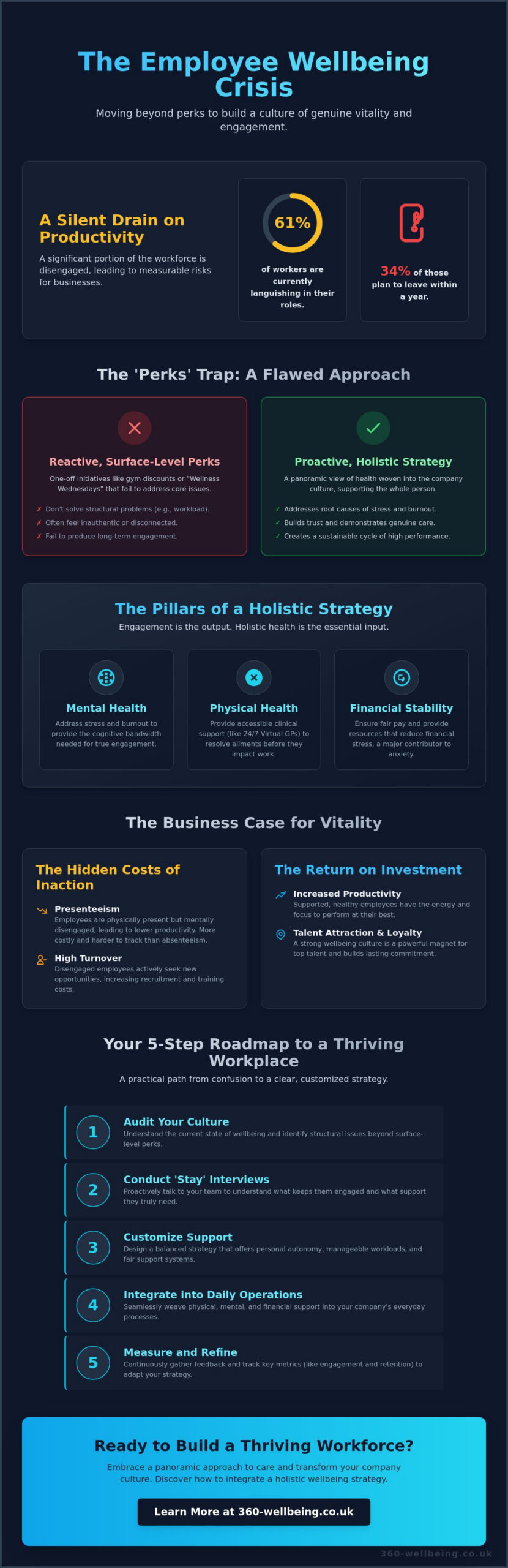
Did you know that 61% of workers are currently languishing in their roles, struggling to find motivation or fulfillment? According to a 2026 report from the University of Illinois, this lack of engagement is a quiet crisis, with 34% of those employees planning to leave their jobs within the next year. It’s frustrating to watch high turnover and absenteeism persist even after you’ve introduced basic perks like gym discounts. You likely understand that a collection of benefits isn’t the same as a genuine employee engagement and wellbeing strategy. True vitality in the workplace requires a panoramic view of your team’s health, moving beyond reactive fixes toward proactive, compassionate care.
We’re here to help you bridge that gap by showing you how to integrate holistic health into a high-impact strategy that drives both productivity and retention. This article provides a clear roadmap for strategy design, moving from confusion over perks to a structured path of support. We’ll examine how to weave together mental health, physical recovery, and financial stability into a single, unified narrative. By the end, you’ll have the tools to build a healthier, more motivated workforce that feels supported for the long term.
Key Takeaways
- Understand why physical and mental health are the essential precursors to cognitive performance and long-term vitality in the modern workplace.
- Learn how to design a comprehensive employee engagement and wellbeing strategy that balances personal autonomy with manageable workloads and fair support.
- Discover the hidden costs of inaction and how a well-structured wellbeing plan provides a significant return on investment for businesses of all sizes.
- Follow a practical 5-step roadmap to audit your current culture and use ‘stay’ interviews to customize support for your team’s specific needs.
- Explore how a panoramic approach to care can seamlessly integrate physical, mental, and financial support into your daily operations within minutes.
The Symbiotic Link: Why Engagement and Wellbeing are Inseparable
In the fast-evolving corporate world of 2026, the lines between personal health and professional performance have blurred entirely. We’ve moved past the era where wellbeing was viewed as a luxury or a corporate gift. Today, a robust employee engagement and wellbeing strategy is a fundamental entitlement for every worker. It’s the foundation upon which all productivity is built. If your team members are struggling with chronic stress or untreated physical ailments, they simply don’t have the cognitive bandwidth to be truly engaged. Cognitive engagement requires a baseline of vitality. When 47% of employees report that job-related stress is the biggest factor impacting their mental health, it becomes clear that engagement is the output, while holistic health is the essential input.
Many organisations suffer from the hidden drain of presenteeism. This happens when employees show up for work but are unable to function at full capacity due to illness, pain, or burnout. It’s often more costly than absenteeism because it’s harder to track and resolve. At 360 Wellbeing, we advocate for a panoramic view of health. This perspective acknowledges that an individual’s physical, mental, and social wellness are all interconnected. You can’t fix one without considering the others. By adopting this view, businesses can identify the underlying factors that lead to disengagement before they manifest as high turnover or long-term sick leave.
Moving Beyond the ‘Perks’ Trap
It’s easy to fall into the trap of offering surface-level perks. While “Wellness Wednesdays” or a bowl of fruit in the breakroom are well-intentioned, they often fail because they don’t address structural issues. A successful employee engagement and wellbeing strategy must be woven into the very fabric of your company culture. It’s about moving away from reactive, one-off initiatives and toward durable, customized support. When wellbeing is a core value, it influences everything from how you schedule meetings to how you manage workloads. Workplace wellness programs that focus only on perks without addressing the “how” of work will rarely see long-term success.
The Business Case for Vitality
Investing in your people isn’t just the right thing to do; it’s a strategic necessity. A supportive culture acts as a powerful magnet for top UK talent, especially when 34% of languishing employees are looking for the exit. By honoring the psychological contract, you show your team that you value them as whole people, not just as units of production. This approach reduces absenteeism and builds a sense of loyalty that basic benefits can’t buy. It’s about creating an environment where people don’t just work, but flourish. When employees feel genuinely cared for, their commitment to the organisation’s goals grows naturally, creating a sustainable cycle of high performance and mutual respect.
The 7 Domains of a Holistic Wellbeing Strategy
For small and medium-sized enterprises, the CIPD’s 7-domain model can sometimes feel overly academic. However, when you distill these domains into a practical employee engagement and wellbeing strategy, they become a powerful blueprint for organizational growth. It starts with the concept of “Good Work.” This isn’t just a corporate buzzword; it’s the practice of providing autonomy, fair pay, and workloads that don’t crush the spirit. When people have control over their tasks and feel justly rewarded, their sense of belonging deepens. This social wellbeing is reinforced by a shared set of values that turn a group of colleagues into a supportive community.
Building this community requires intentionality. You’re not just managing staff; you’re nurturing a collective of individuals who need to feel seen and heard. By implementing practical strategies for engagement and wellbeing, you can ensure that every domain, from career development to social connection, is addressed with foresight and care. This approach creates a durable culture where employees don’t just stay because of a contract, but because they feel they truly belong.
Physical and Mental Health: The Clinical Foundation
A truly panoramic strategy begins with a clinical foundation that your team can trust. We believe that health support shouldn’t be a hurdle. By providing 24/7 Virtual GP access, you remove the anxiety of waiting weeks for an appointment, allowing employees to address concerns before they escalate. Similarly, normalizing mental health support through an Employee Assistance Programme (EAP) and direct therapy sessions helps shift the culture from reactive crisis management to proactive care. It’s about catching the first signs of burnout or physical strain early, ensuring that your workforce remains vibrant and focused.
Financial and Legal Wellbeing: The Often-Overlooked Pillars
We often forget that life outside the office dictates performance inside it. Financial stress is one of the most significant drivers of workplace disengagement, with 74% of employees reporting its impact on their mental health. Offering robust financial support for employees is more than a perk; it’s a vital retention tool that provides security in uncertain times. When a business steps up to help with debt advice or financial planning, it builds a deep level of trust.
This sense of security is completed by legal support and complimentary will writing. These services might seem distant from daily tasks, but they offer immense peace of mind. When an employee knows their family’s future is secure and they have expert advice for life’s legal hurdles, they can bring their whole selves to work. If you’re ready to see how these pillars fit into your business, you can explore our comprehensive support packages to start building a more resilient team today.
Addressing the Budget Barrier: ROI vs. Cost of Inaction
Many business owners believe a comprehensive employee engagement and wellbeing strategy is a luxury reserved for FTSE 100 giants with bottomless HR budgets. This is a misconception that often leads to costly stagnation. In reality, the most expensive strategy is the one you don’t have. For small and medium-sized enterprises in the UK, the cost of inaction manifests as a “churn tax.” When you factor in recruitment fees, the time spent on interviews, and the inevitable dip in productivity during onboarding, replacing a single team member becomes a significant financial burden. By shifting your perspective, you can see that investing in health is actually a method of protecting your most valuable assets.
Modern SaaS-based platforms have democratised access to high-tier benefits. You no longer need a dedicated internal medical team to provide expert care. By adopting an “Expert Caregiver” approach, you can outsource the complexities of health management to specialists. This partnership allows you to focus on your core business while we ensure your team remains resilient. It’s a methodical way to build durability into your workforce, ensuring that your business can weather the challenges of a competitive market without losing its best people to burnout or preventable illness.
Calculating the Real Cost of Absenteeism
Sick pay is only the visible portion of the cost of absenteeism. The hidden damage lies in lost productivity and the increased pressure placed on the colleagues who have to pick up the slack. This strain often creates a domino effect, where one person’s absence leads to the burnout of others. Early intervention is the most effective way to break this cycle. For instance, providing rapid access to Physiotherapy can resolve musculoskeletal issues before they turn into long-term absences. We define “Wellbeing ROI” as a vital measure of your organisation’s long-term durability and its capacity to sustain peak performance without depleting its human capital.
Strategic Outsourcing for SMEs
Managing a fragmented collection of niche providers is a logistical headache that most SMEs can’t afford. A single, unified platform is far more efficient and provides much-needed budget predictability. With a fixed per-employee monthly fee, you can plan your finances with confidence, knowing there won’t be any hidden surprises. Furthermore, leveraging a “discount marketplace” like 360 Rewards offers immediate financial value to your staff. It helps their wages go further during a cost-of-living crisis, providing a tangible benefit that supports their financial wellbeing from day one. This all-encompassing approach ensures that your employee engagement and wellbeing strategy is both fiscally responsible and deeply impactful.
How to Build Your Strategy: A 5-Step Roadmap
Creating a durable employee engagement and wellbeing strategy requires more than good intentions; it needs a methodical, step-by-step approach that moves from initial discovery to long-term sustainability. The first step is to perform a deep audit of your current culture. You must identify specific pain points, such as rising stress levels or financial anxieties, that might be quietly draining your team’s energy. Once you have a baseline, the second step is to listen. Use stay interviews or anonymous surveys to understand what your people actually need. This ensures your strategy is built on reality rather than assumptions.
The third step involves defining clear objectives. Success looks different for every business, so decide whether you are aiming for lower turnover, reduced absenteeism, or a specific lift in employee sentiment scores. Step four is the implementation of a central hub. Accessibility is the key to engagement. If your resources are buried in an outdated handbook, they won’t be used. Finally, step five is a continuous loop of measuring and iterating. Communicate the impact back to your team so they see that their feedback has led to tangible support. To see how a central hub can transform your workplace, you can request a platform demonstration today.
Listening and Customisation
We must avoid the “one-size-fits-all” trap. A younger workforce might prioritise mental health support and lifestyle rewards, while more experienced team members may value 24/7 Virtual GP access or legal support. By using data from platform engagement, you can see which services your staff truly value and adjust your investment accordingly. This level of customisation is only possible when there is a foundation of psychological safety. Employees need to know that when they share their struggles, whether they are financial or emotional, they will be met with compassion and practical solutions rather than judgement.
Empowering Managers as Wellbeing Champions
Line managers are the heartbeat of any employee engagement and wellbeing strategy. They are often the first to notice when a team member is struggling, yet many feel ill-equipped to help. It’s essential to train managers to spot the early signs of burnout and signpost colleagues to professional help, such as an Employee Assistance Programme (EAP) or Physiotherapy. Leadership must also model these behaviours. When a manager openly uses their wellbeing benefits or respects boundaries around non-working hours, it grants the rest of the team permission to do the same. Providing your leaders with the right tools ensures that support is always within reach, fostering a culture of mutual care and professional excellence.
Integrating 360 Wellbeing into Your Engagement Strategy
We’ve explored the “why” and the “how,” but the final piece of the puzzle is the “who.” A successful employee engagement and wellbeing strategy requires a partner that understands the intricate dance between health and productivity. 360 Wellbeing provides that panoramic solution, seamlessly blending physical, mental, and financial support into a single, cohesive experience. We don’t believe in long, drawn-out setups that drain your resources. Our onboarding process is designed to be swift, making professional support accessible to your team in minutes rather than months. By positioning our platform as an extension of your business, you gain the expertise of a dedicated caregiver without the overhead of an internal medical department.
The core of our platform is built around the services that drive the most significant engagement. Access to a 24/7 Virtual GP and comprehensive Mental Health Support addresses the two biggest causes of workplace anxiety and absence. When an employee knows they can speak to a doctor at midnight or book a therapy session without a long waiting list, they feel a profound sense of security. This reliability is what transforms a simple benefits package into a life-changing support system. It’s about showing your team that their health is a professional necessity, not just a box to be ticked.
A Unified Hub for Total Wellness
Efficiency is key for both the user and the employer. Our app serves as a unified hub where staff can access a 24/7 Virtual GP, mental health therapy, and financial advice with just a few taps. This convenience ensures high engagement rates, as employees don’t have to navigate multiple portals or remember various login details. For HR teams, this means a significantly reduced administrative burden. The platform handles the heavy lifting through automated management, allowing you to focus on strategy rather than spreadsheets. The inclusion of 360 Rewards also provides an immediate boost to your team’s real-world income. By offering discounts on everyday essentials, you’re providing tangible financial relief that supports their overall stability.
Next Steps for UK Employers
If your current approach feels scattered or reactive, it’s time to transition toward a unified model that prioritises long-term vitality. Moving from a collection of perks to a structured employee engagement and wellbeing strategy is a journey of maturity for any organisation. We invite you to see the platform in action by requesting a personal demonstration. This allows you to explore how our clinical expertise and warm, human touch can fit into your specific culture. The path to a healthier, more motivated workforce is clear, and we’re here to guide you every step of the way. You can discover how 360 Wellbeing can transform your engagement strategy and start building a more resilient future for your team today.
Building a Culture of Vitality and Resilience
Transitioning to a proactive strategy is about more than just reducing absenteeism; it’s about honoring the psychological contract with your team. By moving beyond surface-level perks and implementing structural support, you create a workplace where people feel valued as whole individuals. This shift is the most effective way to ensure your employee engagement and wellbeing strategy remains durable and impactful as we move into 2026. When your employees have the health and security they need to thrive, your business gains the resilience it needs to grow.
You don’t have to navigate this path alone. With 24/7 UK-registered GP access, holistic mental health and life coaching, and comprehensive financial and legal support included, we provide the panoramic care your business needs to flourish. It’s time to move away from reactive fixes and start investing in the long-term success of your workforce. Book a consultation to build your 2026 wellbeing strategy and take the first step toward a more harmonious, productive, and vibrant workplace today. We’re ready to partner with you in making total wellness a reality for every member of your team.
Frequently Asked Questions
What is the difference between employee engagement and employee wellbeing?
Employee engagement is the level of commitment, passion, and energy a person brings to their role, while employee wellbeing is the foundational health and stability that makes that energy possible. Think of wellbeing as the fuel and engagement as the performance of the engine. A successful employee engagement and wellbeing strategy acknowledges that you can’t have one without the other, as health is the essential precursor to cognitive performance.
How do I measure the success of a wellbeing strategy?
Success is measured through a combination of hard data and human feedback. You should track metrics like absenteeism rates and staff turnover alongside qualitative insights from anonymous surveys or stay interviews. Monitoring how often your team utilizes tools like Mental Health Support or Physiotherapy also provides a clear picture of what support is most valued, allowing you to iterate your approach based on real-world usage.
What are the most important employee benefits for UK SMEs in 2026?
For UK SMEs in 2026, the most impactful benefits are those that provide immediate, practical relief from daily stressors. Access to a 24/7 Virtual GP and Mental Health Support are critical for addressing the primary causes of absence and anxiety. Financial Support and Debt Advice are also essential, as they help mitigate the external pressures that often bleed into the working day and impact productivity.
Can a wellbeing strategy really reduce staff turnover?
A structured strategy definitely reduces turnover by fostering a culture where employees feel genuinely cared for as whole people. Research shows that 34% of employees who feel they are “languishing” plan to leave their jobs within a year. By providing a panoramic support system, you move staff from languishing to flourishing, which significantly strengthens their loyalty and reduces the high costs associated with recruitment and onboarding.
How much should a business spend on employee wellbeing per head?
The amount a business invests per head depends on the depth of support required, but it’s helpful to focus on the return on investment rather than just the cost. Some studies indicate that for every pound invested in a well-designed employee engagement and wellbeing strategy, companies see a significant return through reduced absenteeism and lower medical costs. The goal is to find a predictable, fixed-fee solution that provides comprehensive care without overextending your budget.
What is an Employee Assistance Programme (EAP) and do I need one?
An Employee Assistance Programme (EAP) is a confidential service that offers employees professional support for both personal and work-related challenges. You need one because it acts as a vital safety net, providing your team with immediate access to life coaching or mental health therapy. It ensures that when life becomes difficult, your staff have a structured path forward, which prevents personal struggles from escalating into professional crises.
How does financial support impact employee performance at work?
Financial stress is a major barrier to cognitive performance because it creates a constant background of anxiety that drains mental energy. Since 74% of workers report that financial worries impact their mental health, providing Financial Support and Debt Advice can directly improve focus and productivity. When an employee feels financially secure, they have more mental bandwidth to dedicate to their professional responsibilities and creative problem-solving.
Is a Virtual GP service better than traditional occupational health?
A Virtual GP service provides immediate, 24/7 access to UK-registered doctors, which is often more proactive than traditional occupational health models. While occupational health is frequently reactive and triggered only after an absence has occurred, a Virtual GP allows employees to address health concerns the moment they arise. This speed of care helps prevent minor ailments from escalating into long-term physical or mental health issues that require extended leave.