
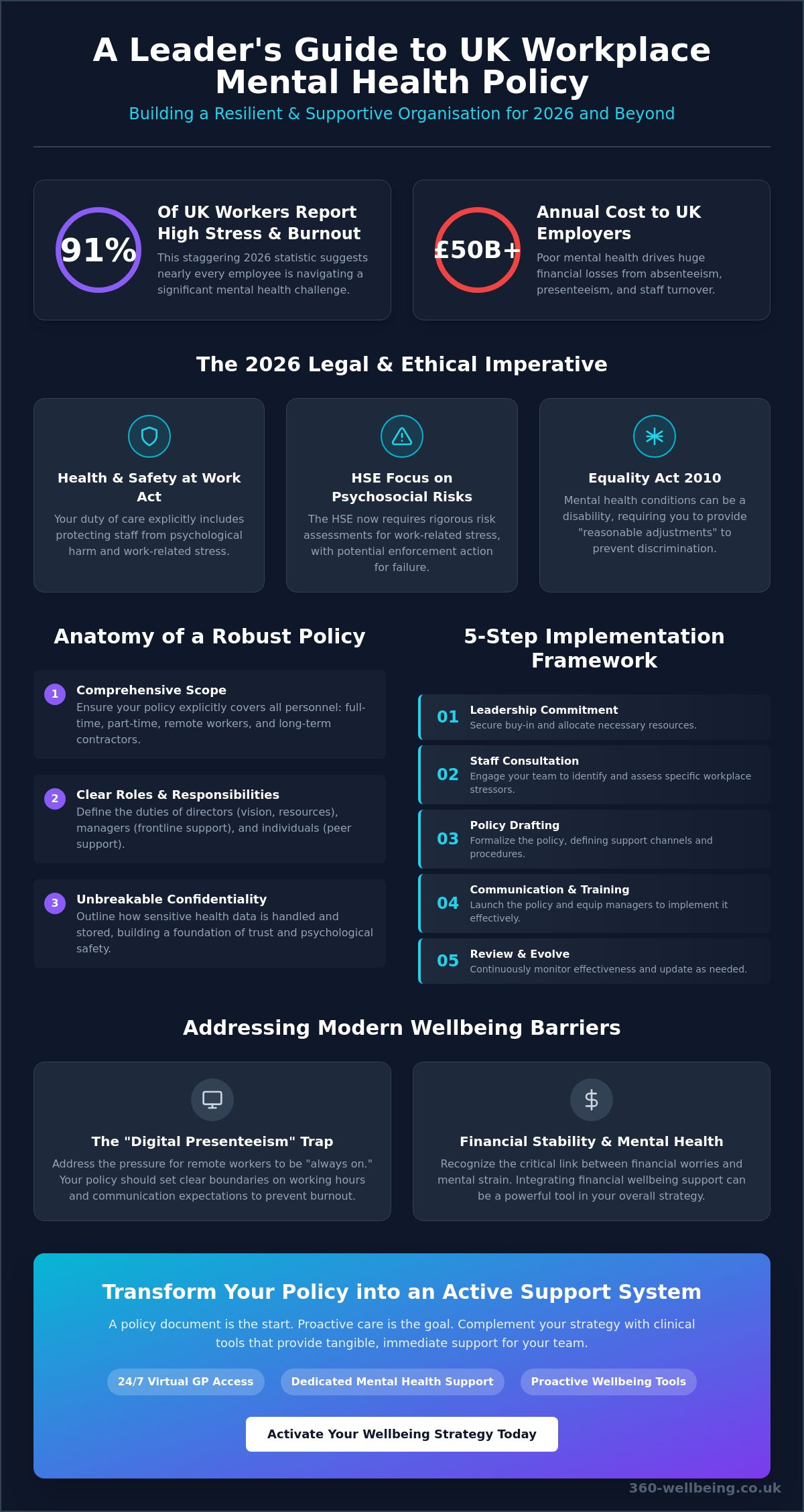
91% of UK workers reported high levels of stress and burnout in 2026, suggesting that nearly every person in your organization is currently navigating a significant mental health challenge. It’s a daunting reality for any leader. You want to protect your team while ensuring your workplace mental health policy uk is legally sound, yet the fear of “doing it wrong” often leads to hesitation. You might feel caught between managing rising absenteeism and deciphering the complex differences between daily work stress and clinical conditions.
We’re here to help you move from reactive worry to proactive care. This guide provides the clarity you need to develop a robust policy that meets the 2026 legal standards, such as the latest Statutory Sick Pay reforms and the HSE’s increased focus on psychosocial risks. We’ll walk you through a clear framework to implement and sustain a strategy that reduces turnover, supports long-term vitality, and transforms your workplace into a partnership of mutual care.
Key Takeaways
- Understand the 2026 legal landscape to ensure your workplace mental health policy uk aligns with the latest Health and Safety and Equality Act standards.
- Identify the essential components of a robust policy, from defining coverage for remote contractors to establishing clear responsibilities for directors and managers.
- Follow a structured five-step implementation framework that prioritizes staff consultation to identify and mitigate specific workplace stressors.
- Learn how to address modern barriers to wellbeing, including the “digital presenteeism” trap and the critical link between financial stability and mental health.
- Discover how to transform a static document into an active support system by integrating clinical tools like 24/7 Virtual GP access and dedicated mental health support.
Understanding the Legal and Ethical Case for a UK Workplace Mental Health Policy
A workplace mental health policy uk is much more than a collection of rules or a standard HR template. At its heart, it’s a formal document that outlines your organization’s commitment to the psychological wellbeing of every team member. It acts as a roadmap for empathy, defining how you identify risks, provide support, and foster an environment where people can thrive. In the current professional landscape, this document serves as the foundation for a partnership between you and your employees, ensuring that health is viewed through a panoramic lens that includes the mind as much as the body.
The legal landscape in 2026 has shifted significantly, making this policy a necessity rather than a “nice to have” feature. Under the Health and Safety at Work etc. Act 1974, your duty of care as an employer explicitly includes protecting staff from psychological harm. The Health and Safety Executive (HSE) now places a greater emphasis on psychosocial risks, requiring businesses to conduct rigorous risk assessments for work-related stress. If you fail to manage these risks, you face potential enforcement action. Beyond the legal mandate, there’s a staggering commercial reality to consider. Poor mental health costs UK employers over £50 billion each year due to absenteeism and “presenteeism,” where staff are physically present but mentally disengaged. By establishing a clear policy, you aren’t just ticking a box; you’re protecting your organization’s long-term durability and financial health.
To understand the broader context of these challenges, it helps to look at the state of Mental health in the United Kingdom. This perspective highlights why proactive management is essential for a modern workforce facing unprecedented levels of burnout and stress.
The Equality Act 2010 and Disability Rights
The Equality Act 2010 provides vital protections for employees with mental health conditions. A condition is often classified as a disability if it has a substantial, long-term effect on a person’s ability to carry out daily activities. As an employer, you’re legally required to provide “reasonable adjustments” to support these individuals. This might include flexible working hours, changes to the physical environment, or tailored communication styles. A robust policy ensures these adjustments are handled consistently, preventing discrimination and protecting your business from the emotional and financial toll of employment tribunals.
Beyond Compliance: The Moral and Productivity Case
Modern leadership is moving away from simply preventing illness toward a positive vision of workplace harmony. When you prioritize psychological safety, you create a culture where staff feel safe to speak up and innovate without fear of judgment. In 2026, talented professionals prioritize mental health support as a fundamental human entitlement. They look for employers who view wellbeing as a professional necessity. By fostering this sense of vitality, you reduce staff turnover and build a high-performance team that feels truly valued and supported.
Essential Components of a Robust Mental Health Policy
A workplace mental health policy uk must be all-encompassing to be effective. It shouldn’t just focus on your full-time office staff. You need to define a scope that includes remote workers, part-time employees, and long-term contractors. This panoramic approach ensures that every individual contributing to your organization feels protected under your umbrella of care. When everyone knows they’re included, you build a foundation of collective security and belonging.
Clear roles are the backbone of any reliable strategy. Directors provide the necessary vision and financial resources, while managers act as the frontline support system. Individuals also play a part by engaging with the tools provided and looking out for their peers. As the Health and Safety Executive (HSE) emphasizes, employers have a legal responsibility to help their employees by identifying and managing work-related stress risks. This partnership ensures that wellbeing isn’t a top-down mandate but a shared professional commitment.
Confidentiality is where trust is truly built. Your policy should clearly outline how sensitive health data is handled and stored, adhering to modern privacy standards. It’s equally important to define the specific, rare instances where “breaking confidence” is necessary for safety, such as when there’s an immediate risk of harm. This transparency provides reassurance, making it easier for staff to reach out when they’re struggling. Offering a clear “Support Menu” further simplifies this process. You might include resources like an Employee Assistance Programme (EAP) or debt advice to provide a complete safety net for your team.
Identifying and Reporting Mental Health Concerns
Standardizing the disclosure process removes the guesswork for struggling employees. Managers should be trained to conduct regular “wellbeing check-ins” that feel like a supportive conversation rather than a clinical assessment. These moments allow for early intervention before stress escalates into burnout. An open-door policy is a proactive tool designed to invite dialogue before a challenge becomes a crisis.
Framework for Reasonable Adjustments
Adjustments are often simpler than employers realize. They can include flexible starting times, redistributing specific tasks, or providing a quiet workspace for deep focus. Documenting these agreed-upon changes in a “Wellness Action Plan” ensures both the manager and employee have a clear path forward. Maintaining consistency across the organization is vital for fairness, ensuring every team member receives the same high standard of individualized care.
5 Steps to Implementing Your Policy Successfully
Creating a document is only the first half of the journey. The second half involves bringing that document to life within your organization. A successful workplace mental health policy uk requires a methodical implementation that moves beyond HR files and into the daily interactions of your team. By following a structured five-step timeline, you transform a static set of rules into a living culture of support and vitality.
- Step 1: Consultation. You can’t solve problems you haven’t identified. Start by gathering honest feedback to understand the unique pressures your team faces.
- Step 2: Drafting. Use the insights from your consultation to write a document that mirrors your company values. A small creative agency will need a different approach than a large manufacturing firm.
- Step 3: Management Training. Leadership confidence is the glue that holds the policy together. Managers need to feel equipped to handle sensitive disclosures with both clinical accuracy and human warmth.
- Step 4: Communication. A policy is useless if it remains hidden. Launch it with clarity, ensuring every individual knows exactly where to turn for help.
- Step 5: Review. The world of work changes fast. Set a firm 12 month schedule to update your policy based on internal usage data and new legal developments.
Consultation: Listening Before Leading
Authentic consultation starts with creating a safe space for honesty. Use anonymous surveys to gauge the “mental health pulse” of your organization without making staff feel exposed. This data often reveals specific “hot spots” of stress, such as a particular department struggling with seasonal deadlines or remote teams feeling isolated. When you understand these underlying factors, you can tailor your financial support and mental health offerings to meet real needs rather than perceived ones. This foresight ensures your resources are spent where they will have the most significant impact on employee durability.
The Launch: Making the Policy Visible
Don’t let your hard work get buried in a 50 page employee handbook. Use diverse communication channels like Slack or Teams, physical posters in breakrooms, and dedicated town hall meetings to keep the narrative alive. Appointing “Mental Health Champions” can also be highly effective. these are peer advocates who provide a relatable bridge between staff and formal support systems. Finally, ensure the policy is a cornerstone of your onboarding process. By introducing your commitment to wellbeing on day one, you signal to new hires that their health is a professional necessity and a fundamental entitlement, not a luxury.
Overcoming Barriers: Remote Work and Financial Stress
A modern workplace mental health policy uk must account for the decentralized nature of the 2026 workforce. Remote and hybrid models have brought many benefits, but they’ve also introduced the “Digital Presenteeism” trap. This is the pervasive pressure to be “always on,” where employees feel they must respond to messages at all hours to prove their productivity. Your policy should explicitly address these boundaries, perhaps by establishing “quiet hours” or clarifying that immediate responses aren’t expected outside of core time. By formalizing these expectations, you relieve the silent anxiety that often leads to burnout in isolated environments.
Spotting signs of struggle in a virtual setting requires a more nuanced approach than in-person observation. You might notice an employee consistently keeping their camera off during meetings, a sudden withdrawal from social chat channels, or a shift in their typical communication rhythm. These subtle changes are often the first indicators of a mental health challenge. To combat the stigma associated with reaching out, senior leaders should lead with vulnerability. When directors share their own experiences with stress or work-life balance, it transforms the company culture from one of silent endurance to one of open partnership.
The Holistic View: Mental, Physical, and Financial
A policy that focuses solely on the mind while ignoring the body and the bank account is likely to fail. We understand that health is a panoramic experience where every element is interconnected. In fact, research shows that 1 in 4 UK employees cite financial stress as their primary mental health detractor, illustrating why debt advice is a clinical necessity. Your document should link to external resources like debt helplines and legal support to provide a complete safety net. You can strengthen this support system by offering Financial Support & Debt Advice as a core benefit for your team.
Support for Managers: Preventing “Compassion Fatigue”
Managers are often the first point of contact for a struggling employee, which puts them at high risk for compassion fatigue. It’s essential to set clear boundaries within your policy: managers are signposters, not therapists. They need their own support network to process the emotional weight of their roles. By providing tools like 24/7 Virtual GP services, you take the medical pressure off your leadership team. This allows managers to focus on being supportive partners while leaving clinical reassurance and diagnosis to the professionals, ensuring the durability of your entire management structure.
Integrating Professional Support: How 360 Wellbeing Complements Your Policy
A document alone cannot listen to an employee’s concerns or provide clinical guidance during a crisis. While your workplace mental health policy uk provides the necessary legal and ethical framework, the 360 Wellbeing platform serves as the engine that powers it. By integrating professional support tools directly into your strategy, you transform a static set of guidelines into an active, responsive ecosystem. This transition ensures that when a team member reaches out, they aren’t just met with a procedure, they’re met with a person and a pathway to recovery.
The Employee Assistance Programme (EAP) should be the cornerstone of your policy’s support section. It provides a confidential, first line of defense for staff navigating everything from workplace stress to personal grief. By offering professional Mental Health Support and Life Coaching, you provide interventions that go far beyond a simple chat. These services offer scientifically grounded strategies that help employees build long-term psychological durability, ensuring they feel supported as both professionals and individuals.
Providing Immediate Clinical Pathways
One of the most effective ways to reduce absenteeism is to provide immediate clinical reassurance. Our 24/7 Virtual GP service allows your team to speak with a doctor at any time, day or night, removing the stress of waiting for a local appointment. When you integrate the 360 Wellbeing app into your policy’s emergency contact list, you provide a direct link to medical expertise. This access includes the ability to secure private prescriptions and specialist referrals for mental health concerns, ensuring that your staff move through the healthcare system with speed and dignity. It’s a proactive approach that treats health as a professional necessity rather than a luxury.
A Panoramic View of Wellness
We believe that true health requires a panoramic viewpoint that encompasses physical, mental, and social wellbeing. Your policy is more likely to succeed when it addresses the external factors that weigh on the mind. By utilizing 360 Rewards, you can help ease the financial pressure on your team while boosting morale through everyday savings. This works in harmony with our Financial Support & Debt Advice and Legal Support, providing a unified narrative of total wellness. When your policy is backed by these diverse tools, you fulfill your commitment to holistic care and create a workplace where harmony is the standard.
Explore how 360 Wellbeing can power your workplace mental health strategy.
Building a Culture of Lasting Vitality
A document is only the first step. A truly thriving culture is built through consistent, meaningful action and a commitment to panoramic care. You’ve now seen how a modern workplace mental health policy uk serves as a roadmap, guiding your organization through the complexities of the 2026 legal landscape and the nuances of remote team dynamics. By prioritizing consultation and addressing the root causes of stress, you aren’t just meeting a duty of care. You’re establishing a partnership that values every individual’s health as a professional necessity.
The most resilient organizations ensure their policies are powered by professional clinical tools. Whether it’s providing immediate 24/7 UK-registered Virtual GP access or offering Life Coaching and Mental Health Therapy, these resources transform your strategy into a tangible safety net. When you combine a comprehensive EAP with Financial & Legal support, you provide the completeness your team needs to flourish.
Your journey toward a more harmonious workplace starts with the right partner. Start supporting your team with 360 Wellbeing today and turn your vision of workplace harmony into a daily reality for your entire organization.
Frequently Asked Questions
Is a mental health policy a legal requirement for UK businesses?
While there’s no specific law stating you must have a standalone document, your legal duty under the Health and Safety at Work etc. Act 1974 includes managing psychological risks. Having a formal workplace mental health policy uk is the most effective way to demonstrate you’re meeting these obligations. It provides a structured framework for risk assessments and ensures your organization remains compliant with Health and Safety Executive (HSE) standards.
What is the difference between a mental health policy and a wellbeing strategy?
Think of a policy as your foundational safety net and a strategy as your proactive growth plan. A policy is a formal document that outlines specific roles, legal commitments, and reporting procedures. A wellbeing strategy is a broader, panoramic vision that focuses on long-term vitality, culture, and preventative care. Both are essential for creating a balanced environment where employees feel safe and empowered to perform their best.
How often should we review our workplace mental health policy?
You should review your policy at least every 12 months to ensure it remains effective and legally sound. Regular updates are vital to reflect changes in UK employment law, such as the 2026 Statutory Sick Pay reforms. Additionally, reviewing your policy allows you to adjust your support based on internal usage data and feedback gathered during staff consultations, ensuring your approach remains durable and relevant.
What are “reasonable adjustments” for mental health in the workplace?
These are practical changes designed to remove barriers for employees with mental health conditions that qualify as a disability. Common examples include offering flexible start times, redistributing specific high-stress tasks, or providing a quiet area for focused work. These adjustments are a legal requirement under the Equality Act 2010. They ensure every team member has an equal opportunity to thrive, regardless of their health status.
Can an employee be dismissed for mental health issues in the UK?
It’s very difficult to legally dismiss an employee simply because of a mental health condition, as this often constitutes discrimination. If a condition affects their ability to work, you must first exhaust all reasonable adjustments and support pathways. Only after a full capability process and consultation, where no further support is viable, can dismissal be considered. Even then, it must be handled with deep empathy and strict legal adherence.
How do we support remote workers under our mental health policy?
Supporting remote teams requires a focus on digital boundaries and virtual accessibility. Your policy should explicitly address “digital presenteeism” by encouraging staff to disconnect outside of core hours. Providing tools like a 24/7 Virtual GP ensures that even those working in isolation have immediate access to clinical reassurance. Regular video check-ins also help managers spot subtle signs of struggle that might otherwise go unnoticed in a virtual environment.
What role does an Employee Assistance Programme (EAP) play in a policy?
An EAP is the active engine of your workplace mental health policy uk. It provides the concrete resources that turn a written commitment into real-world support. By offering confidential counseling, financial advice, and legal support, an EAP gives employees a safe space to resolve personal or professional challenges. It acts as a reliable partner for your HR team, providing expert interventions that manage stress before it escalates into burnout.
How do I handle an employee who refuses to engage with mental health support?
You must respect an employee’s right to refuse support, but you should continue to offer it gently and regularly. Document every offer of help and every conversation to demonstrate that you’re fulfilling your duty of care. If their health begins to impact their performance, you must manage the situation through your standard capability or conduct procedures while keeping the door to support open. It’s about balancing organizational needs with human compassion.