In 2026, the most resilient UK companies have stopped viewing wellness as a luxury and started treating it as a core operational necessity. You’ve likely felt the strain of rising absenteeism and the frustration of seeing talented staff stuck on long waiting lists while your business productivity stalls. It’s disheartening to offer benefits that your team finds too fragmented or difficult to use when they’re actually in need. This is why modern digital healthcare solutions for business have evolved into unified ecosystems that bridge the gap between clinical expertise and everyday accessibility.
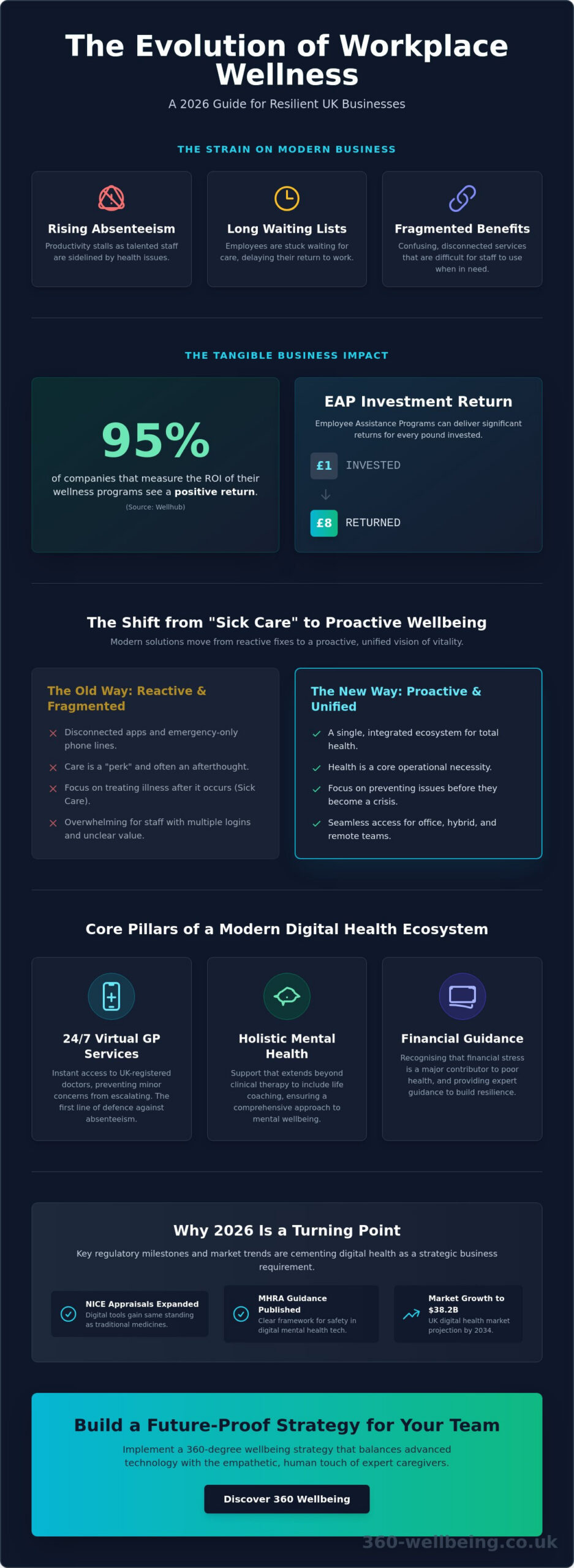
We understand that your people are your most vital asset, and their health is a professional necessity rather than a perk. Research from Wellhub shows that 95% of companies that measure the ROI of their wellness programs see positive returns, while EAPs can deliver up to £8.00 for every £1.00 invested. This guide will show you how a panoramic approach to health drives productivity, reduces absenteeism, and provides the holistic support your entire workforce deserves. We’ll explore how to move away from reactive fixes toward a proactive vision of workplace harmony and long term vitality.
Key Takeaways
- Understand how digital healthcare solutions for business have shifted from reactive “sick care” to proactive, integrated ecosystems that support employees before they reach a crisis point.
- Explore the essential pillars of modern care, including 24/7 Virtual GP access and mental health support that extends into life coaching and financial guidance.
- Learn why UK employers are choosing flexible subscription-based models over traditional private medical insurance to provide high-quality care that’s both accessible and cost-effective.
- Discover how to quantify the impact of your wellbeing strategy by measuring reductions in presenteeism and improvements in long-term staff retention.
- Gain practical insights into implementing a 360-degree wellbeing strategy that balances advanced technology with the empathetic, human touch of an expert caregiver.
Defining Digital Healthcare Solutions for Business in 2026
In 2026, the definition of corporate care has undergone a radical transformation. When we talk about digital healthcare solutions for business, we’re no longer referring to a collection of disconnected apps or a basic phone line for emergencies. Instead, we’re looking at a panoramic, integrated ecosystem that supports the physical, mental, and social health of every employee. Defining Digital Healthcare in this context means acknowledging that technology is the bridge between a person’s daily life and the clinical support they need to thrive. It’s a shift from reactive “sick care” to a proactive vision of vitality where intervention happens before a challenge becomes a crisis.
The old model of workplace wellness often felt fragmented. Staff were frequently overwhelmed by multiple logins for services they didn’t fully understand or value. Today, UK businesses are moving toward unified platforms that offer a single point of entry for everything from mental health support to physiotherapy. For a modern hybrid and remote workforce, this consistency is vital. Whether your team is collaborating in a central office or working from home, they deserve the same reliable access to care. This seamless integration ensures that health is treated as a professional necessity and an essential human entitlement, rather than a luxury perk.
The Evolution of Workplace Wellness
Workplace benefits have matured far beyond the standard gym membership or fruit basket. We’ve entered an era where 24/7 virtual clinical access is the baseline for employee trust. Digital platforms have democratised healthcare, allowing small businesses and sole traders to offer robust support that matches the offerings of multinational corporations. It’s essential that these digital healthcare solutions for business are anchored by UK-registered clinical expertise. This ensures that every interaction, whether it’s a GP consultation or life coaching session, is scientifically grounded and deeply personal.
Why 2026 is the Turning Point for Digital Health
This year marks a pivotal regulatory milestone for the industry. In April 2026, NICE expanded its technology appraisals to include digital health tools, giving them the same legal standing as traditional medicines. This follows the MHRA guidance on digital mental health technologies published in January 2026, which established a clear framework for safety and effectiveness. As NHS wait times continue to impact return-to-work dates, businesses are stepping in to provide faster medical intervention. With the UK digital health market projected to reach USD 38.2 billion by 2034, the use of AI and data analytics to personalise the health journey has become a strategic requirement for business resilience and staff retention.
The Core Pillars of a Comprehensive Digital Health Ecosystem
To truly support a workforce, an employer must look beyond the symptoms of illness and address the person as a whole. A fragmented approach often leaves employees feeling lost in a maze of different portals and passwords. A complete ecosystem of digital healthcare solutions for business succeeds because it integrates physical, mental, and social health into one seamless narrative. When these pillars work in harmony, they create a sense of safety and order that is essential for long term productivity and workplace harmony. This panoramic viewpoint ensures that no aspect of a person’s vitality is left to chance.
Virtual GP Services: The First Line of Defence
The foundation of any reliable health strategy is immediate, clinical trust. Our 24/7 Virtual GP service acts as the first line of defence, providing employees with instant access to UK-registered doctors without the stress of long wait times. This isn’t just about convenience; it’s about foresight. By removing the barriers to medical advice, you’re encouraging your team to seek help early, which prevents minor concerns from escalating into long term absenteeism. Digital prescriptions and specialist referrals can be handled during the consultation, allowing your staff to return to their lives with a clear, structured path forward. This expert caregiver relationship, established via a simple screen, builds a bridge of reliability between the employer and the user.
Beyond the Clinical: Mental and Financial Wellbeing
We believe that wellbeing is an essential human entitlement, and that includes freedom from the stresses that happen outside the clinical office. The growth of the UK digital healthcare market highlights a shift toward all-encompassing care. Mental health support must move beyond basic EAPs to include active therapy and life coaching. These tools help prevent burnout by teaching durability and emotional balance before an employee reaches their breaking point.
Holistic stability also requires addressing the root causes of anxiety. Financial support, debt advice, and legal support are often the missing pieces of the puzzle. When an employee is worried about debt or legal complications, their mental and physical health will inevitably suffer. By providing access to complimentary will writing and financial guidance, you’re offering a proactive vision of total wellness. This integration of social and financial health into your 360-degree wellbeing strategy ensures that your team feels supported in every dimension of their lives. Physical rehabilitation through digital physiotherapy further completes this circle, providing a unified platform that staff actually value and use.
Digital vs. Traditional Healthcare: Why UK Businesses are Switching
For decades, many UK businesses relied on Private Medical Insurance (PMI) as the primary way to care for their staff. However, as we move through 2026, the limitations of this traditional model have become increasingly apparent. PMI often functions as “catastrophic cover,” designed for major surgeries or chronic conditions, but it rarely addresses the daily health challenges that impact your team’s productivity. In contrast, digital healthcare solutions for business provide a proactive, panoramic vision of health that supports employees every single day. This shift isn’t just about changing a provider; it’s about moving from a reactive insurance mindset to a proactive culture of vitality.
The speed of intervention is perhaps the most significant differentiator. While traditional routes can involve long waiting lists and complex claims processes, digital platforms offer near-instant medical advice. This reduces the duration of absenteeism by catching health issues early. It also addresses the “waiting gap” where employees are often too unwell to work but not yet at the front of a clinical queue. By providing immediate support, you’re not just looking out for the individual; you’re protecting the resilience of your entire organisation.
Comparing PMI and Digital Health Platforms
The administrative burden of traditional insurance can be overwhelming for HR departments, often requiring significant time to manage renewals and individual claims. High premiums also mean that PMI is frequently a benefit reserved for senior leadership, creating a disparity in care across the company. Digital platforms remove these barriers. They offer a unified health experience for everyone, from your newest apprentice to your CEO. This inclusivity is a professional necessity in 2026, as workforce harmony depends on every staff member feeling equally valued and supported. Unlike the high-premium models of the past, SaaS-based digital solutions provide predictable costs and a much lower barrier to entry for growing firms.
The Scalability of Digital Solutions
One of the most empowering aspects of modern health technology is its durability for businesses of all sizes. Previously, high-quality clinical support was a luxury that sole traders and SMEs simply couldn’t afford. Now, digital healthcare solutions for business allow you to scale support from five to five hundred employees without increasing administrative complexity. This flexibility ensures that your health strategy grows alongside your company. You can customise the platform to meet the specific needs of your industry, whether that’s mental health support for high-stress roles or physiotherapy for physically demanding work. This tailored approach ensures that your investment in wellbeing is both scientifically grounded and deeply personal to your team’s requirements.
Measuring Success: The ROI of Employee Wellbeing Platforms
Investing in your team’s health is often viewed through the lens of cost, but in 2026, the data tells a different story. For HR leaders, the challenge has always been moving from anecdotal evidence of happy staff to concrete financial metrics. When you implement digital healthcare solutions for business, you gain the ability to quantify success in ways that traditional benefits simply cannot match. Research from Wellhub shows that 95% of companies that measure the ROI of their wellness programs see positive returns. This isn’t just a marginal gain; it’s a fundamental shift in how we value human capital.
One of the most significant yet hidden costs to any UK firm is “presenteeism,” where employees are physically present but mentally or physically unwell. This invisible drain on productivity often costs businesses more than total absenteeism. By providing immediate clinical access, you’re not just reducing sick days; you’re ensuring that when your team is at work, they’re fully engaged and capable. Furthermore, a robust health ecosystem acts as a powerful retention tool. In a competitive talent market, the direct link between digital health access and staff loyalty is undeniable. It reduces the heavy financial burden of recruitment and headhunter fees by creating a workplace where people feel genuinely cared for.
Key Performance Indicators for HR
To understand the true value of your investment, you must look beyond the surface. Traditional EAPs often suffer from low engagement, with many staff members unaware the service even exists. Modern digital platforms, however, see significantly higher adoption rates because they’re integrated into the daily workflow. According to Sonder, the estimated ROI for Employee Assistance Programmes in the UK is now £8.00 for every £1.00 invested. By tracking engagement rates and using anonymised platform data, HR teams can identify rising trends in workplace stress or musculoskeletal issues before they spiral into a crisis. This foresight allows for targeted interventions that save thousands in lost hours and long term disability claims.
The Social Impact: ESG and Corporate Responsibility
In 2026, corporate care is a key pillar of Environmental, Social, and Governance (ESG) criteria. Supporting the “Social” aspect of your ESG strategy means providing inclusive, accessible care that reaches every corner of your workforce. This includes offering mental health support that respects diversity and providing practical help for life’s non-clinical pressures. Integrating Financial Support for Employees into your health narrative is an essential part of this panoramic approach. When you address the root causes of anxiety, such as debt or legal worries, you’re fulfilling a professional necessity and an essential human entitlement. This commitment to total wellness strengthens your employer branding and builds lasting brand loyalty among your workforce.
If you’re ready to see how a data-driven health strategy can transform your bottom line, explore our comprehensive digital healthcare solutions for business today.
Implementing 360 Wellbeing: A Future-Proof Strategy for Your Team
Implementing 360-degree care is the final step in securing your company’s future. Tech is the tool. Empathy is the anchor. It’s not enough to simply sign up for a service; you must weave these digital healthcare solutions for business into the fabric of your daily operations. This requires a delicate balance between high-tech efficiency and high-touch support. We call this the “expert caregiver” approach. It ensures that while your team uses an app to book a 24/7 Virtual GP appointment, they feel the reassurance of a clinician who is genuinely invested in their success. This personal partnership is what transforms a simple benefit into a life-changing resource.
A unified health strategy means your staff don’t have to guess where to turn when they’re struggling. By integrating physical, mental, and social health into a single narrative, you remove the friction that often prevents people from seeking help. This isn’t just about fixing what’s broken. It’s about creating a proactive vision of workplace harmony where every employee feels empowered to maintain their own vitality. When your team knows that Physiotherapy, Mental Health Support, and Financial Support & Debt Advice are all in one place, they can focus on their work with a clear mind.
The 360 Wellbeing Advantage
The most effective systems in 2026 are those that offer simplicity and clinical safety. Providing 24/7 Virtual GP access alongside an Employee Assistance Programme (EAP) in a single subscription creates a sense of order for your HR team. Safety is paramount, which is why we always emphasise the use of UK-registered practitioners for all clinical delivery. To keep the platform at the front of your team’s mind, we suggest integrating 360 Rewards. These daily incentives encourage staff to engage with the platform regularly, making health a habit rather than a last resort. This panoramic viewpoint ensures that your support is both durable and customisable.
Building Your Corporate Health Roadmap
Your journey begins with a clear assessment of your current workforce gaps. Are your staff struggling with the physical demands of their roles, or is mental burnout a more pressing concern? Once you’ve identified these needs, your launch strategy is critical. Avoid overwhelming your team with dense manuals. Instead, use clear, benefit-driven communication that explains how these digital healthcare solutions for business make their lives easier. Mentioning features like complimentary will writing or life coaching can spark immediate interest.
A successful strategy is never static. Use anonymised feedback to refine your roadmap over time. This continuous evolution ensures that your support remains relevant as your business grows. If you’re ready to move toward a more resilient future, the path forward is clear. You can start building your tailored strategy at 360-wellbeing.co.uk to ensure your team has the panoramic support they deserve.
Securing Your Workforce Resilience for 2026 and Beyond
The transition to digital healthcare solutions for business represents a deep commitment to your team’s long term vitality. We’ve explored how moving from fragmented, reactive apps to a unified ecosystem reduces absenteeism and drives a significant return on investment. By providing 24/7 access to UK-registered GPs and holistic support that spans mental, financial, and legal help, you’re treating wellbeing as a professional necessity rather than a luxury. It’s about foresight and durability. Our platform is designed specifically for UK SMEs and growing businesses that want to provide executive level care to every single staff member. It’s time to embrace a proactive vision of workplace harmony where every individual feels supported and valued.
Explore our 360 Wellbeing platform and transform your staff benefits today
Your people are your most vital asset. They deserve a partner who is genuinely invested in their success and long term health. Let’s build a healthier, more resilient future for your organisation together.
Frequently Asked Questions
What are digital healthcare solutions for business?
Digital healthcare solutions for business are integrated ecosystems that provide employees with immediate access to clinical and wellbeing services via digital platforms. These solutions move beyond simple apps by unifying 24/7 Virtual GP consultations, mental health support, and physiotherapy into a single, cohesive experience. By centralising care, businesses ensure that health is treated as a professional necessity rather than a fragmented perk, allowing staff to manage their vitality with clinical guidance from any location.
How much do digital healthcare platforms cost for small businesses?
Costs for these platforms are typically structured as monthly subscription models based on the number of employees. This approach makes high-quality clinical support far more accessible for small businesses and SMEs compared to traditional high-premium insurance models. While we don’t quote fixed industry prices, this SaaS structure provides predictable budgeting and ensures that even sole traders can offer the same level of care as large corporations without significant administrative overhead or complex underwriting.
Are virtual GP services as effective as in-person appointments?
Virtual GP services are highly effective for primary care, providing immediate clinical advice for a wide range of health concerns. Our UK-registered doctors can issue digital prescriptions and specialist referrals just as they would in a physical clinic. While some complex physical examinations still require in-person visits, the speed of digital intervention often prevents minor issues from escalating, which is essential for maintaining workforce durability and reducing the wait for essential medical guidance.
Can digital health solutions help reduce employee absenteeism?
Yes, providing faster access to medical intervention directly reduces the time employees spend away from work. By catching physical or mental health challenges early, digital healthcare solutions for business prevent long term sick leave and address the “waiting gap” often found in traditional healthcare routes. This proactive approach ensures that staff receive the support they need immediately, leading to a more resilient workforce and a measurable reduction in both absenteeism and presenteeism.
What is the difference between an EAP and a digital healthcare platform?
A traditional Employee Assistance Programme (EAP) is often a reactive, phone-based service with lower engagement rates. In contrast, a digital healthcare platform is a proactive ecosystem that integrates clinical services like Virtual GPs and Physiotherapy with mental health and social support. It’s designed for daily engagement rather than crisis-only use. This holistic approach ensures that physical, mental, and financial wellbeing are treated as a single, unified narrative of total wellness.
Is employee data kept private on digital health platforms?
Privacy is a fundamental entitlement in digital care. All platforms must comply with the UK’s strict data protection framework, including the Data Use and Access (DUA) Act 2025. Employers receive anonymised, high-level data to help identify workplace trends, but individual medical records and consultation details remain strictly confidential between the employee and the clinician. This structure creates a sense of safety and order, ensuring staff feel secure when seeking help for sensitive topics.
Do digital healthcare solutions replace traditional health insurance?
For many SMEs, these solutions serve as a more efficient and inclusive alternative to traditional Private Medical Insurance. While PMI often focuses on “catastrophic cover” for major surgeries, digital platforms provide the daily support that keeps a workforce healthy and productive. They bridge the gap between basic care and hospitalisation, offering a panoramic viewpoint of health that addresses mental, financial, and physical needs before they require the high-cost interventions typically covered by insurance.
How long does it take to set up a digital health platform for my company?
Setting up a digital health platform is a methodical yet swift process that can often be completed within a few weeks. Unlike traditional insurance schemes that require lengthy administrative hurdles, digital onboarding is designed to be seamless. We provide structured communication strategies to help you launch the platform effectively, ensuring maximum staff uptake from day one. This allows you to implement a future-proof health strategy without overwhelming your HR team or your employees.