
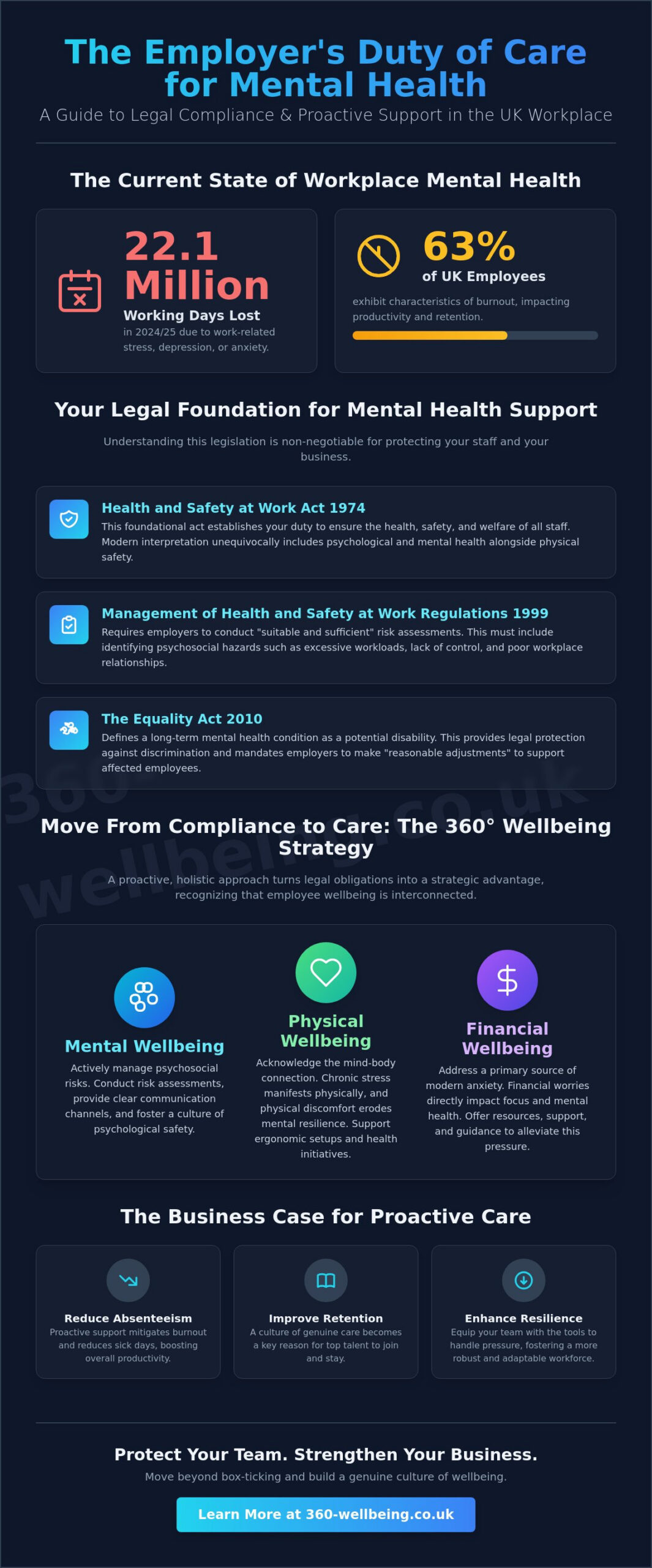
Did you know that an estimated 22.1 million working days were lost to stress, depression, or anxiety in 2024/25? With 63% of UK employees experiencing burnout characteristics according to Deloitte, managing your duty of care for employees mental health has never been more critical. It’s natural to feel concerned about potential legal repercussions or the rising cost of absenteeism, especially when you’re unsure how to handle delicate conversations. You want to protect your team, but you also need to protect the health of your organization.
This guide helps you understand exactly how to meet your legal obligations in a way that feels manageable and supportive. We’ll show you how to move beyond simple box-ticking to build a proactive culture that reduces staff turnover and enhances resilience. We’ll cover the latest HSE enforcement priorities for 2026, the vital concept of foreseeability, and how to implement a 360-degree wellbeing strategy that turns legal compliance into a genuine strategic advantage for your business.
Key Takeaways
- Learn why the legal definition of duty of care for employees mental health now carries the same weight as physical safety in the modern UK workplace.
- Identify the essential legislation you need to know to keep your business compliant and your staff protected from harm.
- Master the art of conducting “suitable and sufficient” risk assessments to catch psychosocial stressors before they impact your team’s performance.
- Explore how reasonable adjustments and flexible working patterns can create a more inclusive environment that supports long term recovery.
- Discover why moving toward a proactive 360-degree strategy helps you bridge the gaps often found in traditional support systems.
Duty of Care for Employees’ Mental Health: What it Means in 2026
In the modern UK workplace, the concept of a legal duty of care has undergone a profound transformation. It’s no longer restricted to physical safety measures like wet floor signs or fire drills. By 2026, the duty of care for employees mental health is viewed by regulators and courts with the same rigorous legal weight as physical protection. This shift reflects a mature understanding that psychological harm can be just as debilitating, and often more enduring, than a physical injury. Employers are now expected to treat the “unseen” risks of the office or home workspace with the same clinical precision they apply to heavy machinery.
We’ve moved away from a reactive era where support only arrived after an employee reached a breaking point. Today, a 360-degree perspective is the gold standard. This approach ensures that no individual falls through the cracks by identifying stressors before they escalate into long term illness. It requires a partnership between the employer and the workforce, built on a foundation of trust and reliable, accessible support systems.
The Moral and Business Case for Care
Supporting mental health isn’t just a legal obligation; it’s a strategic necessity for any thriving business. In 2026, your company culture acts as your most powerful recruitment and retention tool. Top talent now prioritizes psychological safety as much as their base salary. When you foster an environment where people feel genuinely seen and supported, you naturally reduce the impact of absenteeism, which currently sees UK employees taking an average of 9.4 days off per year. Adopting a proactive resilience approach serves as a distinct business advantage, turning workplace wellbeing into a driver of stability and collective vitality.
Holistic Health: The Link Between Mind, Body, and Finance
You cannot treat the mind in total isolation. Physical ailments, such as chronic back pain or sciatica, are frequently intertwined with mental burnout. When an employee suffers from persistent physical discomfort, their mental resilience naturally erodes. Conversely, high levels of cortisol from chronic stress often manifest as physical tension and illness. Acknowledging this connection is vital for a comprehensive health strategy.
Perhaps the most significant driver of workplace anxiety in 2026 is the impact of the wallet. Financial worries don’t stay at home; they follow your staff into every meeting and task. By providing financial support for employees, you address one of the primary root causes of poor mental health. A truly effective strategy recognizes that mental, physical, and financial health are three pillars of a single, unified narrative of wellness.
The Legal Framework: UK Legislation Every Employer Must Know
Understanding the UK legislation every employer must know is the first step toward creating a workplace that is both safe and compliant. The Health and Safety at Work Act 1974 remains the bedrock of all workplace welfare. Section 2 of this Act dictates that you must ensure the health, safety, and welfare of your staff. While this was traditionally interpreted through a physical lens, the legal landscape of 2026 makes it clear that psychological stability is a fundamental part of that welfare. You have a duty of care for employees mental health that is just as enforceable as your duty to prevent physical injury.
The Management of Health and Safety at Work Regulations 1999 adds a layer of specific action to this foundation. These regulations require you to conduct “suitable and sufficient” risk assessments for your business. This isn’t a one-off task. It’s an ongoing process of identifying psychosocial hazards like excessive workloads, lack of control, or poor workplace relationships. If you identify a risk to mental health and fail to take steps to mitigate it, your business remains legally exposed.
The Equality Act and Mental Health
The Equality Act 2010 provides vital protections for employees with long term mental health conditions. Under this Act, a mental health condition is considered a disability if it has a substantial and long term adverse effect on a person’s ability to carry out normal day-to-day activities. “Long term” typically means the condition has lasted, or is expected to last, for at least 12 months. This legal status triggers a strict prohibition against discrimination, harassment, and victimisation. It’s important to remember that these protections aren’t limited to full time staff; they also extend to agency workers and contractors under your supervision. If you’re looking for ways to navigate these complex requirements, integrated legal support can provide the clarity your management team needs.
2026 Regulatory Trends and Case Law
The regulatory environment has become increasingly sophisticated. Recent UK court rulings have tightened the definition of employer liability, particularly regarding burnout. If the signs of stress were “foreseeable” and no intervention occurred, the employer is often held responsible for the resulting harm. The Health and Safety Executive (HSE) Management Standards are now the benchmark for measuring how well you manage workplace stress. The “reasonably practicable” standard means you must balance the level of risk against the cost, time, and effort needed to control it, ensuring your mental health interventions are both effective and proportionate to your business size. This shift emphasizes that ignorance is no longer a valid legal defense in the face of rising workplace stress.
Identifying Psychosocial Risks and Spotting Early Signs
Fulfilling your duty of care for employees mental health requires more than a general policy; it demands a keen eye for the subtle shifts in your team’s daily reality. A “suitable and sufficient” risk assessment isn’t a static document. It’s a living process that examines how work is organized and the impact this has on the mind. By 2026, the Health and Safety Executive expects you to identify psychosocial hazards with the same diligence as physical ones. This involves looking closely at workload, the level of control staff have over their tasks, the quality of support they receive, and the health of their professional relationships.
In our increasingly digital environment, spotting these risks is more complex. You can’t always rely on seeing a slumped posture at a desk. Instead, look for digital cues. An employee who suddenly stops turning their camera on during meetings, or someone who begins sending emails at 2:00 AM, might be struggling with social anxiety or a mounting workload. Regular, empathetic check-ins for remote staff are essential. These conversations shouldn’t just be about “ticking off” project milestones. They should provide a safe space for staff to express concerns about isolation or digital fatigue, which is a core part of implementing a 360-degree strategy that prioritizes people over processes.
Physical and Behavioural Red Flags
Stress often speaks through the body before it’s voiced aloud. Watch for physical symptoms like persistent fatigue, frequent minor illnesses, or a noticeable decline in the standard of work. If a usually focused employee starts missing deadlines or withdraws from social interaction patterns on team platforms, it’s a signal to step in. Many forward thinking businesses now utilize “Mental Health Champions.” These trained peers act as a vital bridge, spotting early signs of distress that might be hidden from management, ensuring that support reaches those who need it before a crisis occurs.
Managing Stress in High-Pressure Environments
High pressure roles often mask “toxic” productivity patterns where long hours are wearing a badge of honor. By 2026, we recognize that this is a precursor to burnout rather than a sign of commitment. Address the “always-on” culture in your hybrid models by setting clear boundaries for communication after hours. Use your internal data to your advantage. If you notice specific departments have higher absenteeism rates or frequent turnover, it’s often a sign of underlying psychosocial stress. Proactively investigating these trends allows you to adjust workloads and resources, protecting your staff and the long term stability of your business.
Reasonable Adjustments and the Duty to Support
Fulfilling your duty of care for employees mental health often involves implementing what the law calls “reasonable adjustments.” This term doesn’t have a rigid, one-size-fits-all definition. Instead, it requires a tailored approach based on the specific needs of the individual and the resources of your business. In 2026, the most effective adjustments are often those that provide flexibility. Allowing an employee to adjust their start and finish times can be transformative for someone managing medication side effects or attending therapy sessions. It’s about removing the barriers that prevent a talented person from performing their role effectively.
Modifying job roles or environments is equally vital, particularly when supporting neurodiversity or high levels of anxiety. For staff dealing with sensory processing challenges, small changes like providing noise-cancelling tools or creating designated quiet zones can significantly reduce daily stress. These aren’t just “perks”; they’re essential modifications that allow for a more inclusive and productive workforce. When an employee takes leave for their mental health, the return-to-work process is a legal necessity. It must be a structured, collaborative effort to ensure the individual feels safe and capable of resuming their duties without the risk of a relapse.
Implementing Practical Adjustments
A phased return is one of the most powerful tools in your kit. It allows staff to re-integrate after a period of poor health by gradually increasing their hours and responsibilities. While traditional occupational health has its place, many modern employers now use 24/7 Virtual GP services to bridge the gap. This provides immediate clinical guidance on which adjustments are most appropriate, ensuring that the support plan is grounded in expert advice. This proactive approach helps you set realistic expectations for both the business and the employee from day one.
Communication Strategies for Sensitive Topics
Opening a conversation about mental health requires a delicate, empathetic touch. You should focus on observable changes in work performance or behavior rather than attempting to “diagnose” a condition. This keeps the conversation professional and avoids overstepping legal boundaries. Maintaining strict confidentiality is a fundamental right for the employee, yet you must also balance this with ensuring the wider team remains supported if workloads need to move. Documenting every step of the support process is essential. It provides a clear, transparent record of the care you’ve provided, which is vital for the employee’s recovery journey and your business’s legal protection should it ever be questioned.
Moving from Compliance to Care: Implementing a 360-Degree Strategy
By 2026, simply having an Employee Assistance Programme (EAP) phone number tucked away in an onboarding handbook isn’t enough. To truly fulfill your duty of care for employees mental health, your strategy must be as dynamic as the modern workplace itself. Standard EAPs are frequently too reactive; they often wait for a crisis to occur before providing a solution. A proactive approach means giving your team the resources to manage their mental fitness every day, preventing minor stressors from escalating into long term sickness absence.
One of the most effective ways to bridge the gap in current NHS mental health support is by integrating 24/7 Virtual GP access. This gives your staff immediate, clinical reassurance at the moment they need it most, without the stress of long waiting times. When you combine this with life coaching and professional therapy, you aren’t just offering a fix for a problem. You’re building long term workforce resilience. This comprehensive support ensures that your team has the psychological tools to handle high pressure environments while feeling genuinely valued by their employer.
We’ve already explored how financial anxiety acts as a major driver of workplace stress. Leveraging tools like 360 Rewards helps you address this root cause directly. By providing tangible savings on daily essentials and financial support, you alleviate the “quiet” stressors that often lead to burnout. It’s a practical, compassionate way to show that your care extends to the full circle of an employee’s life.
The Power of a Unified Wellbeing Platform
A centralized wellbeing platform empowers your employees by putting health, legal, and financial tools in one accessible place. This removes the friction that often prevents people from seeking help early. For your management team, it significantly reduces the administrative burden on HR through automated support systems and clear engagement data. 360 Wellbeing provides a comprehensive safety net that functions 24/7, ensuring that your staff are protected even when the office lights are off.
Next Steps for UK Employers
Your journey toward a more supportive workplace starts with a clear look at your current provision. It’s time to move beyond the basics and build a business case for a package that reflects the 2026 legal and social landscape. Consider these immediate actions:
- Audit your current wellbeing benefits against the latest HSE enforcement standards.
- Identify gaps where employees might be waiting too long for clinical or mental health support.
- Evaluate how well you are addressing the financial and physical pillars of health alongside the mental.
- Ensure your managers have the training and tools to use these resources effectively during check-ins.
Building a proactive culture is an investment in your company’s most valuable asset: its people. When you prioritize holistic health, you don’t just meet your legal obligations; you create a resilient, loyal, and high performing team. Discover how 360 Wellbeing helps you fulfill your duty of care effortlessly.
Building a Resilient Workforce for the Future
Meeting your duty of care for employees mental health is no longer just about avoiding a tribunal; it’s about fostering a culture where every individual can thrive. We’ve explored how the legal landscape of 2026 demands a proactive approach, moving beyond reactive EAPs toward a truly 360-degree strategy. By identifying psychosocial risks early and implementing thoughtful, reasonable adjustments, you protect your team’s vitality and your business’s stability. It’s a journey that turns legal necessity into a powerful strategic asset.
You don’t have to navigate these complex health and legal requirements alone. Our platform provides the comprehensive tools you need to support a modern workforce, including 24/7 UK-registered Virtual GP access, integrated mental health therapy, and life coaching. We also offer tailored financial and legal support specifically designed for SMEs, ensuring no part of your team’s wellbeing is left to chance. Book a demo of the 360 Wellbeing platform today to see how we can partner with you in creating a healthier, more resilient workplace. We’re here to help you lead with compassion and clinical expertise.
Frequently Asked Questions
What is an employer’s legal duty of care for mental health in the UK?
An employer’s legal duty of care involves taking all reasonable steps to ensure the health, safety, and welfare of their staff. This obligation isn’t limited to physical safety; it extends to protecting employees from foreseeable psychological harm caused by work stressors or the environment you provide. By law, you must treat mental health risks with the same level of priority as physical hazards in the workplace.
Can an employee sue an employer for work-related stress?
Yes, an employee can bring a personal injury claim if work-related stress results in a medically recognized psychiatric illness. To succeed in court, they must prove that the injury was a direct result of their work and that the harm was “reasonably foreseeable.” If you were aware of the stress but failed to take action, your business remains legally exposed to potential litigation.
What are ‘reasonable adjustments’ for someone with depression or anxiety?
Reasonable adjustments are tailored changes to a person’s role or environment that help them stay in work while managing their condition. Practical examples include offering flexible start times to avoid rush-hour triggers, providing a quiet workspace, or allowing a phased return after illness. These adjustments should be agreed upon collaboratively to ensure they effectively support the individual’s recovery and productivity.
How do I conduct a mental health risk assessment for my team?
Conducting a mental health risk assessment involves identifying workplace factors that could lead to psychological harm, such as excessive workloads or poor support. You should use the HSE Management Standards as a framework to evaluate areas like control, relationships, and change within the team. Once you’ve identified these risks, you must document your findings and implement clear strategies to mitigate them.
Is stress considered a medical condition under the Equality Act 2010?
Stress isn’t a medical condition or a disability in itself under the Equality Act 2010. However, chronic stress is often a precursor to conditions like clinical depression or anxiety disorders, which are protected if they have a substantial, long term effect on daily life. When a condition meets this threshold, you have a legal duty to provide support and avoid any form of discrimination.
What happens if an employer fails in their duty of care?
Failing in your duty can lead to significant legal consequences, including employment tribunals, personal injury claims, and enforcement action from the Health and Safety Executive. Beyond the courtroom, a failure to support your team often results in higher absenteeism and a damaged company reputation. This makes it much harder to retain your best talent and attract new recruits in a competitive 2026 market.
How can a Virtual GP service help me fulfill my duty of care?
A Virtual GP service provides your staff with 24/7 access to clinical expertise, ensuring they can address mental or physical health concerns as soon as they arise. Offering this resource demonstrates a proactive approach to your duty of care for employees mental health by removing barriers to professional advice. It helps bridge the gap when traditional appointments are unavailable, allowing for earlier intervention and better long term outcomes.
Do I have a duty of care for employees working from home?
Your legal duty of care for employees working from home is exactly the same as for those in a physical office. You must still conduct and document risk assessments that cover their remote setup, including ergonomic safety and the psychological risks of isolation. It’s your responsibility to ensure that home based staff feel just as supported and connected to the business as their on site colleagues.