
In the evolving landscape of 2026, UK employers face a familiar yet intensified challenge: nurturing a resilient and present workforce amidst rising stress and the complexities of permanent hybrid working models. For many, especially small to medium-sized businesses, providing accessible and high-quality mental health support can feel like a significant hurdle. Yet, the solution is more integrated and powerful than ever before. Modern eap counselling has transformed from a simple helpline into a proactive, strategic partner dedicated to building a thriving workplace culture.
This comprehensive guide is designed for forward-thinking UK leaders. We will demystify the entire journey, from triage to recovery, and provide a clear framework for measuring the tangible return on your wellbeing investment. Discover how a tailored, 360-degree support system not only boosts productivity but also builds the foundation for genuine employee loyalty and long-term success. Let’s explore how to choose a trusted partner to handle the complete wellbeing needs of your team.
Key Takeaways
- Understand the direct financial impact of employee wellbeing and how to calculate the return on investment from reduced absenteeism and presenteeism.
- Discover a clear roadmap for selecting and implementing an EAP provider that truly aligns with your company’s unique culture and your team’s specific needs.
- Learn how modern eap counselling has evolved from a reactive helpline into a proactive, comprehensive wellbeing platform for your entire workforce.
- Explore why integrating mental health support with services like 24/7 Virtual GPs creates a total, 360-degree care system for your employees.
What is EAP Counselling? Defining the Modern Safety Net in 2026
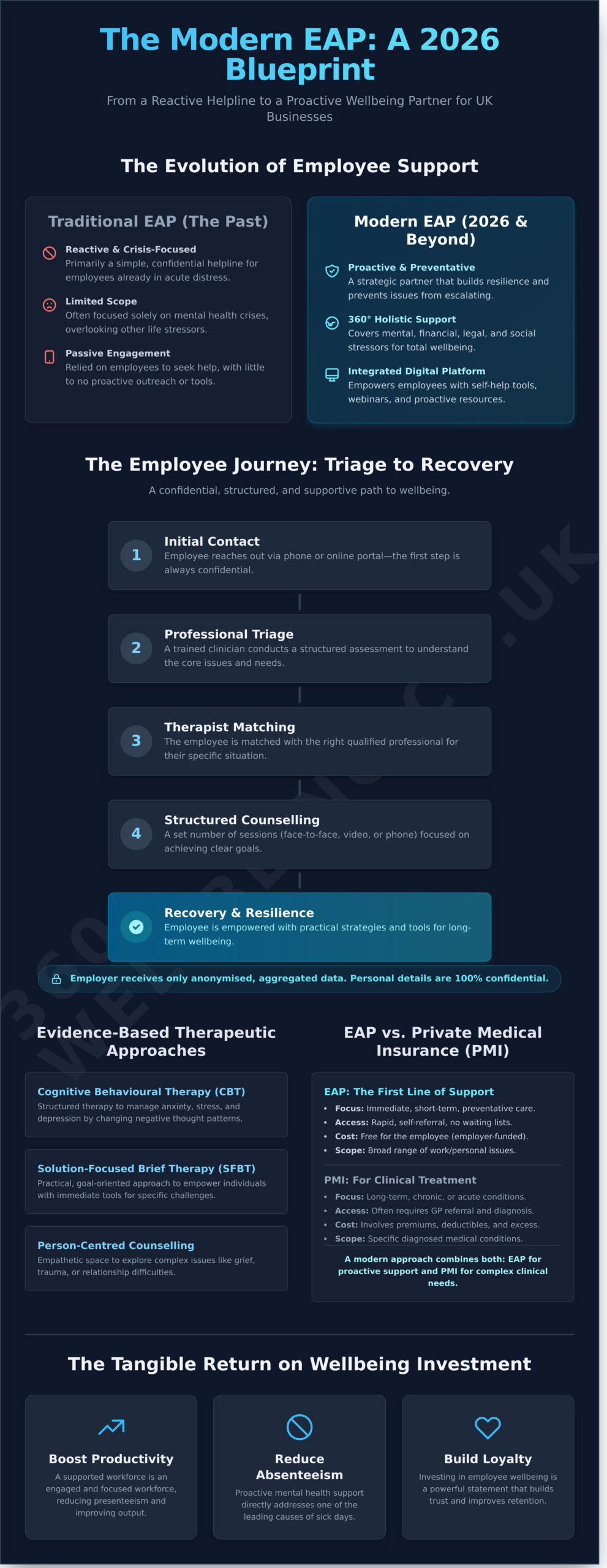
In today’s dynamic workplace, an Employee Assistance Programme (EAP) is far more than a benefit; it’s a foundational pillar of a resilient and thriving organisation. At its core, eap counselling is a confidential, employer-funded service designed to provide your team with professional, therapeutic support for a comprehensive range of personal and work-related challenges. Historically viewed as a simple crisis helpline, the modern Employee Assistance Program has evolved into a proactive, 360-degree wellbeing platform.
This evolution reflects a deeper understanding of employee health. The focus has shifted from merely reacting to problems to proactively building resilience. Instead of only addressing acute mental distress, today’s EAPs provide holistic support covering financial worries, legal questions, and social stressors that impact an individual’s overall vitality. As we look towards 2026, UK workplace mental health standards are reaching a pivotal moment, with employees rightfully expecting a more integrated and preventative approach to their wellbeing from their employers.
The Core Components of an Employee Assistance Programme
A modern EAP is a multi-layered resource tailored to provide support exactly when and how it’s needed. Key components typically include:
- Short-Term Structured Counselling: A set number of solution-focused therapy sessions with a qualified professional, aimed at providing practical strategies for managing specific issues like stress, anxiety, or relationship difficulties.
- 24/7 Crisis Support: An immediate, confidential helpline for employees facing acute distress, offering in-the-moment support from trained counsellors.
- Digital Resources & Self-Help Tools: A rich online portal offering articles, webinars, self-assessment tools, and guided programmes on topics from mindfulness to financial planning, empowering employees to manage their wellbeing proactively.
EAP vs. Private Medical Insurance (PMI): Key Differences
While both support employee health, EAPs and PMI serve distinct, complementary roles. An EAP is designed for immediate, short-term intervention, providing rapid access to support for a wide range of issues at no cost to the employee. This makes it an incredibly accessible and cost-effective solution, particularly for SMEs. In contrast, PMI is structured for diagnosing and treating long-term, chronic, or acute medical conditions, often involving specialist referrals and more extensive treatment plans. For total cover, many forward-thinking UK businesses integrate both, using the EAP as the first line of proactive support and PMI for more complex clinical needs.
Inside the Session: How EAP Counselling Works for Employees
Taking the first step towards support can feel daunting, but the process is designed to be simple, reassuring, and completely confidential. From the moment an employee makes the initial call or clicks through a portal, they are entering a supportive ecosystem. A trained clinician conducts a professional triage, a structured conversation to understand the immediate challenges and assess the level of support required. This ensures the employee is matched with the right therapist and the most effective approach for their needs.
Crucially, all interactions are protected by a strict “Chinese Wall” of confidentiality. Your employer will only ever receive anonymised, aggregated data on service usage-never the personal details of who is accessing support or why. This foundation of trust allows employees to speak openly, whether they choose face-to-face, video, or telephone sessions for their eap counselling.
The Clinical Modalities Used in EAP
Our therapists are trained in a range of evidence-based approaches to provide tailored, effective support. The specific modality is chosen to best address the employee’s unique situation. Common approaches include:
- Cognitive Behavioural Therapy (CBT): A highly effective, structured approach for managing anxiety, stress, and depression by identifying and changing negative thought patterns.
- Solution-Focused Brief Therapy (SFBT): A practical, goal-oriented therapy that empowers individuals with immediate tools to resolve specific workplace or personal challenges.
- Person-Centred Counselling: A non-directive approach that provides a safe, empathetic space for employees to explore complex personal issues like grief, trauma, or relationship difficulties.
The Journey from Triage to Recovery
The therapeutic journey is a structured, collaborative process. The first session is an assessment where the therapist and employee work together to understand the core issues and establish clear, achievable goals. Over a typical course of 6-8 sessions, they will work towards these goals, tracking progress and equipping the employee with lasting coping strategies. If the assessment reveals that longer-term or more specialised care is needed, our clinicians provide guided referral pathways, connecting the employee with the right support through the NHS or private specialists, ensuring a seamless continuation of care. This comprehensive approach ensures no one is left without a clear path forward.
The Business Case: ROI, Resilience, and Reducing Absenteeism
Viewing employee wellbeing as a cost centre is an outdated perspective. In today’s competitive landscape, a proactive approach to mental health is a strategic investment with a measurable return. The cost of doing nothing-of allowing stress, anxiety, and burnout to go unchecked-manifests in tangible losses, from decreased productivity to high staff turnover. Investing in your team’s mental health isn’t just the right thing to do; it’s a powerful driver of organisational stability and growth.
A robust Employee Assistance Programme directly addresses these challenges, transforming a potential liability into a source of strength. The financial case is compelling. Studies by Deloitte UK consistently show that for every £1 spent on mental health support, employers see an average return of £5 in reduced absenteeism and presenteeism. This return is realised through:
- Reduced Sick Days: Providing accessible, confidential support helps employees manage issues before they escalate into long-term absence.
- Lower Staff Turnover: A supportive culture improves loyalty, significantly cutting the high costs associated with recruitment and training.
- Enhanced Productivity: A mentally healthy workforce is more focused, innovative, and engaged in their work.
Combatting Presenteeism and Burnout
Presenteeism is the hidden cost of unmanaged mental health, where employees are physically at work but mentally disengaged and underproductive due to stress or illness. Our comprehensive eap counselling provides a vital early-intervention pathway, offering a confidential space for individuals to address workplace stress, financial worries, or personal challenges before they reach a breaking point. By supporting these “working wounded,” you directly protect daily productivity and prevent the slide towards long-term burnout.
Reporting and Insights for Employers
Understanding your organisation’s wellbeing landscape is key to building a resilient culture. We provide anonymised, aggregated data that offers powerful insights into the challenges your team is facing, all while maintaining strict employee confidentiality. These reports help you spot trends-such as a rise in work-related stress in a specific department-allowing you to use the insights from your eap counselling service to inform and refine your wider wellbeing strategy for maximum impact.
Ultimately, this visible commitment to wellbeing creates a “Halo Effect,” enhancing your employer brand and making your organisation a magnet for top talent in a competitive recruitment market.
Implementing EAP Counselling: A Roadmap for UK SMEs and Managers
Implementing an Employee Assistance Programme is more than a simple procurement exercise; it’s a strategic investment in your team’s resilience and productivity. For UK SMEs, a thoughtful rollout is the key to unlocking its full potential. This practical roadmap ensures your eap counselling service becomes a trusted, high-value resource from day one.
- Assess Your Specific Needs: Begin by understanding your unique landscape. A growing SME may require a comprehensive package with digital resources and management consultancy, while a sole trader or micro-business might prioritise swift, direct access to one-to-one therapy sessions.
- Choose a Provider That Aligns with Your Culture: Look beyond the price tag. Does the provider’s approach reflect your company values? A proactive, holistic partner will feel like an extension of your team, not a detached, impersonal service.
- Communicate the Benefit to Build Trust: How you introduce the EAP matters immensely. Frame it as a confidential, empowering benefit designed for personal and professional growth to foster high engagement from the outset.
- Train and Empower Your Managers: Your line managers are crucial in creating a supportive culture. Equip them with the training to recognise signs of distress and confidently signpost team members toward professional support.
- Regularly Review and Integrate: An EAP shouldn’t exist in a silo. Regularly review anonymised usage data to understand workforce trends and integrate the service with your wider health benefits for a truly 360-degree approach to employee care.
Overcoming the “Trust Gap” in Small Teams
In a close-knit SME, confidentiality is paramount. Address the “will my boss find out?” fear head-on with clear, empathetic communication that guarantees absolute privacy. It is vital to promote the EAP as a proactive perk for navigating all of life’s challenges-from financial stress to personal issues-and to explicitly state that it is entirely separate from any performance management process. This builds the psychological safety needed for genuine engagement.
Managerial Support and Training
Well-supported managers create well-supported teams. Pairing your EAP with training like Mental Health First Aid gives leaders the confidence and vocabulary to handle sensitive conversations. Crucially, encourage managers to use the EAP for their own wellbeing, modelling healthy behaviour and normalising the act of seeking support. This is a powerful step in creating a workplace culture where talking about mental health is simply part of business as usual.
For expert guidance on choosing and implementing the right eap counselling solution for your business, explore our comprehensive corporate wellbeing services.
The 360 Wellbeing Difference: Holistic Support Beyond the Helpline
In today’s complex world, treating employee wellbeing as a series of isolated issues is no longer enough. A mental health concern rarely exists in a vacuum; it is often interwoven with financial pressures, physical health, and legal worries. This is why a 360-degree view of health is essential. We believe that true, proactive support means moving beyond a traditional helpline to offer a completely integrated ecosystem of care, where every aspect of an individual’s life is understood and supported.
Our platform is built on this principle of interconnectedness. By combining expert eap counselling with immediate medical, financial, and legal guidance, we provide a single, confidential touchpoint for your team to find clarity and regain control. This comprehensive approach ensures that the root cause of an issue is addressed, not just the symptom, fostering genuine, long-term resilience.
A Unified Narrative of Wellness
We see the complete picture of your employees’ health, recognising how different life pressures are linked. Our unified platform provides a clear path forward by connecting the dots:
- Financial & Mental Health: With the rising cost of living, financial stress is a major contributor to anxiety. Our service integrates debt advice and legal support directly, helping employees tackle the source of their worry.
- Physical & Mental Health: A 24/7 Virtual GP service allows team members to explore potential physical causes for mental distress, such as hormonal imbalances or vitamin deficiencies, ensuring a truly holistic diagnosis.
- Equitable Support for All: We believe world-class support shouldn’t be reserved for large corporations. Our tailored benefits are designed for everyone, from sole traders to CEOs, ensuring every individual feels valued and protected.
Whether you’re an Oxford-based SME looking for an affordable, high-impact solution or a national organisation seeking a scalable wellbeing partner, our model is designed to fit your unique needs without compromise.
Getting Started with 360 Wellbeing
Implementing a culture of comprehensive care is simpler than you think. Our onboarding process is streamlined for teams of any size, providing immediate access to a full suite of services. Beyond our core eap counselling and GP access, your team also gains entry to a powerful discount marketplace, designed to boost their “real-world” income by saving them hundreds of pounds on everyday expenses. It’s a practical, tangible benefit that demonstrates your commitment to their total wellbeing.
Ready to build a more resilient, engaged, and healthy team? Discover how 360 Wellbeing can transform your team today.
EAP Counselling in 2026: Building Your Most Resilient Workforce Yet
As we’ve explored, the landscape of employee support has fundamentally shifted. A modern, effective programme is no longer just a reactive helpline but a proactive investment in your organisation’s resilience, directly tackling absenteeism and boosting productivity. Investing in comprehensive eap counselling is a direct investment in your company’s most valuable asset-its people, creating a culture where they feel seen, supported, and truly valued.
At 360 Wellbeing, we provide a truly holistic solution designed specifically for the dynamic needs of UK SMEs and sole traders. Our platform goes beyond the traditional by giving your team 24/7 access to UK-registered GPs and BACP-accredited counsellors, alongside vital financial, legal, and physical health support. It is the complete circle of care that empowers your workforce to thrive both personally and professionally.
Ready to see how a proactive, 360-degree approach can transform your workplace? Book a demo of the 360 Wellbeing platform and take the first step towards building a healthier, more engaged, and more resilient team for the future.
Frequently Asked Questions About EAP Counselling
Is EAP counselling truly confidential for my employees?
Absolutely. Confidentiality is the cornerstone of any effective EAP service. All sessions are protected by strict professional codes of conduct and UK data protection laws, including GDPR. An employer will only ever receive anonymised, aggregated data about overall usage trends-never any information that could identify an individual. This ensures your team can seek support with complete confidence and trust, knowing their privacy is fully protected at all times.
How many counselling sessions are typically included in an EAP?
Most EAP packages in the UK offer a set number of sessions per issue, per year. This typically ranges from 6 to 8 sessions of short-term, solution-focused therapy. This structure is designed to provide effective, proactive support for immediate challenges. The goal is to equip your employees with the tools and resilience to navigate their current situation, whether it’s work-related stress, anxiety, or a personal difficulty, in a timely and supportive manner.
Can family members of employees access the EAP services?
Yes, many comprehensive EAP providers extend their services to an employee’s immediate family members, often defined as partners or dependants living in the same household. This holistic approach recognises that an individual’s wellbeing is deeply connected to their family life. Offering this inclusive support helps address challenges at their source, fostering a more stable and resilient home environment which, in turn, positively impacts your employee’s focus and engagement at work.
What is the difference between an EAP and a Mental Health First Aider?
A Mental Health First Aider (MHFA) is a trained colleague who acts as a crucial first point of contact, offering initial support and signposting resources. In contrast, an EAP provides direct, confidential access to qualified professionals, such as accredited counsellors and therapists. While an MHFA offers invaluable peer support, eap counselling delivers structured, clinical intervention from external experts to help resolve underlying issues.
How much does an EAP service cost for a small business in the UK?
The cost for a small business is surprisingly accessible and is typically priced on a per-employee, per-year basis. In the UK, you can expect to invest between £5 and £15 per employee annually. The final price depends on the size of your team and the comprehensiveness of the services included, such as access to legal advice or financial guidance. It represents a highly cost-effective investment in your team’s proactive health and wellbeing.
Can EAP counselling help with non-work issues like debt or bereavement?
Yes, a key benefit of an EAP is its 360-degree support for life’s full spectrum of challenges, well beyond the workplace. Qualified counsellors are equipped to help employees navigate difficult personal events such as bereavement, relationship problems, or substance misuse. Many programmes also include practical support for issues like managing debt, legal queries, or childcare concerns, providing a truly comprehensive wellbeing solution for your team.
What happens if an employee needs more than the allotted sessions?
When an employee’s needs extend beyond the EAP’s short-term model, the counsellor provides a clear and supportive onward pathway. They will conduct a thorough assessment and signpost the employee to the most appropriate long-term support. This could involve a referral to their GP for NHS services, guidance on accessing private therapy, or connecting them with specialist charities. The EAP acts as a vital and effective gateway to the right continuing care.
How do I introduce an EAP to my team without causing alarm?
The key is to frame the EAP as a proactive and positive investment in everyone’s wellbeing, not a reaction to a problem. Introduce it during a calm period and focus on its broad benefits for all of life’s challenges-from stress to financial planning. Ensure senior leadership champions the service and repeatedly communicate that it is a free, confidential, and voluntary resource. This positions it as a valuable employee benefit that empowers your team to thrive.