
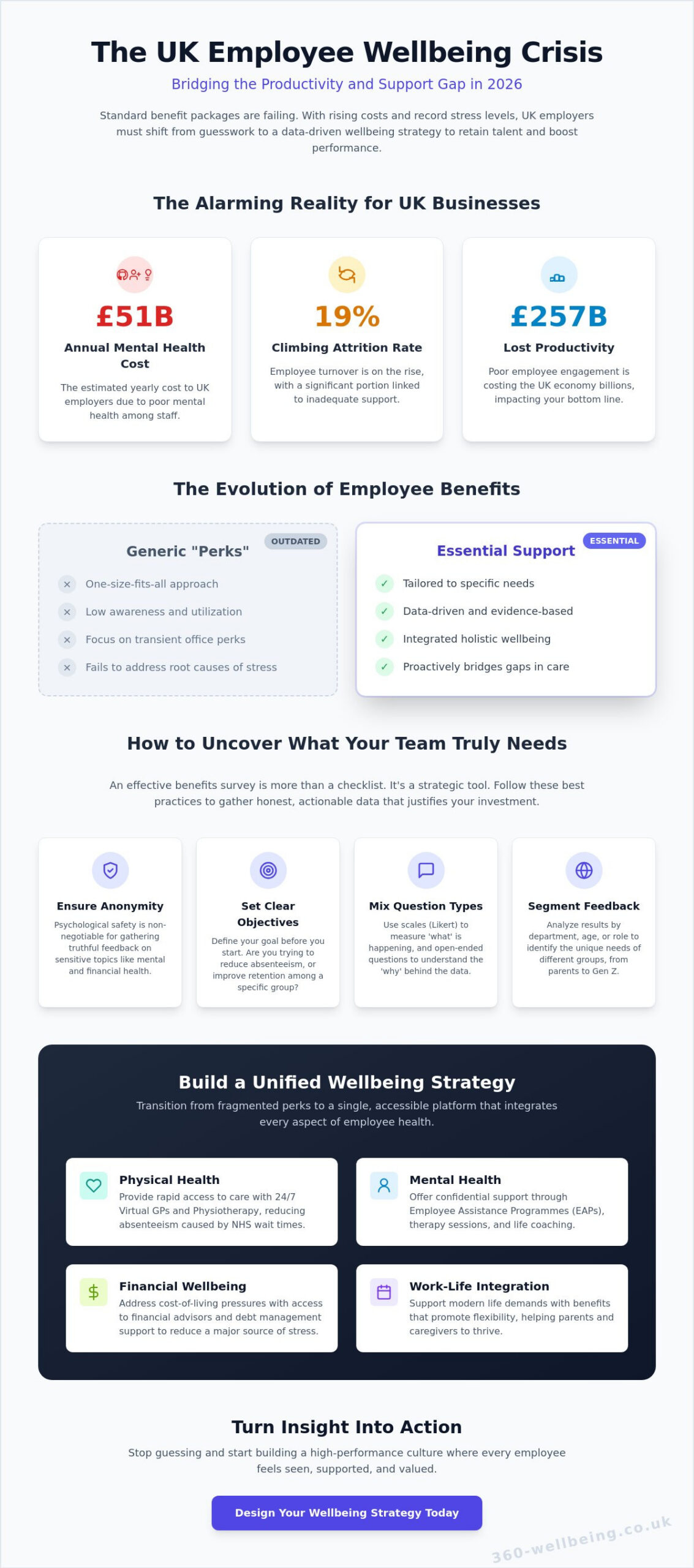
What if the benefits package you’ve carefully curated is technically “satisfactory” but practically invisible to the employees who need it most? In 2026, many UK employers find themselves in a frustrating cycle; investing in perks while attrition rates climb toward 19% and mental health costs hit an estimated £51 billion annually. You likely feel the pressure of balancing budget constraints with the urgent need to support a workforce facing record-high stress and lengthening NHS wait times. It’s clear that a generic approach no longer works. To build a culture where people truly thrive, you need precise employee benefits survey questions uk that move beyond surface-level likes and dislikes to uncover the real barriers to wellbeing.
We understand that your role isn’t just about managing costs; it’s about nurturing the human potential within your organization. This guide promises to help you master your workforce strategy by providing a comprehensive list of UK-specific survey questions designed for the modern landscape. We’ll show you how to identify where traditional support systems are failing and provide a clear framework to justify your benefit spend to the board. You’ll discover how to turn raw feedback into an actionable roadmap that reduces absenteeism, improves vitality, and ensures every team member feels seen and supported as a whole person.
Key Takeaways
- Understand why standard benefit packages are falling short in the 2026 landscape and how to bridge the growing productivity gap.
- Access a curated list of employee benefits survey questions uk designed to reveal whether your team truly values and understands your current offerings.
- Learn the essential role of anonymity and psychological safety in gathering the honest data needed to justify benefit spend to your board.
- Discover how to segment feedback to identify the unique needs of different groups, from parents needing flexibility to Gen Z seeking mental health support.
- Transition from a fragmented collection of perks to a unified wellbeing strategy that integrates physical, mental, and social health into one accessible platform.
Why Employee Benefits Surveys are Critical for UK Businesses in 2026
The UK workforce has reached a turning point where “standard” packages no longer meet the complex needs of modern life. With poor engagement costing the UK economy an estimated £257 billion in lost productivity according to 2026 reports, business leaders can’t afford to guess what their teams need. Employee benefits have evolved from simple financial rewards into a vital support system that safeguards both physical and mental health. Using targeted employee benefits survey questions uk allows you to move away from HR guesswork and toward evidence-based budgeting. It’s about identifying the specific stressors, from financial anxiety to physical pain, that prevent your people from performing at their best.
Addressing the productivity gap requires a panoramic view of your workforce. Data-driven insights help you outpace competitors in a tight talent market where 91% of adults have experienced high levels of pressure in the last year. By validating your benefit spend through employee feedback, you ensure every pound invested contributes to a high-performance culture. This methodical approach creates a sense of safety and order, helping employees feel that their health is a professional necessity rather than a luxury.
The Link Between Holistic Wellbeing and Staff Retention
Loyalty in 2026 is built on a foundation of expert care. With 79% of employees citing a lack of appreciation as a reason for leaving, a robust wellbeing strategy becomes your most powerful retention tool. The cost of replacing a mid-level employee often dwarfs the investment in a comprehensive wellbeing platform that offers 24/7 Virtual GP access or Mental Health Support. Employees now prioritize health security and durability over transient office perks like casual dress codes. When you provide a safety net that includes Physiotherapy or Life Coaching, you aren’t just ticking a box; you’re demonstrating a deep commitment to their long-term success.
Moving from “Perks” to “Essential Support” in a Post-NHS Crisis Era
The current pressure on the NHS has redefined the role of the employer. Long wait times for primary care directly impact your bottom line through increased absenteeism and reduced focus. By facilitating faster health interventions through services like an Employee Assistance Programme (EAP) or Virtual GP consultations, you act as a vital bridge to recovery. This proactive approach aligns perfectly with 2026 cost-of-living challenges, where employees are increasingly squeezed by “fiscal drag” and rising costs. Providing Financial Support & Debt Advice alongside health benefits ensures your team feels empowered to manage both their physical vitality and their economic stability. Gathering data via specific employee benefits survey questions uk ensures your investment addresses these real-world pressures rather than just offering what’s trendy.
Designing an Effective Employee Benefits Questionnaire: Best Practices
Designing a survey for a small or medium-sized enterprise requires a delicate balance. You aren’t just collecting data; you’re opening a professional consultation with your team. Before you draft your employee benefits survey questions uk, establish a clear objective. Are you trying to reduce absenteeism related to NHS wait times, or is the goal to improve retention among parents? Knowing what you want to change prevents the survey from feeling like a hollow tick-box exercise. It’s about foresight and customization, ensuring the final strategy reflects the unique pulse of your specific workforce.
Psychological safety is the bedrock of this process. Anonymity is non-negotiable, especially when asking about sensitive topics like debt or mental health. If employees fear their answers could be traced back to them, they’ll provide the “safe” answer rather than the truth. To get the most actionable data, utilize a mix of Likert scales for quantitative tracking and open-ended questions for qualitative depth. While scales tell you what is happening, the open-ended responses reveal the why behind the numbers. This combination ensures your message is impactful and informative, guiding you through the complexities of corporate strategy without losing the human touch.
Once the data is in, you must “close the loop”. Transparency is essential for building trust and reinforcing a sense of partnership. Share a summary of the findings with the whole team and explain which changes you’ll implement first. This demonstrates that you’re an approachable authority, deeply invested in their long-term success. If you’re looking for a way to streamline this process, exploring a holistic wellbeing platform can provide the structure needed to turn these insights into reality.
Frequency and Timing: When to Ask
Timing is everything. While an annual review provides a solid baseline, “Pulse Surveys” allow you to maintain a panoramic view of sentiment throughout the year. Given the high attrition rates seen across the UK in recent years, waiting twelve months to identify a problem is a risk most SMEs can’t afford. Consider surveying at key milestones, such as the end of a probation period or 90 days after onboarding, to understand how new hires perceive your support systems before they become disengaged.
Survey Accessibility for Diverse Workforces
In 2026, your team might be split between the office, their homes, or the frontline. Your survey must be accessible to everyone. Use a mobile-first design to ensure that staff without a dedicated desk can participate easily. Keep the language inclusive and clear; avoid complex HR jargon that might alienate employees with different educational backgrounds. Every person in your organization is entitled to wellness, and their voice should be heard regardless of their role or location.
40+ Essential Employee Benefits Survey Questions (Categorised)
To build a high-performance culture, you must first understand the silent needs of your team. Many traditional lists of employee benefits survey questions uk focus on superficial perks like office snacks or social events. However, in 2026, the real value lies in providing essential support that addresses the core stressors of modern life. This section categorises the questions you need to ask to uncover whether your current strategy is truly durable or if there are gaps in the health and financial security you provide. It’s about moving toward a panoramic view of your workforce, ensuring that every individual feels their wellbeing is a priority rather than an afterthought.
We’ve structured these questions to help you identify not just what employees like, but what they truly rely on. By focusing on value perception and core awareness, you can ensure your budget is invested in services that offer genuine reassurance. When employees feel that their physical and mental health is supported by expert care, they’re far more likely to stay engaged and loyal for the long term.
Health, Mental Wellbeing, and Virtual GP Questions
Health-related absenteeism is often preceded by a period of presenteeism, where employees struggle to focus due to underlying physical or mental strain. Use these questions to gauge the accessibility of your current support systems and identify where the “silent needs” of your organisation lie:
- On a scale of 1 to 10, how would you rate your ease of access to a GP for non-emergency appointments?
- How much does health-related anxiety currently affect your daily focus and productivity at work?
- Would having 24/7 access to a Virtual GP improve your peace of mind and reduce the need to take time off for medical appointments?
- How comfortable do you feel accessing Mental Health Support or an Employee Assistance Programme (EAP) through your workplace?
- If you experienced a physical limitation, such as back pain, how confident are you that our current Physiotherapy benefits would help you recover quickly?
Financial Wellness and Lifestyle Support
With ongoing cost-of-living challenges and fiscal drag impacting take-home pay, financial wellbeing is no longer a luxury; it’s a professional necessity. Use these questions to see if your team feels financially secure and supported:
- How well do our current benefits help you manage the cost of living and everyday expenses?
- Are you aware of our financial support and debt advice services available to you?
- Would you value complimentary legal support, such as will writing or legal advice, as part of your core package?
- How often do you use our 360 Rewards or retail discount marketplace for everyday savings?
- Would access to Life Coaching help you better manage the balance between your personal finances and professional goals?
Communication and Ease of Use
Even the best benefits are useless if your team doesn’t know they exist or finds them difficult to access. A fragmented approach often leads to low engagement and wasted investment. Ask these questions to assess your communication rhythm:
- Where do you typically go to find information about your employee benefits when you need it?
- On a scale of 1 to 10, rate the ease of use of our current benefits platform or digital portal.
- How would you prefer to receive updates about new benefits, perks, or wellness opportunities?
- Do you feel that our current benefits package is tailored to your individual life stage and personal needs?
Interpreting Your Results: Turning Data into a Wellbeing Strategy
Once you have gathered responses to your employee benefits survey questions uk, the true work of an expert caregiver begins. It is not enough to simply look at high-level satisfaction scores; you must dive into the data with a methodical, panoramic viewpoint. A common pitfall is the “Silent Gap,” where employees rate a benefit like an Employee Assistance Programme (EAP) highly in theory, but internal records show usage is near zero. This often indicates that while the team values the safety net, they find the access route confusing or feel a lack of psychological safety. Your strategy should move beyond providing perks to ensuring every individual feels empowered to use them when they are most vulnerable.
Segmentation is your most powerful tool for creating a durable culture. In 2026, the needs of a Gen Z recruit often differ vastly from those of a senior leader or a working parent. With 91% of UK adults reporting high or extreme stress levels in the past year, your data might show that younger staff are crying out for Mental Health Support, while parents are more focused on the flexibility of a 24/7 Virtual GP to manage family health around school runs. By identifying these nuances, you can move away from a one-size-fits-all approach toward a strategy of individualized care that actually moves the needle on your 19% attrition risk.
To turn these insights into a structured path forward, you need to benchmark your results against current UK standards. The 2026 Employee Benefits Benchmarking Report shows that 45.8% of employers now offer home working, and 31.5% provide private health options. If your survey reveals that staff feel unsupported during NHS wait times, prioritising a unified wellbeing platform that offers faster health interventions will have a higher impact on productivity than traditional office-based rewards. This evidence-based budgeting allows you to justify every pound of spend to the board.
Spotting the Signs of Burnout and Stress in Survey Data
Qualitative comments are often the first place burnout reveals itself. Look for recurring themes of workplace pressure or mentions of physical limitations that are being ignored. There is a direct correlation between low benefit awareness and high stress; when employees don’t know where to turn for help, their anxiety compounds. If your survey data shows a cluster of “exhaustion” or “lack of focus,” it provides the clinical evidence needed to advocate for stronger Mental Health Support or Physiotherapy services to prevent long-term absenteeism.
Communicating the “Why” Behind Your Benefit Decisions
Building a narrative of continuous improvement requires transparency. If you cannot fulfill a specific request due to budget constraints, explain the underlying factors honestly. Tell your team that you’re choosing to invest in 24/7 Virtual GP access or Financial Support & Debt Advice because these provide essential health security during the current cost-of-living crisis. By highlighting that new additions are a direct result of their feedback, you foster a sense of partnership and reassure them that their wellbeing is viewed as a human entitlement, not a luxury.
Bridging the Gap: Implementing a Holistic Benefits Platform
The transition from analyzing data to implementing a solution is where many workforce strategies falter. You’ve asked the right employee benefits survey questions uk and identified the gaps, but providing a stack of physical flyers or a dozen different logins often leads to the “Wellbeing Paradox.” This is the gap where support exists but isn’t used because it’s too difficult to navigate. A fragmented approach feels impersonal and overwhelming for employees already struggling with stress. By contrast, a unified digital wellbeing platform creates a single, welcoming entry point for all health and lifestyle needs, mirroring a philosophy of all-encompassing care.
A holistic platform doesn’t just centralize information; it significantly reduces the administrative burden on HR teams. Automated onboarding and real-time reporting allow you to see which benefits are truly providing value without the need for manual data entry or complex spreadsheets. This methodical approach ensures that your strategy remains durable and responsive to the needs of a 2026 workforce. It’s about building a partnership with your employees that feels both scientifically grounded and deeply personal, moving away from a one-off service toward a culture of continuous support.
Why 360 Wellbeing is the Logical Conclusion of Your Survey
360 Wellbeing addresses the top complaints typically found in benefits surveys: lack of access, poor communication, and irrelevant perks. By providing 24/7 Virtual GP access, you offer the immediate health security your team is likely asking for in a climate of long NHS wait times. Integrating Mental Health Support, Life Coaching, and Physiotherapy into one app ensures that physical and mental wellness are treated as a unified narrative of total health. Meanwhile, the 360 Rewards marketplace provides tangible financial relief, addressing the cost-of-living concerns identified in your survey data through everyday savings.
Next Steps: From Survey to Solution
Transitioning from legacy systems or a fragmented collection of perks shouldn’t be a source of stress. 360 Wellbeing is designed for ease of use and customization, ensuring a smooth path forward for both individuals and corporate clients. You can see how this panoramic viewpoint translates into daily vitality by booking a platform demo to explore the interface and reporting features. This is your opportunity to move from identifying challenges to providing a clear, structured path for your team’s success. Transform your employee benefits with 360 Wellbeing today and ensure your workforce strategy is as resilient as the people it supports.
Cultivating a High-Performance Culture Through Expert Care
Building a resilient workforce in 2026 requires more than just a list of perks; it demands a panoramic view of your team’s physical, mental, and financial health. By utilizing targeted employee benefits survey questions uk, you’ve taken the first step toward uncovering the silent gaps that impact productivity and retention. You now have the evidence needed to move away from fragmented, low-usage services and toward a unified narrative of total wellness. It’s about ensuring that every individual feels their health is a professional necessity and a human entitlement, supported by a partner who is truly invested in their long-term success.
At 360 Wellbeing, we’re ready to help you turn those survey insights into a durable strategy. Our platform provides the essential support your employees need, from 24/7 UK-registered Virtual GP access and comprehensive EAP and Mental Health support to thousands of retail discounts via 360 Rewards. This combination of clinical expertise and tangible financial relief ensures your team stays healthy, focused, and valued. Book a consultation to build your 2026 wellbeing strategy today. Let’s work together to create a workplace where vitality and harmony aren’t just goals, but a daily reality for everyone.
Frequently Asked Questions
Are employee benefits surveys usually anonymous?
Yes, anonymity is the gold standard for ensuring psychological safety and obtaining honest feedback. When employees feel their responses are private, they are much more likely to share genuine concerns about sensitive topics like mental health, debt, or physical limitations. This level of trust is essential for gathering the high-quality data you need to build a durable and supportive workplace culture.
How many questions should be in an employee benefits survey?
The ideal length depends on the frequency of your outreach, but for a comprehensive annual review, aim for 15 to 25 questions. This allows for a panoramic view of employee sentiment without causing survey fatigue. If you are running a monthly pulse check, keep it concise with 5 to 10 employee benefits survey questions uk that focus on specific areas like access to healthcare or current stress levels.
What is the best time of year to run a benefits survey in the UK?
Q1 (January or February) is often the most strategic time to run a survey in the UK. This timing allows you to gather insights ahead of the new tax year in April, when statutory rates for sick pay and maternity pay typically change. It also avoids the summer holiday slump and the busy December period, ensuring your team has the mental space to provide thoughtful, methodical feedback.
How do I encourage a high response rate for my staff survey?
Clear communication regarding the “why” behind the survey is the most effective way to drive participation. Explain to your team that their feedback directly influences your investment in their wellbeing and health security. Ensuring the survey is mobile-friendly and accessible for frontline staff also helps. When employees see that previous surveys led to tangible changes, like the introduction of 24/7 Virtual GP access, they feel empowered to participate again.
What are the most common benefits UK employees ask for in 2026?
In 2026, UK employees are increasingly prioritizing essential health support and financial wellness over traditional office perks. With 91% of adults experiencing high stress, there is a significant demand for Mental Health Support and faster access to primary care through Virtual GPs. Financial education and retail discounts are also highly valued as households continue to navigate cost-of-living challenges and the impact of fiscal drag on their take-home pay.
Should I share the survey results with my employees?
Closing the loop by sharing a summary of the results is vital for maintaining trust and partnership. You don’t need to share every raw data point, but highlighting key themes and the resulting action plan shows that you are an approachable authority. This transparency reinforces the idea that wellbeing is a human entitlement and that you are genuinely invested in the long-term success of every team member.
How can I measure the ROI of my employee benefits package?
You can measure ROI by tracking specific metrics such as attrition rates, which averaged 19% across the UK in 2025, and the cost of health-related absenteeism. By comparing your employee benefits survey questions uk data with actual usage rates of services like Physiotherapy or EAPs, you can identify which investments are reducing the £51 billion annual cost of poor mental health. A unified platform makes this reporting much simpler by centralizing usage data in one place.
Can I use a survey to remove existing benefits that aren’t being used?
Yes, surveys are an excellent tool for identifying “silent gaps” where investment is being wasted on perks that don’t provide value. However, it’s important to frame this as a reallocation of resources rather than a simple cut. If the data shows that a benefit isn’t being used, explain that you are reinvesting that budget into more impactful support, such as 24/7 Virtual GP access or Financial Support & Debt Advice, to better serve the team’s current needs.