
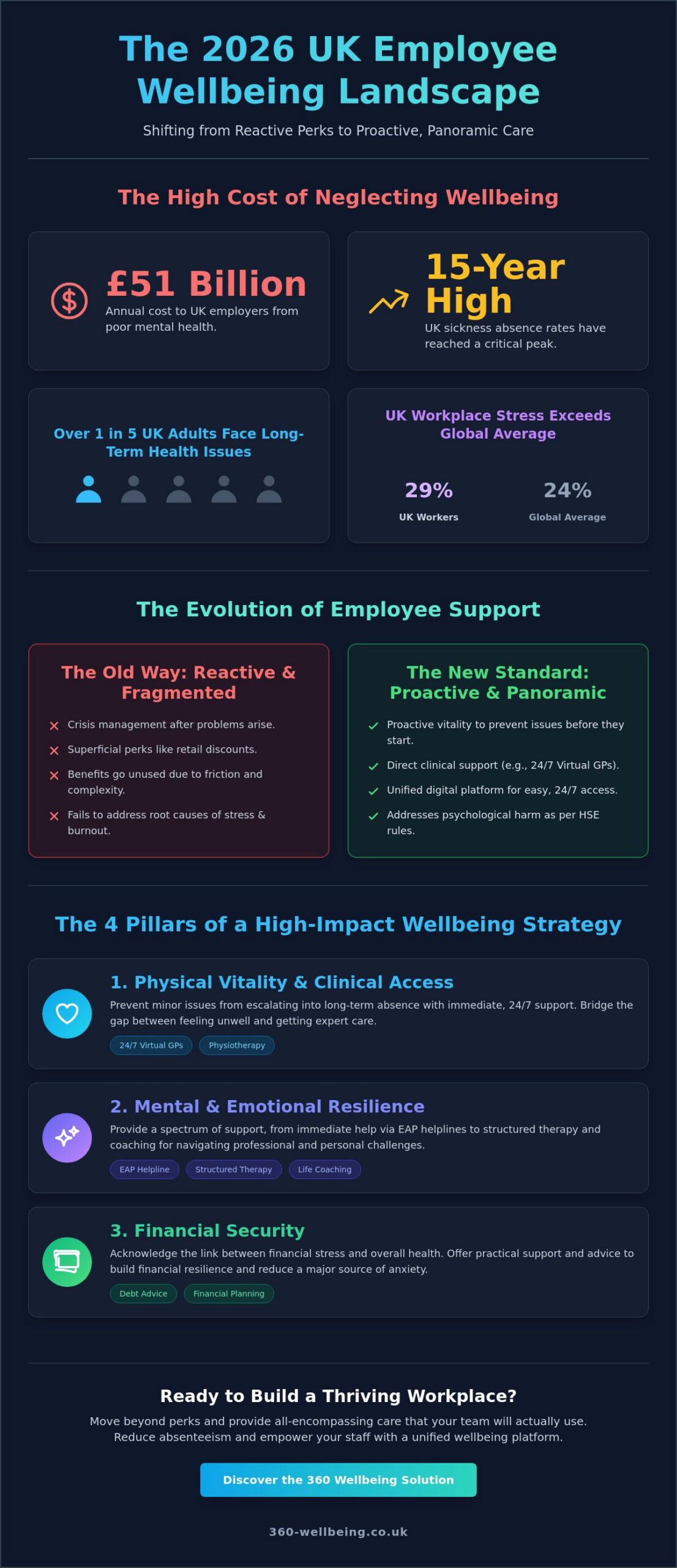
Poor mental health is no longer just a private concern. It’s costing UK employers an estimated £51 billion annually as of June 2026. If you’re searching for employee wellbeing initiatives uk workforces actually respond to, you’ve likely realized that traditional models are struggling to keep pace. You’re probably facing the rising cost of private medical insurance while watching sickness absences hit a 15-year high. It’s disheartening to provide benefits that your team rarely uses, especially when you want to be a partner in their long-term health and success.
We understand that you want to move away from reactive crisis management toward a proactive vision of workplace harmony. This guide promises to show you how to build a high-impact, holistic wellbeing strategy that reduces absenteeism and empowers your staff. We’ll explore the latest 2026 regulatory shifts, including the new HSE requirements for psychological risk assessments, and provide a clear, methodical path to creating a culture where your employees feel genuinely cared for and protected.
Key Takeaways
- Learn why shifting from reactive perks to a panoramic approach is the new baseline for attracting and retaining top UK talent in 2026.
- Discover how to integrate physical, mental, and social health into cohesive employee wellbeing initiatives uk teams will actually value and use.
- Identify the “hidden friction” that causes most wellbeing benefits to go unused and how to solve it with a single, unified digital platform.
- Follow a step-by-step roadmap to conduct a panoramic audit of your current support systems to ensure they meet the specific needs of your workforce.
- Explore the impact of providing all-encompassing care through instant 24/7 access to Virtual GPs, mental health therapy, and life coaching.
What are Employee Wellbeing Initiatives in the 2026 UK Landscape?
Defining these initiatives means looking at proactive steps designed to safeguard the physical, mental, and social health of your team. While you might wonder What is Workplace Wellness? in a historical context, the 2026 landscape demands a much broader, “panoramic” view. It’s no longer just about meeting minimum legal requirements; it’s about acknowledging that health is a professional necessity and an essential human entitlement. We’ve moved past the era where a discount code for a gym was enough to satisfy a workforce. Today, employees expect direct clinical support, such as 24/7 Virtual GPs and immediate mental health interventions, as a baseline for their commitment to a company.
The shift we’re seeing is one from reactive crisis management to proactive vitality and foresight. In the past, many employee wellbeing initiatives uk firms offered were only triggered once an employee was already struggling. In 2026, the focus has moved toward durability. This means providing tools that help staff maintain their health daily, preventing the burnout that leads to long-term absence. Distinguishing between “perks,” like retail rewards, and “clinical support,” such as physiotherapy or life coaching, is vital. While rewards have their place in culture, they don’t solve the underlying health challenges that impact your bottom line.
The Evolution of Workplace Health in the UK
Workplace health has undergone a profound transformation. In 2024, sickness absence hit a 15-year high, and by early 2026, the Health and Safety Executive (HSE) explicitly clarified that an employer’s duty to protect staff includes psychological harm. This regulatory shift means your risk assessments must now specifically address workplace stress. We’ve seen that “engagement fatigue” occurs when staff are offered superficial benefits that don’t address their actual needs. If your team is struggling with long-term health issues, which now affect over 1 in 5 working-age adults in the UK, they need more than a “perk”; they need a partner who is invested in their long-term success.
Panoramic Wellbeing: A New Standard
The concept of panoramic wellbeing represents a move toward all-encompassing care. It’s the understanding that a person’s physical health, mental resilience, and financial security are all connected. For instance, financial stress often manifests as physical illness or mental burnout. By providing a spectrum of support, from physiotherapy and EAP services to financial debt advice, you create a culture of workplace harmony. Accessibility is the final piece of the puzzle. Modern employee wellbeing initiatives uk businesses implement must be digital-first. If a service isn’t available 24/7 through a unified platform, it creates friction that prevents people from getting help before a minor issue becomes a crisis.
The 4 Essential Pillars of an Effective Wellbeing Strategy
Building a strategy that actually works requires looking at the whole person rather than just their professional output. In 2026, the most successful employee wellbeing initiatives uk companies adopt are built on four distinct pillars. These provide a structure that ensures no aspect of a person’s health is overlooked, moving from surface-level perks toward a model of all-encompassing care that prioritises durability and foresight.
Physical Vitality and Clinical Access
Waiting weeks for a medical appointment is a primary driver of workplace absence and anxiety. By providing 24/7 Virtual GP services, you give your team the ability to speak with a clinician at a time that suits them, often on the same day. This immediate access prevents minor ailments from escalating into long-term sickness. Similarly, early intervention through physiotherapy support can stop musculoskeletal issues from becoming chronic conditions. Rapid clinical access serves as a professional necessity in 2026 because it bridges the gap between feeling unwell and receiving the expert care needed to return to vitality.
Mental and Emotional Resilience
Mental health remains a significant challenge for the modern workforce. Recent data shows that 29% of UK workers report high stress at work, which is notably higher than the global average of 24%. An effective strategy must offer a spectrum of support, from the immediate relief provided by an Employee Assistance Programme (EAP) helpline to structured therapy sessions for deeper challenges. Life coaching also plays a vital role in helping employees navigate professional hurdles with confidence. While following HSE guidance on mental health at work is a legal starting point, the ultimate goal is to create an environment where seeking help is empowered and proactive.
Financial and Legal Security
Financial stress is a silent productivity killer. When employees worry about debt or legal issues, their focus at work inevitably suffers. Offering debt advice and financial support can alleviate these pressures at the source. You can explore our Financial Support for Employees: A Comprehensive Guide for UK Employers in 2026 to see how these services integrate into a wider strategy. Unique benefits, such as complimentary will writing and legal support, provide a sense of security that traditional benefits often miss. When designing employee wellbeing initiatives uk staff will truly embrace, addressing these “hidden” stressors is essential for fostering a culture of genuine workplace harmony. If you’re ready to see how these pillars fit together, exploring a consolidated wellbeing solution can help you provide this level of care effortlessly.
Closing the Engagement Gap: Why Many Initiatives Fail
Many employers invest heavily in employee wellbeing initiatives uk teams ostensibly want, only to see engagement rates stall. This failure isn’t usually due to a lack of interest from staff. It’s often caused by “hidden friction.” When help is buried behind complex insurance portals or requires a phone call during a busy shift, employees simply don’t use it. To be effective, support must be immediate and intuitive. We’ve seen that the more steps an employee has to take to access a benefit, the less likely they are to engage with it before a minor issue becomes a major problem.
Research into evidence-based approaches to workforce wellbeing shows that accessibility is a major determinant of success. If your team has to jump through hoops to see a doctor or talk to a therapist, they’ll likely wait until they hit a crisis point. We want to avoid that. A single, unified digital platform that houses all services, from physiotherapy to mental health support, removes these barriers. It transforms wellbeing from a series of disjointed perks into a reliable, all-encompassing safety net that employees actually trust.
Frictionless Access to Care
Busy staff don’t have time to wait weeks for a GP appointment. Providing a 24/7 Virtual GP is the ultimate friction-reducer. It allows a parent to consult a doctor at 10 PM or a remote worker to get a prescription without leaving their desk. This “anytime, anywhere” support is essential for modern hybrid teams who may not have access to traditional on-site support. Beyond clinical care, digital marketplaces like 360 Rewards offer immediate, tangible value. They make wellbeing feel like a positive part of daily life rather than a chore. When benefits are this easy to access, they become a seamless part of the workday, fostering durability and long-term health.
Empathetic Leadership and Communication
Line managers are your most valuable allies in closing the engagement gap. However, they shouldn’t feel like they need to be medical experts. Their role is to champion these initiatives and act as a bridge to professional help. Training managers to spot the physical symptoms of stress, such as changes in sleep patterns or withdrawal from social interaction, is a practical first step. It’s about moving from a reactive “crisis” mindset to one of foresight.
It’s also about changing the narrative. We should move away from fear-based health warnings and toward “vitality opportunities.” When you frame health support as a tool for empowerment and a professional necessity, you remove the “fear factor” that often prevents staff from coming forward. Every employee should feel that their wellbeing is a human entitlement, not a luxury provided at the company’s whim. This cultural shift, supported by a partner who’s invested in your long-term success, ensures that your strategy doesn’t just look good on paper, but actually changes lives.
How to Implement a Wellbeing Roadmap for Your UK Business
Creating a sustainable strategy for employee wellbeing initiatives uk teams will embrace requires more than just a list of benefits. It’s a methodical journey toward building a culture of durability and mutual respect. By following a structured roadmap, you can ensure your investment translates into a healthier, more engaged workforce that feels supported at every level. This process begins with foresight and ends with a customized, data-driven approach to care.
The first step is a “Panoramic Audit.” This involves looking beyond surface-level engagement to identify the actual gaps in your current support. You might find that your existing EAP or insurance policies are too reactive or difficult to navigate, leaving employees without help when they need it most. Once these gaps are clear, the next stage is consolidation. Bringing your services—such as 24/7 Virtual GPs, mental health therapy, and financial advice—into a single, unified platform reduces the friction we discussed earlier. For many UK businesses, a SaaS model is the most practical choice, offering predictable per-employee costs while ensuring that physical, mental, and financial health bases are all covered.
Auditing and Consolidating Support
When you audit your current provision, ask whether your tools are available 24/7. In a 2026 landscape, a benefit that only operates during office hours is often insufficient for a hybrid or flexible workforce. Consolidation isn’t just about saving time; it’s about creating a sense of safety and order for your staff. When an employee knows exactly where to go for physiotherapy or legal support, they’re more likely to seek help early. This proactive approach prevents minor issues from spiraling into long-term absence, protecting both the individual and the business’s operational resilience.
Measuring Success Beyond Absenteeism
While reducing sick days is a vital goal, it shouldn’t be your only metric. We also need to track “presenteeism,” where staff are physically at work but mentally or physically unwell, leading to a drop in quality and morale. Using regular feedback loops allows you to see which initiatives, such as life coaching or rewards, are resonating most with your unique team. Calculating the true ROI of your strategy is achieved by observing measurable improvements in staff retention rates and overall team productivity over time.
To truly bring this roadmap to life, you must launch with an empathetic, benefit-driven communication strategy. Don’t just announce a new tool; explain how it empowers each individual to take control of their vitality. Empowering “Wellbeing Champions” within your departments can also help lead by example, making the support feel more accessible and less corporate. If you’re ready to take the first step, you can build your wellbeing roadmap with a partner who’s committed to your team’s long-term success.
The 360 Wellbeing Solution: All-Encompassing Care for UK Teams
Integrating the various pillars we’ve discussed into a single, cohesive strategy is where many businesses struggle. This is why 360 Wellbeing exists. We provide a panoramic viewpoint on employee health that moves away from fragmented services and toward a unified narrative of total wellness. By choosing 360 Wellbeing, you’re not just buying a set of tools; you’re investing in employee wellbeing initiatives uk workforces can rely on for the long term. Our solution ensures that physical, mental, and social health are scientifically grounded yet deeply personal.
Imagine the reassurance your team will feel knowing they have 24/7 Virtual GP access and professional mental health therapy right in their pocket. Our app removes the friction of traditional healthcare, allowing staff to seek advice from a clinician or a therapist at a time that fits their life. This accessibility is a professional necessity in 2026, especially as we see the rise in long-term health issues across the UK. It’s about providing durability and foresight, catching small health concerns before they impact an employee’s vitality or your business’s productivity.
Our commitment goes beyond clinical health. We’ve integrated financial support, debt advice, legal aid, and even complimentary will writing into our platform. These services address the root causes of workplace stress, providing a sense of safety and order that traditional medical services often overlook. We believe that every worker, whether part of a large corporation, a small business, or operating as a sole trader, deserves this level of all-encompassing care. Our mission is to make high-impact employee wellbeing initiatives uk accessible to every employer, regardless of their size or sector.
A Partnership for Long-Term Vitality
We see ourselves as an expert caregiver and a dedicated partner in your success. Our approach balances clinical expertise with a warm, human touch, ensuring that complex health topics feel manageable and accessible. To add daily value, the 360 Rewards marketplace provides tangible benefits that employees can enjoy immediately, while our life coaching and physiotherapy services offer ongoing support for personal growth. These customisable solutions are designed to grow with your organisation, ensuring your strategy remains relevant as your team evolves.
Getting Started with 360 Wellbeing
Starting your journey toward a healthier workplace is simple and methodical. We operate a transparent per-employee subscription model that provides predictable costs for your business, avoiding the high premiums of traditional insurance. We are the preferred partner for UK employers because we don’t just provide a one-off service; we look out for the long-term interests of your staff. Discover how 360 Wellbeing can transform your workplace culture and help you build a workforce that feels genuinely cared for, empowered, and ready to thrive.
Empowering Your Team for the Years Ahead
The landscape of workplace health has fundamentally changed. Shifting from reactive crisis management to a proactive vision of vitality is now a necessity for any business looking to thrive. We’ve explored how implementing employee wellbeing initiatives uk workforces respond to requires a panoramic approach that integrates physical, mental, and financial health into a single, accessible narrative. By removing the friction of complex portals and providing immediate clinical support, you transform wellbeing from a luxury into a professional entitlement that empowers every member of your workforce.
Whether you’re a sole trader or managing a large enterprise, our scalable solutions are designed to grow with you. You can provide your team with 24/7 access to UK-registered GPs and holistic support that covers everything from mental health therapy to financial and legal aid. It’s time to move toward a culture of durability and genuine care. Book a consultation to build your bespoke 360 Wellbeing package today. Let’s work together to ensure your team has the support they need to achieve long-term harmony and success.
Frequently Asked Questions
What are the most effective employee wellbeing initiatives for UK small businesses?
Small businesses achieve the best results by focusing on high-impact, digital-first tools that offer immediate clinical support. Prioritising 24/7 Virtual GP access and mental health therapy ensures that your team can address health concerns without the need for lengthy time off. Consolidated platforms are particularly effective for smaller teams because they provide a wide range of services, from physiotherapy to life coaching, without requiring a dedicated internal medical department.
How much do employee wellbeing programs typically cost in the UK?
The cost of these programs is usually structured as a monthly subscription per employee, making it a predictable investment for your budget. While prices vary depending on the depth of clinical and lifestyle support included, many businesses find this model more affordable than traditional private medical insurance. This approach allows you to provide all-encompassing care that covers physical, mental, and social health through a single, manageable fee.
Can wellbeing initiatives really reduce employee absenteeism?
Yes, proactive employee wellbeing initiatives uk firms implement are specifically designed to catch health issues before they lead to long-term absence. By providing rapid access to clinicians and therapists, you allow staff to seek help at the first sign of a problem. This preventative approach is essential for maintaining workplace harmony and protecting your business from the operational disruptions caused by high sickness rates.
What is the difference between an EAP and a full wellbeing platform?
An Employee Assistance Programme (EAP) is typically a reactive service focused on crisis helplines and short-term counselling. A full wellbeing platform offers a more panoramic viewpoint, integrating the EAP with proactive tools like Virtual GPs, rewards, and financial advice. It moves the focus from simply “fixing” a problem to maintaining long-term vitality and foresight, ensuring employees feel supported in every aspect of their lives.
How do I encourage staff to actually use the wellbeing benefits provided?
The best way to increase engagement is to remove all “hidden friction” by using a single, intuitive app for all services. If help is easy to find and available 24/7, employees are far more likely to use it. You should also frame these benefits as a professional necessity and a human entitlement. When leadership teams actively champion the platform and use it themselves, it helps to remove any lingering stigma around seeking support.
Are virtual GP services as effective as in-person appointments for employees?
Virtual GP services are highly effective for the majority of primary care needs, including diagnosis, prescriptions, and referrals. They offer a level of convenience that in-person appointments often cannot match, especially for hybrid or remote workers. By giving your team 24/7 access to a UK-registered GP, you ensure they get the expert care they need exactly when they need it, which is vital for maintaining long-term health.
What legal duties do UK employers have regarding staff wellbeing?
UK employers have a legal duty under the Health and Safety at Work Act 1974 to protect employees from harm, which the HSE has explicitly confirmed includes psychological harm as of 2026. You are required to conduct risk assessments that specifically address workplace stress. Additionally, the Equality Act 2010 mandates that you make reasonable adjustments for staff with mental health conditions, ensuring they have the support needed to succeed in their roles.
How can I support the financial wellbeing of my employees during a cost-of-living crisis?
Supporting financial health involves addressing both immediate pressures and long-term security. Effective employee wellbeing initiatives uk employers use include providing debt advice, legal support, and access to a rewards marketplace that helps with daily living costs. Offering unique benefits like complimentary will writing also provides employees with significant peace of mind, reducing the background stress that often impacts their focus and productivity at work.