
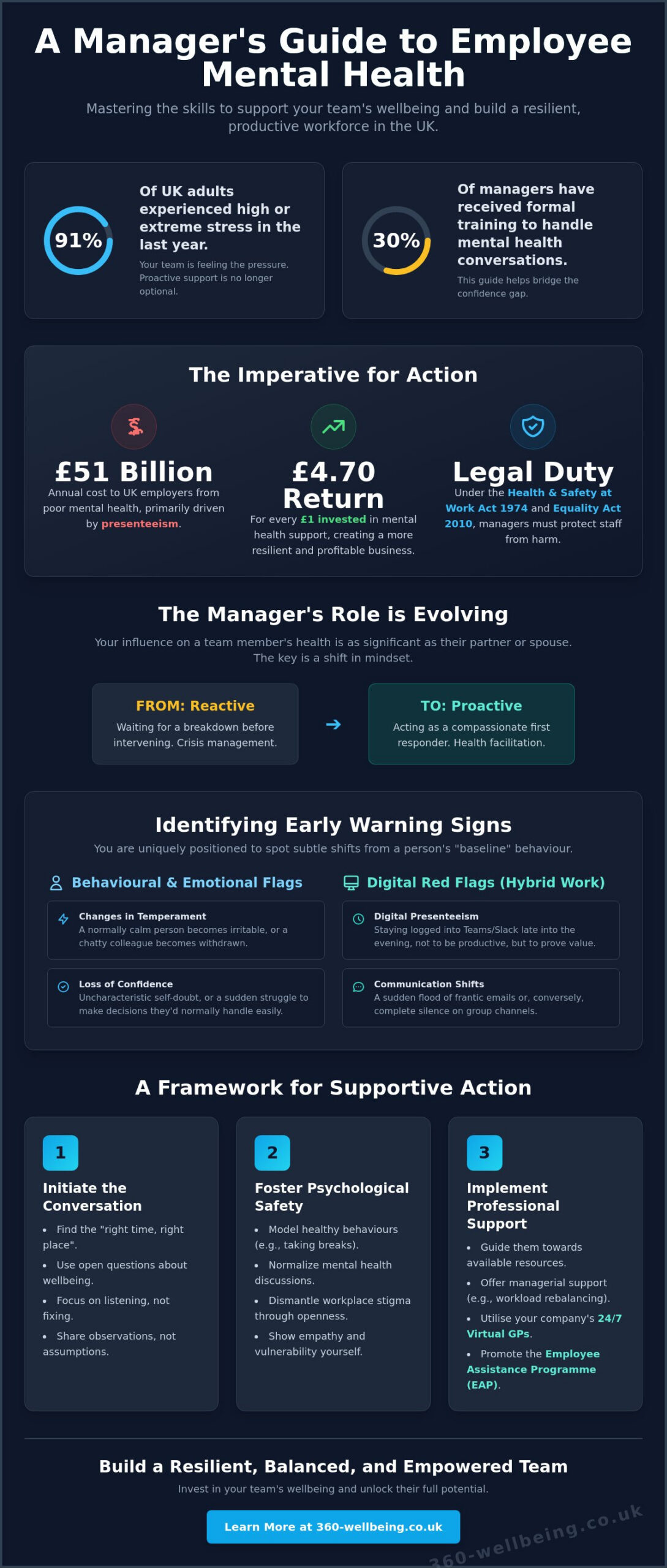
Did you know that 91% of UK adults reported experiencing high or extreme levels of pressure and stress over the last year? As a manager, you’re likely feeling the strain of this reality as you balance demanding KPIs with a genuine concern for your team’s wellbeing. It’s natural to worry that starting a conversation about mental health might “open a can of worms” you aren’t equipped to handle, especially when only 30% of managers have received formal training for these delicate moments.
You understand that a healthy team is a productive one, but the line between managing performance and supporting a person’s health can feel incredibly thin. This guide provides the clarity you need to master how managers can support employee mental health uk effectively. We’ll move beyond the fear of legal “duty of care” requirements and provide you with a practical framework for having difficult conversations. You will learn how to spot early signs of burnout, conduct mandatory stress risk assessments, and access a professional toolkit of resources to ensure your team remains resilient, balanced, and empowered.
Key Takeaways
- Shift from reactive crisis management to proactive health facilitation by positioning yourself as a compassionate first responder for your team’s wellbeing.
- Learn to recognize subtle behavioral shifts and understand the “spectrum of health” to identify early warning signs of burnout or anxiety.
- Master the “right time, right place” rule and effective questioning techniques to understand how managers can support employee mental health uk through meaningful, pressure-free conversations.
- Foster a culture of psychological safety by modeling healthy behaviors and normalizing discussions about mental health to dismantle workplace stigma.
- Implement robust support infrastructure, such as 24/7 Virtual GPs and Employee Assistance Programmes, to bridge the gap between identifying a struggle and accessing professional care.
The Manager’s Role in Workplace Mental Health and Wellbeing
In the evolving landscape of 2026, the definition of leadership has shifted. You’re no longer just responsible for hitting targets; you’re the primary custodian of your team’s psychological wellbeing. This doesn’t mean you need a medical degree. Instead, you act as a “first responder” who recognizes when a colleague is struggling and guides them toward the right professional help. Understanding how managers can support employee mental health uk starts with accepting that your influence on a team member’s health is as significant as that of their own partner or spouse.
The shift from reactive crisis management to proactive facilitation is essential for modern durability. Historically, businesses waited for a breakdown before intervening. Today, the focus is on foresight. In our digital-first era, managers leverage tools like 24/7 Virtual GPs and Mental Health Support platforms to provide immediate care, especially for hybrid teams where physical cues might be missed. While a doctor provides clinical treatment, your role is to offer managerial support through workload rebalancing and empathetic listening. This holistic approach ensures that Mental health in the United Kingdom remains a priority within the corporate narrative, blending physical and social health into a unified strategy.
Understanding Your Legal Duty of Care in the UK
Your professional duty is a legal requirement. The law is clear. Under the Health and Safety at Work Act 1974, you must protect employees from psychological harm. The HSE has increased enforcement in 2026, making stress risk assessments mandatory for all teams. Additionally, the Equality Act 2010 classifies many mental health conditions as disabilities, requiring you to make reasonable adjustments to ensure staff aren’t disadvantaged by their health status.
The Business Case: ROI of a Mentally Healthy Team
Poor mental health costs UK employers £51 billion annually. While absenteeism is visible, the hidden drain is presenteeism. Presenteeism is the primary drain on UK productivity, occurring when staff are physically present but mentally unable to function effectively. Every £1 spent on support yields a £4.70 return. Mastering how managers can support employee mental health uk builds a more resilient, profitable business that attracts and retains the best talent.
Identifying Early Warning Signs of Mental Ill-Health in Staff
Managers are uniquely positioned to act as an early warning system. You spend hours each week collaborating with your team, which gives you a panoramic view of their usual habits and temperaments. This proximity means you’ll often spot a subtle shift in tone or a drop in engagement long before a formal HR issue arises. Understanding how managers can support employee mental health uk starts with recognizing that mental state is a spectrum. Nobody stays at 100% all the time. People move back and forth along this line depending on their workload, personal life, and innate resilience.
To notice a deviation, you must first understand a person’s “baseline.” Every individual has a different normal. Some employees are naturally quiet; others are highly vocal and energetic. A sudden withdrawal from a normally chatty team member is a signal. Conversely, if a calm individual becomes uncharacteristically irritable or snappy, it’s time to pay attention. Your regular 1-to-1 meetings should be your primary diagnostic tool. Use this time to ask open questions about their energy levels and current focus, rather than just ticking off KPI boxes. This creates a safe space for them to share challenges before they escalate into a crisis.
Behavioural and Emotional Red Flags
Look for an uncharacteristic loss of confidence or a sudden struggle to make decisions. In our hybrid world, “digital presenteeism” is a rising concern you should watch for. This occurs when staff stay logged into Teams or Slack late into the evening, not because they’re being productive, but because they feel a desperate need to prove their value. Watch for changes in communication frequency on digital channels. A sudden flood of frantic emails or a total silence on group chats can both indicate that a team member is feeling overwhelmed or isolated. Mastering how managers can support employee mental health uk involves catching these digital cues early.
Physical Symptoms of Stress at Work
Mental strain rarely stays confined to the mind. It often manifests physically as persistent fatigue, frequent headaches, or a string of minor illnesses like colds that a team member just can’t seem to shake. There’s a deep, scientifically grounded link between physical health and mental resilience. If you notice a colleague frequently mentioning they’re “under the weather” or looking visibly exhausted on camera, it might be a physical manifestation of burnout. You can find a detailed list of physical symptoms of stress to help you identify these patterns before they lead to long-term absence.
Providing your team with direct access to Mental Health Support can give them a professional outlet to address these symptoms early, ensuring minor stresses don’t become major health obstacles.
How to Have a Supportive Mental Health Conversation
Moving from identifying a struggle to addressing it requires a shift in mindset. You aren’t stepping into the role of a therapist; you’re acting as a compassionate facilitator. The most effective way how managers can support employee mental health uk is by using the “Listen, Validate, Signpost” framework. This structured approach ensures the employee feels heard without you feeling pressured to provide a clinical solution. Your goal is to create a bridge between their current challenge and the professional support systems available to them.
Timing and environment are everything. The “right time, right place” rule dictates that these discussions should never happen in a rushed gap between meetings or in a public space. Privacy is the foundation of trust. When the conversation begins, your primary task is to manage your own emotional reaction. It’s a natural human instinct to want to “fix” a problem immediately, but jumping to solutions can sometimes make an employee feel dismissed. Instead, use open ended questions like “How has your week been feeling for you?” or “I’ve noticed you haven’t been your usual self lately, is there anything you’d like to talk about?” to encourage disclosure at their own pace.
Preparing for the Disclosure Meeting
Before you sit down, whether in a physical office or via a private video call, ensure all distractions are removed. Turn off notifications and set your status to “do not disturb.” Preparation also involves reviewing your toolkit. Refresh your knowledge of the company’s Employee Assistance Programme (EAP) and 24/7 Virtual GP services so you can provide immediate, concrete options. Setting a professional yet warm tone from the outset helps lower the employee’s defenses and signals that this is a safe, non-judgmental space for them to be honest.
Handling Disclosures and Planning Adjustments
When an employee shares a diagnosis or a personal struggle, your response should be rooted in validation. A simple “Thank you for sharing that with me, I appreciate your honesty” is often more powerful than a long speech. Transition quickly into collaborative goal setting. Ask what reasonable adjustments could make their daily work life more manageable right now. This might include flexible start times, temporary workload redistribution, or more frequent check ins.
Documentation is a professional necessity but must be handled with care. Keep notes focused on the agreed adjustments and the impact on work rather than the intimate details of the health condition. This respects both the employee’s privacy and your obligations under GDPR. By following this methodical path, you fulfill your duty of care while maintaining the professional boundaries essential for a healthy working relationship.
Building a Proactive Culture of Psychological Safety
Psychological safety is the bedrock of any high-performing team. It’s the belief that no one will be punished or humiliated for speaking up with ideas, questions, concerns, or mistakes. In a workplace where this safety exists, employees feel comfortable being vulnerable. Understanding how managers can support employee mental health uk involves looking beyond individual crises to the environment you create every day. When you model this vulnerability yourself, perhaps by sharing your own challenges with work-life balance or a stressful week, you effectively dismantle the stigma that often keeps people silent.
True culture change requires moving past surface-level perks. While “Yoga Fridays” or fruit bowls are well-intentioned, they don’t address the root causes of workplace stress. Systemic workload management is far more impactful. This means looking at the panoramic view of your team’s capacity and ensuring that expectations align with reality. In many UK workplaces, peer support networks and Mental Health Champions provide an additional layer of safety, offering staff a relatable point of contact who isn’t their direct supervisor. This distributed approach to wellbeing ensures that support feels like a shared value rather than a top-down directive.
The Manager’s Oxygen Mask: Protecting Your Own Wellbeing
You can’t pour from an empty cup. Managers are often at the highest risk for “compassion fatigue” because they carry the emotional weight of their entire team. A vital part of how managers can support employee mental health uk is acknowledging that you cannot lead effectively if you are running on empty. Setting firm boundaries is a professional necessity. You should be supportive during working hours without feeling the need to be “on call” 24/7. Leaders must prioritise their own Mental Health Support to maintain the durability and clarity needed to guide others. When your team sees you taking your wellbeing seriously, it gives them permission to do the same.
Work-Life Integration and Boundary Setting
Encouraging “true” downtime is essential in our hyper-connected world. The right to disconnect should be respected and actively promoted by leadership. You can facilitate this by creating a team “Wellbeing Charter.” This is a collaborative document that defines expected behaviours, such as not sending emails after 6 PM or respecting focus hours where meetings aren’t allowed. Managing workloads to prevent stress from becoming chronic requires constant foresight and adjustment. By setting these clear boundaries, you foster a culture where productivity and health coexist in a sustainable balance.
Ready to transform your workplace culture? Empower your leadership team with our professional wellbeing solutions to build a more resilient and engaged workforce.
Implementing Professional Support Infrastructure for Managers
Traditional HR models often fall short for small and medium-sized UK businesses. Relying on slow occupational health referrals can leave a struggling employee in limbo for weeks or even months, which only deepens their distress. When you’re learning how managers can support employee mental health uk, you quickly realize that speed is a professional necessity. A proactive infrastructure replaces long waiting lists with “always-on” support, ensuring that the moment a team member reaches out, a path to professional care is already open. This foresight reduces the burden on you as a leader, allowing you to signpost staff to clinical experts while you focus on managing their daily workload.
Signposting effectively means more than just handing over a brochure. It’s about knowing exactly where the employee will go and what they’ll experience. When you can confidently say, “You can speak to a GP right now through our app,” you provide a sense of immediate relief that traditional models simply can’t match. Integrating financial and legal support into your mental health narrative is equally vital. Wellbeing isn’t a series of isolated silos; it’s a unified experience. By providing a panoramic range of services, you address the root causes of stress before they manifest as a performance crisis. This holistic approach creates a sense of safety and order, showing your team that their health is an essential human entitlement rather than a luxury.
Virtual GP and 24/7 Mental Health Therapy
Immediate access to a UK-registered GP can significantly reduce employee anxiety. When a physical symptom or a mental health concern arises, the ability to speak with a professional within hours rather than weeks provides immense reassurance. Remote therapy plays a crucial role here, offering discreet and fast-acting support that fits around the modern hybrid schedule. Positioning 360 Wellbeing as your ultimate support tool empowers you to offer clinical expertise with a human touch. It bridges the gap between identifying a struggle and starting the recovery journey, ensuring that no one on your team feels they have to navigate their health journey alone.
The Link Between Financial Wellness and Mental Health
In 2026, debt and financial worry remain leading causes of workplace stress. Research indicates that productivity loss linked to financial stress costs UK businesses over £2.5 billion annually. Providing financial support isn’t just an extra perk; it’s a preventative mental health measure. Holistic platforms that offer debt advice and financial planning alongside mental health therapy cover the “360” of employee needs. This completeness ensures that your team feels supported in every aspect of their lives, fostering long-term durability and workplace harmony. When you address the financial roots of anxiety, you’re not just helping their bank balance; you’re protecting their mental resilience.
Leading with Foresight and Compassion
Leading a team in 2026 requires more than just technical skill; it demands a panoramic commitment to the health of every individual. You’ve seen that your role isn’t to diagnose, but to act as a compassionate facilitator. By spotting early warning signs and mastering the art of the supportive check-in, you’ve already taken the first steps in understanding how managers can support employee mental health uk. Remember that building a resilient culture starts with psychological safety and clear professional boundaries, protecting your own wellbeing just as fiercely as your team’s.
To truly bridge the gap between identifying a struggle and achieving lasting vitality, you need the right tools. Empower your managers with the 360 Wellbeing platform today to provide your staff with 24/7 access to UK-registered GPs and professional mental health therapy sessions. By integrating comprehensive financial and legal support into your corporate strategy, you address the holistic needs of your workforce. You don’t have to carry the weight of your team’s wellbeing alone. With the right partnership, you can build a workplace where both productivity and personal harmony thrive.
Frequently Asked Questions
What are the first steps a manager should take if they suspect an employee is struggling?
The first step is to initiate a private, informal conversation as soon as you notice a change in their usual behavior. Focus on specific observations, such as a shift in their communication style or missed deadlines, rather than making assumptions about their health. This is a core part of how managers can support employee mental health uk, as it establishes a foundation of trust without overstepping into a clinical role.
Can a manager be held legally responsible for an employee’s mental health in the UK?
Yes, managers and employers have a clear legal duty of care under UK law. The Health and Safety at Work Act 1974 requires you to protect staff from psychological harm just as you would from physical injury. In 2026, the HSE has clarified that this includes conducting formal stress risk assessments. Failing to address workplace-induced stress can lead to both corporate and personal liability.
How do I distinguish between poor performance and a mental health issue?
Distinguishing between the two requires comparing an employee’s current output to their long-term “baseline.” If a previously consistent performer suddenly struggles with decision-making or becomes uncharacteristically irritable, it’s often a sign of a health fluctuation rather than a lack of capability. Use your 1-to-1 meetings to explore the underlying factors behind the performance dip before moving toward any formal disciplinary procedures.
What are “reasonable adjustments” for mental health in a UK workplace?
Reasonable adjustments are practical changes that help an employee perform their role while managing a condition. Under the Equality Act 2010, this might include flexible start times to accommodate medication side effects or redistributing high-pressure tasks during a difficult period. Other examples include providing a quiet workspace or allowing for more frequent breaks. These adjustments should always be decided through a collaborative, non-judgmental discussion.
How can I support an employee’s mental health if we all work remotely?
Remote support relies on intentional, non-transactional communication. Since you can’t pick up on physical cues, you must schedule regular video check-ins that focus on wellbeing rather than just project updates. Watch for “digital presenteeism,” such as staff logging on at unusual hours. Providing access to remote therapy and virtual GP services ensures they have professional support regardless of their location, which is vital for how managers can support employee mental health uk.
What should I do if an employee refuses support but their work is suffering?
If an employee refuses support, you must focus the conversation on their objective work performance while keeping the door to health support open. You can’t force someone to disclose a condition or seek treatment, but you can explain the professional resources available if they change their mind. Document the performance impact clearly and remind them that accessing support is a confidential process designed to help them succeed.
How much does it cost for a small business to provide professional mental health support?
While costs vary depending on the depth of the service, the return on investment is significant. Research shows that for every £1 spent on supporting employee mental health, UK employers see an average return of £4.70 in increased productivity. While individual training courses like Mental Health First Aid can cost around £325 per person in 2026, the cost of doing nothing is far higher when accounting for absenteeism and presenteeism.
Is an Employee Assistance Programme (EAP) enough to support a modern UK team?
A traditional EAP is a strong foundation, but modern teams often require a more holistic approach to remain resilient. Workplace stress in 2026 is frequently tied to external pressures like financial worry or legal challenges. A truly effective infrastructure integrates mental health therapy with financial debt advice, legal support, and 24/7 Virtual GP access. This ensures that you’re addressing the root causes of stress rather than just the symptoms.