
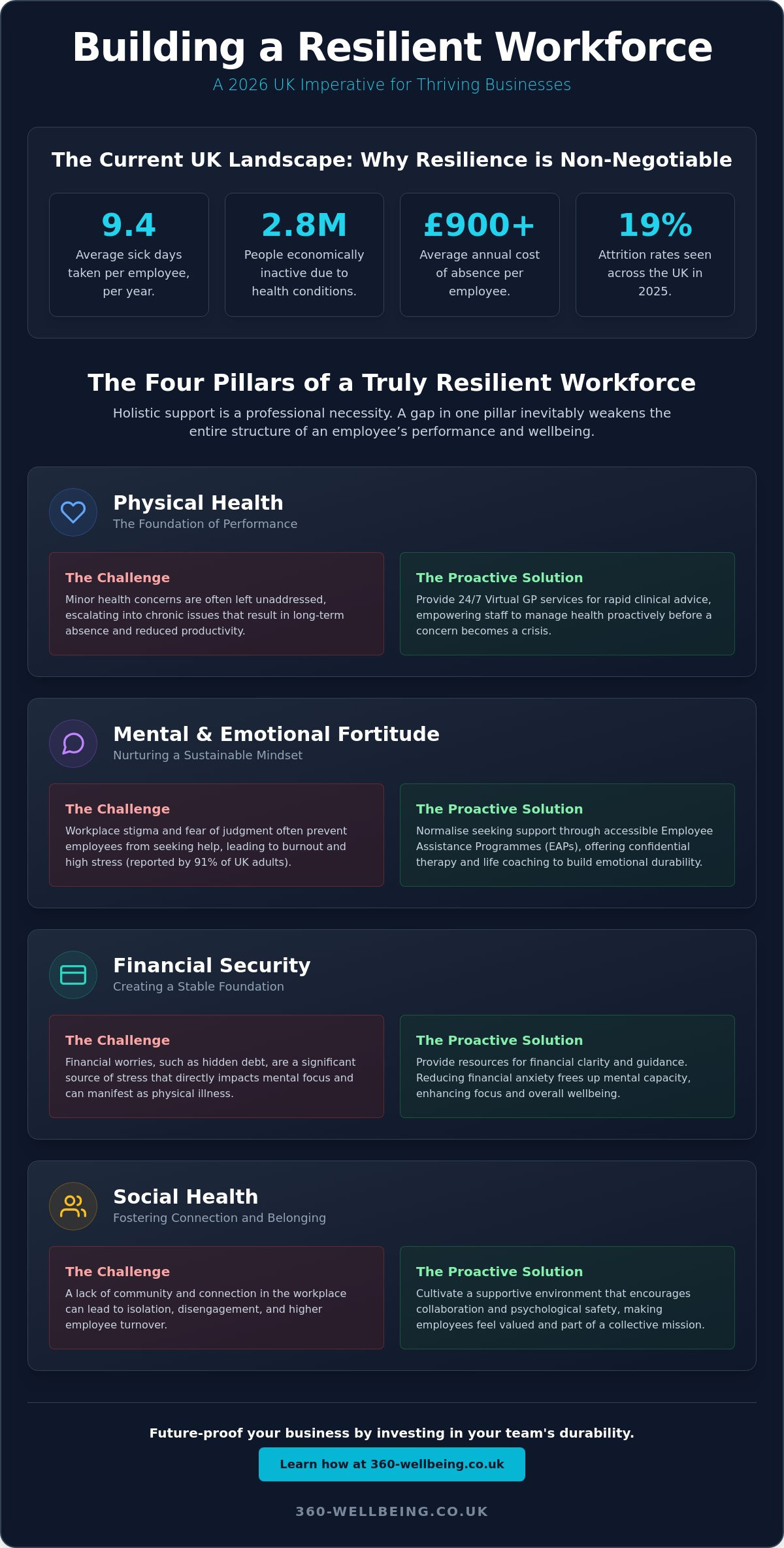
With UK employees now taking an average of 9.4 sick days per year and over 2.8 million people economically inactive due to health conditions, the pressure on your leadership team has never been higher. You’re likely seeing the ripple effects of this through rising recruitment costs and a sense of collective overwhelm that persists despite your best efforts. Understanding how to build a resilient workforce isn’t just a corporate goal; it’s a vital necessity for any business hoping to thrive amidst the legislative shifts and economic volatility of 2026.
We understand that you want to be a supportive partner to your staff, yet it’s difficult to find the balance between maintaining productivity and protecting your team’s health. This guide provides a holistic, proactive framework designed to move your strategy from reactive crisis management to a vision of long-term vitality. By integrating physical health, mental wellbeing, and financial security, you’ll learn to create a stable, adaptable environment where employees feel empowered rather than exhausted. We’ll explore the practical steps required to reduce absenteeism and build a reputation as a truly top-tier employer in a competitive market.
Key Takeaways
- Understand why durability and adaptability have become the essential benchmarks for organisational success in the 2026 UK economic climate.
- Learn how to build a resilient workforce by integrating the four essential pillars of physical, mental, financial, and social health into a single, unified strategy.
- Discover practical methods to overcome common barriers such as budget constraints and workplace stigma to ensure your support systems are truly effective.
- Follow a methodical 5-step roadmap to audit your current resilience baseline and implement frictionless support for your entire team.
- Explore how a panoramic approach to wellbeing can significantly reduce absenteeism while future-proofing your business against future volatility.
What is Workforce Resilience and Why Does It Matter in 2026?
Workforce resilience is often misunderstood as a simple measure of how much pressure a team can withstand before they break. In truth, workplace resilience is the collective ability of an organisation to adapt, evolve, and remain durable through periods of intense volatility. As we move through 2026, the UK landscape has shifted significantly. With economic inactivity reaching 2.8 million people and statutory sick pay becoming a day-one right, the old definitions of ‘powering through’ no longer suffice. Employers are now tasked with understanding how to build a resilient workforce that doesn’t just survive change but finds a way to thrive within it.
There’s a vital distinction between ‘grit’ and true resilience. Grit is temporary endurance; it’s the act of holding one’s breath during a storm. While useful in short bursts, it’s ultimately exhausting and leads to the high levels of stress reported by 91% of UK adults last year. Resilience, by contrast, is sustainable adaptability. It’s the institutional capacity to adjust workloads, support mental health, and provide financial clarity so that employees remain steady even when the external environment is shaky. When resilience is low, the consequences are visible in record-high absenteeism rates, which reached 9.4 days per employee in 2024, and a constant cycle of recruitment churn that drains both morale and capital.
The Shift from Reactive to Proactive Durability
Waiting for a crisis to occur before offering support is a failing strategy that often results in long-term absence. True durability is built through preventative resilience, which prioritises early health interventions before a minor concern becomes a clinical issue. This requires a shift in perspective. Resilience is a shared institutional responsibility rather than a burden placed solely on the individual employee’s shoulders. By providing accessible tools such as a 24/7 Virtual GP or Mental Health Support, you create a safety net that catches people before they fall, ensuring your team stays intact and functional.
The Economic Impact of a Resilient Team
Industry data indicates that with the average cost of employee absence now exceeding £900 per worker annually, the ROI of a durable team is reflected in immediate cost savings and preserved operational momentum. Resilience acts as a vital buffer against market shocks and the 19% attrition rates seen across the UK in 2025. When employees feel secure, they’re more engaged and less likely to seek roles elsewhere. This direct link between employee security and long-term business profitability makes how to build a resilient workforce one of the most important strategic questions for any modern UK employer.
The Four Pillars of a Truly Resilient Workforce
Building a durable team requires a panoramic viewpoint that extends beyond the traditional boundaries of office life. It isn’t enough to focus on just one area of health; true resilience is built on four interconnected pillars: Physical, Mental, Financial, and Social. When we consider how to build a resilient workforce, we must recognise that these elements don’t exist in isolation. A gap in one area inevitably weakens the entire structure of an employee’s performance. For instance, an individual struggling with hidden debt is significantly more likely to experience a decline in mental health, which eventually manifests as physical illness or burnout. Holistic support isn’t a corporate luxury; it’s a professional necessity for long-term stability.
Physical Health: The Foundation of Performance
Physical vitality is the bedrock of productivity. When minor health concerns are left unaddressed, they often escalate into chronic issues that result in long-term absence. Rapid medical access is vital here. By providing Virtual GP services, you allow your staff to seek professional clinical advice 24/7. This ensures they can manage their health proactively without the stress of waiting for appointments or taking time off work for routine consultations. It’s about giving your team the tools to maintain their durability before a health concern becomes a crisis.
Mental and Emotional Fortitude
Resilience is also an emotional state that requires consistent nurturing. Normalising the use of mental health support, including therapy and life coaching, helps remove the stigma that often prevents people from asking for help. An Employee Assistance Programme (EAP) acts as a vital safety net, offering immediate intervention when life feels overwhelming. This proactive approach prevents the slow slide into burnout. By catching these issues early, you protect your team’s morale and ensure they have the emotional resources to handle workplace challenges with confidence.
Financial and Legal Security
Financial anxiety is often the number one distraction in the modern workplace. It’s hard for an employee to remain focused when they’re worried about debt or legal complications. Providing comprehensive financial support and legal advice builds a deep sense of loyalty and security. Simple benefits like debt helplines or complimentary will writing offer immense peace of mind that translates directly into better focus and higher engagement. When an employer looks out for the person’s life outside of the office, the person is much better equipped to show up fully inside it. Exploring holistic wellbeing solutions is the first step toward ensuring these pillars remain strong for every member of your organisation.
Overcoming Common Barriers to Workforce Adaptability
Many business leaders understand the theory of durability but struggle with the practical hurdles of implementation. The most common objection is often financial. There’s a lingering belief that a comprehensive wellbeing strategy is a luxury reserved for global corporations. However, when we look at how to build a resilient workforce effectively, we see that the true barrier isn’t the cost of support, but the escalating cost of neglect. In 2026, with Statutory Sick Pay (SSP) becoming a “Day One” right and the removal of the Lower Earnings Limit, the financial impact of even minor illnesses has become more immediate for every UK employer.
Beyond the balance sheet, cultural barriers often prevent these tools from being used. A “stigma barrier” persists where employees fear that accessing mental health support or life coaching might signal a lack of professional capability. This is often fueled by the misconception that resilience is a fixed trait; something you’re born with rather than a skill set that’s developed. Finally, the “Access Gap” creates a hurdle where benefits are so buried in HR portals or involve such long waiting times that they’re practically invisible. If a staff member has to wait weeks for a consultation, the window for early intervention closes.
The Cost of Inaction vs. The Investment in Support
Reframing wellbeing spend as “retention insurance” changes the conversation from an expense to an asset. Digital-first platforms have democratised high-level care, making tools like 24/7 Virtual GPs and professional debt advice accessible for SMEs. When you compare a modest monthly subscription per employee to the disruption caused by a single day of unplanned absence, the logic is clear. Investing in these services isn’t just about being a kind employer; it’s a strategic move to protect your bottom line against the record-high sickness rates currently affecting the UK market.
Creating a Culture of Psychological Safety
Support systems only work if people feel safe using them. Leaders play a critical role here by modeling resilient behaviour, such as being open about their own health boundaries or the importance of taking breaks. Appointing “Mental Health Champions” within different departments helps bridge the gap between management and the wider team, providing a peer-level point of contact. By ensuring anonymity and making access frictionless through 24/7 helplines, you build the trust necessary for a truly adaptive culture. This is the practical reality of how to build a resilient workforce that feels supported from the ground up.
A 5-Step Roadmap to Build Workforce Resilience
Moving from a theoretical understanding of wellbeing to a practical, operational strategy requires a methodical approach. It’s not about launching a dozen disconnected initiatives at once; it’s about creating a structured path that addresses your team’s specific vulnerabilities. When you’re looking at how to build a resilient workforce, you need a plan that is both scalable and sustainable. This roadmap provides a clear sequence for UK employers to move from reactive crisis management to a proactive culture of durability.
Auditing Your Resilience Baseline
You can’t improve what you don’t measure. The first step for any UK manager is to track key indicators such as turnover rates and the Bradford Factor to identify patterns in short-term absence. These metrics often signal where the “hidden” stressors lie. Using anonymous surveys allows your team to be honest about their pressures without fear of judgement. This data helps you determine which of the four pillars is currently weakest in your organisation. For example, if your survey reveals that 40% of your staff are distracted by housing or debt concerns, your focus should shift toward financial security rather than just general fitness initiatives.
Implementing Frictionless Health Infrastructure
Once you’ve identified the gaps, you must provide tools that are easy to use. In a modern, hybrid work environment, “digital-first” access is no longer a luxury; it’s essential. By integrating employee wellbeing platforms into daily workflows, you remove the barriers to care. Providing 24/7 access to Virtual GPs and helplines significantly reduces employee stress levels because they know support is always available, even outside of traditional office hours. This infrastructure ensures that help is only a few clicks away, catching minor issues before they escalate into long-term leave. To see how this could work for your organisation, you can request a consultation for your team today.
The final stages of the roadmap focus on long-term sustainability. Step 3 involves upskilling your management team so they can spot the early signs of burnout, such as withdrawal or a sudden drop in engagement. Step 4 requires you to diversify your benefits to ensure you’re covering the panoramic needs of your staff, including legal and financial health. Finally, Step 5 is about iteration. Use your platform usage data and regular feedback loops to refine your strategy. Understanding how to build a resilient workforce is an ongoing process of listening and adapting to the evolving needs of your people.
Strengthening Your Team with 360 Wellbeing
Building institutional durability isn’t a task you have to undertake alone. While the roadmap provided earlier offers a strategic path, the actual implementation requires a partner that understands the delicate balance between clinical authority and human empathy. 360 Wellbeing acts as that expert caregiver, providing the tools and expertise needed to bridge the gap between individual health and organisational success. We don’t just offer a list of services; we provide a unified ecosystem where every benefit is designed to reinforce the others. This is the final, essential piece of the puzzle when considering how to build a resilient workforce that’s prepared for whatever the future holds.
Our platform integrates essential services like 24/7 Virtual GP access, mental health therapy, and life coaching into a single, accessible interface. This ensures that when a team member feels the first signs of strain, whether physical or emotional, they have an immediate and professional path forward. We also recognise that resilience is often undermined by external pressures, which is why our Financial Support & Debt Advice and Legal Support are central to our offering. These aren’t just “add-ons”; they’re vital tools that address the social and economic factors that frequently lead to workplace absence. By providing 360 Rewards and complimentary will writing, we help you support the person’s entire life, not just their job description.
All-Encompassing Care for Every Employee
We believe that high-quality wellbeing support should be a professional necessity for everyone, not just a luxury for large corporations. Our per-employee model is specifically designed to make these corporate-level benefits accessible to sole traders and SMEs alike. This ensures that even the smallest teams can benefit from a single, unified platform that covers physical, mental, and financial health without the administrative burden of managing multiple providers. 360 Wellbeing provides a panoramic view of health that treats physical, mental, and social vitality as a single, unified narrative of total wellness.
Starting Your Resilience Journey Today
Transitioning from a reactive culture to a proactive one is simpler than you might think. We provide a dedicated account management team to handle the onboarding process, ensuring that your health infrastructure is integrated into your daily workflows with minimal disruption. By choosing a partner that prioritises foresight and durability, you’re not just providing benefits; you’re investing in the long-term sustainability of your business. If you’re ready to take the next step in learning how to build a resilient workforce, we’re here to help you navigate that journey with confidence and care.
Book a consultation or explore our platform here to discover how we can support your team’s vitality and success.
Future-Proofing Your Business Through Holistic Care
Building a durable organisation requires more than just high-level strategy; it demands a genuine commitment to the human beings who drive your success. You’ve seen that understanding how to build a resilient workforce involves moving away from reactive crisis management toward a panoramic model of care. By addressing the physical, mental, and financial pillars of wellbeing, you create an environment where your team doesn’t just endure pressure but grows stronger because of it. This proactive approach is the most effective safeguard against the rising costs of absenteeism and staff turnover in the current UK market.
At 360 Wellbeing, we provide the clinical expertise and human support needed to make this vision a reality. Our platform gives your employees access to 24/7 UK-registered Virtual GPs, comprehensive Mental Health and Life Coaching support, and essential Financial and Legal advice. These tools ensure your staff feel secure and valued, allowing them to focus on what they do best. Empower your team with the 360 Wellbeing platform today and take the first step toward a more stable, harmonious workplace. Your team’s vitality is your business’s greatest asset, and we’re here to help you protect it for the long term.
Frequently Asked Questions
What is the most effective way to measure workforce resilience?
The most effective way to measure workforce resilience is by tracking a combination of quantitative metrics and qualitative employee feedback. Data points like the Bradford Factor and staff turnover rates provide a baseline, while anonymous engagement surveys help uncover hidden stressors that aren’t visible in attendance records. By monitoring these trends over time, you can determine if your support systems are actually reducing the frequency and duration of sickness absences.
How much does it cost to implement a resilience programme for a small business?
Implementing a resilience programme for a small business is typically structured as a per-employee monthly subscription, making high-level benefits accessible without a massive upfront investment. This model ensures that SMEs can provide the same clinical and financial support as global corporations. The cost is often significantly lower than the expense of a single day of unplanned absence or the recruitment fees required to replace a burnt-out staff member.
Can resilience be taught to employees who are already feeling burnt out?
Resilience skills are difficult to absorb when an employee is already in the middle of a burnout crisis. In these instances, the priority must be clinical intervention, such as mental health therapy or life coaching, to help the individual recover their baseline health. Once they’re stable, you can focus on how to build a resilient workforce by teaching proactive stress management and setting healthier workplace boundaries to prevent future relapses.
What is the difference between an EAP and a workforce resilience strategy?
An Employee Assistance Programme (EAP) is a specific tool, whereas a workforce resilience strategy is the overarching framework that integrates physical, mental, and financial health. While an EAP provides essential reactive support like counseling, a full strategy includes proactive elements such as Virtual GP access and financial debt advice. A truly durable team requires a panoramic approach that goes beyond just providing a phone number for crises.
How does financial wellbeing impact an employee’s resilience at work?
Financial anxiety is a primary driver of workplace stress, often leading to a direct decline in an employee’s mental and physical health. When a worker is distracted by debt or legal concerns, their cognitive capacity and emotional durability are significantly reduced. Providing access to financial support and legal advice helps remove these external pressures, allowing the individual to remain focused and adaptable when facing professional challenges.
Is a Virtual GP service enough to build a resilient workforce?
A Virtual GP service is a vital foundation for physical durability, but it isn’t enough on its own to build a resilient workforce. Physical health is only one of the four essential pillars. To create a truly adaptable team, you must also address mental health, financial security, and social connection. A holistic strategy ensures that every aspect of an employee’s wellbeing is supported, preventing a gap in one area from weakening their overall performance.
What role does leadership play in building a resilient team culture?
Leadership is the primary driver of a resilient team culture because managers set the tone for psychological safety and work-life boundaries. When leaders model healthy behaviours and speak openly about the importance of wellbeing, it normalises the use of available support systems. This transparency builds trust, ensuring that employees feel safe enough to access help early before a minor issue develops into a long-term absence.
How can I support employee resilience in a remote or hybrid work environment?
Supporting resilience in remote or hybrid environments requires a digital-first approach that provides frictionless access to care regardless of location. 24/7 Virtual GP services and online mental health platforms are essential tools for teams that don’t share a physical office. By ensuring that support is available at the touch of a button, you provide a consistent safety net that maintains team durability across different time zones and working patterns.