
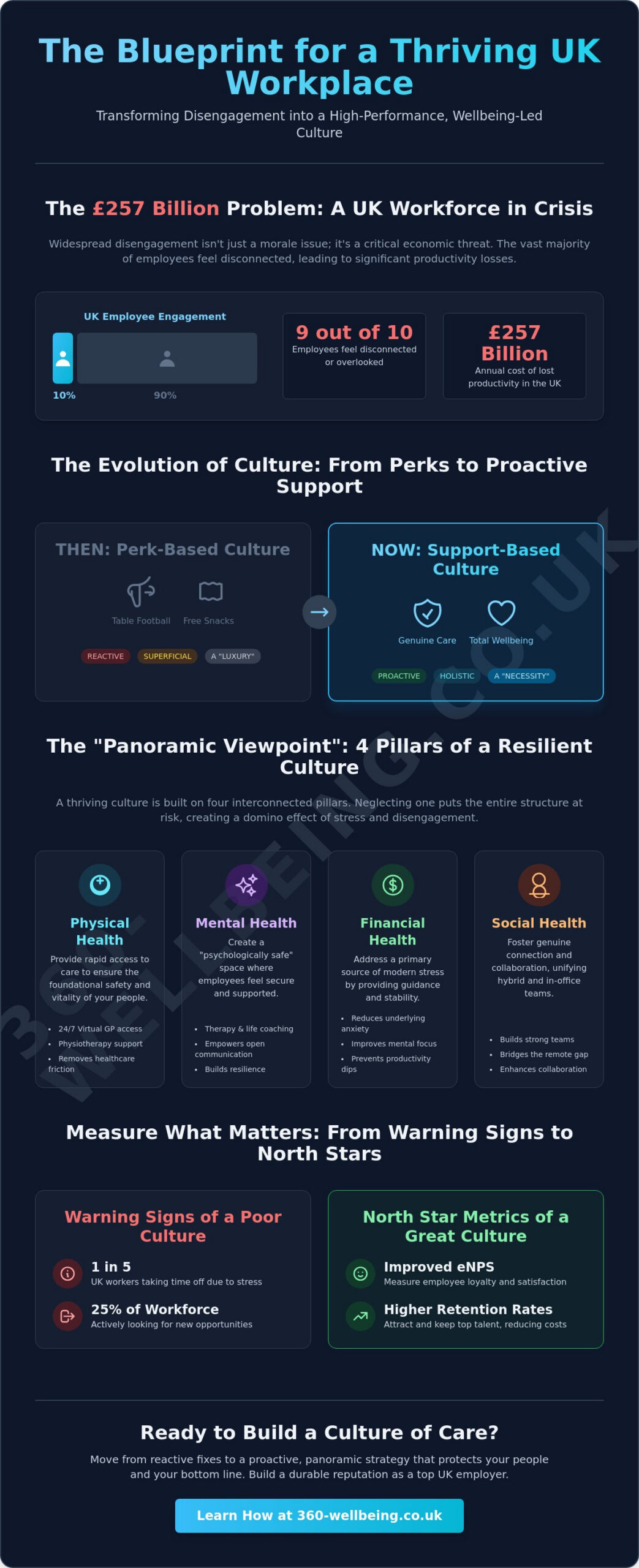
It is a sobering reality that only 10% of UK employees feel truly engaged at work, meaning 90% of our colleagues are navigating their days feeling disconnected or overlooked. This widespread disengagement isn’t just a morale issue; it’s costing the UK economy an estimated £257 billion annually in lost productivity. If you’re currently facing high staff turnover or noticing a rise in stress-related absenteeism, you aren’t alone. Learning how to improve company culture uk has become a vital necessity for leaders who want to protect their people and their bottom line in this evolving landscape.
We understand that you want to create a workplace where people don’t just show up, but actually thrive. This guide provides a clear, actionable roadmap to transform your environment into one that attracts and retains the best talent through genuine, wellbeing-led support. We will walk you through the latest 2026 employment law changes, such as “Day One” rights for parental leave, and show you how to move from reactive fixes to proactive, panoramic care. By focusing on intentional culture design and human-centric leadership, you can build a resilient team that views wellbeing as a professional necessity rather than a luxury.
Key Takeaways
- Learn to transition from reactive crisis management to a proactive culture that treats employee wellbeing as a professional necessity rather than an optional luxury.
- Discover a practical, step-by-step approach on how to improve company culture uk by conducting anonymous audits and codifying vague values into specific, daily behaviours.
- Adopt the “Panoramic Viewpoint” to address the four essential pillars of a resilient workplace: physical, mental, financial, and social health.
- Identify the “North Star” metrics, such as eNPS and retention rates, to accurately correlate your cultural improvements with tangible business productivity.
- Understand how integrating comprehensive support tools, from mental health resources to financial guidance, builds a durable reputation as a top UK employer.
Defining Company Culture in the 2026 UK Business Landscape
Company culture is often described as the heartbeat of an organisation. It represents the sum of the “unwritten rules” that dictate how people interact, make decisions, and feel valued when they’re away from the boardroom. In a formal sense, Organizational culture encompasses the shared values, beliefs, and daily behaviours that create the social and psychological environment of a business. By 2026, the UK market has reached a tipping point where these internal dynamics are no longer secondary to strategy; they are the strategy.
The current economic climate, marked by a £257 billion annual loss in productivity due to disengagement, has forced a radical shift in employee expectations. We’ve moved past the era of “perk-based” culture where table football and free snacks were seen as sufficient. Today’s workforce demands a “support-based” culture. This means moving from reactive fixes to a proactive model that anticipates needs before they become crises. Learning how to improve company culture uk in this environment requires a panoramic view of the employee experience, ensuring that every individual feels seen, supported, and secure.
Why Culture is a Professional Necessity, Not a Luxury
A thriving culture isn’t just a “nice to have” element of your business plan. It’s a fundamental professional necessity. With one in five UK workers taking time off due to work-related stress in 2026, the cost of a toxic environment is written clearly in your absenteeism figures and recruitment bills. When 25% of the workforce is looking for new opportunities, your Employer Value Proposition (EVP) must be rooted in genuine care. Leaders who adopt the persona of an expert caregiver don’t just manage tasks; they act as empathetic partners. This approach builds a durable foundation where employees feel empowered to perform at their peak because they know their health and stability are protected.
The Evolution of Hybrid Culture in the UK
Maintaining a cohesive identity across remote and office-based teams is perhaps the greatest challenge for leaders today. In 2026, the “water cooler” has been replaced by digital accessibility. If your support systems are buried in an outdated handbook, your culture will feel fragmented. A successful hybrid culture relies on a steady, methodical communication rhythm. It ensures that a team member in a home office feels just as connected to the company’s values as someone in a central hub. By providing consistent, all-encompassing support that is accessible at any time, you create a unified narrative of wellness that bridges the physical gap between desks. This intentional design is the key to how to improve company culture uk for the modern, flexible age.
The 4 Pillars of a Resilient Workplace Culture
When considering how to improve company culture uk, we must look beyond surface-level engagement. A resilient culture is built on what we call the “Panoramic Viewpoint”, a strategy that integrates physical, mental, financial, and social health into a single, unified narrative. This approach ensures that we don’t just treat symptoms of a poor culture but cultivate total wellness. In a modern UK business, these elements are not optional extras; they are essential human entitlements that provide the stability required for high performance.
These four pillars are deeply interconnected. If one pillar fails, the entire structure is at risk. For instance, an employee struggling with significant financial anxiety will likely experience a decline in mental focus and physical health, eventually withdrawing from social collaboration. This domino effect is why many leaders fail when they focus only on social perks while ignoring the underlying health or financial stressors. To truly Build A Company Culture That Thrives, you need a strategy that protects every angle of an individual’s life.
Physical and Mental Health: The Foundation
The foundation of any culture is the safety and vitality of its people. Providing rapid access to healthcare through services like a 24/7 Virtual GP or physiotherapy removes the friction and anxiety of long waiting times. When combined with mental health therapy and life coaching, you create a “psychologically safe” environment where employees feel empowered to speak up and take risks. Effective leadership in 2026 requires a precise blend of clinical expertise and a warm, human touch to ensure that every support measure feels personal and accessible.
Financial and Legal Security: The Missing Links
Often overlooked, financial and legal security are the hidden engines of employee loyalty. A distracted worker is rarely a productive one, and debt remains a primary driver of workplace stress. By offering Financial Support for Employees: A Comprehensive Guide for UK Employers in 2026, including professional debt advice, you directly reduce the mental load on your team. Similarly, providing legal support and complimentary will writing demonstrates a long-term commitment to an employee’s family and future. These are the “missing links” that transform a standard job into a deeply supportive career. If you’re ready to start building these pillars, exploring a comprehensive Employee Assistance Programme (EAP) can provide the all-encompassing care your team deserves.
7 Actionable Ways to Improve Your Company Culture Today
Transforming your workplace doesn’t happen overnight. It requires a series of intentional, compassionate choices. If you’re wondering how to improve company culture uk, the most effective starting point is an honest audit. Using anonymous, wellbeing-focused surveys allows your team to speak freely about their daily experiences. This data provides the foresight needed to address specific pain points rather than applying generic fixes.
Once you have your data, move beyond vague mission statements. Codify your values into specific behaviours. Instead of just saying “we value health”, show it by democratising access to healthcare. By providing tools like a 24/7 Virtual GP or physiotherapy to every team member, you remove health inequality. This ensures that support isn’t a perk for the few, but an essential entitlement for everyone.
To further normalise vulnerability, implement Mental Health Champions. These are individuals trained to listen and guide colleagues toward professional mental health support or life coaching. Pair this with “Total Reward” transparency. Make sure your team understands the full value of their package, including non-salary benefits like legal support or debt advice. This clarity builds trust and highlights your commitment to their long-term stability and success.
Leading by Example: The Role of Empathetic Leadership
Managers play a critical role in this cultural shift. They must transition from traditional supervisors to empathetic wellbeing partners. This involves adopting a steady, calm, and methodical communication rhythm that prioritises human connection. Instead of waiting for an exit interview, conduct “stay interviews”. Ask your people what they value most about their roles and what support they need to thrive. This proactive approach allows you to make adjustments before talent walks out the door.
Integrating Digital Wellbeing Tools
In our hybrid world, accessibility is everything. A single digital platform can unify disparate benefits like an EAP, 360 Rewards, and GP services into one manageable hub. This is especially vital for supporting shift workers or remote staff who may feel disconnected from traditional office-based support. It ensures that holistic health is a functional tool available at the point of need. By integrating these services, you provide a panoramic safety net that feels both scientifically grounded and deeply personal.
Measuring ROI: How to Prove Culture Change is Working
Proving the value of cultural investment is essential for any leader who wants to move beyond surface-level perks. While ping-pong tables are easily counted, they rarely impact the long-term health of an organisation. True cultural health is measured through “North Star” metrics: retention rates, employee Net Promoter Scores (eNPS), and absenteeism figures. By 2026, the average attrition rate in the UK has climbed to 19%, making retention a primary indicator of your strategy’s success. When you understand how to improve company culture uk, you can correlate the usage of your wellbeing platform with these hard figures. Seeing a rise in 24/7 Virtual GP consultations or Mental Health Support sessions often precedes a drop in long-term sick leave, providing the clinical data needed to justify continued investment.
Benchmarking your progress against international standards like ISO 45003 is another way to ensure your efforts are scientifically grounded. This standard focuses on psychological health and safety at work, helping you move away from reactive fixes toward a proactive vision of vitality. It provides a methodical framework for identifying psychosocial risks, such as excessive workload or poor communication. By following this structure, you transform the concept of “employee happiness” into a structured, manageable business strategy that appeals to both the heart and the boardroom.
Tracking the Cost of Inaction
Presenteeism, the act of being at work while mentally or physically unwell, is a silent drain on UK productivity. It’s often more expensive than absenteeism because it masks the depth of employee burnout while slowing down every process. Beyond this, the hidden costs of recruitment, interviewing, and onboarding can cripple a growing business. In 2026, the cumulative impact of low engagement and the resulting lost productivity is estimated to cost the UK economy £257 billion annually. Investing in a supportive culture isn’t just about being kind; it’s about protecting your organisation from these significant financial leaks.
Qualitative Feedback: Listening to the Human Story
While data tells you what is happening, your people tell you why. Anecdotal evidence gathered from different departments often reveals “micro-cultures” that broad metrics might miss. Life coaching sessions serve as an excellent pulse-check for organisational stress, offering foresight into where leadership might need to provide more tailored support. This shift from fear-based health warnings to proactive vitality metrics ensures your culture remains balanced and durable. To see how these metrics can work for your business, explore our comprehensive wellbeing services today and start building a culture that lasts.
Building a Culture of Care with 360 Wellbeing
Creating a resilient workplace requires more than just a list of values on a wall. It needs a dedicated partner who understands the intricate link between individual health and organisational success. 360 Wellbeing serves as the clinical heart of this transformation, providing UK businesses with a single, unified platform for total wellness. By integrating physical, mental, and financial support, we help you move beyond fragmented benefits and toward a panoramic strategy that truly protects your team. Whether you’re a large corporation or a sole trader, our per-employee model ensures that high-quality care remains affordable and accessible for every level of the UK market.
Our approach is rooted in the belief that wellbeing is a professional necessity. We don’t just provide services; we offer a safety net that supports the “total life” of your employees. This all-encompassing nature is what defines how to improve company culture uk in 2026. By providing tools like 24/7 Virtual GPs and professional debt advice, you demonstrate a deep, empathetic commitment to your staff’s long-term stability. This foresight builds a culture of loyalty and vitality that is difficult to replicate with surface-level perks alone.
The 360 Wellbeing Advantage for UK Employers
The core of our platform is designed to address the four pillars of culture we’ve discussed. Having 24/7 access to UK-registered GPs is a significant cultural differentiator, removing the anxiety of waiting for appointments and reducing absenteeism. For the social pillar, 360 Rewards supports your team’s daily lives through meaningful savings, making their salary go further. Additionally, our Employee Assistance Programme (EAP) acts as a vital safety net. It provides managers with the resources they need to support their teams while giving employees a confidential space to address mental health or legal concerns, including complimentary will writing.
Next Steps: Starting Your Cultural Transformation
We understand that introducing new systems can sometimes feel daunting. That’s why we’ve made onboarding simple and methodical, ensuring you don’t overwhelm your team with “another new app.” Our dedicated account management team works closely with your HR department to ensure the transition is smooth and the support is tailored to your specific micro-culture. This partnership ensures that your investment in wellbeing becomes a functional, daily part of your business operations rather than a forgotten benefit. If you’re ready to redefine how to improve company culture uk within your organisation, now is the time to act. Discover how 360 Wellbeing can transform your company culture and help your team reach a state of proactive vitality.
Empowering Your Team for a Durable Future
Building a resilient workplace is a journey of intentional design rather than a one-off event. We’ve explored how moving from surface-level perks to a panoramic viewpoint of support ensures that every individual feels truly seen and protected. By integrating physical, mental, and financial health into your daily operations, you transform your organisation into a destination for top UK talent. Learning how to improve company culture uk is ultimately about recognising that wellbeing is an essential human entitlement, which in turn drives the productivity and loyalty your business needs to thrive.
Our platform provides the clinical heart for this transformation, offering 24/7 access to UK-registered GPs, a comprehensive EAP, and mental health support that is both accessible and manageable. With our affordable per-employee SaaS pricing, you can provide a panoramic safety net that scales with your growth. It’s time to move toward a proactive vision of workplace harmony where your people can perform at their peak with total peace of mind. Book a demo of the 360 Wellbeing platform today and take the first step toward a healthier, more vibrant future for your entire team.
Frequently Asked Questions
What is the fastest way to improve company culture in a UK SME?
The fastest way to improve company culture in a UK SME is to conduct an anonymous, wellbeing-focused audit to identify immediate pain points. Once you understand the specific stressors your team faces, you can implement a targeted solution like an Employee Assistance Programme (EAP). This shows your team that you aren’t just listening; you’re actively investing in their stability and health.
How does employee wellbeing impact company culture?
Employee wellbeing is the bedrock of a resilient organisation because it directly dictates the collective energy and focus of your team. When nine in ten UK adults report high stress levels, a culture that ignores health will inevitably suffer from high turnover and burnout. Learning how to improve company culture uk starts with viewing wellbeing as a professional necessity that fuels productivity and psychological safety.
Can a virtual GP service really help with workplace culture?
A virtual GP service supports workplace culture by removing the stress and downtime associated with traditional healthcare appointments. Providing 24/7 access to a UK-registered GP demonstrates that you value your employees’ time and physical health as much as their output. This level of digital accessibility is a key differentiator for modern employers who want to build a reputation for genuine, all-encompassing care.
What are some low-cost ways to improve company culture in 2026?
Low-cost cultural improvements often focus on recognition and communication rather than expensive office renovations. Implementing “stay interviews” to understand what keeps your people motivated is a highly effective, zero-cost strategy for 2026. Additionally, clearly codifying your values into daily behaviours helps ensure that everyone feels a sense of purpose and belonging, which costs nothing but intentional leadership time.
How do I measure the success of a culture change initiative?
You can measure the success of a culture change initiative by tracking “North Star” metrics such as retention rates, eNPS, and absenteeism figures. It’s also helpful to monitor the uptake of support services like life coaching or mental health therapy. A steady increase in the use of these proactive tools often correlates with improved morale and a reduction in the hidden costs of presenteeism.
What is the difference between company culture and employee engagement?
Company culture represents the “unwritten rules” and shared values of your organisation, while employee engagement is the emotional commitment an individual has to their work. Think of culture as the environment you create and engagement as the fruit it produces. By focusing on how to improve company culture uk, you naturally foster a more engaged, loyal, and profitable workforce.
How can we maintain culture in a fully remote UK team?
Maintaining culture in a remote UK team requires intentional digital accessibility and a steady, methodical communication rhythm. You must ensure that remote staff have the same access to support as office-based colleagues, including 24/7 Virtual GPs and mental health resources. This unified narrative of care bridges the physical distance and ensures every team member feels like a valued part of the collective whole.
Why is financial support now considered a part of company culture?
Financial support is now a vital part of company culture because financial stress is a primary driver of workplace distraction and poor mental health. Providing access to professional debt advice and financial support shows that you care about the “total life” of your employees. This panoramic approach to wellness helps build a durable relationship based on mutual trust and long-term security.