
What if the secret to retaining your best talent in 2026 isn’t a higher salary, but a proactive commitment to their total health? With Deloitte’s 2024 research revealing that poor mental health costs UK employers approximately £51 billion every year, learning how to improve staff morale and motivation has become a vital financial strategy rather than a luxury. You’ve likely noticed that simply offering a competitive pay packet no longer shields your organisation from high turnover or the quiet, costly drain of presenteeism. It’s a challenge many leaders face as they struggle to compete with larger firms on budget alone. We understand that you want a team that feels truly supported, not just managed.
This guide reveals how to build a resilient, high performing team by fortifying the physical, mental, and financial foundations of your workforce. We’ll move beyond surface level perks to explore a comprehensive, 360 degree framework designed to reduce absenteeism and improve productivity. By the end of this article, you’ll have a clear roadmap to create a culture where loyalty is the natural result of genuine care and professional stability.
Key Takeaways
- Understand the vital distinction between emotional morale and the drive to act, and why this balance is essential for the 2026 UK workforce landscape.
- Discover how prioritising physical and mental health serves as the foundation for team resilience and reduces the long-term impact of workplace anxiety.
- Learn how to improve staff morale and motivation by alleviating the ‘cognitive tax’ of financial stress through tailored legal and financial safety nets.
- Explore why flexible working arrangements and personalised recognition are often more effective than traditional salary increases in the modern British economy.
- Transition from fragmented perks to a unified 360-degree strategy that uses clear KPIs to measure the success of your wellbeing initiatives.
Defining the Link Between Staff Morale and Motivation in 2026
To understand how to improve staff morale and motivation, we must first distinguish between these two pillars of workplace performance. Employee morale describes the collective emotional health, outlook, and satisfaction of your team. It represents the “internal weather” of your organisation. Motivation, by contrast, is the engine. It is the specific drive that pushes an individual to complete tasks, innovate, and exceed targets. While they are distinct, they are deeply symbiotic; you cannot sustain high motivation in an environment where morale has turned toxic.
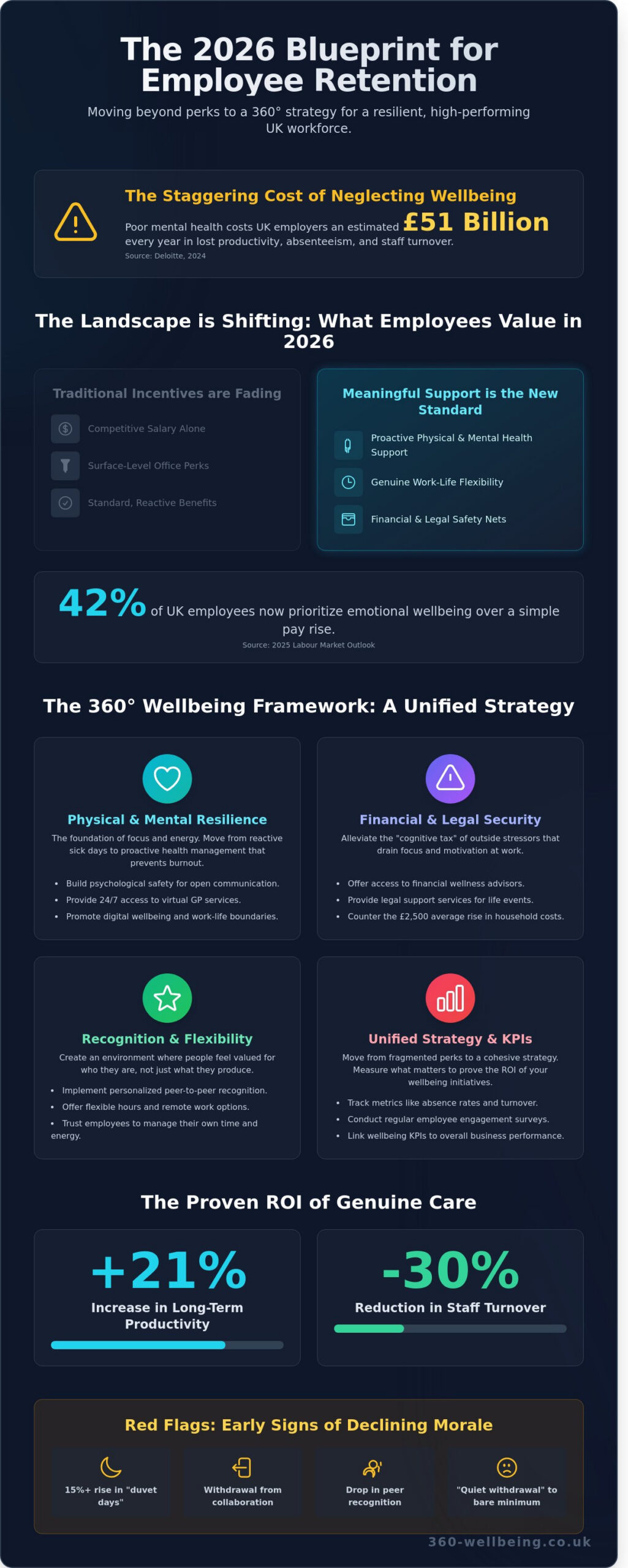
The UK workforce landscape in 2026 demands a proactive approach to engagement. Following several years of economic volatility, the 2025 Labour Market Outlook reported that 42% of UK employees prioritise emotional wellbeing over a simple pay rise. High morale is no longer a “soft” metric. It has a measurable impact on the bottom line. Companies that successfully foster a positive culture see a 21% increase in long-term productivity and a 30% reduction in staff turnover rates. Identifying the subtle signs of declining morale is vital before they lead to resignations. Key indicators include:
- A 15% or higher increase in short-term “duvet days” or unexplained absences.
- A noticeable withdrawal from collaborative digital spaces or non-mandatory meetings.
- A drop in the frequency of peer-to-peer recognition and support.
- The “quiet withdrawal” where employees meet the bare minimum requirements but stop offering creative solutions.
The Psychology of Workplace Engagement
Modern engagement requires revisiting Maslow’s hierarchy through a 2026 lens. While basic needs remain, the “safety” tier now encompasses psychological safety and digital wellbeing. Psychological safety forms the bedrock of a high-morale team; it is the belief that one can speak up with ideas or mistakes without fear of humiliation. Leadership plays a decisive role here, as they set the emotional tone. A 2024 study by the Management Institute revealed that 70% of a team’s engagement variance is determined solely by the manager’s communication style. Leaders must act as expert caregivers, guiding their teams with transparency and empathy rather than just monitoring output.
Why Traditional Incentives Are No Longer Enough
The era of “perk-fatigue” has arrived in the UK. Surface-level benefits like office fruit bowls or gym discounts are failing to engage a workforce that has faced a £2,500 average increase in annual household costs over the last three years. Employees now seek “meaningful” benefits that impact their daily lives and resilience. This includes proactive health screenings, flexible working hours that respect caregiving responsibilities, and robust mental health support. If you are looking at how to improve staff morale and motivation, you must shift from transactional perks to a comprehensive wellbeing strategy that treats health as a strategic asset rather than a luxury.
Prioritising Holistic Health: The Foundation of Employee Resilience
Physical and mental health aren’t just personal matters; they’re the primary drivers of workplace energy and focus. When staff feel physically drained or mentally overwhelmed, their engagement inevitably drops. A 2023 CIPD report found that UK absence rates reached a ten-year high of 7.8 days per employee, costing businesses dearly in both productivity and momentum. To understand how to improve staff morale and motivation, leaders must move beyond reactive “sick notes” and embrace proactive health management that builds resilience before a crisis occurs.
A 360-degree view of health ensures that every team member feels seen and supported as a whole person. This involves more than just basic insurance; it requires a culture where health is treated as a strategic asset. By implementing practical strategies for boosting morale, such as regular wellness check-ins and accessible medical support, businesses can prevent the burnout that often leads to long-term turnover. When employees know their health is a priority, they’re more likely to invest their best efforts back into the company.
The Impact of 24/7 Virtual GP Access
Traditional GP appointments in the UK often require weeks of waiting or hours spent on hold at 8:00 am. This creates significant anxiety for employees who worry about their symptoms while trying to maintain their daily tasks. Providing 24/7 virtual GP access removes this barrier immediately. It allows staff to speak with a qualified doctor during a lunch break or from the comfort of their home, ensuring rapid medical reassurance. This level of care improves workplace presence and helps normalise health check-ins as a standard, stress-free part of the working week.
Mental Health Support as a Strategic Asset
Mental ill-health costs UK employers approximately £56 billion every year, according to Deloitte’s 2022 analysis. Addressing this requires professional intervention that goes beyond a simple box-ticking exercise. Providing access to therapy sessions and life coaching helps staff navigate both personal and professional hurdles with confidence. A robust Employee Assistance Programme (EAP) destigmatises these challenges, showing employees that their mental wellbeing is a fundamental right rather than a luxury. It’s about creating a tailored wellbeing journey that treats the person, not just the symptom, which is the most effective way to discover how to improve staff morale and motivation in the long term.
- Proactive Care: Identifying health risks before they lead to absence.
- Immediate Reassurance: Reducing the anxiety of medical uncertainty through instant access.
- Comprehensive Support: Balancing physical recovery with mental and emotional resilience.
Alleviating Outside Stressors: Financial and Legal Security
Employee engagement doesn’t stop at the office door. When a team member sits at their desk, they bring their external worries with them. Research from the Centre for Economics and Business Research suggests that financial stress costs UK employers £6.2 billion annually in lost productivity. This “cognitive tax” consumes the mental bandwidth needed for creativity and focus. If you’re looking for how to improve staff morale and motivation, you must address the life events happening outside the workplace. By providing a safety net, you transform from a mere paymaster into a genuine partner in their life journey.
Addressing the whole person means acknowledging that a staff member isn’t just a resource. They’re individuals managing mortgages, family estates, and future savings. When an organisation steps in to provide stability during turbulent times, it builds a level of loyalty that salary alone cannot buy. This proactive support reduces the “noise” of external stress, allowing employees to bring their full, focused selves to their roles.
Financial Wellbeing in the Modern Workplace
Financial anxiety is often a silent struggle. In 2024, a survey by Wagestream found that 70% of UK workers felt more stressed about their finances than in previous years. Employers can mitigate this by offering confidential debt helplines and proactive financial planning sessions. Transparent communication about the company’s own financial health also reduces the anxiety associated with job insecurity. For a deeper look at specific strategies, read our financial support for employees guide. These tools empower staff to manage their money better, which directly fosters long-term resilience and reduces the likelihood of burnout.
Legal Peace of Mind as a Staff Benefit
Legal troubles are uniquely draining. Whether it’s a complicated probate issue or a property dispute, these problems often feel insurmountable without expert help. Offering complimentary will writing is a powerful way to show you care about an employee’s family long-term. It removes the nagging anxiety of “what if” and provides a tangible sense of security. Providing access to legal aid distinguishes your business from the 60% of UK SMEs that only offer standard health insurance. This holistic approach is a key component of how to improve staff morale and motivation, as it proves you value the individual’s peace of mind as much as their professional output.
- Debt Helplines: Provide immediate, anonymous support for those struggling with rising costs.
- Will Writing: A benefit that protects the family’s future and reduces long-term anxiety.
- Financial Planning: Help staff move from reactive surviving to proactive thriving.
- Legal Support: Expert advice for personal disputes or complex paperwork.
Cultivating a Supportive Culture Through Recognition and Flexibility
As we move through 2026, the traditional corporate hierarchy has evolved into a more fluid, partnership-based model. Learning how to improve staff morale and motivation requires a shift from transactional rewards to relational support. While salary remains a baseline, a 2024 survey by the CIPD found that 46% of UK employees now prioritise flexible working over a pay rise. This shift reflects a deeper desire for autonomy and a work-life balance that respects individual commitments outside the office.
Building a culture of transparency is essential for this transition. When leadership is approachable and shares the “why” behind business decisions, it removes the anxiety of the unknown. This transparency is a cornerstone of how to improve staff morale and motivation across diverse UK sectors. It creates a sense of psychological safety where employees feel empowered to voice concerns before they escalate into burnout.
The Power of Regular, Meaningful Recognition
The “Employee of the Month” plaque is no longer effective in a modern workplace. Modern recognition must be real-time and personalised. Some team members appreciate a public shout-out during a briefing, while others find it uncomfortable and prefer a private, handwritten note or a specific message of thanks. Peer-to-peer gratitude programmes are particularly effective; they decentralise appreciation and ensure that small, daily contributions don’t go unnoticed. Data from 2025 workplace studies suggests that teams with active peer-recognition systems see a 14% increase in overall engagement levels.
Implementing Flexible and Hybrid Work Models
Flexibility in 2026 is about more than just working from home. It involves trust-based management where output is valued over hours spent at a desk. The 2022-2023 UK pilot for the four-day work week showed that 92% of participating companies decided to continue the trial, citing improved employee health and stable productivity. To maintain team spirit in these models, focus on intentional connection rather than forced socialising. Effective strategies include:
- Core Collaboration Hours: Setting specific windows for meetings while allowing total freedom outside those times.
- Purposeful In-Person Days: Using office time for creative brainstorming or social bonding rather than solitary tasks.
- Digital Watercoolers: Creating non-work channels for hobbies and shared interests to maintain social cohesion.
Genuine connection is built through shared experiences that feel authentic. Instead of generic “fun” days, organise activities that align with your team’s values, such as community volunteering or group wellbeing workshops. This proactive approach ensures your staff feel seen as people, not just resources.
Ready to transform your workplace culture with tailored support? Discover how our comprehensive wellness strategies can support your team
Implementing a 360-Degree Wellbeing Strategy for Your Team
Moving away from fragmented perks like occasional fruit bowls or gym discounts is the first step toward a resilient workforce. Many UK businesses still rely on disconnected benefits that fail to address the root causes of burnout. By transitioning to a unified wellbeing platform, you create a cohesive ecosystem where physical, mental, and financial health are treated as a single, integrated priority. This strategic shift is central to how to improve staff morale and motivation in a way that lasts beyond a single pay cycle.
Success requires clear metrics. You can’t manage what you don’t measure. Effective KPIs for your wellbeing strategy include tracking your Employee Net Promoter Score (eNPS), monitoring monthly absence rates, and measuring the uptake of specific services like mental health counselling. A 2024 report by Deloitte found that UK employers receive an average return of £4.70 for every £1 spent on mental health interventions. These figures prove that comprehensive support isn’t a sunk cost; it’s a high-yield investment. Lowering turnover saves your business an average of £3,000 per employee in recruitment and training costs, according to recent UK industry benchmarks.
For the 5.5 million SMEs and sole traders in Britain, a tailored approach is vital. You don’t need a massive HR department to provide world-class care. A scalable, per-employee model allows smaller teams to access the same clinical expertise and rewards as major corporations, ensuring no one is left behind.
Steps to Launching Your Wellbeing Programme
Start by auditing your current culture to identify morale killers such as excessive overtime or lack of autonomy. Use anonymous surveys to gather genuine employee feedback. This ensures the benefits you provide actually match their needs rather than your assumptions. Once your platform is ready, communicate the launch through a clear, multi-channel strategy. High uptake only happens when staff feel the programme is a fundamental right, not a corporate tick-box exercise.
The 360 Wellbeing Difference
Our platform integrates 24/7 GP services, mental health support, and lifestyle rewards into one accessible hub. It removes the friction of traditional healthcare by providing immediate digital access to professionals. Managing this through a simple per-employee subscription model means your costs remain predictable as you grow. Knowing how to improve staff morale and motivation starts with providing a safety net that catches people before they fall. Lead your team toward a healthier, more motivated future by making proactive care your new standard. Together, we can build a culture where your people don’t just work; they thrive.
Future-Proofing Your Business Through Proactive Care
By 2026, the most successful UK businesses will be those that treat employee health as a strategic asset rather than a simple overhead. You’ve seen that understanding how to improve staff morale and motivation requires a shift away from surface-level perks toward a model that addresses the whole person. Data from Deloitte’s 2024 mental health report shows that poor wellbeing costs UK employers approximately £51 billion every year; a figure that highlights the urgent need for robust, proactive support. By integrating mental health resilience with practical solutions for financial and legal stressors, you create a culture where people feel genuinely valued and secure.
True workplace harmony is built on reliability and accessibility. Our platform provides your employees with 24/7 access to UK-registered GPs, ensuring medical peace of mind at any hour. We combine this with holistic mental health support, life coaching, and tailored advice for those complex legal or financial worries that often keep staff awake at night. When your team knows they have a partner looking out for their total wellbeing, their commitment to your business grows naturally.
Discover how our 360-degree wellbeing platform can transform your team’s morale today
Investing in your people is the most powerful way to secure your company’s future. We’re here to help you build a healthier, happier, and more motivated workforce starting right now.
Frequently Asked Questions
What is the fastest way to improve staff morale?
The fastest way to improve staff morale is through immediate, authentic recognition of individual contributions. A 2023 Gallup study shows that employees who feel recognised are 73% less likely to experience burnout. You can start today by personally thanking a team member for a specific task. This small act of appreciation creates an instant emotional lift and reinforces a culture where people feel seen and valued.
How can I motivate employees without offering a pay rise?
You can motivate employees without a pay rise by offering flexible working patterns and professional growth opportunities. The CIPD 2024 Health and Wellbeing report found that 41% of UK staff prioritise flexibility over salary. Providing a clear path for career progression or extra holiday days empowers your team. It shows you’re invested in their long-term vitality rather than just their immediate output.
What are the common causes of low morale in the workplace?
Low morale often stems from poor communication and a lack of support from management. In 2023, the Health and Safety Executive reported that 875,000 UK workers experienced work-related stress, frequently cited as a result of unmanageable workloads. When staff feel they’ve no control over their tasks, their enthusiasm fades. Addressing these systemic issues requires a proactive shift toward a more transparent and supportive workplace culture.
How do I measure employee morale effectively?
You measure employee morale effectively by combining anonymous pulse surveys with Employee Net Promoter Scores (eNPS). Industry data from 2024 suggests that organisations using monthly surveys see 14% higher engagement than those relying on annual reviews. These metrics provide a clear, data-driven snapshot of your team’s health. It allows you to identify specific challenges before they escalate into larger retention problems.
Can an Employee Assistance Programme (EAP) really improve motivation?
An Employee Assistance Programme (EAP) improves motivation by providing professional support for personal and professional stressors. The EAPA UK 2023 report highlights that for every £1 spent on an EAP, employers see a return of £10.85 through improved productivity. By offering 24/7 access to counselling and financial advice, you’re providing a comprehensive safety net. This allows employees to focus on their roles with a clear mind.
Is there a difference between employee engagement and morale?
Morale reflects the collective mood and outlook of your team, whereas engagement measures their commitment to organisational goals. Understanding this distinction is vital when learning how to improve staff morale and motivation within a UK business. High morale creates a positive atmosphere, while high engagement ensures that energy is directed toward productive outcomes. Both elements are essential for a balanced and resilient workforce.
How does financial stress impact workplace productivity?
Financial stress directly reduces productivity by causing 25% of UK workers to lose focus during the day, according to the 2024 Money and Pensions Service report. This often manifests as “presenteeism,” where staff are physically present but mentally distracted by debt or bills. Providing financial wellbeing tools helps alleviate this burden. It restores a sense of security and allows your team to perform at their natural best.
What role does leadership play in staff motivation?
Leadership is the primary driver of workplace culture, as managers account for 70% of the variance in team engagement levels. When leaders adopt an empathetic, 360-degree approach, they create the psychological safety necessary for people to thrive. Effective leadership is the foundation of how to improve staff morale and motivation. It transforms the workplace from a source of stress into a space of shared purpose and proactive support.