
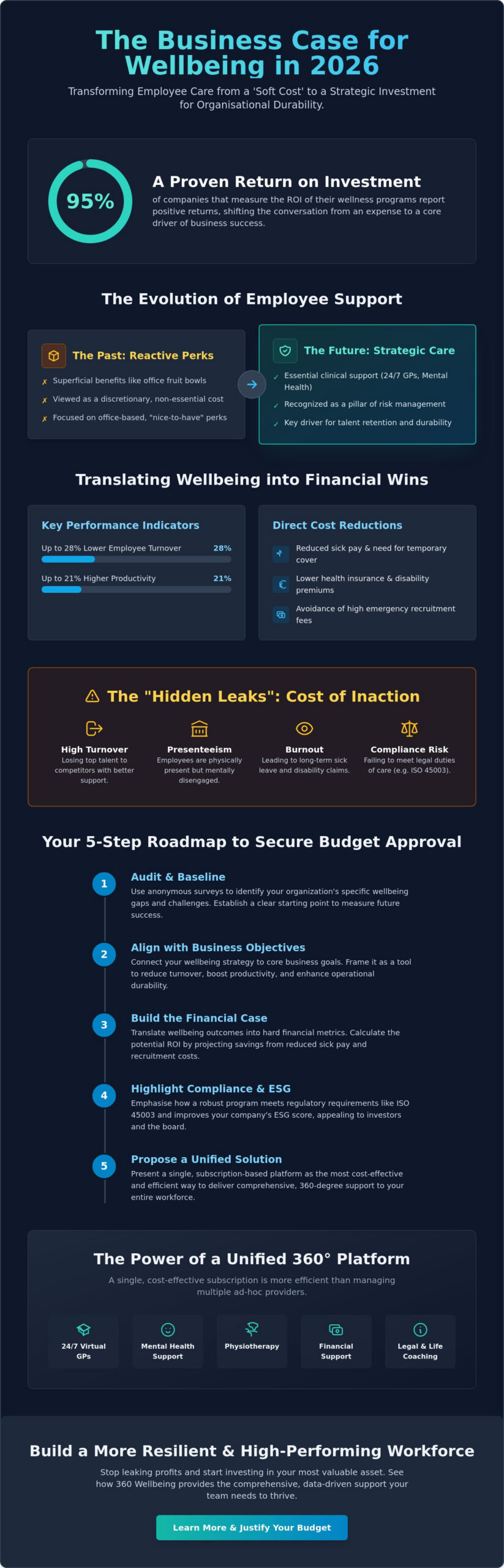
Did you know that 95% of companies that measure the ROI of their wellness programs report positive returns? It’s a striking figure that challenges the old-fashioned view of employee care as a drain on resources. If you’re currently wondering how to justify wellbeing budget requests to a skeptical board, you aren’t alone. Many leaders still view these programs as a luxury, yet the data from 2026 suggests that proactive care is now a fundamental pillar of risk management and long-term operational durability.
We understand the pressure you’re under to prove that every pound spent translates into a healthier bottom line, especially when turnover and burnout rates continue to disrupt your team’s rhythm. This guide will help you transform your wellbeing strategy from a perceived “soft cost” into a high-performing strategic investment using verified metrics and the latest 2026 regulatory frameworks. We’ll explore the crucial difference between Return on Investment and Value on Investment, explain how to align your proposal with the Employment Rights Act 2025, and provide a clear path to securing approval for a comprehensive support platform.
Key Takeaways
- Shift your strategy from superficial perks to essential clinical support, including 24/7 Virtual GPs and mental health services, to build long-term organizational durability.
- Learn how to translate wellbeing outcomes into clear financial metrics that help Finance Directors see the hard savings in reduced sick pay and insurance premiums.
- Discover how to justify wellbeing budget requests by identifying the “hidden leaking” of profits caused by presenteeism and high employee turnover.
- Follow a structured five-step roadmap to audit your current workplace challenges and align your wellbeing spend with specific business objectives.
- Understand why a unified, subscription-based platform offering everything from physiotherapy to financial support is more cost-effective than managing multiple ad-hoc providers.
Why Wellbeing Budgets are a Strategic Necessity in 2026
In 2026, the conversation around corporate health has undergone a fundamental shift. We’ve moved away from viewing employee support as a discretionary “perk” that can be trimmed during lean times. Instead, savvy leaders now treat their wellbeing budget as a strategic asset, essential for maintaining the durability and vitality of their workforce. When you’re looking at how to justify wellbeing budget requests this year, the argument isn’t about making people “happy”; it’s about building a resilient infrastructure that protects your organization from the rising costs of burnout and disengagement.
The modern workforce expects more than superficial benefits. The era of gym discounts and office fruit bowls has been replaced by a demand for high-quality clinical support. In a competitive UK labour market, providing immediate access to 24/7 Virtual GPs and professional mental health support isn’t just a bonus; it’s a primary retention tool. If you can’t offer the security of rapid medical care, your top talent will find an employer who can. This shift toward clinical intervention reflects a deeper understanding of what it takes to keep a business running smoothly in a high-pressure world.
The Evolution of Corporate Wellness
Today’s employees view health through a panoramic lens. They understand that physical, mental, and financial health are deeply interconnected. This shift has led to the rise of holistic, 360-degree support systems that move beyond reactive care. A modern framework for workplace wellness now integrates diverse services like physiotherapy, life coaching, and financial support into a single, accessible ecosystem. Providing 24/7 medical access has become a standard expectation for UK staff who are often balancing hybrid work schedules with complex personal lives. When support is available at any hour, it creates a sense of safety that fosters deeper loyalty and workplace harmony.
Regulatory and Compliance Drivers
The legal landscape in 2026 has made psychological safety a non-negotiable boardroom priority. With the full implementation of ISO 45003, companies are now held to a global standard for managing psychosocial risks in the workplace. This isn’t just about best practices; it’s about fulfilling a legal duty of care for mental health. By implementing a robust strategy that includes an Employee Assistance Programme (EAP) and legal support, you significantly reduce the risk of costly employment tribunals. Additionally, as ESG (Environmental, Social, and Governance) scores become a key metric for investors, the health of your workforce directly impacts your company’s market valuation. A healthy team is no longer just a human entitlement; it’s a professional necessity that safeguards your brand’s future.
Building the Business Case: ROI vs. VOI Frameworks
When you sit down with your Finance Director, the conversation often shifts from “people” to “percentages.” To bridge this gap, you need a framework that translates human vitality into fiscal durability. Learning how to justify wellbeing budget allocations requires a two-pronged approach: Return on Investment (ROI) and Value on Investment (VOI). Before you even draft your proposal, it’s essential to establish a “wellbeing baseline” through anonymous employee surveys. This data gives you a starting point, allowing you to show exactly where the gaps in support are currently draining your resources and impacting your team’s harmony.
Research from April 2026 shows that 95% of companies that measure the ROI of their wellness programs report positive returns. This isn’t just about avoiding costs; it’s about active gain. Companies with structured programs report up to 28% lower employee turnover and 21% higher productivity. These aren’t just “nice” numbers; they’re the foundation of a robust business case that views health from a panoramic perspective, ensuring your organization remains resilient in a changing market.
Calculating Hard ROI
ROI focuses on the hard numbers that keep the board awake at night. Think about the direct savings gained by reducing the need for temporary cover or the high fees associated with emergency recruitment. For instance, providing 24/7 Virtual GPs significantly reduces “time out” for medical appointments. Instead of an employee taking half a day off to visit a local clinic, they can consult a professional during a break. Similarly, early Mental Health Support prevents minor stress from spiraling into long-term disability claims, protecting your bottom line from the heavy cost of extended sick pay and lost hours.
Measuring Value on Investment (VOI)
While ROI tracks the money you save, VOI tracks the value you gain. This includes morale, engagement, and the strength of your employer brand. There’s a documented link between staff happiness and customer satisfaction scores; when your team feels cared for, they extend that same care to your clients. You can measure this through the Employee Net Promoter Score (eNPS). High scores don’t just indicate a happy team; they also reduce the “time to hire” for new talent. Prospective employees in 2026 prioritize companies that offer A Critical Public Health Perspective within their corporate structure, viewing it as a sign of a forward-thinking culture that values human entitlement over mere output.
By combining these two metrics, you present a case for health that is both scientifically grounded and financially sound. If you’re ready to start building this case, exploring a unified wellbeing platform can help you consolidate these metrics into one manageable system that supports your team’s physical, mental, and financial health.
The Cost of Inaction: Addressing Boardroom Skepticism
Boardroom skepticism often stems from the belief that if you can’t see a problem, it doesn’t exist. However, waiting for a visible crisis is a high-risk strategy that ignores the silent erosion of your bottom line. When considering how to justify wellbeing budget requests, it’s vital to shift the focus from the price of the platform to the price of the status quo. In 2026, the most significant drain on company profits isn’t usually total absence; it’s the “hidden leaking” of productivity from staff who are physically present but mentally elsewhere.
This phenomenon, known as presenteeism, occurs when employees struggle through illness, burnout, or personal stress without the support they need to recover. It’s estimated that poor mental health costs the global economy approximately $1 trillion per year in lost productivity. For a single business, this translates to reduced output, more errors, and a culture of “quiet quitting” where people do the bare minimum to survive the day. Thinking of wellbeing as “preventative maintenance” for your people ensures your most expensive asset remains functional and engaged.
Absenteeism vs. Presenteeism
While absenteeism is easy to track on a spreadsheet, presenteeism is often far more expensive. Research indicates that financial stress alone causes employees to lose an average of three hours of productive time per week. By providing digital health tools like a 24/7 Virtual GP or an Employee Assistance Programme (EAP), you give your team the means to address health concerns before they become debilitating. These tools keep the workforce “present” in mind as well as body, ensuring that when people are at their desks, they’re actually working at their full potential.
The Recruitment and Retention Crisis
The financial drain of high staff turnover in the UK market is a persistent challenge for HR leaders. Replacing an employee involves significant recruitment fees, onboarding time, and the loss of institutional knowledge. Gen Z and Millennial workers, who now dominate the workforce, consistently prioritise comprehensive health benefits over simple salary bumps. They look for a panoramic support system that includes mental health support and financial support for employees. Integrating these services into a holistic retention strategy doesn’t just stop people from leaving; it builds a culture of durability where employees feel a deep sense of partnership with their employer. This emotional connection is often the strongest defense against the talent wars of 2026.
5 Steps to Justify Your Wellbeing Spend to Stakeholders
Pitching a new budget can feel like a daunting climb, but it’s much easier when you have a clear, sequential map to follow. Understanding how to justify wellbeing budget requirements involves moving from emotional appeals to logical, data-led frameworks that speak the language of the boardroom. By following a structured path, you can demonstrate that you aren’t just asking for a “nice-to-have” perk; you’re proposing a vital tool for organizational durability. Here is a proven five-step process to secure the approval you need.
- Step 1: Audit current “hidden” costs. Gather data on your current sick days, staff turnover rates, and the cost of temporary cover. This creates a baseline of what the status quo is already costing the business.
- Step 2: Align wellbeing goals with business objectives. Link your proposal directly to the company’s growth targets, such as reducing turnover by 10% or improving productivity metrics.
- Step 3: Present a tiered solution. Offer a choice between a basic support package and a more comprehensive platform. This allows stakeholders to feel in control of the investment level.
- Step 4: Highlight the “All-in-One” efficiency. Explain how a single fee for a unified platform reduces the administrative burden of managing multiple ad-hoc providers for mental health, physiotherapy, and legal support.
- Step 5: Propose a pilot period. Suggest a six-month trial with clear KPIs to lower the perceived risk of a long-term commitment.
Aligning with Business Objectives
To gain genuine buy-in, you must map your health strategy to the company’s three-year growth plan. If the business is planning to scale, you can argue that a robust Employee Assistance Programme (EAP) is essential for onboarding and retaining new talent in a competitive market. Use departmental data to show where stress is impacting the bottom line; perhaps one team has higher absence rates that correlate with peak project times. Creating a “Wellbeing Steering Committee” with members from different departments can also help you gather internal support before you even reach the board. This committee ensures that the proposal reflects the actual needs of the workforce, making it much harder for leadership to dismiss.
The Power of the Pilot Program
A six-month trial is often the most effective way to lower the barrier to budget approval. During this period, you can set “Success Signals” that the Board cannot ignore, such as a reduction in short-term absences or a rise in engagement scores. While the hard data is crucial, don’t overlook the impact of qualitative “hero stories.” Collecting anonymous feedback about how a 24/7 Virtual GP saved a parent a day of worry, or how Life Coaching helped a manager avoid burnout, provides a human touch that numbers alone can’t convey. These stories prove that your strategy is working on a personal, human level. If you’re ready to start your journey toward a healthier workforce, you can explore our comprehensive wellbeing platform to see how an integrated approach simplifies your strategy.
Maximising Budget Efficiency with 360 Wellbeing
Efficiency isn’t just about spending less; it’s about making every pound work harder for your people. When you’re determining how to justify wellbeing budget decisions, the structure of the service is just as important as the content itself. Ad-hoc services often lead to fragmented care and unpredictable invoices that fluctuate based on usage. By moving to a subscription-based model, you create a stable financial environment that CFOs appreciate. A transparent per-employee-per-month fee makes forecasting simple and eliminates the surprise costs often associated with pay-as-you-go mental health or legal support.
Beyond the direct costs, an integrated platform significantly reduces the administrative burden on your HR team. Managing separate contracts for physiotherapy, life coaching, and an Employee Assistance Programme (EAP) is time-consuming and inefficient. A unified system automates the onboarding and management process, saving internal hours that can be redirected toward higher-level strategy. This streamlined approach ensures that your health infrastructure is as durable and well-organised as your business operations.
The 360 Wellbeing Advantage
Our platform provides a panoramic view of health, integrating physical, mental, and financial support into a single, unified narrative of wellness. The 24/7 Virtual GP is a flagship benefit that offers immediate ROI by reducing the time staff spend away from work for medical consultations. Instead of waiting days for an appointment, employees get the reassurance they need in minutes. Beyond reactive care, our mental health support and life coaching provide the proactive tools needed to build resilience and prevent burnout before it starts. We also include a 360 Rewards marketplace, which allows employees to save money on daily essentials. This effectively offsets the cost of the platform for the user, adding a layer of financial support that feels both scientifically grounded and deeply personal.
Conclusion: Taking the First Step
The shift from viewing employee health as a cost-centre to seeing it as a profit-enabler is the most significant cultural change for HR leaders in 2026. By building a robust business case rooted in data and clinical expertise, you aren’t just asking for money; you’re securing the future durability of your organisation. Providing comprehensive support is no longer a luxury; it’s a professional necessity and an essential human entitlement. We’re here to help you navigate this transition with a sense of safety and order. It’s time to lead this transformation and provide your team with the all-encompassing care they deserve. Book a demo to see how 360 Wellbeing fits your budget and start your journey toward a more harmonious and productive workplace.
Empowering Your Team for a Durable Future
The transition from viewing health as an expense to a strategic investment is the most vital step an HR leader can take in 2026. By moving beyond reactive care and embracing a panoramic view of employee vitality, you protect your most expensive asset from the high costs of burnout and presenteeism. We’ve seen how identifying hidden productivity leaks and using the ROI vs. VOI framework provides the logical foundation you need when considering how to justify wellbeing budget requests to your board.
A robust business case isn’t just about the bottom line; it’s about fulfilling a human entitlement while ensuring long-term commercial success. Our unified platform supports this vision by providing 24/7 UK-registered Virtual GP access, comprehensive EAP and mental health support, and expert financial and legal advice. This all-encompassing approach simplifies your administration while fostering a culture of harmony and foresight.
If you’re ready to transform your workplace into a proactive environment where every individual can thrive, we’re here to partner with you. You can request a bespoke quote for your team today. Together, we’ll build a healthier, more resilient workforce that’s ready for whatever the future holds.
Frequently Asked Questions
How much should a company budget for employee wellbeing per year?
Most forward-thinking organisations align their spend with a fixed per-employee-per-month rate rather than a fluctuating percentage of payroll. This approach allows for precise financial forecasting and ensures every team member has equal access to support. In 2026, the focus is on quality over quantity; investing in a unified platform that covers mental, physical, and financial health is often more efficient than maintaining several smaller, disconnected budgets.
Can I justify a wellbeing budget without hard data on absenteeism?
Yes, you can build a compelling case by focusing on turnover rates, recruitment costs, and qualitative employee feedback. If you don’t have internal absence data, use industry benchmarks to highlight the “hidden leaking” of productivity caused by presenteeism. Demonstrating a proactive vision for workplace harmony often carries as much weight as a spreadsheet of sick days, especially when you can show how a lack of support impacts your team’s long-term durability.
What are the most cost-effective wellbeing benefits for small businesses?
Small businesses benefit most from bundled, subscription-based platforms that provide a panoramic range of services for a single fee. Prioritising high-impact clinical tools like a 24/7 Virtual GP or an Employee Assistance Programme (EAP) provides immediate value without the high overheads of on-site services. These digital-first solutions offer a sense of safety and professional care that helps smaller teams compete with larger corporations for top-tier talent.
Is an Employee Assistance Programme (EAP) enough to satisfy duty of care?
While an EAP is a foundational requirement, it’s often insufficient on its own to meet the proactive standards set by the Employment Rights Act 2025. Modern duty of care requires employers to actively manage and prevent psychological risks before they escalate. Integrating additional layers of support, such as physiotherapy, life coaching, and financial advice, ensures you’re addressing the whole-person needs of your workforce and fulfilling your legal obligations with genuine foresight.
How do I measure the ROI of mental health support?
You measure the ROI of mental health by tracking the reduction in long-term disability claims and the savings gained from improved staff retention. When you’re looking at how to justify wellbeing budget allocations, highlight that early intervention prevents minor stress from spiraling into total burnout. By providing immediate mental health support, you’re essentially protecting the business from the significant costs of replacing experienced staff and paying extended sick leave.
What is the difference between wellbeing ROI and VOI?
ROI (Return on Investment) focuses on hard financial savings, like lower insurance premiums, while VOI (Value on Investment) measures broader benefits such as morale and employer brand strength. While ROI tells you how much money you’ve saved, VOI shows you the value you’ve gained in terms of employee engagement and customer satisfaction. Both metrics are essential for a complete business case, as they prove that health is both a financial asset and a cultural necessity.
How can I convince a skeptical Finance Director to invest in wellbeing?
Position your proposal as a risk management strategy rather than a human resources request. Use data to show that the “cost of inaction” is higher than the cost of the platform, focusing on productivity losses that occur when staff are present but unwell. Proposing a six-month pilot program with clear KPIs can also lower the barrier to approval, allowing the FD to see the tangible impact on the bottom line before making a long-term commitment.
Are wellbeing platforms tax-deductible for UK businesses?
Many wellbeing initiatives, including Employee Assistance Programmes and certain health screenings, are typically treated as deductible business expenses by HMRC. Because these services are designed to maintain a healthy workforce, they are often exempt from Benefit-in-Kind tax, making them a highly tax-efficient way to support your team. It’s always best to consult with your financial advisor to ensure your specific package aligns with the latest 2026 tax regulations for corporate wellness.