
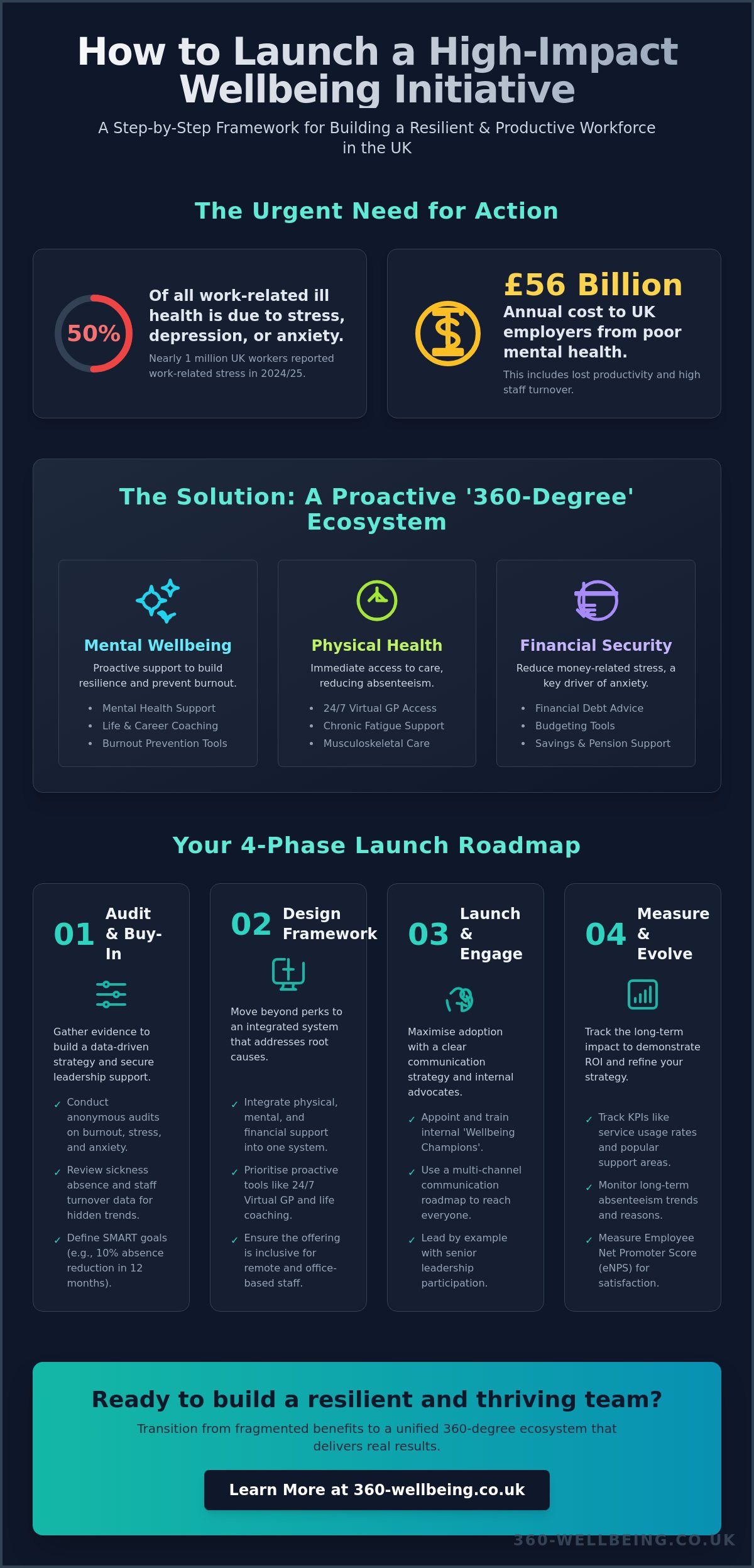
In the 2024/25 period, nearly 1 million UK workers reported stress, depression, or anxiety related to their jobs, accounting for a staggering 50% of all work-related ill health. You’ve likely felt this impact through rising absenteeism or seen your team struggle despite offering standard perks. It’s frustrating to manage the complexity of multiple health vendors when your primary goal is simply to keep your people healthy and productive. Understanding how to launch a wellbeing initiative that addresses these real-world challenges is now a critical priority for any resilient business.
We agree that the old model of reactive care isn’t enough when mental health issues cost UK employers £56 billion annually. This guide provides a clear, step-by-step framework to design, launch, and sustain a high-impact wellbeing initiative that supports your team’s mental, physical, and financial health. You’ll discover how to transition from fragmented benefits to a unified 360-degree ecosystem, incorporating essential tools like 24/7 Virtual GP access, mental health support, and life coaching. We will show you how to move beyond basic compliance and build a proactive culture where your employees can truly thrive.
Key Takeaways
- Identify hidden workplace stressors by conducting anonymous audits and reviewing sickness absence data before designing your strategy.
- Learn how to launch a wellbeing initiative that integrates physical, mental, and financial health into a unified “360-degree” support system.
- Boost employee participation by appointing internal Wellbeing Champions and utilizing a multi-channel communication roadmap.
- Move beyond basic perks toward a proactive model that includes 24/7 Virtual GP access and life coaching to prevent burnout before it starts.
- Track the long-term impact of your programme through measurable KPIs like usage rates, absenteeism trends, and employee Net Promoter Scores.
What is a Wellbeing Initiative and Why Does Your Business Need One Now?
A wellbeing initiative is far more than a collection of disconnected benefits; it’s a strategic organisational commitment to the physical, mental, and social health of your workforce. Historically, many firms viewed Workplace wellness as a reactive “break-fix” model, where support only appeared after an employee reached a crisis point. By 2026, the landscape has shifted. Leading UK employers now focus on proactive, preventative care that identifies risks before they result in long-term absence. Learning how to launch a wellbeing initiative that is integrated into your company culture ensures that support is a fundamental right, not a seasonal luxury.
Poor mental health now costs UK employers an estimated £56 billion annually. This figure isn’t just an abstract number; it represents lost productivity, high staff turnover, and the 22.1 million working days lost to stress and anxiety in 2024/25. Genuine support means moving beyond “perk-washing,” such as occasional office snacks or superficial gestures that fail to address root causes. Instead, businesses are prioritising comprehensive systems that offer real clinical and emotional depth to foster long-term resilience.
The Business Case for Proactive Wellbeing
Reducing absenteeism is a primary driver, especially since sickness absence in the UK reached a 15-year high in 2024. For UK SMEs, a robust wellbeing strategy is a powerful tool for talent attraction, as candidates in 2026 increasingly value health support as a core part of their compensation. The ROI of wellbeing is evidenced by the potential to reclaim a significant portion of the £56 billion lost annually to mental health issues through targeted, early intervention. By addressing issues early, you don’t just save money; you build a loyal, engaged team that feels genuinely valued.
Identifying the ‘360-Degree’ Employee Needs
True wellness is an ecosystem where physical health, mental resilience, and financial security intersect. Workplace stress often manifests as physical symptoms like chronic fatigue or musculoskeletal pain, which is why a 360-degree approach is vital. According to Mental Health UK’s 2026 Burnout Report, nine in ten adults are experiencing high stress levels, making it essential to understand how to launch a wellbeing initiative that reaches every corner of your business. Your strategy must be inclusive, supporting remote workers who may feel isolated and office-based staff facing high-pressure environments. This involves providing diverse tools, from 24/7 Virtual GP services to financial debt advice, ensuring every team member has a path to vitality.
Phase 1: Auditing Your Needs and Securing Leadership Buy-In
Before you commit resources, you must understand the specific heartbeat of your organisation. You wouldn’t prescribe a clinical treatment without a diagnosis; the same principle applies when you’re learning how to launch a wellbeing initiative. Phase one is about gathering evidence that transforms a “nice to have” idea into a strategic necessity. By identifying the unique pressures your team faces, you ensure your strategy is tailored rather than generic.
- Step 1: Conduct an anonymous wellbeing audit. Go beyond surface-level questions. Ask about burnout, childcare stress, and financial anxiety to identify where your support is most needed.
- Step 2: Review existing data. Analyse your sickness absence records and staff turnover rates. With UK sickness absence hitting a 15-year high, your internal data often reveals hidden trends in departmental stress.
- Step 3: Define SMART goals. Success must be measurable. Aim for specific outcomes, such as a 10% reduction in mental health-related absence or a 15% increase in employee engagement scores within twelve months.
- Step 4: Present the ‘Wellbeing Business Case’. Use your audit findings to secure a dedicated budget. Show stakeholders that investing in proactive care is a direct investment in business resilience.
Effective Workforce Auditing Techniques
While simple pulse surveys offer a quick snapshot, psychometric tools provide deeper insights into the psychological safety of your environment. You can identify high-risk groups, such as middle managers who often face “sandwich” pressures of leadership and operational tasks, without compromising individual privacy. Analysing the gap between the benefits you currently offer and actual employee usage is crucial. If your team isn’t using existing perks, it’s a sign that those services don’t align with their 360-degree needs. If you’re unsure where to start your audit, exploring comprehensive wellbeing support can provide the clarity needed to build your business case.
Winning Over the C-Suite and Management
To secure long-term commitment, frame wellbeing as a strategic asset rather than a cost centre. The shift toward proactive health is supported by government-backed wellbeing initiatives, which emphasise the shared responsibility of keeping the workforce healthy and productive. Address objections about “distraction” by presenting the cost of inaction, such as the £123.25 weekly Statutory Sick Pay (SSP) costs and the wider impact of lost productivity. Leaders must model healthy behaviours themselves. If managers don’t take their breaks or use the support services, the rest of the team won’t feel empowered to do so either. This cultural alignment is the foundation of a successful launch.
Designing a Holistic ‘360-Degree’ Wellbeing Framework
Building a successful strategy requires a shift from offering isolated “perks” to creating a unified ecosystem. When you’re determining how to launch a wellbeing initiative, the focus should be on building a safety net that supports employees across every aspect of their lives. The UK Health Security Agency offers evidence-based toolkits for employers that emphasise the need for structured, evidence-led interventions. A 360-degree framework ensures that physical, mental, and financial health are treated with equal importance, creating a culture of total wellness.
A common mistake is neglecting the deep connection between financial pressure and mental health. Financial anxiety is a primary driver of workplace stress, yet it’s frequently the “missing link” in corporate strategies. By integrating financial support for employees, such as debt advice, legal support, and complimentary will writing, you address the practical burdens that keep your team awake at night. When you understand how to launch a wellbeing initiative that balances clinical support with practical help, your business becomes a destination for top talent.
The Power of Digital Health Access
Physical health support must be accessible to be effective. Integrating 24/7 Virtual GP services allows your team to access clinical expertise without the stress of traditional appointment wait times. This convenience significantly reduces the need for staff to take time off for minor health concerns or prescriptions. It provides immediate reassurance, allowing employees to book consultations from home or during their breaks; this effectively lowers the burden on the NHS while keeping your productivity steady. When health support is this seamless, employees feel empowered to manage their vitality proactively.
Beyond the GP: Mental and Social Resilience
While traditional Employee Assistance Programmes (EAPs) provide a vital baseline, a 360-degree model goes further by offering proactive mental health tools. Life coaching is a powerful addition, helping employees set personal goals and navigate workplace challenges with confidence. This preventative approach reduces the likelihood of burnout and long-term sickness. Social resilience is equally important; building a sense of community through reward marketplaces and shared recognition programmes helps staff feel connected. Considering that nearly one in three employers admit their managers lack the resources to support mental health, a structured framework provides the necessary order and safety for your entire organisation.
The Launch Roadmap: Maximising Employee Engagement and Adoption
Securing the budget and designing the framework are significant milestones, but the true test of how to launch a wellbeing initiative lies in its adoption. Many programmes fail not because the services are poor, but because employees don’t know they exist or don’t trust them. Overcoming implementation friction requires a methodical roadmap that combines clear communication with peer-to-peer advocacy. By focusing on the user experience from day one, you ensure that your investment translates into a healthier, more resilient workforce.
- Multi-channel communication. Use email, Slack, town halls, and physical posters to reach every employee, whether they’re on the road or at a desk.
- Reducing friction. A single, unified digital platform is essential. If staff have to manage multiple health vendors and separate logins, engagement will inevitably drop.
- The first 90 days. Establish a ‘Wellbeing Calendar’ with monthly themes, such as financial health in January or mental resilience in May, to keep the initiative visible and relevant.
Effective Communication Strategies
Every piece of communication should answer one question: “What’s in it for me?” Tailor your messaging so a junior developer understands the value of life coaching, while a senior manager sees how a 24/7 Virtual GP saves them precious time. Storytelling is a powerful tool here. Using anonymous testimonials about how the services helped a colleague manage stress or recover from an injury humanises the clinical support. You must also address the fear of surveillance. Be explicit that all interactions with services like mental health support or debt advice are strictly confidential and never shared with management.
Sustaining Momentum with Wellbeing Champions
A top-down approach only goes so far; you need ‘Wellbeing Champions’ to drive change from within. These are staff members from different departments who are trained to promote the initiative and spot early signs of struggle in their peers. An ideal Wellbeing Champion is an approachable individual who demonstrates empathy, actively listens, and has a genuine passion for fostering a healthy workplace culture. They act as the bridge between the digital platform and the human experience, signposting colleagues to the right support before a minor issue becomes a crisis. To begin building this internal network, you can launch your comprehensive wellbeing strategy with our expert support.
Measuring Success and Evolving Your Wellbeing Strategy
The journey doesn’t end once the platform is live and the first communications have been sent. A strategy that remains static quickly loses its impact; you must treat your initiative as a living ecosystem that adapts to the changing needs of your workforce. Understanding how to launch a wellbeing initiative is only the first step. Long-term success is found in the steady, methodical analysis of how your team interacts with the support provided. By measuring specific outcomes, you can move from guesswork to a data-driven culture of care that protects both your people and your bottom line.
Tracking the right Key Performance Indicators (KPIs) allows you to demonstrate the tangible return on your investment. Focus on three primary areas: usage rates across different services, changes in absenteeism, and your employee Net Promoter Score (eNPS). If you notice high engagement with financial support but low usage of physiotherapy, it’s a clear signal to adjust your internal marketing or investigate if there’s a specific departmental need. This iterative approach ensures that your budget is always directed where it can provide the most relief and reassurance.
Using Data to Refine Your Approach
Modern platforms provide anonymised usage reports that act as an early warning system for emerging health trends. If mental health support requests spike during a specific quarter, you can proactively introduce targeted workshops or life coaching sessions to get ahead of the curve. Annual wellbeing reviews are essential to keep your strategy aligned with shifting demographics, such as an increase in remote workers or a growing number of employees with caring responsibilities. Sharing these success stories, while maintaining strict confidentiality, helps justify continued investment to stakeholders by showing the human impact behind the data.
The 360 Wellbeing Advantage for SMEs
For UK SMEs, managing multiple health vendors is often too complex and expensive. 360 Wellbeing provides a streamlined solution by acting as your long-term strategic partner. We offer a “one-stop-shop” that integrates 24/7 Virtual GP access, mental health support, and legal advice into a single, cohesive framework. Our fixed per-employee monthly fee model ensures total cost-predictability, allowing you to provide a high-impact initiative without the financial uncertainty often associated with traditional medical services. This all-encompassing approach simplifies the process of learning how to launch a wellbeing initiative that truly lasts.
- Sickness absence rates show a steady decline compared to previous years.
- Employees actively mention wellbeing tools during 1-to-1s or exit interviews.
- A measurable increase in your eNPS or general engagement survey scores.
- High adoption rates for proactive tools like life coaching and reward marketplaces.
- Managers report feeling more confident in signposting staff to professional support.
Ready to transform your workplace culture? Book a demo of our comprehensive wellbeing platform today.
Taking Your First Step Toward a Resilient Team
Building a culture of health is a journey that pays dividends in both productivity and employee loyalty. By auditing your team’s specific needs and securing leadership commitment, you’ve already laid the essential groundwork for a more sustainable business. We’ve explored how a holistic 360-degree framework, encompassing physical, mental, and financial health, transforms wellbeing from a luxury into a strategic asset. You now have the definitive roadmap for how to launch a wellbeing initiative that delivers measurable results and long-term vitality.
Success lies in the details, such as providing 24/7 Virtual GP access with UK-registered doctors and offering comprehensive mental health support alongside life coaching. For SMEs, our fixed and affordable per-employee pricing ensures high-impact care remains accessible without the complexity of traditional medical services. This approach moves beyond basic perks to create a proactive environment where your employees feel truly seen and supported. It’s about creating an atmosphere where resilience is built into the very fabric of your daily operations.
Empower your team with a 360-degree wellbeing platform; start your journey today. We’re ready to partner with you to build a workplace where every individual can flourish and your business can reach its full potential.
Frequently Asked Questions
How much does it cost to launch a wellbeing initiative in the UK?
Costs vary depending on the level of support, but most modern providers use a subscription model based on a fixed fee per employee per month. This approach allows for predictable budgeting without the high premiums associated with traditional medical services. You can also leverage tax-exempt benefits, such as eye tests for DSE users or seasonal flu vaccinations, which are exempt from tax as of April 6, 2026.
Can a small business with only 5 employees have a wellbeing programme?
Absolutely, scalability is a core feature of modern digital health platforms. Small businesses with as few as five employees can access the same level of 24/7 Virtual GP and mental health support as large corporations. This level of care is often more critical for small teams, where a single person’s absence has a 20% impact on total daily productivity and puts significant pressure on the remaining staff.
What is the difference between an EAP and a full wellbeing platform?
Traditional Employee Assistance Programmes (EAPs) are typically reactive, providing support only when an individual is already in crisis. A full wellbeing platform is a proactive ecosystem that integrates daily health tools like life coaching, financial advice, and rewards. It’s designed to keep employees healthy and engaged, rather than just helping them recover after they’ve already reached a point of burnout or illness.
How do I ensure employee confidentiality when using health services?
Confidentiality is maintained through strict adherence to GDPR and clinical data standards. When you learn how to launch a wellbeing initiative, it’s vital to communicate that all medical consultations and coaching sessions are private. Employers only receive anonymised, high-level usage reports that identify general trends without revealing any personal health data, specific medical conditions, or individual identities.
How do we measure the ROI of our wellbeing initiative?
You measure ROI by tracking long-term trends in employee retention, recruitment costs, and engagement scores (eNPS). While direct financial returns can be complex to isolate, the reduction in staff turnover and the improvement in workplace morale provide a clear indicator of success. Proactive support helps prevent the extreme stress levels reported by 90% of adults in the latest 2026 burnout research.
What are the most popular wellbeing benefits for UK employees in 2026?
In 2026, employees prioritise immediate access to clinical care and financial security. 24/7 Virtual GP services and debt advice are highly valued due to their practical impact on daily life. There is also a significant trend toward life coaching and physiotherapy, as staff look for holistic support that addresses both their physical vitality and their professional growth within the company.
How do I get staff to actually use the wellbeing platform we’ve paid for?
Engagement starts with visibility and peer-to-peer advocacy. Introducing the platform during onboarding and utilizing Wellbeing Champions within your departments ensures the service remains a consistent topic of conversation. Regular Wellbeing Calendars that highlight different features, such as legal support or rewards, help keep the initiative relevant to employees’ evolving needs. Understanding how to launch a wellbeing initiative effectively requires making these services part of the daily workplace culture.
Is a virtual GP service as good as a traditional in-person doctor?
Virtual GP services provided by UK-registered doctors offer the same clinical expertise as traditional surgeries but with significantly faster access. For approximately 70% of common health concerns, a digital consultation can provide an immediate diagnosis, prescription, or referral. This convenience is a cornerstone of a modern strategy, as it significantly reduces the time staff spend away from work for routine medical appointments.