
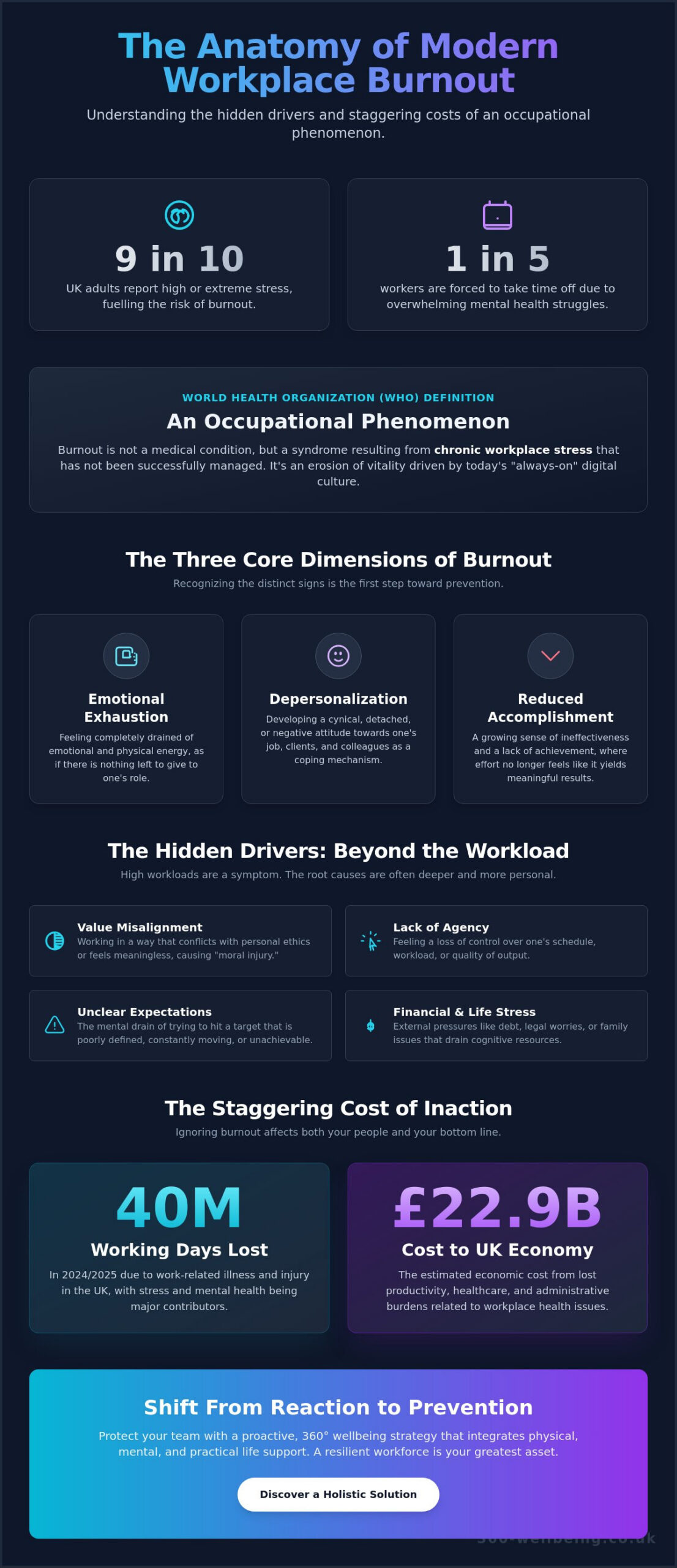
With nine in ten UK adults reporting high or extreme stress and one in five workers forced to take time off due to mental health struggles, the traditional approach to office wellness is no longer enough. You’ve likely seen the impact of the “always-on” culture firsthand through rising absenteeism and a team that feels increasingly overwhelmed. Understanding how to prevent burnout at work is no longer just a supportive gesture; it’s a professional necessity and a legal requirement under the HSE’s 2026 workplace inspection priorities. We know you care deeply about your people’s vitality, yet distinguishing between temporary stress and chronic exhaustion remains a significant challenge for even the most attentive leaders.
This article offers a comprehensive, 360-degree approach to identifying and managing workplace exhaustion through proactive, holistic care. You’ll discover a clear framework for burnout prevention that balances physical health with mental resilience and practical life support. We’ll walk you through evidence-based strategies to improve employee retention, from utilizing 24/7 Virtual GPs and Mental Health Support to providing the financial and legal guidance that helps your team feel truly secure. By the end, you’ll have a roadmap to transform your workplace into a sanctuary of sustained productivity and genuine harmony.
Key Takeaways
- Learn why modern burnout is defined as an occupational phenomenon driven by digital fatigue and misaligned values rather than just a heavy workload.
- Discover evidence-based strategies on how to prevent burnout at work by shifting from reactive crisis management to a proactive culture of wellbeing foresight.
- Identify the hidden impact of digital presenteeism and learn how to normalise mental health support to foster a more resilient team environment.
- Explore the “Panoramic View” of health, where physical, mental, and social wellbeing are integrated into a single, unified strategy for total wellness.
- Understand how immediate access to tools like 24/7 Virtual GPs and professional mental health support can reduce employee stress and improve long-term retention.
Understanding Burnout in the 2026 Workplace
The World Health Organization (WHO) identifies burnout as an occupational phenomenon rather than a medical condition. It’s a syndrome resulting from chronic workplace stress that hasn’t been successfully managed. If you’re wondering what is occupational burnout? specifically in today’s context, it is often the result of an “always-on” digital culture. By 2026, the lines between home and office have blurred so much that many employees struggle to find a true moment of rest. This constant connectivity, paired with a culture of “upward comparison” on professional platforms, creates a relentless cycle of feeling “behind,” even when productivity is high.
As an expert caregiver in the corporate space, we see burnout as more than a HR metric. It’s a gradual erosion of a person’s total vitality, affecting their physical health, mental clarity, and social connections. To understand how to prevent burnout at work, we must first distinguish between healthy workplace pressure and toxic chronic stress. Pressure can be a positive catalyst for growth when it’s short-term and followed by recovery. However, when the “sprint” never ends, the body and mind begin to shut down. Proactive foresight is required to ensure that your team’s energy remains durable and balanced.
The Three Dimensions of Burnout
Burnout isn’t a single feeling but a complex interplay of three distinct dimensions. First, emotional exhaustion leaves individuals feeling completely drained, as if they have nothing left to give to their roles. Second, depersonalisation occurs when an employee develops a cynical or detached attitude toward their work or colleagues. This often acts as a subconscious defense mechanism but can quickly damage team harmony. Finally, a sense of reduced personal accomplishment makes even the most capable professionals feel like they’re “treading water,” where no amount of effort seems to yield meaningful results or satisfaction.
The Economic and Human Cost of Inaction
The cost of ignoring these warning signs is staggering for both the individual and the business. In the 2024/2025 period, the Health and Safety Executive (HSE) reported that 40 million working days were lost due to work-related illness and injury. This resulted in an estimated cost of £22.9 billion to the UK economy. Beyond the balance sheet, the human toll includes long-term physical health complications such as cardiovascular issues or weakened immune systems. Catching symptoms in the “early warning” phase is essential. Providing access to professional support tools isn’t just a benefit; it’s a foundation for a resilient and healthy workforce.
Identifying the Hidden Drivers: Beyond the Workload
While we explored the official definition of burnout in the previous section, it’s vital to look past the volume of emails and deadlines. High workloads are rarely the sole culprit. Instead, burnout often takes root when an employee experiences a “moral injury.” This happens when their personal ethics or sense of purpose clash with their daily tasks. It’s a quiet, internal friction that erodes vitality far faster than a busy schedule ever could.
A lack of agency also plays a significant role. When individuals feel they’ve lost control over their schedules or the quality of their output, they begin to feel like a small cog in a large, indifferent machine. To understand how to prevent burnout at work, we must address these hidden psychological drivers. When people feel they have no say in their professional outcomes, the work begins to feel futile, leading to the detachment and cynicism we identified earlier.
Common hidden drivers include:
- Value Misalignment: Working in a way that feels dishonest, unimportant, or contrary to personal beliefs.
- Isolation: Feeling physically or emotionally separated from the team, especially in hybrid or remote setups.
- Unclear Expectations: The mental drain of trying to hit a target that keeps moving or isn’t defined.
Financial Stress as a Burnout Catalyst
External pressures like debt and legal worries don’t simply vanish when someone logs on. Debt anxiety is a powerful cognitive disruptor. It limits an employee’s ability to process complex information and make sound decisions. This is why integrated financial support is a critical component of any modern mental health strategy. By providing access to professional debt advice and legal support, you can help lift the heavy burden of outside stress. Making these services a standard part of your benefit package helps reduce the stigma and ensures your team remains durable and focused.
The Physical Precursors of Mental Exhaustion
The nervous system often signals distress through the body long before a mental breakdown occurs. Chronic stress frequently manifests as physical ailments like persistent headaches, digestive discomfort, or even sciatica. Ignoring these signs is a risk to long-term health. When you’re looking at how to prevent burnout at work, remember that physical health and mental resilience are inextricably linked.
Early intervention is the most compassionate and effective path forward. Whether it’s a quick consultation for a physical ache or seeking Mental Health Support, addressing these issues early prevents them from snowballing. Access to a 24/7 Virtual GP allows employees to seek guidance at the first sign of physical strain, protecting their total wellness and ensuring they have the foresight to rest before they reach a breaking point.
Proactive Strategies for Sustainable Performance
Shifting from reactive crisis management to proactive wellbeing foresight is the most effective way to protect your team’s durability. The traditional workplace model often waits for a formal sick note or a visible decline in performance before offering help. By this stage, however, the employee has likely already reached a state of exhaustion that requires significant recovery time. To truly understand how to prevent burnout at work, we must move toward a panoramic view of health that integrates physical, mental, and social support into the daily flow of business.
Building restorative spaces goes beyond physical breakrooms. It involves creating digital boundaries and psychological safety where rest is respected as a professional necessity rather than a luxury. According to Gallup research on the causes of burnout, factors like unfair treatment and unmanageable workloads are primary drivers. Addressing these requires a customised approach rather than a one-size-fits-all benefits package. Every individual has unique needs, and a flexible support system allows them to access the specific care they require at the right moment.
Reactive vs. Proactive Wellbeing Models
The ROI of a proactive model is clear and measurable. Employees experiencing burnout are estimated to lose 119% more productive time compared to their peers who aren’t at risk, according to Vitality’s “Britain’s Healthiest Workplace Report.” By providing immediate access to a 24/7 Virtual GP or Mental Health Support, you reduce the friction of seeking help. Proactive care builds resilience and foresight, leading to lower turnover and a team that feels genuinely valued as humans, not just as assets.
The Power of Life Coaching and Mentorship
Life Coaching serves as a powerful tool for reclaiming a sense of agency and purpose. It helps employees navigate the “moral injury” and value clashes mentioned earlier by aligning their personal goals with their professional contributions. Regular check-ins and professional development build what we call “psychological capital.” When you encourage a culture where seeking help is viewed as a professional strength, you create a durable workforce. This approach ensures that wellbeing is seen as a human entitlement, fostering a positive vision of vitality and workplace harmony.
The Manager’s Toolkit: Creating a Culture of Resilience
Managers often find themselves on the front lines of the wellbeing crisis, yet many feel ill-equipped to handle the emotional complexities of their team. For small business owners and department heads, the pressure to maintain productivity while protecting staff can feel like a delicate balancing act. Understanding how to prevent burnout at work requires moving beyond surface-level “how are you?” queries and into a structured framework of support. This toolkit provides five actionable steps to foster a durable and psychologically safe environment.
- Step 1: Normalise the conversation. Make mental health a standard agenda item in one-to-ones. When leaders speak openly about stress, it removes the stigma and encourages early disclosure.
- Step 2: Combat digital presenteeism. Set clear expectations regarding “switching off.” In our 2026 digital landscape, the compulsion to respond to messages after hours is a primary driver of exhaustion.
- Step 3: Deploy an active Employee Assistance Programme (EAP). Ensure your team knows how to access Mental Health Support and Life Coaching. An EAP only works if it is visible and trusted.
- Step 4: Provide Financial and Legal First Aid. Use dedicated helplines to help employees manage external pressures. Offering Financial Support and Legal Support can resolve the “life-admin” stress that often triggers workplace fatigue.
- Step 5: Model healthy boundaries. If you don’t disconnect during your leave, your team won’t either. Leadership must demonstrate that rest is a professional necessity.
Identifying “Quiet” Burnout in Remote Teams
Remote and hybrid work can mask the early warning signs of exhaustion. Managers should watch for “quiet” burnout, which often manifests as a sudden shift in communication patterns or a persistent “camera-off” culture during meetings. Regular, non-work-related virtual check-ins help maintain the social health of the team. For remote workers who may struggle to visit a physical clinic, 24/7 Virtual GP services provide a vital bridge, ensuring they can access clinical expertise without the added stress of travel or long wait times.
Legal and Ethical Responsibilities of the Employer
In 2026, the UK’s Health and Safety Executive (HSE) has made mental health a core priority for workplace inspections. Employers have a clear legal duty of care to protect staff from psychological harm under the Health and Safety at Work Act 1974. Adopting global standards like ISO 45003 for psychological safety demonstrates a commitment to best practices. Beyond basic compliance, providing practical tools like complimentary will writing or debt advice shows a genuine investment in your team’s long-term security. These services reduce the cognitive load on employees, allowing them to focus on their roles with a sense of completeness and balance.
Holistic Support Systems: How 360 Wellbeing Protects Your Team
Creating a resilient workplace requires more than just good intentions; it requires a robust infrastructure that catches employees before they fall. The 360 Wellbeing philosophy is built on the principle of total wellness through integrated care. We believe that health isn’t a series of isolated symptoms but a panoramic experience where physical, mental, and social factors are deeply intertwined. When you consider how to prevent burnout at work, you must look at the person as a whole. Our approach ensures that every individual has a safety net that is both scientifically grounded and deeply personal.
By integrating various support streams into a single narrative, we remove the friction that often prevents people from seeking help. Whether it’s a quick consultation for a physical ache or a deep dive into mental resilience with a specialist, the path to care should be seamless. This unified strategy transforms wellbeing from a corporate checkbox into a durable human entitlement. It empowers your team to maintain their vitality, ensuring they have the foresight to manage stress before it evolves into a crisis.
The Virtual GP: Your First Line of Defence
Most discussions regarding workplace exhaustion focus solely on the mind, yet the body often registers distress much earlier. Chronic stress frequently manifests as physical symptoms like digestive issues, tension headaches, or persistent fatigue. A 24/7 Virtual GP acts as a critical first line of defence, allowing employees to speak with a UK-registered doctor at any hour of the day or night. This immediate access reduces the anxiety of waiting for a traditional appointment and ensures that “minor” physical ailments are addressed before they escalate.
The reassurance of clinical expertise provides a sense of safety that is essential for recovery. When an employee can access medical advice from the comfort of their home, they feel supported and valued. This proactive intervention is a cornerstone of how to prevent burnout at work, as it identifies the physiological markers of an overtaxed nervous system early in the journey.
A Unified Narrative of Wellness
A modern corporate strategy must address the “real-world” problems that bleed into professional life. This is why our platform integrates 360 Rewards with essential health and life tools. From Mental Health Support and Life Coaching to practical Financial Support & Debt Advice, we provide a complete ecosystem of care. Legal Support and complimentary will writing further reduce the cognitive load on your staff, solving the practical worries that often keep them awake at night. This combination of clinical expertise and practical life-aid creates a sense of completeness and balance.
Choosing a unified platform is the logical conclusion for any forward-thinking employer. It replaces fragmented services with a single, accessible safety net that grows with your business. By investing in the long-term interests of your team, you foster a culture of workplace harmony and sustained productivity. Take the first step toward a healthier, more vibrant workplace and Contact 360 Wellbeing today to discover how we can partner with you in your team’s success.
Cultivating a Future of Workplace Vitality
Building a resilient workforce requires a fundamental shift in perspective. We’ve seen that exhaustion is rarely just a matter of heavy workloads; it’s often rooted in a loss of agency or the weight of external financial and legal pressures. By moving away from reactive crisis management toward a model of wellbeing foresight, you protect your team’s long-term durability. Understanding how to prevent burnout at work means providing a safety net that addresses the physical, mental, and social needs of every individual before they reach a breaking point.
A unified approach ensures that your employees feel supported in every aspect of their lives. Whether it’s the reassurance of 24/7 access to UK-registered GPs, integrated Mental Health Support and Life Coaching, or practical Financial Support & Debt Advice, these tools transform wellbeing from a luxury into a professional necessity. You have the power to create a culture where vitality and harmony are the standard, not the exception. It’s time to invest in a strategy that honours the human entitlement to health and balance.
Empower your team with a 360-degree wellbeing platform and begin your journey toward a more vibrant, sustainable workplace today. Your team’s success is your success, and we’re here to help you protect it.
Frequently Asked Questions
What are the first signs of burnout I should look for in my staff?
Watch for emotional exhaustion, cynicism, and a drop in professional efficacy. You might notice a team member becoming unusually detached or impersonal during meetings or group projects. Physical signs like persistent fatigue, frequent minor illnesses, or changes in sleep patterns are also common indicators that a person’s vitality is eroding. Identifying these early warning signs allows for a proactive rather than reactive response to their wellbeing.
How is burnout different from just being stressed at work?
Stress is often characterized by over-engagement and urgency, while burnout is defined by disengagement and blunted emotions. While stress feels like “too much” pressure, burnout feels like “not enough” motivation or hope. Stress can often be managed with short-term rest and better time management. However, burnout requires a more comprehensive, 360-degree approach to recovery and long-term prevention strategies to restore a person’s sense of purpose.
Can an Employee Assistance Program (EAP) really prevent burnout?
An Employee Assistance Programme (EAP) is highly effective when it’s proactive and visible. By providing immediate access to Mental Health Support and Life Coaching, an EAP helps employees build the psychological capital needed to handle workplace pressure. It works best when integrated into a wider culture of wellbeing rather than being treated as a one-off emergency tool for people who are already in a state of crisis.
How does a Virtual GP help with workplace mental health?
A Virtual GP serves as a vital first line of defence by identifying physical symptoms linked to chronic stress. Since many mental health issues manifest as headaches, digestive problems, or sleep disturbances, early clinical intervention can stop the spiral. Having 24/7 access to a UK-registered doctor provides the reassurance needed to address health concerns before they escalate into a full mental or physical breakdown.
Is burnout prevention expensive for a small business?
Burnout prevention is often more cost-effective than the alternative of high turnover and absenteeism. For a small business, lost productivity and recruitment costs far outweigh the investment in a unified wellbeing platform. Many modern support systems offer customized, scalable solutions that provide essential tools like Financial Support and Legal Support without requiring a massive corporate budget, making comprehensive care accessible for smaller teams.
What should I do if an employee is already in the late stages of burnout?
If an employee is already in the late stages of burnout, prioritize immediate rest and professional clinical support. You should encourage them to utilize Mental Health Support and consult a GP to assess their physical and psychological health. Creating a phased return-to-work plan with reduced responsibilities helps them rebuild their sense of agency without feeling overwhelmed by their previous workload or digital presenteeism.
How can I encourage my team to use their wellbeing benefits?
Normalising the conversation around mental health is the most effective way to drive benefit engagement. When leaders openly discuss how to prevent burnout at work and share their own use of tools like Life Coaching, it removes the stigma for the entire team. Highlighting specific features, such as 360 Rewards or complimentary will writing, makes the benefits feel more practical and relevant to their daily lives and personal security.
What role does financial stress play in workplace burnout?
Financial stress is a major contributor to workplace exhaustion, often causing debt anxiety that impairs cognitive function. External pressures like mounting bills or legal worries bleed into professional performance and reduce an employee’s mental bandwidth. Providing integrated Financial Support & Debt Advice helps lift this burden, allowing your team to focus on their work with a clearer, more balanced mindset and a sense of total wellness.