
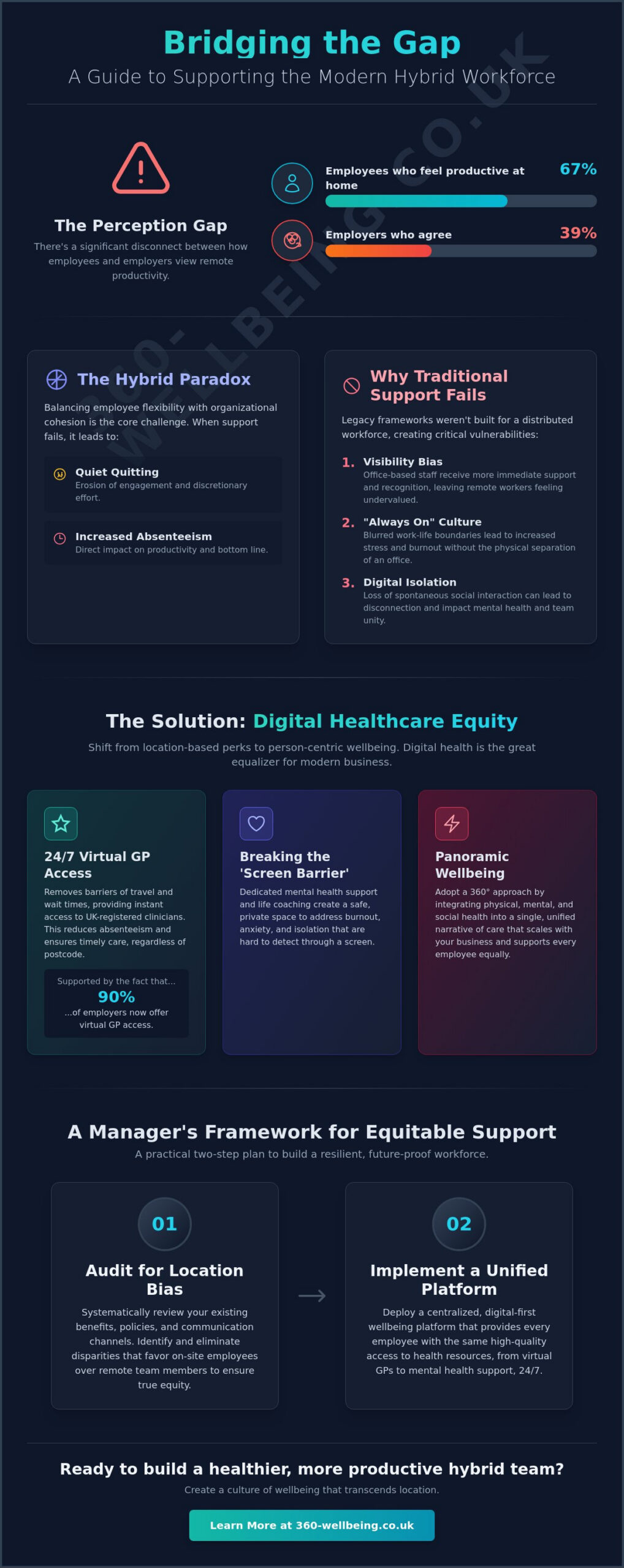
Did you know that while 67% of employees feel they are more productive working from home, only 39% of employers share that view? This perception gap often masks deeper issues like digital presenteeism and a growing sense of disconnection that can quietly erode your culture. You likely recognize that learning how to support a hybrid workforce isn’t just about providing a laptop and a video link anymore. It’s about ensuring every team member feels seen and supported, whether they’re at a kitchen table in Kent or a corner office in London.
We understand the pressure of balancing rising absenteeism with the need for a unified team. You want a strategy that protects your people’s mental health without adding a mountain of paperwork to your HR team’s desk. This guide will show you how to bridge the gap between office and remote environments to create a healthy, productive, and inclusive culture. We’ll explore how to integrate 24/7 virtual healthcare and navigate the 2026 statutory sick pay updates to build a resilient, future-proof workforce that thrives regardless of their postcode.
Key Takeaways
- Shift your perspective from managing location to building a robust infrastructure that guarantees equitable access to health resources for all team members.
- Discover how to support a hybrid workforce by using digital healthcare tools, such as 24/7 Virtual GPs, to remove the physical barriers of traditional appointments.
- Uncover the hidden financial and legal stressors that impact hybrid employees and learn how addressing these can directly improve your overall productivity.
- Follow a practical two-step framework to audit your existing benefits for location bias and implement a unified wellbeing platform for your entire organization.
- Adopt a panoramic approach to wellness that integrates physical, mental, and social health into a single narrative of care that scales with your business.
The Evolution of Hybrid Work: Defining Support in 2026
In the current landscape, hybrid support is far more than a collection of remote-work policies. It’s the vital infrastructure that ensures equitable access to health and professional resources for every member of your team. The Evolution of Hybrid Work has shifted significantly over the last few years. By 2026, approximately 40% to 44% of UK working adults are in remote or hybrid roles. This means your approach to health and productivity is no longer a secondary concern; it’s a strategic necessity that defines your brand’s durability and appeal.
Truly understanding how to support a hybrid workforce involves navigating what many call the “Hybrid Paradox.” This is the ongoing challenge of balancing the individual flexibility that 44% of UK workers now prefer with the organizational cohesion required for a business to function. When support systems are weak, we see a rise in “quiet quitting” and employee absenteeism. Failure to bridge this gap doesn’t just hurt morale. It actively diminishes your bottom line through lost productivity and the high cost of staff turnover.
Why Traditional Support Systems Fail Distributed Teams
Many legacy frameworks suffer from “visibility bias.” This is the tendency for office-based staff to receive more immediate support and recognition simply because they’re physically present. For those at home, the “Always On” culture often blurs the lines between professional and private life. Without the physical boundary of an office, stress levels can climb as employees feel pressured to respond to messages at all hours. Digital isolation also remains a significant threat. Losing spontaneous social interactions can lead to a sense of disconnection that eventually impacts mental health and team unity.
The Shift Toward Holistic Health Equity
We’re seeing a definitive move away from location-based perks toward person-centric wellbeing. In 2026, foresight is the most valuable tool in your occupational health kit. It’s about predicting challenges and providing preventative care that reaches an employee wherever they are. We believe that comprehensive wellbeing is an essential human entitlement, not a luxury reserved for those in a head office. This means integrating mental, physical, and social health into a single narrative. By offering digital-first solutions that are accessible 24/7, you provide a safety net that feels personal, professional, and entirely inclusive.
Health Equity in a Distributed Team: The Role of Digital Healthcare
Digital healthcare has emerged as the great equalizer for modern businesses. When your team is scattered across the UK, providing a physical clinic at a head office creates a disparity that remote workers feel deeply. By 2026, the UK’s digital health market is projected to reach £18.40 billion, reflecting a shift where 90% of employers now offer virtual GP access. This isn’t just a trend; it’s a fundamental pillar of A Manager’s Framework for Equitable Hybrid Support. When we discuss how to support a hybrid workforce, we must look beyond policy and focus on clinical accessibility that treats every employee’s health as a priority.
24/7 Virtual GP: The Cornerstone of Remote Support
Waiting weeks for a local appointment is a significant driver of absenteeism. For a remote employee, the stress of travel and long waiting times often leads to delayed care and prolonged illness. A 24/7 Virtual GP removes these barriers entirely. It provides instant access to UK-registered clinicians from the comfort of a home office or a quiet corner of the kitchen. This immediacy offers a sense of reassurance that is often missing in distributed environments. It allows staff to integrate consultations into their working day without the disruption of a half-day commute to a surgery, keeping them healthy and engaged.
Mental Health and the ‘Screen Barrier’
Detecting struggles through a monitor is notoriously difficult. The “screen barrier” can hide symptoms of social anxiety or burnout that would be obvious in person. Providing dedicated mental health support and life coaching creates a safe, private space for employees to unpack these challenges. Life coaching, in particular, helps maintain professional vitality by focusing on motivation and goal-setting, which can easily slip when working in isolation. By using digital platforms to monitor wellbeing, you gain a panoramic view of your team’s health that traditional surveys simply can’t capture.
Physical health also requires a tailored approach. Home workstations are rarely as ergonomic as office setups, leading to an increase in musculoskeletal complaints. Access to digital physiotherapy ensures that minor aches don’t become chronic issues that lead to long-term leave. By offering a unified suite of holistic health services, you ensure that every employee receives the same high standard of care regardless of their postcode. This proactive stance moves away from reactive fixes and toward a culture of durable, long-term wellness that supports the whole person.
Addressing the Hidden Stressors: Financial and Legal Safeguards
While physical and mental health often take center stage in corporate wellness discussions, financial and legal stability form the quiet foundation of an employee’s ability to focus. In a remote or hybrid setting, these stressors are frequently amplified. Without the daily rhythm of office life, employees can feel more isolated with their personal burdens, and the lack of casual “water cooler” chats means managers often miss the subtle signs of financial strain. Understanding how to support a hybrid workforce means recognizing that a person’s digital “presence” is heavily influenced by the weight of their real-world responsibilities.
Financial anxiety is a significant drain on cognitive resources. When a team member is worried about rising debt or navigating complex legal issues, their capacity for deep, creative work diminishes. By providing a safety net that includes professional debt advice and legal helplines, you’re not just offering a perk. You’re actively removing the mental clutter that prevents your people from thriving. This proactive approach to wellbeing treats financial and legal security as a professional necessity rather than a luxury.
Financial Wellbeing as a Productivity Tool
The link between a clear mind and high performance is undeniable. Even though hybrid work can save employees up to £2,400 annually on commuting costs, ongoing cost-of-living pressures in 2026 continue to weigh heavily on UK households. Offering access to expert financial support and debt advice helps reduce the cognitive load on your staff, allowing them to bring their best selves to their roles. Additionally, integrating discount marketplaces through services like 360 Rewards provides tangible, daily relief that supports long-term retention. For a more detailed look at these strategies, you can explore our financial support for employees guide.
Legal Support and Life Planning
Legal issues are often high-stress events that employees feel they must handle in complete secrecy. Whether it’s a complicated rental dispute or the need for family law guidance, having access to a confidential legal helpline can be transformative. It offers a sense of order and safety during chaotic times. We also believe that life planning is an essential component of total wellness. Offering benefits like complimentary will writing provides deep peace of mind, ensuring that employees feel their future, and that of their families, is secure. This panoramic viewpoint on health ensures that your support strategy is as durable and multifaceted as the people it serves.
A Manager’s Framework for Equitable Hybrid Support
Moving from theory to practice requires a structured, empathetic approach. Managers are the vital bridge between company policy and the daily employee experience. To understand how to support a hybrid workforce effectively, we must move beyond simply managing tasks. We must manage the whole person. This framework provides a methodical path toward a culture of care that feels consistent for everyone, whether they are in a central office or a home workspace. It’s about building a sense of safety and order that allows every team member to thrive.
- Step 1: Audit for ‘location bias’ to ensure benefits aren’t tethered to a physical office.
- Step 2: Implement a unified digital wellbeing platform for equal access to care.
- Step 3: Train managers to spot the subtle, physical symptoms of stress through a screen.
- Step 4: Foster connection through purposeful, non-transactional communication.
- Step 5: Measure ROI by tracking absenteeism data and long-term engagement metrics.
Auditing for Location Bias
Are your benefits truly inclusive for a distributed team? If your Employee Assistance Programme (EAP) relies on physical posters in a breakroom or local gym memberships, your remote staff are already at a disadvantage. You should ask yourself: Can my remote staff access a GP as easily as those in the office? If the answer is no, your infrastructure has a location bias that could lead to feelings of exclusion. It’s essential to ensure that perks like 360 Rewards are accessible nationally, providing a panoramic view of support that reaches every postcode with the same level of care.
Training Managers for the Virtual World
The role of a manager has evolved into that of an expert caregiver. This doesn’t mean becoming a therapist, but it does require the foresight to identify when a colleague is struggling. Methodical check-ins are crucial in a hybrid environment. Instead of starting every call with a project update, lead with a genuine “How are you?”. Using standards like ISO 45003 can provide a structured guide for these workplace health conversations, ensuring they remain professional yet deeply supportive. This approach moves away from high-pressure management toward a proactive and positive vision of workplace harmony.
By 2026, the removal of the three-day SSP waiting period means that tracking absenteeism data provides more immediate insights into your team’s health. When you combine this data with regular engagement metrics, you can see the real-world impact of your wellbeing strategy. It’s a professional necessity to ensure that your support is as durable and customized as the people it serves. Ready to unify your team’s health strategy? Discover our comprehensive wellbeing solutions today and build a more resilient workforce.
The 360 Wellbeing Approach: Scaling Holistic Care Nationally
Building a resilient team requires more than just good intentions; it requires a unified infrastructure that remains consistent across every location. When you are deciding how to support a hybrid workforce, the sheer number of disconnected health tools can be overwhelming. 360 Wellbeing simplifies this by providing a single, cohesive solution that scales with your business. We move away from fragmented benefits toward a panoramic viewpoint that treats physical, mental, and social health as one single narrative of total wellness.
We believe that high-quality support shouldn’t be a luxury reserved for global corporations. Our model is built around affordable, per-employee pricing specifically designed to empower SMEs and sole traders. This ensures that even the smallest teams can offer their staff a level of care that matches the largest firms. By making total wellness a reality for your entire workforce, you aren’t just ticking a box. You’re building a foundation of durability and foresight that protects your most valuable asset: your people.
A Partnership for Long-Term Vitality
Our approach is grounded in the idea of partnership. Our UK-registered GPs and therapists don’t just provide a service; they act as an empathetic extension of your own team. They’re there to guide your employees through their health journeys with a warm, human touch that balances clinical expertise with genuine care. This partnership removes the coldness often found in traditional health services, replacing it with a modern persona that is forward-thinking and deeply invested in each individual’s success.
The simplicity of our platform is its greatest strength. Instead of juggling multiple logins for an Employee Assistance Programme (EAP), physiotherapy, and financial advice, your staff can access everything in one place. This ease of use empowers employees to take a proactive approach to their own health before minor issues escalate into chronic problems. It’s about providing the tools for vitality and letting your team lead the way. When health support is accessible and manageable, it stops being a source of stress and starts being a source of strength.
Ready to Support Your Hybrid Team?
The transition to a healthier, more inclusive hybrid culture doesn’t have to be a daunting task. It starts with a single, methodical step toward better integration. By joining thousands of UK businesses that prioritize holistic care, you’re choosing a path of workplace harmony and long-term productivity. You’re ensuring that every member of your team, whether they’re in a home office or on-site, feels seen, supported, and valued as a human being. It’s time to bridge the gap and create a unified culture of care that lasts.
Discover how 360 Wellbeing empowers your hybrid workforce and take the first step toward a more resilient future today.
Building a Resilient Future for Your Distributed Team
The landscape of work has fundamentally shifted. True success in 2026 isn’t just about where your employees sit, but how they’re supported throughout their lives. We’ve explored why digital health equity and financial safeguards are now professional necessities. By removing the physical barriers to care, you create a culture where everyone can thrive. Understanding how to support a hybrid workforce means adopting a panoramic viewpoint that integrates physical, mental, and social health into one unified narrative of total wellness.
At 360 Wellbeing, we specialize in providing this all-encompassing care. Our platform offers 24/7 access to UK-registered GPs alongside holistic support for mental, financial, and legal health. We’ve designed our services specifically for UK SMEs and sole traders, ensuring that premium wellbeing support is accessible to businesses of all sizes. You don’t have to navigate these changes alone. A partnership with an expert caregiver can turn your corporate strategy into a proactive vision of vitality and workplace harmony.
Take the next step in your leadership journey. Secure your hybrid team’s future with 360 Wellbeing and build a workplace where health is a shared entitlement. Your team’s long-term success starts with a single, supportive choice today.
Frequently Asked Questions
What is the biggest challenge when supporting a hybrid workforce?
The most significant hurdle is navigating the “Hybrid Paradox,” which is the balance between providing individual flexibility and maintaining organizational cohesion. This often manifests as visibility bias, where office-based staff receive more immediate support than their remote colleagues. To overcome this, you must build a unified infrastructure that ensures every team member has equitable access to health and professional resources, regardless of their physical location.
How can I ensure remote employees don’t feel isolated from the team?
You can prevent isolation by fostering purposeful, non-transactional communication that goes beyond simple project updates. Encourage your managers to lead with empathy, asking about a person’s wellbeing before discussing tasks. Implementing a shared digital wellbeing platform also helps by giving everyone access to the same rewards and health services. This creates a common culture that bridges the gap between home and office environments.
Is a Virtual GP service better than a traditional EAP for hybrid teams?
These services are most effective when they work together as part of a panoramic approach to health. While an Employee Assistance Programme (EAP) provides essential counseling and crisis support, a 24/7 Virtual GP offers immediate clinical intervention for physical ailments. For hybrid teams, the Virtual GP is often the great equalizer because it removes the geographical barriers of visiting a local surgery during the working day.
How do I spot burnout in an employee I only see on screen?
Identifying burnout through a monitor requires a methodical approach to your regular check-ins. Look for subtle shifts in behavior, such as a drop in spontaneous participation, delayed response times, or a flat emotional tone during video calls. Training managers to use ISO 45003 standards can help them guide these sensitive conversations, allowing them to spot the early signs of stress before they lead to long-term absenteeism.
What legal obligations do UK employers have for hybrid workers’ wellbeing?
UK employers have a statutory duty of care to protect the health and welfare of all staff, including those working from home. You’re responsible for ensuring home workstations are safe and for complying with the latest employment laws. As of April 2026, Statutory Sick Pay is payable from the first day of sickness at a weekly rate of £123.25, as the previous three-day waiting period has been abolished.
Can small businesses afford comprehensive wellbeing platforms?
Yes, modern wellbeing platforms are specifically designed to be accessible for SMEs and sole traders through affordable, per-employee pricing models. This allows smaller businesses to offer the same high-standard benefits as global corporations without a massive upfront investment. By choosing a scalable solution, you can provide your team with total wellness support that feels like a professional necessity rather than an out-of-reach luxury.
How does financial support impact employee retention in hybrid roles?
Financial support is a powerful retention tool because it directly reduces the cognitive load on stressed employees. Even with commuting savings, cost-of-living pressures in 2026 remain a concern for many households. Providing debt advice and legal helplines offers a sense of safety and order. When employees feel their employer is invested in their long-term security, they’re far more likely to remain loyal to the organization.
What are the best employee benefits for a distributed UK team?
The most effective benefits are those that prioritize accessibility and holistic care. When you’re deciding how to support a hybrid workforce, look for digital-first solutions like 24/7 Virtual GPs, mental health therapy, and online physiotherapy. These tools ensure that support isn’t tied to a specific location. Adding financial debt advice and life coaching creates a panoramic support system that covers every aspect of your team’s wellbeing.