
What if the most effective way to lead isn’t by solving your team’s problems, but by providing the infrastructure they need to solve them? With poor mental health costing UK employers an estimated £51 billion every year, the stakes for getting these interactions right are incredibly high. You probably worry about overstepping or saying the wrong thing when someone opens up, especially when you’re already managing your own targets. Learning how to support an employee with personal issues is a professional necessity that balances genuine compassion with the practical needs of your business.
This guide offers a steady, methodical path through the complexities of modern workplace wellbeing. We’ll show you how to navigate sensitive disclosures with empathy, ensuring you feel confident rather than unqualified when faced with mental health or financial concerns. You’ll discover a clear framework for supportive conversations, learn when to refer to professional services like an Employee Assistance Programme (EAP) or legal support, and see how proactive care boosts long-term retention. By moving toward a partnership-based approach, you can maintain workplace harmony while honouring the human entitlement to wellness.
Key Takeaways
- Adopt a panoramic view of management that recognizes personal wellbeing as a core professional KPI and an essential human entitlement.
- Learn how to prepare for sensitive consultations by gathering objective facts and selecting the right timing to ensure a calm, safe environment.
- Master a structured five-step framework on how to support an employee with personal issues through empathetic openings and active, non-judgmental listening.
- Gain the confidence to navigate complex disclosures around mental health and financial strain by applying a methodical and supportive response strategy.
- Understand how to leverage professional safety nets like EAPs and 24/7 Virtual GPs to provide expert care while maintaining your own professional boundaries.
The Link Between Personal Wellbeing and Professional Performance
The old mantra that professionals should “leave their personal lives at the door” has become a relic of a bygone era. In our modern hybrid environment, the home and office are physically and mentally intertwined. For a manager in 2026, mastering how to support an employee with personal issues is no longer a soft skill; it’s a core competency that directly impacts the bottom line. Poor mental health costs UK employers an estimated £51 billion annually, according to Deloitte 2024 data. Ignoring these challenges doesn’t make them disappear. Instead, it fosters a culture of silence that leads to burnout, reduced cognitive bandwidth, and high turnover.
We advocate for a “Panoramic View” of leadership. This approach recognizes that an individual’s physical health, financial stability, and home life are the primary drivers of their workplace focus. When one of these pillars falters, productivity inevitably follows. By treating wellbeing as a professional necessity rather than a luxury, you create a resilient team capable of enduring long-term pressure. Understanding how to support an employee with personal issues ensures that your management style remains proactive rather than reactive, protecting both the individual and the business’s output.
Recognising the Subtle Signals of Personal Struggle
Struggle rarely announces itself with a formal meeting request. It usually manifests as uncharacteristic errors, a sudden withdrawal from team chats, or a noticeable drop in enthusiasm during collaborative sessions. You might notice physical signs like persistent fatigue, irritability, or a pattern of frequent, short-term absences. Wellbeing Signals are the early warning system for performance dips. Identifying these changes early allows you to intervene before a personal challenge becomes a professional crisis that threatens team morale.
The Manager as a Facilitator, Not a Therapist
Your role isn’t to fix the problem or provide clinical advice. Effective leadership involves acting as a knowledgeable facilitator who guides team members toward professional resources. Maintaining this boundary is essential for your own mental health and for the safety of the employee. You should focus on creating psychological safety, where people feel secure enough to be honest about their capacity. Empathy is a professional tool that builds trust, but for specific interventions, you should rely on an Employee Assistance Program (EAP) or mental health specialists. This ensures the employee receives expert care while you maintain a supportive, objective management relationship.
Preparing for a Supportive Consultation
Preparation is the bridge between a manager feeling overwhelmed and an employee feeling truly heard. Before you initiate a conversation, you must shift your focus from office gossip or assumptions to tangible, objective facts. Relying on “I heard you’re struggling at home” creates a defensive atmosphere. Instead, ground your approach in observable changes, such as missed deadlines, a sudden shift in communication style, or a withdrawal from team collaborations. This factual foundation allows you to maintain professional boundaries while demonstrating that you are paying attention to their wellbeing.
Timing is just as critical as the content of the meeting. You should avoid high-pressure periods, such as the hour before a major project launch or the dreaded “Friday afternoon bombshell.” These moments heighten anxiety and make it difficult for an employee to process support. Aim for a mid-morning slot on a Tuesday or Wednesday when the week’s initial rush has subsided. Ensure you are in a calm, methodical state of mind yourself. If you are rushing between back-to-back meetings, your stress will be palpable, undermining the sense of safety you are trying to build. A neutral, private space is essential. If you are in a hybrid setting, ensure your video call is secure and that you are in a location where you won’t be overheard.
Setting the Right Tone from the Start
The first two minutes of your meeting often dictate the entire level of disclosure. Start by establishing yourself as a reliable partner rather than an interrogator. Use neutral body language, keep your hands visible, and maintain a relaxed but attentive posture. This signals that you are providing expert care and that the employee is your absolute priority. Switch off all notifications. Even a vibrating phone on a desk can make someone feel like their personal struggle is an interruption to your “real” work. When you understand how to support an employee with personal issues, you recognise that undivided attention is the most valuable tool you possess.
Documentation and the “Support File”
Consistency is vital for long-term trust. Keeping a “support file” helps you track what help has been offered and ensures you don’t repeat the same questions in every check-in. It is important to differentiate between performance metrics and wellbeing observations in your notes. While you must remain professional, you also need to respect the boundaries of confidentiality. You should only share what is strictly necessary with HR, focusing on how the personal issue impacts work rather than the intimate details of the disclosure. For managers looking to build a more robust framework, exploring integrated wellbeing strategies can provide the formal structure needed to handle these records with total compliance and care.
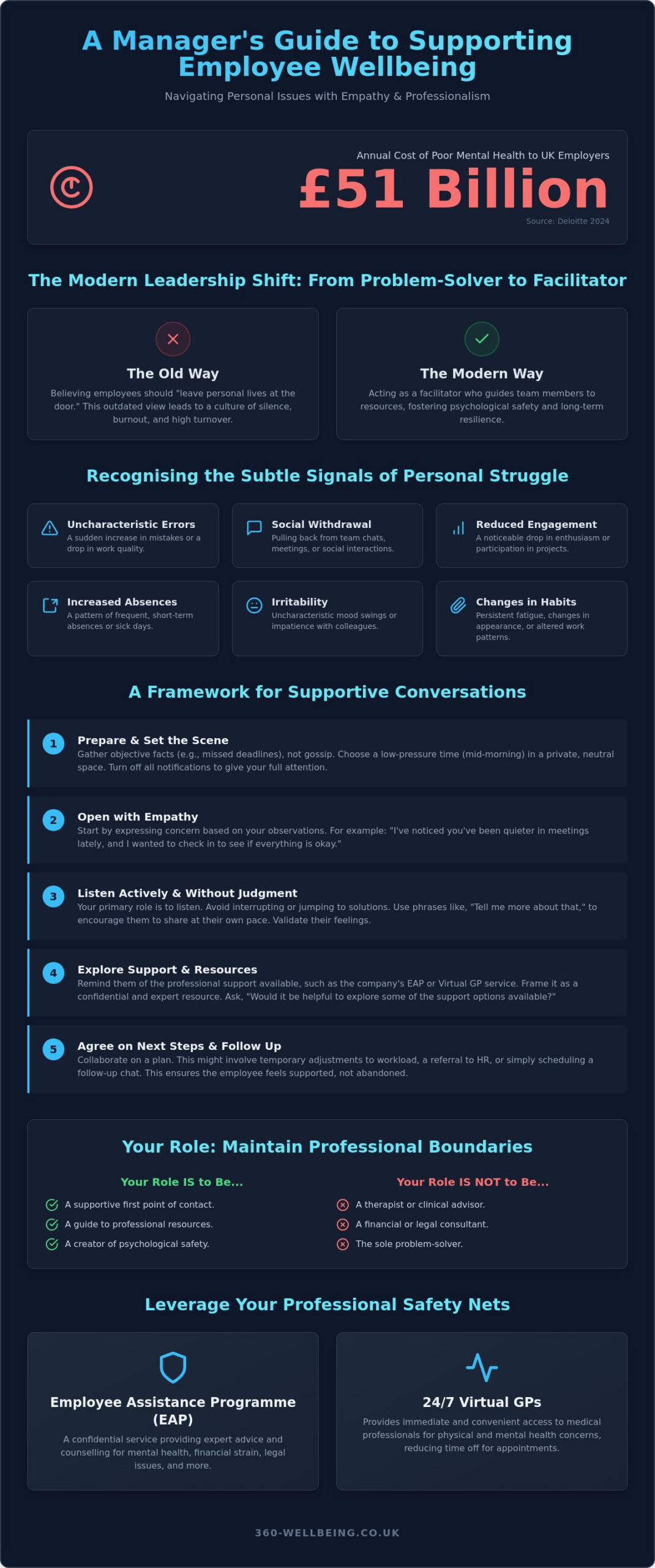
A 5-Step Framework for Supporting Employees with Personal Issues
Navigating the actual conversation requires a structured yet flexible approach. When you are learning how to support an employee with personal issues, having a repeatable framework reduces the anxiety of saying the wrong thing. This five-step process ensures you remain a supportive facilitator while upholding professional standards. It moves the conversation from a place of uncertainty to a clear, actionable path forward.
- Step 1: The Empathetic Opening. Use the objective observations you gathered during your preparation. Focus on changes in work patterns or engagement rather than making assumptions about their character or home life.
- Step 2: The Listening Phase. This is the most critical stage. Step back and allow the employee to lead the narrative. Active listening means being fully present without formulating your next response while they are still speaking.
- Step 3: The Validation Phase. Acknowledge the difficulty of their situation without over-identifying. You don’t need to have experienced the same issue to recognise that it is challenging for them.
- Step 4: The Resource Referral. This is your pivot to professional care. Connect them with established systems such as your Employee Assistance Programme (EAP), Mental Health Support, or Financial Support & Debt Advice.
- Step 5: The Collaborative Follow-up. End the meeting with a clear plan. Agree on a specific time to check in again to see how the support is working and if any temporary work adjustments are needed.
Leading with Empathy: Effective Opening Phrases
“I’ve noticed you’ve seemed less like yourself in our team sessions lately, and I wanted to check in” is far more effective than asking “Why are you so distracted?”. This reduces defensiveness and opens the door for honest dialogue. If they respond with “I’m fine,” don’t push immediately; instead, reiterate that your door is always open if things change. You can pivot from a work topic to a personal check-in by saying, “Before we wrap up the project update, I’d like to see how you are doing personally.”
The Power of Active Listening and Silence
Managers often rush to “fix” things because they feel responsible for the team’s output. However, your role is to listen rather than solve. Silence isn’t empty; it’s space. Use the “Three-Second Rule”: when an employee stops talking, count to three in your head before responding. This brief pause often encourages them to elaborate on a point they might have otherwise held back. Summarising their concerns at the end ensures they feel truly understood and confirms that you’ve captured the facts correctly. This methodical approach builds the durability of the relationship and ensures the employee feels valued as a person, not just a resource.
Navigating Sensitive Disclosures: Mental Health and Financial Stress
When an employee reveals a mental health struggle or a significant financial crisis, your immediate reaction sets the stage for their recovery. You don’t need to be a clinician to be effective. Your goal is to stay calm, supportive, and methodical. If the disclosure triggers an emotional reaction, such as tears or anger, maintain your professional composure. Offer a short break, a glass of water, or simply a moment of silence. This demonstrates respect for their humanity without allowing the conversation to spiral into an unmanaged crisis. Knowing how to support an employee with personal issues means being the steady anchor they need when their own situation feels chaotic.
Addressing the “Hidden” Drivers: Debt and Health
Performance dips are often symptoms of underlying challenges that aren’t immediately visible. Chronic physical pain or the symptoms of menopause can manifest as poor concentration, irritability, or uncharacteristic errors. Financial stress is another massive driver of workplace absence. Data from HRZone in early 2026 indicated that nearly half of UK adults were considered financially vulnerable, with financial stress contributing to 19% of all sick leave. When an individual’s cognitive bandwidth is consumed by debt, their ability to focus on complex tasks diminishes. Providing access to Financial Support for Employees helps remove these invisible barriers, allowing them to regain their professional focus.
When Personal Issues Require Workplace Adjustments
Under the Equality Act, you may have a legal obligation to provide reasonable adjustments if an employee’s personal issue stems from a long-term health condition or disability. These adjustments don’t always have to be permanent or expensive. Temporary changes can make a profound difference to someone’s ability to stay in work. Consider these options:
- Flexible hours: Allowing for later start times or mid-day appointments.
- Workload redistribution: Temporarily moving high-pressure deadlines to other team members.
- Quiet spaces: Providing a dedicated area for those needing a sensory break or a private place to take a call.
Balancing these individual needs with the requirements of the wider team is a delicate but necessary task. While adjustments support the individual, you must also consider the impact on collective morale. Integrating professional Life Coaching can be an effective way to help employees navigate major life transitions, ensuring they have the tools to return to full capacity. If you’re looking to strengthen your team’s durability, exploring our comprehensive Mental Health Support services can provide the expert infrastructure your managers need to handle these sensitive moments with confidence.
Integrating Proactive Support: The Role of EAPs and Virtual GPs
The most successful managers in 2026 recognise that they don’t have to carry the emotional weight of their team’s personal struggles alone. While you provide the initial empathetic response, professional infrastructure acts as your essential safety net. An Employee Assistance Programme (EAP) is designed to take the pressure off leadership by providing expert intervention for complex issues. This doesn’t just benefit the individual; it protects your own mental health and allows you to remain focused on your primary role. Statistics from 2023 indicate that for every £1 invested in an EAP in the UK, the average return on investment is £10.85, largely due to reduced absenteeism and improved focus.
Integrating tools like a 24/7 Virtual GP can be a game-changer for resolving health-related anxieties before they escalate. When an employee is worried about a physical symptom or a family member’s health, that distraction bleeds into their professional output. Providing immediate access to clinical advice ensures they feel supported and can return to a state of focus much faster than if they were waiting days for a traditional appointment. When you understand how to support an employee with personal issues, you see that these digital health tools are performance-recovery assets rather than just “perks.”
Normalising Professional Support
The way you introduce these services is vital. You should suggest a Virtual GP consultation or EAP support without sounding like you are making a diagnosis. Try positioning it as a confidential benefit that the company has already paid for to help them navigate life’s hurdles. You might say, “We have a service that provides 24/7 access to a GP, which many of the team find helpful for getting quick answers to health worries.” This frames the support as a professional entitlement. Because these services are available around the clock, they significantly reduce stress-related absenteeism by allowing staff to seek help outside of core working hours.
Building a Long-Term Wellbeing Infrastructure
Moving from crisis management to a culture of continuous care is both more compassionate and more cost-effective. A holistic platform that combines Mental Health Support, Physiotherapy, and Financial Support & Debt Advice creates a durable environment where issues are caught early. Using 360 Rewards or debt guidance can alleviate the daily stressors that lead to long-term burnout. By providing a unified narrative of wellness, you ensure that every team member feels valued for their total contribution. Discover how 360 Wellbeing’s platform empowers managers to support their staff effectively, providing a scientifically grounded path to workplace harmony. Mastering how to support an employee with personal issues becomes much simpler when you have a modern, forward-thinking partner looking out for your team’s long-term interests.
Building a Resilient Future for Your Team
The transition from a traditional supervisor to a holistic facilitator is one of the most significant shifts in modern management. By applying a methodical framework and maintaining clear professional boundaries, you ensure that your support is both sustainable for you and effective for your staff. You’ve learned that understanding how to support an employee with personal issues isn’t about having all the answers; it’s about being the knowledgeable partner who provides a safe path toward professional resolution.
True workplace harmony is built on a foundation of proactive care rather than reactive crisis management. When you integrate comprehensive resources, you move beyond temporary fixes and toward a culture of long-term durability. We are here to help you bridge that gap by providing the expert systems your business needs to thrive and maintain its vital momentum.
Explore how our wellbeing platform supports your team with 24/7 UK-registered Virtual GP access, integrated Mental Health Support and Life Coaching, and comprehensive Financial and Legal Support for your entire staff. Investing in your team’s total wellness is the most powerful way to secure their future and yours.
Frequently Asked Questions
What is the best way to start a conversation about personal issues?
The most effective way to start is by using specific, non-judgmental observations about an employee’s work patterns or engagement levels. You might say, “I’ve noticed you’ve seemed a bit quieter in our team meetings lately, and I wanted to check in to see how you are doing.” This shifts the focus from a performance critique to a genuine wellbeing inquiry. It’s vital to hold this conversation in a private, neutral space where the individual feels safe.
Can I ask an employee about their mental health directly?
You can ask an employee how they are feeling, but you should avoid attempting to diagnose specific conditions. Instead, ask open-ended questions like, “How has your mental health been lately?” or “Is there anything outside of work that is impacting your ability to focus?” This allows the employee to lead the disclosure. If they do share a concern, your role is to listen empathetically and offer professional resources rather than providing clinical advice.
How do I maintain professional boundaries when an employee is in crisis?
Maintaining boundaries requires you to act as a facilitator rather than a problem-solver or therapist. While you should offer a calm and steady presence, you must avoid getting drawn into the intimate details of the crisis or offering personal life advice. Clearly define what workplace support you can provide, such as temporary workload adjustments, and then bridge the gap to professional services. This ensures the employee receives expert care while you protect your own professional objectivity.
What should I do if an employee refuses professional support?
You cannot force an employee to use professional support services, as engagement must be voluntary for it to be effective. If they refuse, you should respect their decision while reiterating that the resources remain available if they change their mind. Continue to monitor their performance and wellbeing objectively. If their personal issues continue to impact their work, you must address the performance gap through standard professional channels while keeping the door open for future support.
Is an employee entitled to time off for personal issues?
In the UK, employees have specific statutory rights depending on the nature of the issue. As of April 2026, the three-day waiting period for Statutory Sick Pay (SSP) has been abolished, meaning employees are entitled to pay from the first day of a health-related absence. For family emergencies, employees are entitled to “reasonable” unpaid time off to deal with unexpected situations involving a dependant. You should check your specific company policy regarding discretionary paid leave for other circumstances.
How can an Employee Assistance Programme (EAP) help my team?
An EAP provides your team with confidential, 24/7 access to experts who can handle a wide range of challenges, from mental health support to financial and legal guidance. It acts as a professional safety net that reduces the pressure on managers to be all-knowing caregivers. By offering immediate intervention, an EAP helps reduce stress-related absenteeism and improves overall morale. It’s a cost-effective way to ensure your staff have the tools to resolve personal struggles effectively.
What are “reasonable adjustments” for mental health at work?
Under the Equality Act, reasonable adjustments are changes to a job or working environment that help an employee with a disability or long-term health condition perform their role. For mental health, this might include flexible start and finish times, a redistribution of high-pressure tasks, or providing a quiet workspace. These changes are often temporary and aimed at helping the individual maintain their productivity. Knowing how to support an employee with personal issues often involves collaborating on these practical adjustments.
How do I handle personal issues with a remote or hybrid employee?
Supporting remote employees requires a more intentional approach to communication since you lack physical cues. Look for changes in digital behaviour, such as a sudden drop in camera use during calls or a shift in the tone of their written messages. Schedule a dedicated video call for a wellbeing check-in rather than tacking it onto a project update. This ensures the employee feels seen and valued, even when they aren’t physically present in the office environment.