
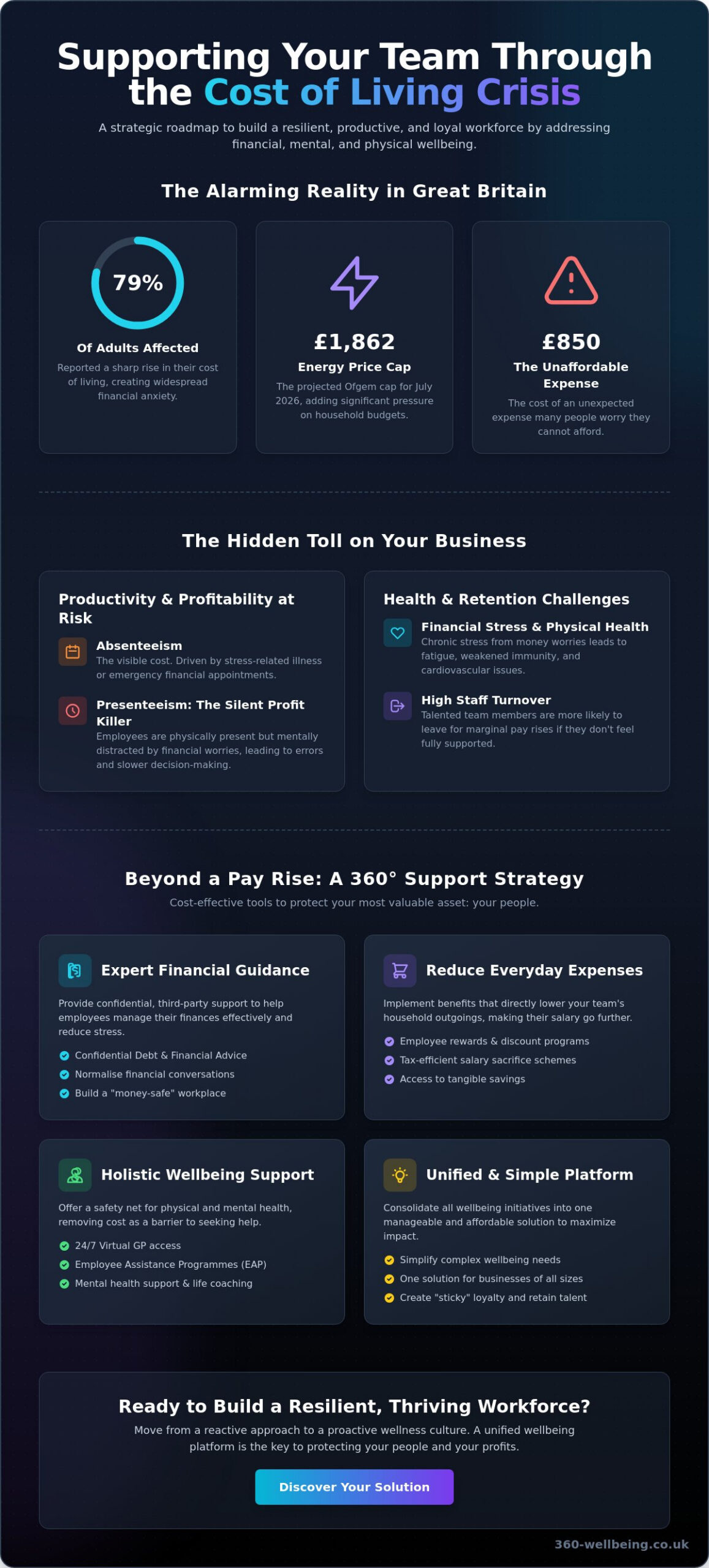
Did you know that 79% of adults in Great Britain reported a sharp rise in their cost of living this past April? With the Ofgem energy price cap set to climb to £1,862 in July 2026, your team is likely feeling the weight of a “new” crisis that hasn’t quite let up since the start of the decade. You’ve probably noticed the signs: a dip in focus during the afternoon or perhaps a talented team member leaving for a slightly higher salary elsewhere. Learning how to support employees through cost of living crisis challenges is no longer just a HR checkbox; it’s a vital strategy for protecting your business’s most valuable asset.
We understand the dilemma you’re facing. You want to do right by your people, but with the Bank of England base rate holding at 3.75%, your own operational margins are tighter than ever. This guide promises to show you how to build a resilient workforce using practical, cost-effective tools that go far beyond a standard pay review. We’ll explore a 360-degree approach that integrates financial guidance, mental health support, and tangible savings to reduce your team’s outgoings. By the end, you’ll have a clear roadmap to foster a culture of vitality and workplace harmony that keeps your best talent exactly where they belong.
Key Takeaways
- Recognize the link between financial anxiety and workplace productivity to better protect your business from the hidden costs of absenteeism.
- Discover how to support employees through cost of living crisis pressures using cost-effective tools like salary sacrifice schemes and expert financial guidance.
- Learn how to lower everyday household expenses for your staff through rewards programs and virtual GP services that remove the financial burden of healthcare.
- Move toward a proactive wellness culture by integrating mental health support and life coaching into a single, supportive narrative of care.
- See how a unified platform can simplify complex wellbeing needs into one manageable and affordable solution for businesses of all sizes.
Understanding the Impact of the Cost of Living Crisis on Workplace Productivity
The 2026 economic environment isn’t a brief storm to weather; it’s a permanent shift in how households manage their resources. As the energy price cap rises to £1,862 this summer, the ripple effects extend far beyond the kitchen table and straight into your office or shop floor. Understanding the Impact of the Cost of Living Crisis requires looking past the headline inflation rates to the human cost of financial anxiety. When people are worried about an unexpected £850 expense they can’t afford, their focus isn’t on your quarterly targets. This is where learning how to support employees through cost of living crisis pressures becomes a strategic necessity for any business aiming for durability.
Absenteeism is the visible tip of the iceberg, often driven by stress-related illness or the need to handle emergency financial appointments. However, ‘presenteeism’ is the silent profit killer. It’s the cost of a team member being physically present but mentally miles away, calculating debt repayments or worrying about grocery prices. This mental distraction erodes the bottom line by slowing down decision-making and increasing the likelihood of errors. You might notice subtle signs like a change in temperament, increased fatigue, or a sudden reluctance to join social events. These aren’t just personal quirks; they’re often red flags of a person reaching their financial limit.
The Link Between Financial Stress and Physical Health
Money worries aren’t just “in the head.” They trigger a biological cascade, keeping the body in a state of high alert that floods the system with cortisol. Over time, this leads to chronic fatigue, weakened immune systems, and cardiovascular issues. In 2026, we see a worrying trend where employees skip routine health check-ups or dental appointments to save money. This creates a ticking time bomb for employers. Providing rapid access to a 24/7 Virtual GP or an Employee Assistance Programme (EAP) acts as a vital safety net. It ensures that a minor health concern doesn’t escalate into long-term sick leave because someone was too worried about the cost of travel or time off to see a doctor.
Retention Challenges in a High-Inflation Economy
Replacing a skilled staff member in today’s market is a heavy investment, often costing significant amounts in recruitment fees, training, and lost productivity. While salary increases are the most obvious lever, they aren’t always sustainable for every business. A robust benefits package that includes life coaching, financial support, and debt advice creates a sense of “sticky” loyalty. It shows you’re a partner in their long-term success, not just a source of a paycheck. Employees are less likely to jump ship for a marginal pay rise if they feel their current employer genuinely cares for their total wellness. Discovering how to support employees through cost of living crisis periods by offering holistic care is often more effective than a one-off bonus. In 2026, employee wellbeing has moved from a “nice-to-have” benefit to a core business KPI that determines long-term stability and growth.
Practical Financial Support Strategies Beyond Salary Increases
For many small and medium sized businesses, matching every inflationary spike with a direct pay rise is a mathematical impossibility. While the National Living Wage rose to £12.71 in April 2026, the cumulative pressure of several years of high costs means many households still feel vulnerable. Providing meaningful relief doesn’t always require a larger payroll budget. Instead, it involves looking at the structures of how your team receives and manages their money. Creating a “money-safe” workplace culture where financial stress is discussed without stigma is the first step. When you normalise these conversations, you move from being just an employer to a proactive partner in your team’s financial durability. Learning how to support employees through cost of living crisis challenges starts with identifying where their money is leaking and helping them plug those gaps.
Access to Professional Debt and Financial Advice
Personal finance is a deeply private matter. Most employees won’t feel comfortable discussing their credit card balances or tenancy disputes with a manager. This is why confidential, third-party support is far more effective than in-house guidance. By providing professional Financial Support & Debt Advice as a standard benefit, you give your team a safe space to tackle the root causes of their anxiety. This is particularly vital given that 21% of UK adults reported borrowing more money or using more credit than usual this spring. Beyond debt, offering Legal Support for consumer or housing issues and Complimentary Will Writing provides a sense of long-term security. These services act as a “financial shield,” protecting your staff from the high costs of private legal fees while offering the peace of mind that their families are protected. A comprehensive Employee Assistance Programme can bridge this gap by providing these specialized services through a single, confidential portal.
Salary Sacrifice and Tax-Efficient Benefits
Salary sacrifice remains one of the most effective ways to increase take-home value for both you and your employees. In the 2026/27 tax year, the main rate of Employee National Insurance is 8% for most earners. When an employee sacrifices a portion of their gross salary for a non-cash benefit, they don’t pay tax or NI on that amount, and you save on Employer NI contributions. Popular schemes in 2026 include:
- Technology and EV Charging: Helping staff upgrade to energy-efficient appliances or manage the costs of commuting.
- Cycle-to-Work: Reducing transport costs while promoting physical health.
- Pension Contributions: Boosting long-term resilience through increased employer matching.
It’s vital to ensure these schemes are implemented with care. You must always check that a salary sacrifice doesn’t take an employee’s hourly rate below the National Living Wage of £12.71. When managed correctly, these strategies provide tangible, monthly savings that help your team navigate the £1,862 energy price cap and rising food costs without placing an unsustainable burden on your business’s cash flow.
Leveraging Employee Benefits to Reduce Everyday Household Costs
While structural financial strategies provide long-term stability, your team feels the immediate pressure of the cost of living crisis every time they tap their card at a supermarket checkout. In April 2026, 92% of UK adults cited rising food prices as a primary concern. When we consider how to support employees through cost of living crisis challenges, we must look at the micro-transactions that drain a household budget. By integrating benefits that reduce these daily outgoings, you provide a form of “shadow salary” that increases an employee’s disposable income without inflating your payroll tax liabilities. These lifestyle perks aren’t just extras; they’re essential tools for maintaining a household’s financial durability.
The Power of a Reward and Discount Marketplace
A well-structured rewards platform acts as a continuous financial boost. By offering thousands of discounts on high-street brands and essential retailers, you help your team stretch their pounds further on everything from the weekly shop to school uniforms. For a basic rate taxpayer, an annual saving of £500 through a platform like 360 Rewards is roughly equivalent to a £750 gross salary increase. This tangible impact on their bank balance fosters a deep sense of partnership and appreciation. Beyond simple discounts, cashback schemes provide a direct psychological win. Seeing a small percentage of every purchase return to their digital wallet creates a proactive and positive vision of money management, turning a stressful chore into a manageable task.
Virtual GP Services as a Cost-Saving Tool
The “hidden costs” of healthcare are often overlooked in corporate wellness strategies. In 2026, taking half a day of unpaid leave to attend a daytime GP appointment isn’t just an inconvenience; it’s a financial hit that many can’t afford. This often leads to people “powering through” illness, which eventually results in longer, more expensive absences. Providing 24/7 Virtual GP access is a vital financial benefit because it removes the friction of travel costs and lost wages. It’s particularly empowering for parents and carers who may need clinical reassurance at 10:00 PM without the stress of an A&E visit. This rapid access ensures that minor health concerns are addressed before they escalate, protecting both the individual’s vitality and the company’s productivity. When you understand how to support employees through cost of living crisis conditions, you see that time saved is literally money saved for your staff. Subsidising the commute through season ticket loans or offering flexible working to reduce petrol costs further rounds out this panoramic approach to household savings.
Implementing a Holistic Wellbeing Strategy for 2026
A truly effective strategy in 2026 moves away from reactive, one-off perks toward a proactive culture where every aspect of a person’s health is considered a professional priority. It isn’t enough to offer a list of phone numbers and hope for the best. Instead, you need a system that anticipates challenges before they become crises. This panoramic approach ensures that your team feels supported not just as workers, but as individuals with complex lives. When you consider how to support employees through cost of living crisis conditions, the goal is to create a sense of durability and foresight that salary alone cannot provide. Communication is the heartbeat of this strategy; if your team doesn’t know the support exists, the benefit doesn’t exist.
Mental Health and the Financial Crisis
Financial stress and mental health are inextricably linked. When someone is struggling to meet the July 2026 energy price cap of £1,862, their cognitive load is exhausted, leaving little room for workplace creativity. This is why financial support must be paired with Mental Health Support sessions. An Employee Assistance Programme (EAP) provides a vital 24/7 safety net, offering immediate clinical expertise when anxiety peaks. However, the EAP is only half the battle. You must also train your managers to spot the subtle signs of financial fatigue, such as uncharacteristic irritability or a drop in engagement. By fostering an environment where seeking help is seen as a proactive step toward vitality, you reduce the stigma that often keeps people suffering in silence. To build a more resilient workforce, you can explore our comprehensive Mental Health Support services today.
Building Long-Term Resilience with Life Coaching
Resilience isn’t just about surviving a crisis; it’s about having the tools to move forward. Life Coaching plays a pivotal role here, helping staff navigate their career progression and set personal goals that feel achievable despite economic headwinds. This forward-thinking support empowers employees to take control of their narrative, turning a period of scarcity into an opportunity for growth. A holistic strategy also recognizes that physical health is a foundational requirement for mental clarity. Integrating services like Physiotherapy or nutritional guidance helps reduce the overall physical stress that money worries often manifest. This creates a unified narrative of total wellness that includes:
- Social Wellness: Encouraging community and peer support within the team.
- Legal Wellness: Providing Legal Support to handle the administrative burdens of life.
- Physical Durability: Ensuring rapid access to clinical care to prevent minor aches from becoming chronic limitations.
Finally, you must measure the ROI of these initiatives. Use engagement data and feedback loops to see which services your team values most. In 2026, the most successful businesses are those that treat wellbeing as an essential human entitlement and a core business KPI, ensuring their strategy remains as adaptable as the people it protects.
How 360 Wellbeing Simplifies Employee Support in a Crisis
Managing a disparate collection of benefit providers is often as stressful for the employer as the crisis itself is for the staff. 360 Wellbeing offers a unified solution that bridges the gap between physical health, mental resilience, and financial durability. By consolidating your support systems into a single, accessible platform, you reduce the administrative burden on your HR team while providing a seamless experience for your employees. Understanding how to support employees through cost of living crisis challenges becomes significantly simpler when every tool they need is just a few clicks away. Our affordable per-employee subscriptions are specifically designed for SMEs and sole traders, ensuring that high-level corporate wellness isn’t just a luxury for the few, but a standard entitlement for every team member.
A Comprehensive Financial and Health Safety Net
A panoramic safety net must address the specific stressors of 2026 with precision and empathy. Our platform provides direct access to Financial Support & Debt Advice and Legal Support, helping employees manage the complexities of tenancy agreements or consumer disputes that often arise during economic instability. We’ve also integrated Complimentary Will Writing to offer that vital sense of long-term security for families. The 24/7 Virtual GP service remains a cornerstone of this approach, providing clinical reassurance and prescriptions without the need for travel or unpaid time off. This rapid access is a professional necessity that keeps your team healthy and focused. For a deeper dive into these strategies, you can explore our financial support pillar, which serves as a detailed resource for UK businesses navigating these complex waters.
Getting Started with 360 Wellbeing
Onboarding your team shouldn’t be a hurdle. We provide dedicated support for corporate memberships, ensuring your staff can start benefiting from the 360 Rewards marketplace and Mental Health Support immediately. Choosing an all-in-one platform is far more cost-effective than managing multiple standalone services, which often lead to fragmented care and wasted budgets. By taking a proactive approach today, you aren’t just reacting to a temporary economic dip; you’re building a culture of workplace harmony and vitality. This unified narrative of wellness ensures that your business remains a place where people feel valued, secure, and empowered to do their best work. It’s about moving toward a future where every employee has the tools to thrive, regardless of the economic climate outside your office doors.
Building a Resilient Future for Your Workforce
Navigating the economic landscape of 2026 requires more than just reactive measures; it demands a commitment to long-term durability and foresight. By learning how to support employees through cost of living crisis challenges, you aren’t just protecting your payroll. You’re fostering a culture of workplace harmony where every team member feels seen and valued as an individual. We’ve explored how integrating tax-efficient salary sacrifice schemes and proactive health tools can bridge the gap that salary alone cannot fill. From reducing the “hidden costs” of healthcare to providing a safe space for debt and legal advice, your strategy should be as multifaceted as the lives of your people.
A unified approach ensures that no one falls through the cracks when financial or mental fatigue sets in. With 24/7 UK-registered Virtual GP access, holistic mental health support, and thousands of high-street savings through 360 Rewards, you can provide the panoramic care your team deserves. Protect your team and your business with 360 Wellbeing’s all-in-one platform today. Investing in your team’s total wellness is the most effective way to ensure your business remains strong, healthy, and ready for whatever the future holds. Together, we can build a proactive vision of vitality that lasts.
Frequently Asked Questions
How can employers help staff with the cost of living without raising salaries?
Employers can provide significant relief through tax-efficient salary sacrifice schemes for technology, cycle-to-work programs, or increased pension contributions. These schemes reduce National Insurance contributions for both the business and the employee, effectively increasing monthly take-home pay. Additionally, offering professional debt advice and rewards platforms helps team members manage their existing income more effectively. This proactive approach shows you’re a partner in their financial durability without placing an unsustainable burden on your company’s payroll budget.
What are the best employee benefits for reducing household costs?
Discount marketplaces that offer cashback and high-street savings on groceries are among the most impactful benefits for immediate relief. With 92% of UK adults concerned about food prices in 2026, these platforms provide a tangible monthly boost to disposable income. Virtual GP services also reduce household costs by eliminating the need for travel or taking unpaid time off for daytime appointments. This ensures that health remains a professional necessity rather than a financial burden for your team.
Is a virtual GP service a taxable benefit for UK employees?
Most virtual GP services are considered a Benefit in Kind (BIK), meaning they may be subject to tax based on their calculated value. However, the cost per employee is typically low, so the tax impact is often minimal compared to the significant value of 24/7 clinical access. It’s best to consult with your payroll provider or check the latest HMRC 2026/27 guidelines to understand how these benefits fit into your specific tax reporting and P11D requirements.
How does financial stress affect employee productivity and absenteeism?
Financial anxiety creates a heavy cognitive load that leads to “presenteeism,” where employees are physically at work but mentally distracted by debt or rising bills. This mental exhaustion slows down decision-making and increases the likelihood of errors. Physically, chronic stress triggers cortisol release, which can lead to long-term illness and increased absenteeism. Learning how to support employees through cost of living crisis pressures is essential because a distracted workforce directly erodes your company’s bottom line and operational efficiency.
Can a small business afford an employee wellbeing platform?
Yes, modern wellbeing platforms are highly accessible for small businesses and sole traders through affordable per-employee subscription models. These platforms consolidate multiple services like mental health support, physiotherapy, and rewards into one manageable monthly cost. The return on investment is often seen in reduced staff turnover and lower absenteeism rates. By choosing a unified solution, you avoid the high costs of managing multiple standalone services while providing a panoramic level of care for your team.
What is the difference between an EAP and a full wellbeing platform?
An Employee Assistance Programme (EAP) typically focuses on reactive crisis support, such as short-term counselling or emergency helplines. In contrast, a full wellbeing platform like 360 Wellbeing offers a proactive and all-encompassing vision of health. This includes daily lifestyle rewards, virtual GP access, and life coaching alongside traditional EAP services. While an EAP is a vital safety net, a full platform integrates physical, mental, and social health into a single, unified narrative of total wellness.
How do I communicate new benefits to staff so they actually use them?
Effective communication starts with normalising the conversation around financial and mental health to remove any existing stigma. Use multiple channels like team meetings, internal newsletters, and digital portals to explain exactly how to support employees through cost of living crisis tools. Training your managers to act as “wellbeing ambassadors” is also crucial. When leaders openly discuss and use the benefits themselves, it creates a sense of safety and encourages the wider team to engage with the support.
What legal support should I offer my employees during a financial crisis?
Providing access to legal support for tenancy disputes, debt management, and consumer rights is incredibly valuable during periods of economic instability. These issues often cause significant hidden stress that spills over into the workplace. Offering complimentary will writing also provides employees with long-term peace of mind regarding their family’s security. By including legal and financial guidance as a standard benefit, you help your team navigate complex life challenges with clinical expertise and a warm, human touch.