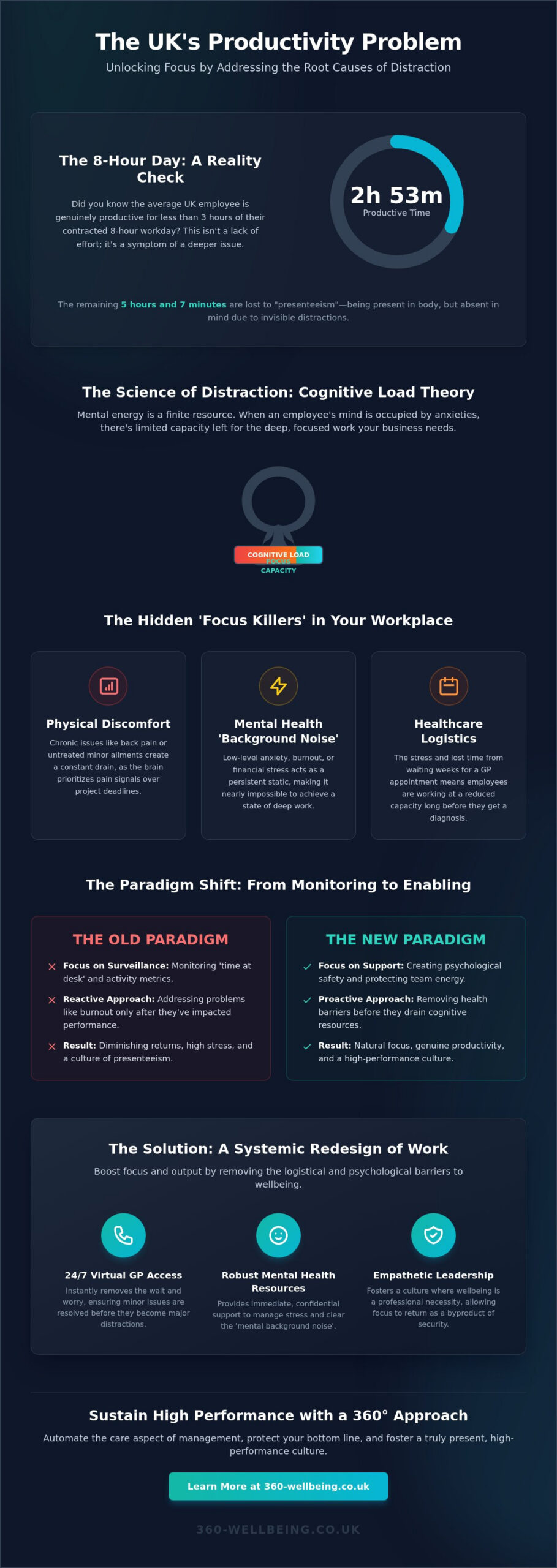
Did you know that the average UK employee is productive for only 2 hours and 53 minutes of an 8-hour day? It’s a sobering statistic for any leader, especially when you’re already navigating the modern challenges of “quiet quitting” and rising absenteeism. You’ve likely felt the frustration of seeing a talented team present in body but absent in spirit, struggling to maintain momentum amidst a sea of invisible distractions. We understand that you want more than just a busy office; you want a vibrant, high-performing culture where everyone feels empowered to do their best work.
The secret to improving employee focus and productivity in 2026 isn’t found in stricter monitoring or longer hours. Instead, it lies in a systemic redesign of work that prioritises psychological safety and holistic health. When you remove the underlying anxieties related to health and wellbeing, focus returns naturally as a byproduct of personal security. This guide will show you how to transform workplace output by addressing these root causes through all-encompassing support. We’ll explore practical strategies, from providing 24/7 Virtual GP access to offering robust mental health resources, that create a resilient, dedicated, and truly present workforce.
Key Takeaways
- Understand how “Cognitive Load Theory” explains the way health anxieties drain your team’s mental energy and block high-value work.
- Uncover the hidden “focus killers” in your office, from chronic physical discomfort to the subtle background noise of mental health struggles.
- Move beyond micromanagement by adopting an empathetic leadership style that treats wellbeing as a professional necessity rather than a luxury.
- Explore a practical roadmap for improving employee focus and productivity by removing the logistical barriers to essential healthcare and support.
- Learn how a 360 Wellbeing platform can automate the care aspect of management, protecting your bottom line while fostering a high-performance culture.
The Science of Focus: Why Employee Productivity Starts with Wellbeing
True employee focus is more than just a lack of distraction. It’s the cognitive ability to maintain attention on high-value tasks that drive your business forward. To understand The Science of Focus, we have to look at how the human brain processes information. When we discuss improving employee focus and productivity, we must acknowledge that mental energy is a finite resource. If a team member is preoccupied with a health concern or feeling the weight of burnout, their ‘cognitive load’ is already nearing capacity. Cognitive Load Theory suggests that our brains can only process a certain amount of information at once. When health worries or physical discomfort take up mental space, there’s little room left for the deep work your projects require.
We often mistake activity for productivity. An employee might respond to fifty emails in an hour, but if those tasks don’t move the needle on your strategic goals, it’s merely ‘busy work.’ Genuine productivity is about delivering value, not just filling time. In 2026, the hidden cost of presenteeism remains a primary driver of lost UK GDP, as staff who are physically present but mentally disengaged cannot contribute effectively to the 2.1% annual growth in output per hour recorded in the first quarter.
The Cost of the ‘Distracted Employee’ in the UK
Presenteeism, where staff are at work but not fully functioning, often costs UK businesses more than total absenteeism. While a sick day is visible and measurable, mental fog from untreated minor illnesses or stress is a silent drain on your resources. This fog slows down project timelines and creates a frustrating ripple effect across departments. When one person is distracted, it disrupts the collective momentum. Other team members may have to pick up the slack or find their own work delayed while waiting for inputs. This doesn’t just affect the bottom line; it erodes the morale of your highest performers who feel the extra weight of a fragmented team.
Focus as a Finite Resource
Focus isn’t a tap you can simply turn on harder. Pushing for longer hours or more intense monitoring usually leads to diminishing returns and eventual burnout. As a leader, your role is shifting toward being an ‘Expert Caregiver’ who protects the team’s energy. This means moving away from a surveillance culture that focuses on ‘time at desk’ and toward a support culture. By addressing health concerns early and proactively, you ensure that when your people are at their desks, they have the cognitive space to be truly productive. It’s about creating an environment where wellbeing is viewed as a professional necessity, allowing focus to return as a natural byproduct of feeling secure and supported.
Identifying the Hidden ‘Focus Killers’ in Your Workplace
While many leaders look at time management software or office layouts to boost output, the most significant barriers are often invisible. Improving employee focus and productivity requires us to look beneath the surface at the physiological and psychological burdens your team carries. These “focus killers” act as a cognitive tax, siphoning off mental energy before a single task is even started. When an employee is struggling with a persistent health issue or financial worry, their capacity for deep work is fundamentally compromised.
Physical discomfort is a primary culprit. Chronic conditions like back pain or sciatica aren’t just physical inconveniences; they are constant signals to the brain that demand attention. It’s nearly impossible to maintain cognitive flow when your body is in distress. Similarly, mental health “background noise,” such as low level anxiety or persistent low mood, acts as a steady distraction. This isn’t always about a major crisis. It’s often the quiet, daily struggle to stay motivated while feeling mentally overextended. We believe that addressing these issues isn’t just a “perk” but a core component of a durable business strategy.
The Impact of Physical Health on Mental Clarity
The link between physical wellbeing and sharp thinking is undeniable. When an employee has to wait weeks for a standard GP appointment, they aren’t just “waiting”; they’re working at a reduced capacity for that entire duration. Minor ailments that go untreated can lead to significant focus lapses, as the body prioritises pain signals over project deadlines. This proactive approach ensures that minor physical issues don’t snowball into long term productivity drains. Consider how these common ailments disrupt the flow of work:
- Musculoskeletal pain: Back and neck issues from poor ergonomics or remote setups.
- Repetitive strain: Minor injuries that make typing or mouse use painful and slow.
- Sleep disruption: Physical discomfort often leads to poor rest, further depleting cognitive reserves.
Immediate access to clinical expertise is vital for modern teams. Digital health solutions, such as a 24/7 Virtual GP or direct access to Physiotherapy, allow staff to address concerns the moment they arise, keeping their focus where it belongs.
Financial Anxiety: The Silent Productivity Destroyer
Financial stress is perhaps the most pervasive “silent” killer of concentration. In the UK, the weight of debt and cost of living concerns can be overwhelming. Evidence suggests that Productivity Starts with Wellbeing, which encompasses a sense of financial security. When workers spend their mornings worrying about rising bills or credit card debt, they have less cognitive room for innovation and problem solving. By providing Financial Support for Employees, including debt advice and financial planning, you aren’t just helping their bank accounts. You’re freeing their minds to focus on their professional contributions. If you’re looking for ways to safeguard your team’s mental space, our Employee Assistance Programme (EAP) offers a panoramic approach to these complex challenges.
Management vs. Support: Shifting the Productivity Paradigm
The way we lead has a profound impact on cognitive capacity. If your management style relies on constant surveillance, you’re likely creating an environment of performance anxiety rather than one of high performance. Improving employee focus and productivity is less about tracking every minute spent at a desk and more about removing the hurdles that prevent high-value work. We encourage leaders to adopt a panoramic viewpoint, seeing the employee not just as a unit of production, but as a human navigating a complex life cycle. By shifting from a culture of monitoring to one of empowerment, you give your team the mental freedom to engage deeply with their tasks.
Adopting an “Empathetic Expert” approach means leading with health-first policies that prioritise durability over short-term bursts of effort. When employees feel that their wellbeing is a professional necessity rather than a luxury, they are more likely to return that investment with loyalty and focus. This paradigm shift requires us to trust in outcomes rather than activity, ensuring that our management practices support the biological and psychological needs of our people.
The Failure of Micromanagement
Checking in on staff every hour might feel like you’re staying on top of things, but it actually destroys the capacity for “Deep Work.” Every interruption requires a cognitive reset, draining the finite mental energy we discussed earlier. Surveillance software and constant reporting requirements often backfire. They increase stress levels and encourage “performative busyness” where staff prioritise looking busy over delivering genuine value. To build a high-performing team, focus on transparent goal-setting. When people understand exactly what success looks like, they don’t need a manager hovering over them; they need the space to execute.
The Manager as a Wellbeing Facilitator
Managers don’t need to be clinicians, but they should be trained facilitators. This involves learning to spot the physical symptoms of stress, such as increased irritability, withdrawal, or a sudden dip in work quality. Instead of reacting with discipline, a supportive leader points the employee toward professional resources. By equipping your leadership team with a platform that handles the clinical side of care, such as direct access to Mental Health Support or an Employee Assistance Programme (EAP), you allow them to remain focused on coaching. Creating a safe space where employees feel comfortable admitting they are struggling to focus is the first step toward solving the problem. It turns a potential performance issue into a collaborative health journey, ensuring that improving employee focus and productivity remains a shared and attainable goal.
5 Actionable Steps to Boost Collective Concentration and Output
Improving employee focus and productivity isn’t a one-off event. It’s a continuous commitment to removing the friction from your team’s daily lives. By the time an employee sits down to work, they’ve often already navigated a gauntlet of personal stressors. As a leader, your strategy should focus on clearing that path. When you provide the right tools, you aren’t just “managing” people; you’re facilitating their best work. Here are five practical steps to transform your workplace culture into a powerhouse of concentration.
- Step 1: Implement “Frictionless Health”. With the 2026 abolition of the three-day waiting period for Statutory Sick Pay, keeping your team healthy from day one is a financial imperative. Providing a 24/7 Virtual GP ensures staff can address minor ailments instantly, preventing them from escalating into full blown absences.
- Step 2: Normalise Mental Health Days. Don’t wait for a crisis. Use an Employee Assistance Programme (EAP) to provide immediate Mental Health Support and therapy. When people know help is a click away, they spend less time worrying and more time engaging.
- Step 3: Audit the “Financial Noise”. Personal debt is a major focus killer. Offer Financial Support & Debt Advice along with Legal Support to help employees resolve external stressors that drain their cognitive energy.
- Step 4: Design for Focus. Encourage “No-Meeting” blocks and asynchronous communication. This protects the “Deep Work” capabilities of your team, allowing them to finish high-value tasks without constant interruption.
- Step 5: Reward Holistic Success. Use a platform like 360 Rewards to stretch employee salaries further. A discount marketplace acts as a continuous “thank you” that supports their lifestyle outside of work.
Designing a “Focus-Friendly” Environment
The physical and digital environment must support the mental state you’re trying to cultivate. Flexible working plays a huge role here by reducing “commuting fatigue,” a major drain on early morning focus. You can further support this by offering Life Coaching to help employees align their personal growth with business KPIs. When an individual feels their personal journey is supported, their professional output often rises to match. Implementing “Deep Work” protocols, such as turning off non-essential notifications during set hours, helps the entire organisation respect the value of undivided attention.
Leveraging Benefits to Stretch Household Income
In 2026, the psychological boost of feeling “looked after” by an employer is a powerful motivator. A rewards platform does more than save money; it signals that you value your team’s life beyond the office. This builds a positive workplace culture where staff feel secure and appreciated. When financial pressure is eased through 360 Rewards, the “background noise” of money worries fades, leaving more room for innovation. If you’re ready to build a more resilient team, explore our 360 Wellbeing platform to see how we can support your productivity goals.
Sustaining High Performance with the 360 Wellbeing Platform
Improving employee focus and productivity shouldn’t be a manual task that consumes a manager’s entire week. The 360 Wellbeing platform is designed to automate the care aspect of leadership, providing a seamless bridge between an employee’s needs and professional support. By integrating resources like an Employee Assistance Programme (EAP) and Life Coaching directly into the workflow, you ensure that help is always available without requiring a complex referral process. This panoramic approach allows leaders to focus on strategic growth while knowing their team’s mental and physical health is being proactively managed by experts.
The financial return on this investment is most visible when looking at the ROI of a 24/7 Virtual GP. In 2026, the pressure on traditional healthcare often leads to significant delays in treatment, which can derail a team’s momentum for weeks. When an employee can speak to a clinician from their desk or home in minutes, you save thousands in lost “waiting room” hours. This immediate access prevents minor symptoms from developing into the long-term absences that trigger the new Statutory Sick Pay obligations. It closes the gap between the need for care and the provision of support, keeping your team present and engaged.
The 360 Wellbeing Advantage for SMEs
Small and medium-sized enterprises often struggle to compete with the sprawling benefit packages of multinational corporations. However, a total wellness solution allows you to offer the same high-level support to attract and retain top talent. Onboarding is designed to be effortless, allowing you to set up a comprehensive support system in days rather than months. Providing robust Mental Health Support and Physiotherapy doesn’t just reduce staff turnover; it builds a culture of loyalty. When employees see that their health is a priority, they’re more likely to stay committed to the company’s long-term vision.
Making Wellbeing a Professional Necessity
We believe that health support is no longer a “perk” or a “luxury” for the few. It’s a core business strategy and an essential human entitlement. Shifting this perception within your organisation has a profound impact on your brand reputation and recruitment efforts. In a competitive market, being known as an employer that integrates physical, mental, and social health into a single narrative of wellness is a significant advantage. It signals foresight and a commitment to the durability of your workforce. Discover how 360 Wellbeing can transform your team’s focus today and start building a high-performance culture that lasts.
Building a Resilient and Focused Future
Transforming your workplace output isn’t about implementing stricter controls; it’s about fostering an environment where your team feels secure enough to do their best work. We’ve seen how the invisible burdens of health anxiety and financial stress act as the true “focus killers” in the modern office. By shifting your approach from traditional oversight to proactive support, you unlock the cognitive potential that already exists within your people. Improving employee focus and productivity is a sustainable goal when you have the right partners to help you navigate the complexities of workforce wellbeing.
Our platform is designed specifically for UK SMEs and sole traders, providing a panoramic support system that includes 24/7 UK-registered Virtual GP access alongside expert mental health, legal, and financial advice. This ensures your workforce has a reliable safety net, allowing them to dedicate their full attention to your business’s success. When you prioritise the person, the professional output follows naturally.
Ready to see the difference a health-first strategy can make for your organisation? Book a demo of the 360 Wellbeing platform to boost your team’s productivity. We’re here to help you build a culture of vitality and workplace harmony that stands the test of time.
Frequently Asked Questions
How do I measure employee productivity without micromanaging?
Focus on outcome-based milestones and value delivery rather than tracking hours or activity levels. By setting transparent goals and clear KPIs, you allow your team the autonomy to manage their own time while ensuring the business objectives are met. This approach builds trust and protects the cognitive space required for deep work, which is often destroyed by constant reporting or surveillance software.
Can a wellbeing platform really improve my company’s bottom line?
Yes, by directly reducing the costs associated with presenteeism and absenteeism. Improving employee focus and productivity leads to higher output per hour, which ONS data showed grew by 2.1% in early 2026 for businesses using data-driven HR strategies. When you provide immediate clinical support, you prevent minor health issues from escalating into long-term absences that trigger Statutory Sick Pay from day one.
What are the most common causes of low focus in the UK workplace?
The primary “focus killers” are unaddressed physical pain, mental health “background noise,” and financial anxiety. Chronic conditions like back pain or sciatica often derail concentration, while the cognitive tax of debt can siphons off mental energy. Research indicates that the average UK employee is productive for less than three hours a day, largely due to these invisible distractions that drain their cognitive load.
How does a Virtual GP service benefit a small business?
A Virtual GP service eliminates the need for staff to take half-days off for standard medical appointments. With 24/7 access to UK-registered clinicians, your team can address health concerns before or after work, or even during a short break. This is a vital tool for SMEs to maintain momentum, especially as traditional NHS wait times continue to impact workforce availability in 2026.
Is it my responsibility as an employer to help with staff financial stress?
Modern duty of care standards and the Employment Rights Act 2025 suggest that protecting employees from psychological harm is a professional necessity. Financial stress is a major contributor to workplace anxiety and reduced concentration. Providing access to Financial Support & Debt Advice is a strategic move that removes a significant distraction, allowing your team to focus more effectively on their professional roles.
What is the difference between employee engagement and employee focus?
Engagement refers to an employee’s emotional commitment to the company’s goals, while focus is the biological and cognitive ability to execute high-value tasks. You can have a highly engaged employee who still struggles with productivity because they are physically in pain or mentally overextended. Improving employee focus and productivity requires a holistic approach that supports both the heart and the mind.
How can I introduce a wellbeing platform to a skeptical team?
Lead with empathy and clearly communicate that the platform is a benefit designed for their support, not a tool for management surveillance. Emphasise the total confidentiality of services like the EAP and Mental Health Support. When staff understand that they have 24/7 access to a GP and rewards that stretch their household income, they’ll view the platform as a valuable entitlement rather than an obligation.
What should I do if an employee’s focus is slipping due to mental health?
Act as a facilitator rather than a disciplinarian by pointing them toward professional clinical resources. Use your platform to provide immediate access to Mental Health Support or Life Coaching, allowing experts to handle the clinical side of the journey. This proactive approach shows you’re invested in their long-term success and helps restore their focus much faster than traditional performance management routes.