
What if the biggest threat to your business in 2026 isn’t competition or rising costs, but the quiet erosion happening inside your own team? Burnout, disengagement, and persistent absenteeism are costing UK employers billions each year, and many organisations are still responding with outdated, piecemeal solutions that barely scratch the surface.
If you’re searching for practical answers on how to improve employee wellbeing without wasting budget on benefits your team never actually uses, you’re not alone. Most employers know something needs to change; they just aren’t sure where to start or which investments will genuinely move the needle.
The truth is, wellbeing isn’t a single problem with a single fix. It’s a connected ecosystem of physical health, mental resilience, financial security, and social support, and when one pillar weakens, the others follow. This guide is built around that panoramic view. Inside, you’ll find a clear, practical framework covering the most effective strategies for 2026, from virtual healthcare and mental health support to financial wellbeing and the benefits that genuinely drive retention, so you can build a workplace where your people don’t just cope, they thrive.
Key Takeaways
- Employee wellbeing in 2026 is a strategic business necessity, not a perk — organisations that treat it as optional are quietly haemorrhaging productivity, talent, and revenue.
- Learning how to improve employee wellbeing starts with understanding the four interconnected pillars: physical, mental, financial, and social health, because a weakness in one will destabilise the rest.
- Not all wellbeing solutions are built equal — this guide compares traditional models like Private Medical Insurance against scalable, SaaS-based platforms that work for businesses of every size, including sole traders and small teams.
- A structured five-step framework, starting with a Wellbeing Audit, gives you a clear, evidence-based path to closing gaps in your current support offering without wasting budget.
- The right wellbeing partner brings everything together under one roof — from Virtual GP access and mental health support to financial guidance and legal helplines — making comprehensive care genuinely manageable for time-poor employers.
What is Employee Wellbeing and Why Does it Matter in 2026?
Employee wellbeing isn’t a mood score or a fruit bowl in the break room. It’s the total vitality of a person: their physical health, mental resilience, financial security, and sense of connection at work. When all four dimensions are functioning well, people bring their best selves to work. When even one starts to fracture, the effects ripple outward in ways that show up directly on your bottom line.
For years, wellbeing was treated as a goodwill gesture, something progressive employers offered to stand out. That era is over. In 2026, understanding how to improve employee wellbeing is a core operational priority, sitting alongside talent strategy and financial planning. The shift has been accelerated by something specific: the normalisation of always-on digital culture. Hybrid working dissolved the boundary between office and home, and for many employees, that boundary never fully returned. The result is a workforce that is more connected than ever, and more exhausted because of it.
Seeing your people as whole human beings, not just productive units, is what we mean by a panoramic view of wellbeing. It means recognising that the employee struggling to focus on a Tuesday afternoon might be dealing with a debt worry, a sleepless night, or the quiet weight of anxiety they haven’t yet named. Addressing the surface symptom without understanding the root cause is how wellbeing budgets get spent without results.
The True Cost of Neglecting Workplace Health
Absenteeism gets measured. Presenteeism, where employees show up physically but are mentally checked out, rarely does, and yet it’s consistently estimated to cost UK employers more than absence itself. Add to that the creeping phenomenon of quiet quitting, where disengaged employees do the minimum required without formally leaving, and the hidden drain becomes significant. Staff turnover compounds the problem: replacing a single mid-level employee in the UK can cost an employer the equivalent of six to nine months of that person’s salary once recruitment, onboarding, and lost productivity are factored in.
From Reactive to Proactive: The 2026 Wellbeing Paradigm
The old model waited for a crisis: a resignation, a long-term sick note, a grievance. The new model intervenes before any of those events occur. For SMEs especially, early support is the most cost-effective strategy available, because the cost of prevention is almost always lower than the cost of recovery. This is where a genuine wellbeing partnership matters. Rather than bolting on isolated benefits, the most effective employers work with a provider who delivers connected, consistent support across every dimension of their people’s health, from a Virtual GP appointment at midnight to debt advice on a difficult Friday afternoon.
Knowing how to improve employee wellbeing, then, starts with a simple but powerful reframe: your people’s health isn’t a liability to manage. It’s a capability to invest in.
The Four Pillars of a Comprehensive Wellbeing Strategy
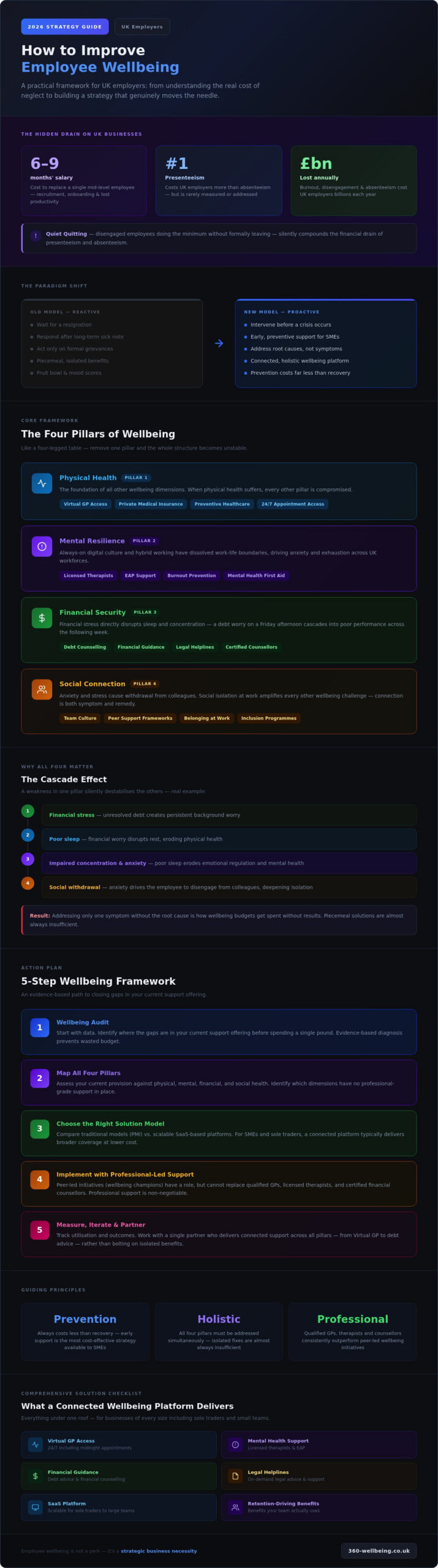
Think of your wellbeing strategy as a four-legged table. Remove one leg and the whole structure becomes unstable. This is the fundamental truth that separates genuinely effective workplace wellbeing from the kind that looks good in a benefits brochure but fails to change anything meaningful. Understanding how to improve employee wellbeing requires engaging with all four dimensions simultaneously: physical health, mental resilience, financial security, and social connection.
The interconnection between these pillars isn’t theoretical. It plays out in real, measurable ways every single day. An employee managing unresolved debt doesn’t sleep well. Poor sleep erodes concentration and emotional regulation. Eroded emotional regulation makes them more vulnerable to anxiety. Anxiety makes them withdraw from colleagues. Each pillar feeds into the next, and a weakness in one will quietly destabilise the others if left unaddressed. Piecemeal solutions that target only one dimension are almost always insufficient.
One more principle matters here before we examine each pillar: professional-led support consistently outperforms peer-led initiatives. Wellbeing champions and mental health first aiders have a role, but they cannot replace access to qualified GPs, licensed therapists, certified financial counsellors, and legal professionals. The standard of care your people receive should never depend on whether a sympathetic colleague happens to be available.
Physical Health: Beyond Traditional Medical Insurance
Physical health support has historically meant Private Medical Insurance, a product that carries significant cost and typically excludes the smaller businesses that need it most. A more scalable and immediately practical alternative is 24/7 Virtual GP access, which allows employees to consult a UK-registered doctor at any time, from any location, without waiting weeks for an NHS appointment. The practical impact is significant: employees get clinical reassurance quickly, minor conditions are addressed before they escalate, and time away from work for routine appointments is substantially reduced.
Physiotherapy is equally important and often overlooked. Whether your workforce is largely sedentary, spending hours at a desk, or physically active in a trade or care environment, musculoskeletal issues are a leading driver of short-term absence. Early physiotherapy access addresses problems before they become long-term conditions.
Mental Health and the Employee Assistance Programme (EAP)
An Employee Assistance Programme is the cornerstone of any credible mental health offer. At its core, it provides a confidential safety net for employees dealing with stress, anxiety, depression, or difficult life circumstances. But the most effective EAPs go further than crisis support. Access to professional therapy sessions and life coaching means employees can work proactively on their mental fitness, not just seek help when they’re already struggling.
Destigmatising mental health support is as important as providing it. Regular, normalised internal communication about available resources, led by leadership rather than HR alone, shifts the culture from one where help-seeking feels like weakness to one where it’s simply part of how your organisation takes care of its people.
The Missing Link: Financial and Legal Wellness
Financial stress is one of the most pervasive and least-addressed drivers of poor employee performance. The sustained pressure of the cost of living on household budgets means that a significant proportion of your workforce is carrying financial worry into work every day, whether or not they’re talking about it. Providing access to debt advice, financial helplines, and practical resources like complimentary will writing signals something powerful: that your organisation sees the whole person, not just the employee.
Legal support sits in the same category. Employees navigating landlord disputes, family law questions, or consumer rights issues often have nowhere affordable to turn. A dedicated legal helpline removes that barrier entirely. For a deeper exploration of this pillar, the Financial Support for Employees: A Comprehensive Guide for UK Employers in 2026 covers the full landscape of financial and legal wellness in detail.
Critically, every pillar described here only delivers value if employees can actually access it when they need it. A therapy service that operates office hours, or a GP line with a two-day callback, isn’t a wellbeing benefit; it’s a liability. Accessibility, including genuine availability outside the standard nine-to-five, is the difference between a benefit that’s used and one that’s forgotten. If you’re reviewing your current provision, exploring a platform built around genuine round-the-clock access is a practical starting point.
Comparing Wellbeing Solutions: Which Model Fits Your Business?
Once you’ve accepted that a panoramic approach to wellbeing is non-negotiable, the next practical question is a straightforward one: which type of solution actually delivers it? The market offers everything from traditional insurance products to modern digital platforms, and the differences between them matter enormously, particularly if you’re running a small or growing business where every pound of budget needs to earn its place.
PMI vs. Wellbeing Platforms: Understanding the Difference
Private Medical Insurance and digital wellbeing platforms are often discussed in the same breath, but they serve fundamentally different purposes. PMI is designed for significant medical events: surgery, specialist consultations, inpatient treatment. It’s a reactive product, activated when something has already gone wrong. A wellbeing platform, by contrast, operates in the daily space between wellness and illness, supporting employees before a problem becomes a crisis.
That distinction has a direct commercial consequence. PMI premiums are calculated per head and tend to scale steeply, making them difficult to justify for smaller teams or businesses with fluctuating headcount. A SaaS-based wellbeing platform carries a far lower cost-per-head, with no requirement for minimum team sizes, which makes it genuinely accessible to sole traders and micro-businesses that traditional insurance models simply weren’t built for.
The two models aren’t mutually exclusive. A platform like 360 Wellbeing can sit alongside existing PMI, filling the gaps that insurance leaves open: the 3am health worry that doesn’t warrant a hospital visit, the financial stress that’s quietly eroding someone’s concentration, the early-stage anxiety that a clinical threshold won’t yet reach. Or it can stand alone as a complete, affordable wellbeing infrastructure for businesses that don’t have PMI at all.
The Value of Integrated Rewards and Perks
One of the most underestimated tools in figuring out how to improve employee wellbeing is purchasing power. When the cost of living is compressing household budgets, a discount marketplace that saves employees money on everyday spending, from groceries and fuel to leisure and retail, has a tangible, measurable impact on financial stress.
360 Rewards delivers exactly this, giving employees access to thousands of everyday offers that effectively increase their disposable income without requiring a pay rise. The psychological effect matters too. Lifestyle rewards create a consistent, visible reminder that the employer is invested in their people’s lives beyond the working day. That kind of ongoing, low-friction benefit builds a quiet but durable sense of loyalty that a one-off bonus rarely achieves.
Contrast this with the fragmented approach of sourcing separate providers for mental health, physical health, financial support, and rewards. Managing multiple contracts, logins, and communication channels doesn’t just create administrative friction; it creates gaps. Employees who can’t easily find or access a benefit simply don’t use it. A single, mobile-first platform removes that barrier entirely, keeping everything your team needs in one place, accessible from any device, at any time.
5 Practical Steps to Improve Wellbeing in Your Team
Strategy without structure rarely survives contact with a busy working week. Knowing how to improve employee wellbeing in principle is one thing; translating that into a sequence of actions your organisation can actually follow is another. These five steps give you a clear, ordered path from where you are now to where your people need you to be.
Step 1: Conduct a Wellbeing Audit. Before spending a single pound, find out where the gaps actually are. A wellbeing audit combines anonymous pulse surveys, absence data analysis, and informal manager conversations to build an honest picture of your current support landscape. You’re looking for patterns: which teams report the most stress, which benefits go unused, where people are falling through the cracks. Without this baseline, you’re guessing.
Step 2: Secure leadership buy-in by presenting the ROI of health. Wellbeing initiatives stall when they’re owned by HR alone. Senior leaders need to see the business case: the cost of replacing a mid-level employee, the productivity drag of presenteeism, the retention advantage of a credible benefits offering. Frame wellbeing as a commercial decision, not a cultural nicety, and you’ll find the conversation changes quickly.
Step 3: Implement a centralised digital platform. Fragmented tools create fragmented outcomes. A single, mobile-accessible platform that brings Virtual GP access, mental health support, financial guidance, and lifestyle rewards into one place removes the friction that stops employees engaging with benefits at all. Ease of access isn’t a convenience; it’s the difference between a benefit that gets used and one that quietly expires.
Step 4: Train managers to recognise stress and signpost to professional help. More on this below.
Step 5: Review and iterate. Usage data tells you what’s working. Low engagement with a particular service isn’t always a sign that employees don’t need it; it’s often a sign they don’t know it exists. Set a quarterly review rhythm, track uptake across different teams, and adjust your communication approach accordingly.
Upskilling Managers for Empathetic Leadership
Managers are the first line of detection for struggling employees, and most of them haven’t been trained for it. The traits of an expert caregiver, listening without judgement, noticing behavioural shifts, responding with curiosity rather than performance management, don’t come automatically. They require deliberate development.
Practical training should cover three things: how to open a sensitive conversation without overstepping, how to respond when an employee discloses a mental or physical health difficulty, and how to signpost to professional support without attempting to provide it themselves. That last point is critical. A manager’s role isn’t to be a therapist; it’s to bridge the gap between an employee in difficulty and the qualified professional who can actually help them.
The EAP is the tool that makes this possible. When managers understand what the EAP offers and feel confident recommending it, uptake increases significantly. A simple script can help: “I’ve noticed you seem under pressure lately. I want you to know there’s confidential support available through our EAP, including therapy and financial advice, and I’d encourage you to use it.” That’s not overreach. That’s leadership.
Communicating Benefits Effectively
Poor internal communication is the single most common reason wellbeing benefits go unused. Employees can’t access support they don’t know exists, and a one-time email at onboarding isn’t enough. Benefits awareness needs to be built into the rhythm of your organisation.
When launching a wellbeing platform, work through this checklist:
- Pre-launch email from a senior leader explaining what’s coming and why it matters
- Launch-day communication with clear instructions on how to register and what’s available
- Physical touchpoints where relevant: posters in communal areas, printed guides for non-desk workers
- Town hall or team briefing where managers can answer questions in real time
- Monthly reminders tied to relevant moments: financial tips in January, mental health awareness in May
- Manager briefing pack so every team lead can answer basic questions confidently
The goal is always-on visibility. Help should be findable at the moment someone needs it, not just in the week it was launched. Pinning the platform link in your team communication channels, including it in new starter packs, and referencing it in one-to-ones keeps it present without being intrusive.
If you’re ready to put this framework into practice, explore how 360 Wellbeing brings every pillar of support together in one platform built specifically for UK employers who want results, not just a benefits brochure.
Partnering for Success: The 360 Wellbeing Solution
Everything covered in this guide, the four pillars, the five-step framework, the case for proactive intervention, points toward the same practical conclusion: none of it works without the right partner behind it. Knowing how to improve employee wellbeing in theory is only half the equation. The other half is having a platform that actually delivers it, consistently, accessibly, and without creating more administrative work for an already stretched team.
360 Wellbeing is built around that reality. It’s a single, integrated platform designed specifically for the UK market, bringing 24/7 Virtual GP access, mental health support, an Employee Assistance Programme, life coaching, physiotherapy, financial guidance, debt advice, legal support, and a comprehensive rewards marketplace into one place. No juggling multiple providers. No gaps between services. No employees falling through the cracks because one benefit didn’t quite cover their situation.
The subscription model is straightforward: a fixed monthly fee per employee, with no hidden costs and no minimum team size. That structure matters enormously for SMEs and sole traders, who’ve historically been priced out of the kind of comprehensive wellbeing support that larger organisations take for granted. 360 Wellbeing removes that barrier entirely.
Seamless Integration for SMEs and Sole Traders
For time-poor employers, the administrative simplicity of a single platform isn’t a convenience; it’s a genuine operational advantage. New staff members can be onboarded quickly, with access to the full suite of benefits from day one, sending an immediate signal that their wellbeing matters before they’ve even settled in. Two services in particular set 360 Wellbeing apart for smaller teams: complimentary will writing and a dedicated legal helpline. These aren’t services most SMEs would think to source independently, yet they address real, pressing needs that employees carry quietly into work every day. Providing them signals a depth of care that goes well beyond a standard benefits package.
Measuring ROI and Employee Engagement
A wellbeing platform is only as valuable as its uptake, and 360 Wellbeing gives employers the visibility to track exactly that. Usage data across services shows which benefits your team values most, where engagement is strong, and where communication might need reinforcing. That insight turns your wellbeing investment from a leap of faith into an evidence-based strategy you can refine over time.
The long-term picture is equally compelling. A workforce with reliable access to healthcare, mental health support, and financial guidance is a more resilient, more focused, and more loyal one. Reduced absence, lower turnover, and stronger day-to-day performance aren’t abstract aspirations; they’re the measurable outcomes of sustained, professional-grade wellbeing support.
If you’re ready to move from intention to action, explore how 360 Wellbeing can support your team today.
Your Next Step Toward a Healthier, More Resilient Team
The case is clear. Knowing how to improve employee wellbeing isn’t about adding another benefit to a dusty brochure; it’s about building a workplace where your people have genuine, professional-grade support across every dimension of their health. Physical, mental, financial, and social wellbeing are inseparable, and the businesses that treat them as such will carry a real, measurable advantage into 2026 and beyond.
Three things matter most when you’re ready to act. Start with an honest audit of where your current provision falls short. Secure leadership commitment by making the business case, not just the human one. Then choose a partner who delivers everything in one place, so your people can actually find and use the support they need.
360 Wellbeing brings 24/7 Virtual GP access, UK-registered mental health experts, and comprehensive financial and legal support together under one roof, at a cost that works for businesses of every size.
Book a demo to see how our panoramic wellbeing platform supports your staff and take the first confident step toward a team that genuinely thrives.
Frequently Asked Questions
How can a small business afford an employee wellbeing programme?
The assumption that comprehensive wellbeing support is only for large organisations is one of the most persistent and costly myths in HR. SaaS-based platforms like 360 Wellbeing operate on a fixed monthly fee per employee with no minimum team size, making them genuinely accessible to sole traders and micro-businesses. The more useful question isn’t whether you can afford a wellbeing programme; it’s whether you can afford the recruitment and absence costs that accumulate without one.
What are the most important elements of a workplace wellbeing strategy?
A credible strategy addresses physical health, mental resilience, financial security, and social connection in parallel rather than in isolation. Within that framework, the non-negotiables are professional-grade access: a qualified GP when someone needs clinical guidance, a licensed therapist when anxiety becomes unmanageable, and a financial counsellor when debt is quietly eroding someone’s focus. Peer support and manager training are valuable additions, but they can’t substitute for qualified professionals.
How do I measure the success of wellbeing initiatives?
Start with the metrics you already have: absence rates, staff turnover, and any existing engagement scores. Then add platform usage data, which shows which services employees are actually using and where uptake is low. Low engagement with a particular benefit is rarely a sign that employees don’t need it; it’s usually a communication gap. Reviewing these figures quarterly gives you enough data to adjust your approach without waiting for a problem to escalate into a crisis.
Can a Virtual GP really replace an in-person doctor for staff?
For the majority of everyday health concerns, a Virtual GP consultation with a UK-registered doctor delivers the same clinical outcome as an in-person visit, without the wait. It’s particularly effective for prescription requests, test result discussions, referral letters, and reassurance for symptoms that feel worrying but aren’t emergencies. It doesn’t replace specialist or emergency care, but it handles the routine consultations that currently send employees to overstretched NHS surgeries or, more often, cause them to delay seeking help altogether.
What is an Employee Assistance Programme (EAP) and do I need one?
An EAP is a confidential support service that gives employees access to professional help for mental health, personal difficulties, and work-related stress, typically including therapy sessions, counselling, and signposting to specialist resources. If you’re asking how to improve employee wellbeing in any meaningful way, an EAP isn’t optional; it’s the foundation. Without it, your people have nowhere professionally qualified to turn when they’re struggling, and managers are left trying to fill a gap they were never trained for.
How can I support employee mental health without being an expert myself?
You don’t need to be an expert; you need to know how to open a conversation and where to direct someone once you have. Training managers to notice behavioural shifts, ask a simple and non-intrusive question, and confidently signpost to the EAP is far more valuable than expecting them to provide emotional support themselves. A practical script helps: acknowledging that someone seems under pressure and letting them know confidential support is available removes the awkwardness without overstepping professional boundaries.
Does financial support really belong in a workplace wellbeing package?
Absolutely. Financial stress is one of the most common and least visible drivers of poor concentration, low morale, and absenteeism in UK workplaces. Employees carrying debt worry or household budget pressure don’t leave that anxiety at the door. Access to a financial helpline, debt advice, and practical tools like an employee rewards marketplace that stretches disposable income addresses a real and pressing need. It also signals something meaningful: that your organisation sees the whole person, not just the role they fill.
How often should we review our employee benefits package?
A formal review once a year is the minimum; quarterly check-ins on usage and engagement data are more effective. Benefits that made sense two years ago may no longer reflect what your team actually needs, particularly as workforce demographics, working patterns, and cost-of-living pressures shift. The most reliable signal is uptake: if a benefit consistently goes unused, it’s either not relevant or not visible enough, and only a structured review will tell you which problem you’re actually solving.