
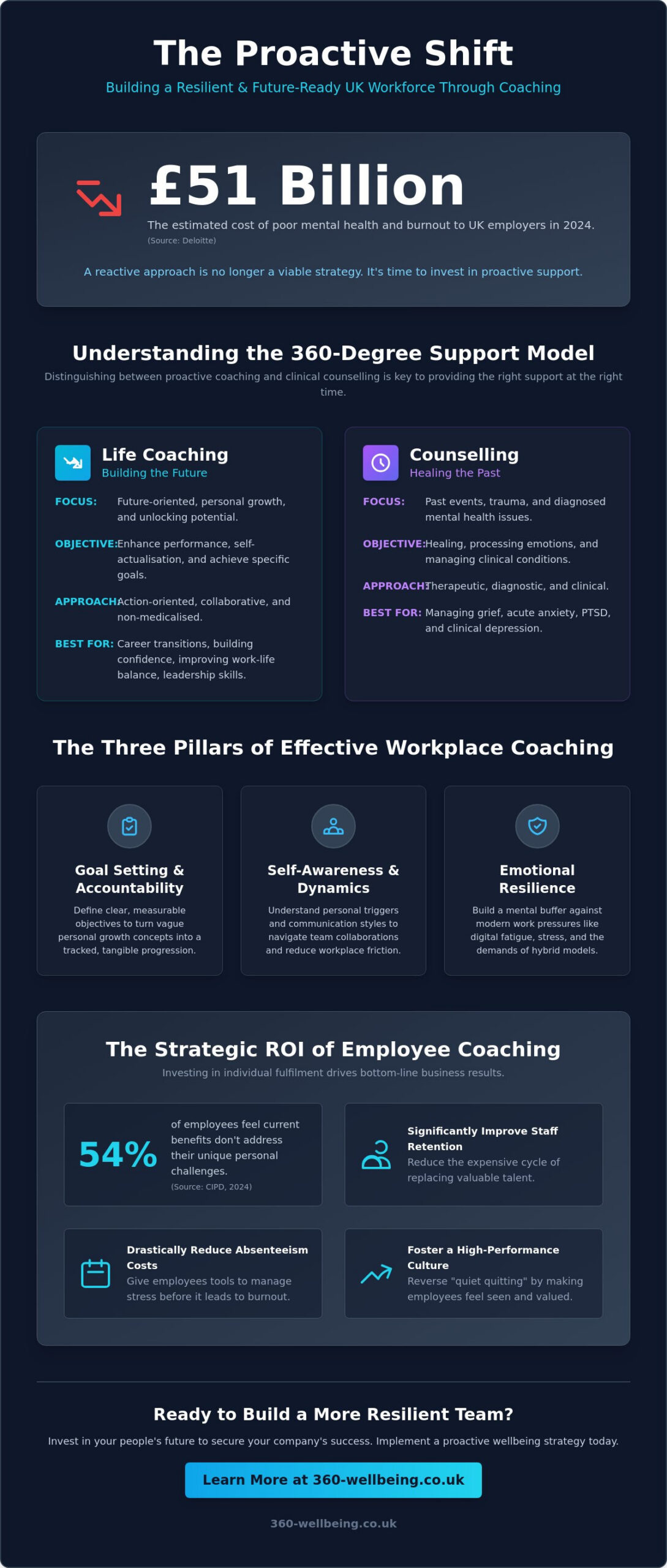
Did you know that poor mental health and burnout cost UK employers an estimated £51 billion in 2024, according to Deloitte’s latest mental health report? You likely see these pressures reflected in your own team through rising absenteeism and the expensive cycle of replacing talented people who feel overwhelmed. It’s a heavy burden for any leader to carry, and it’s clear that waiting for a crisis to happen before offering support is no longer a viable strategy. Integrating life coaching for employees uk wide provides a proactive, human-centred approach to building resilience before your staff reach their breaking point.
We agree that your people deserve a workplace that nurtures their growth, yet we know how confusing it is to distinguish between coaching, counselling, and mentoring. This guide promises to clear that confusion and demonstrate how a tailored coaching strategy provides a genuine competitive advantage for your business in 2026. We’ll explore the practical steps to embed coaching into your existing benefits, helping you reduce recruitment costs and foster a truly motivated, 360-degree culture of wellness.
Key Takeaways
- Learn how shifting from reactive mental health support to proactive personal development builds a more resilient and future-ready UK workforce.
- Understand the vital differences between clinical counselling and performance coaching to provide a balanced, 360-degree support system for your team.
- Discover the strategic ROI of life coaching for employees uk, focusing on improved staff retention and significant reductions in absenteeism costs.
- Follow a clear implementation framework for HR leaders to audit employee needs and select high-quality, UK-registered coaching partners.
- Access cost-effective strategies for SMEs to scale professional wellbeing services through integrated, per-employee subscription models.
What is Life Coaching for Employees in the Modern UK Workplace?
Life coaching for employees uk is a collaborative, action-oriented partnership that prioritises an individual’s future growth over their past limitations. It marks a significant departure from traditional, reactive mental health support that only kicks in during a period of crisis. Instead, this approach focuses on proactive personal development; it helps staff members bridge the gap between their current reality and their highest potential. By shifting the focus toward future goals, employers can foster a culture where workers feel empowered to take ownership of their professional and personal trajectories.
The 2026 UK workplace landscape demands more than standard perks. A 2024 study by the CIPD indicated that 54% of employees feel their current benefits packages don’t address their unique personal challenges. Traditional benefits often fail because they don’t treat the employee as a whole person. Coaching serves as a non-medicalised intervention, distinct from counselling or therapy. It doesn’t focus on clinical diagnosis; it targets self-actualisation and the removal of internal barriers to success. This distinction is vital for UK businesses that want to support their teams without overstepping into the territory of clinical psychology.
The Core Pillars of Workplace Coaching
Effective life coaching for employees uk relies on three fundamental pillars that transform how individuals show up at work:
- Goal setting and accountability: Coaches use structured frameworks to help employees define clear, measurable objectives. This ensures that personal growth isn’t just a vague concept but a tracked progression that aligns with their professional role.
- Self-awareness and interpersonal dynamics: By understanding their own triggers and communication styles, employees can navigate office politics and team collaborations with greater ease. This reduces friction and improves collective output.
- Emotional resilience: Modern work environments are fast-paced. Coaching provides tools to build a buffer against stress triggers, such as digital fatigue or the pressures of hybrid working models.
Why UK Employers are Investing in Coaching Now
There’s a direct correlation between personal fulfilment and bottom-line productivity. When an employee feels supported in their whole life, their output naturally increases. Gallup’s 2023 State of the Global Workplace report highlighted that low engagement costs the global economy roughly £7 trillion. UK firms are increasingly using coaching to reverse the “quiet quitting” trend by offering individualised support that makes employees feel seen and valued. Rather than a one-size-fits-all approach, coaching provides a tailored space for employees to solve specific life hurdles that might otherwise distract them from their work.
Employee life coaching acts as a catalyst for professional agility.
Coaching vs. Counselling: Understanding the 360-Degree Support Model
To build a resilient workforce, UK employers must distinguish between clinical intervention and professional development. While counselling addresses past trauma or diagnosed mental health disorders, life coaching for employees uk focuses on future-oriented goals and personal growth. An integrated 360-degree approach ensures that staff receive the right support at the right time, creating a safety net that protects both the individual and the organisation. High-quality coaching adheres to International Coaching Federation (ICF) standards, ensuring practitioners follow a strict ethical code and possess verified competencies. This professional rigour transforms coaching from a “nice-to-have” perk into a strategic business tool.
When to Use Counselling vs. Life Coaching
Counselling is essential for managing clinical issues like grief, acute anxiety, or PTSD. It provides a therapeutic space to heal. In contrast, life coaching is the preferred route for career transitions, improving work-life balance, or building self-confidence. A robust Employee Assistance Programme (EAP) uses a “triage” system to direct individuals to the most appropriate service. This prevents the misapplication of resources, ensuring a person struggling with clinical depression isn’t mistakenly pushed toward performance coaching. By coaching employees who are ready for growth, managers can foster a high-performance culture without overstepping clinical boundaries.
- Counselling: Focused on healing, clinical recovery, and resolving past issues.
- Coaching: Focused on action, future potential, and achieving specific milestones.
- Integrated Safety: A combined model ensures that if a coaching client reveals deep-seated trauma, they can be immediately referred to a qualified counsellor.
The Proactive Advantage: Moving Beyond Crisis Management
Traditional workplace support often waits for a crisis to occur. Proactive life coaching for employees uk identifies burnout markers, such as a 15% drop in productivity or increased irritability, before they lead to long-term absenteeism. This shifts the internal narrative from “fixing what’s broken” to “unlocking potential.” When development is viewed as a strength, the stigma surrounding support vanishes. According to 2024 industry insights, UK companies that implement proactive wellbeing strategies see a significant reduction in staff turnover. Integrating these services into a holistic wellbeing platform allows your team to thrive rather than just survive. It turns personal resilience into a collective corporate asset that drives long-term success.
The Business Case: Calculating the ROI of Life Coaching
Investing in your team isn’t just a moral choice; it’s a strategic financial decision that protects your company’s future. Poor mental health costs UK employers approximately £51 billion annually, according to Deloitte’s 2024 analysis. By implementing life coaching for employees uk, businesses can directly tackle the £24 billion lost each year to presenteeism, where staff are physically present but mentally disengaged. This proactive intervention transforms the workplace from a source of stress into a hub of resilience.
Retention is another critical factor where the numbers speak for themselves. Replacing a mid-level professional in the UK costs an average of £30,000 when factoring in recruitment fees, onboarding, and the initial dip in productivity. Coaching builds a culture of loyalty that makes people want to stay. Research indicates that Success Coaching creates a robust leadership pipeline, allowing companies to fill a higher percentage of senior roles through internal promotion. This reduces the reliance on expensive external headhunters and ensures your leadership understands your brand DNA.
Tangible Benefits for the Organisation
Data from the International Coaching Federation suggests that 70% of employees who receive coaching see improved work performance and better communication skills. These interventions also play a vital role in diversity and inclusion initiatives. By providing tailored support, you ensure that employees from all backgrounds have the tools to overcome personal barriers to promotion. Empowering staff with greater autonomy through coaching directly correlates with a 19% increase in operating income, as individuals take personal ownership of commercial outcomes.
The “Ripple Effect” of Individual Coaching
The impact of coaching extends far beyond the individual. When one team member develops better emotional regulation and communication skills, it reduces friction across the entire department. This leads to a measurable decrease in conflict-related management time for HR, which currently consumes up to 20% of a typical UK manager’s week. It’s about creating a calmer, more focused environment where collaboration happens naturally.
To achieve a 360-degree view of health, many organisations integrate these sessions with financial support for employees. This comprehensive strategy ensures that external stressors like debt or inflation don’t derail internal growth. By offering life coaching for employees uk as part of a wider wellness package, you’re not just buying a service; you’re securing the long-term vitality and harmony of your entire workforce. It’s a clear path forward that balances clinical expertise with a warm, human touch.
How to Implement Life Coaching: A Framework for UK HR Leaders
Implementing a successful programme for life coaching for employees uk requires a structured approach that looks at the individual from a 360-degree perspective. It isn’t just about professional output; it’s about personal resilience and mental clarity. You should start with a comprehensive wellbeing audit to pinpoint where your team feels stretched. According to the CIPD’s 2023 Health and Wellbeing at Work report, 76% of respondents reported stress-related absence in their organisations, making a proactive strategy essential rather than optional.
To build a framework that lasts, follow these core steps:
- Identify Specific Needs: Use anonymised surveys to discover if your staff need help with work-life balance, career transitions, or confidence building.
- Vet Your Partners: Select a platform that provides access to coaches registered with UK bodies like the Association for Coaching (AC) or the International Coaching Federation (ICF).
- Strategic Communication: Launch the benefit by framing it as a tool for high performance and personal growth. This reduces stigma and encourages take-up among those who might feel “coaching” is only for remedial issues.
- Set Clear KPIs: Monitor success through metrics such as a 15% reduction in short-term sickness absence or improved scores in annual engagement surveys.
Choosing the Right Coaching Format
Accessibility is a priority for the 44% of UK workers who currently work in a hybrid or remote capacity. Virtual sessions allow employees to connect with experts from the comfort of their home, removing the logistical barriers of travel and making the service feel more personal. While group workshops are effective for collective challenges like change management, one-to-one sessions provide the deep, individualised support necessary for true personal growth. Providing 24/7 access ensures your team can seek guidance when they actually need it, not just during the standard 9-to-5 window.
Ensuring Confidentiality and Trust
Trust is the foundation of any coaching relationship. To protect all parties, you should establish a three-way contract between the coach, the employee, and the employer. This document clearly outlines that while the employer pays for the service, the specific details of the conversations remain private. External platforms often outperform internal mentoring because they offer a safe space free from internal office politics or fears of career repercussions. All data handling must comply with UK GDPR standards, ensuring that personal disclosures never influence performance reviews or disciplinary records. This separation of coaching from management is what allows employees to be truly honest and vulnerable.
Scaling Wellbeing with the 360 Wellbeing Platform
Implementing a robust wellness strategy shouldn’t feel like an administrative burden or a financial gamble. Our platform provides a streamlined, integrated approach to life coaching for employees uk, ensuring that professional guidance is accessible to everyone in your organisation. We’ve developed a per-employee subscription model specifically to support SMEs. This fixed-cost structure removes the unpredictability of pay-as-you-go services, allowing small and medium businesses to provide the same level of care as global corporations without stretching their budgets. It’s a cost-effective way to invest in your most valuable asset: your people.
Onboarding is designed to be swift and intuitive. We understand that HR teams are often overstretched, so we’ve made the setup process simple for businesses of all sizes. Once active, the platform creates a powerful synergy between different health disciplines. An employee might start with a virtual GP appointment to discuss fatigue and then be guided toward mental health support or life coaching to address the underlying causes of burnout. This interconnectedness ensures that no one falls through the cracks. It moves the conversation from reactive crisis management to a proactive culture of vitality.
Total Support: The 360-Degree Perspective
Our 360-degree perspective is built on the reality that physical, mental, and financial health are deeply linked. If an employee is struggling with debt, their mental health suffers; if they’re physically unwell, their productivity drops. Our platform addresses these facets simultaneously. Every specialist on our platform is a UK-registered expert. This gives your team peace of mind that they’re receiving clinical-grade care and reliable advice that meets UK regulatory standards.
You can customise the platform experience to reflect your specific organisational goals. Whether you’re aiming to reduce absenteeism or improve staff retention, the platform provides the data and tools to make it happen. Recent industry reports show that UK businesses with comprehensive wellbeing programmes see a 15% increase in overall employee engagement. By tailoring the support to your workforce’s unique demographic, you create a culture where everyone feels seen and supported.
Next Steps for Your Organisation
Empowering your team to take charge of their own health is the most sustainable way to build resilience. When employees have the tools to manage their own vitality, they become more confident and capable in their professional roles. You can see how this works in practice by requesting a demo of our platform. We’ll show you how the interface works and how it can be branded for your company. It’s a practical step toward a more harmonious workplace. Transform your workplace with 360 Wellbeing and start building a foundation of strength today.
Build a More Resilient Future for Your Team
Investing in a resilient culture starts with a proactive commitment to every individual’s growth. By adopting a 360-degree support model, you provide your team with the specific tools needed to manage stress and improve performance before challenges become crises. This strategic shift toward life coaching for employees uk helps bridge the gap between clinical intervention and daily wellbeing. It’s an approach that treats health as a fundamental right rather than a luxury. When people feel supported in their personal and professional lives, they’re better equipped to contribute to a thriving, harmonious workplace.
Our comprehensive health and lifestyle platform already supports thousands of UK staff with 24/7 access to UK-registered GPs and expert coaches; this ensures that empathetic, expert-led guidance is always available when it matters most. By integrating physical, mental, and social health into a single narrative, you create a workplace where everyone can thrive. You’re not just offering a service; you’re building a legacy of care and professional excellence.
Book a demo to see how 360 Wellbeing can support your staff and discover a more balanced, proactive way to lead. You have the power to transform your corporate culture into one of vitality and shared success.
Frequently Asked Questions
Is life coaching for employees different from regular therapy?
Yes, life coaching is distinct from therapy because it focuses on future goals and proactive skill-building rather than clinical diagnosis or healing past trauma. While therapy is essential for managing clinical mental health conditions, coaching helps staff develop resilience and professional clarity. It’s a solution-focused partnership that empowers your team to bridge the gap between where they are and where they want to be.
How many coaching sessions do employees typically need to see results?
Most employees experience measurable shifts in their mindset and productivity within 4 to 6 sessions. This duration allows enough time to identify core obstacles and implement practical strategies in the workplace. According to the International Coaching Federation (ICF), 70% of individuals who receive coaching report improved work performance. We typically suggest bi-weekly sessions to maintain steady momentum and ensure lasting behavioral change.
Will my company receive reports on what employees discuss in coaching?
No, the specific details of every session remain strictly confidential to ensure a safe and trusting environment. Trust is the cornerstone of effective life coaching for employees uk, so we never share private conversations with management. Employers instead receive high-level, anonymised reports that highlight general themes and engagement rates. This data helps you understand workforce trends without compromising the psychological safety of your individual team members.
Can life coaching help with employee retention in the UK?
Yes, life coaching is a highly effective tool for improving staff retention across UK industries. A 2022 report from Deloitte found that UK employers see an average return of £5.30 for every £1 invested in staff wellbeing. When you provide personalised development support, employees feel valued as individuals rather than just workers. This sense of investment significantly reduces turnover and helps you keep your best talent for longer.
Is life coaching a taxable benefit for UK employees?
Work-related coaching is generally not considered a taxable benefit if it’s designed to improve an employee’s performance or manage work-related stress. Under HMRC Section 250 of ITEPA 2003, training that provides staff with skills useful for their role is often exempt from Benefit in Kind (BIK) tax. It’s always best to verify your specific programme structure with a tax professional to ensure it meets current UK regulatory requirements.
How does life coaching fit into a standard Employee Assistance Programme (EAP)?
Life coaching serves as a proactive upgrade to the reactive nature of most standard EAPs. While many EAPs focus on crisis intervention or short-term counselling, coaching offers a structured path toward long-term personal growth and resilience. It fills a vital gap by helping healthy employees stay healthy and perform at their peak. Integrating both services ensures your team has a comprehensive support system for every stage of their journey.
Can life coaching help employees manage work-life balance effectively?
Life coaching provides employees with concrete strategies to set healthy boundaries and prioritise their daily tasks. The CIPD’s 2023 Health and Wellbeing at Work report noted that 76% of UK professionals observed stress-related absences in their workplace. Coaches help individuals identify their primary stressors and create a sustainable routine. This proactive focus on balance reduces the risk of burnout and keeps your workforce focused and energised during business hours.
What qualifications should I look for in a corporate life coach?
You should look for coaches who are accredited by professional bodies like the International Coaching Federation (ICF) or the Association for Coaching (AC). These organisations require hundreds of hours of supervised practice and adherence to strict ethical codes. It’s also beneficial to choose coaches with experience in organisational psychology or corporate leadership. These credentials ensure the coach understands the specific pressures of the UK business environment and can deliver measurable results.