
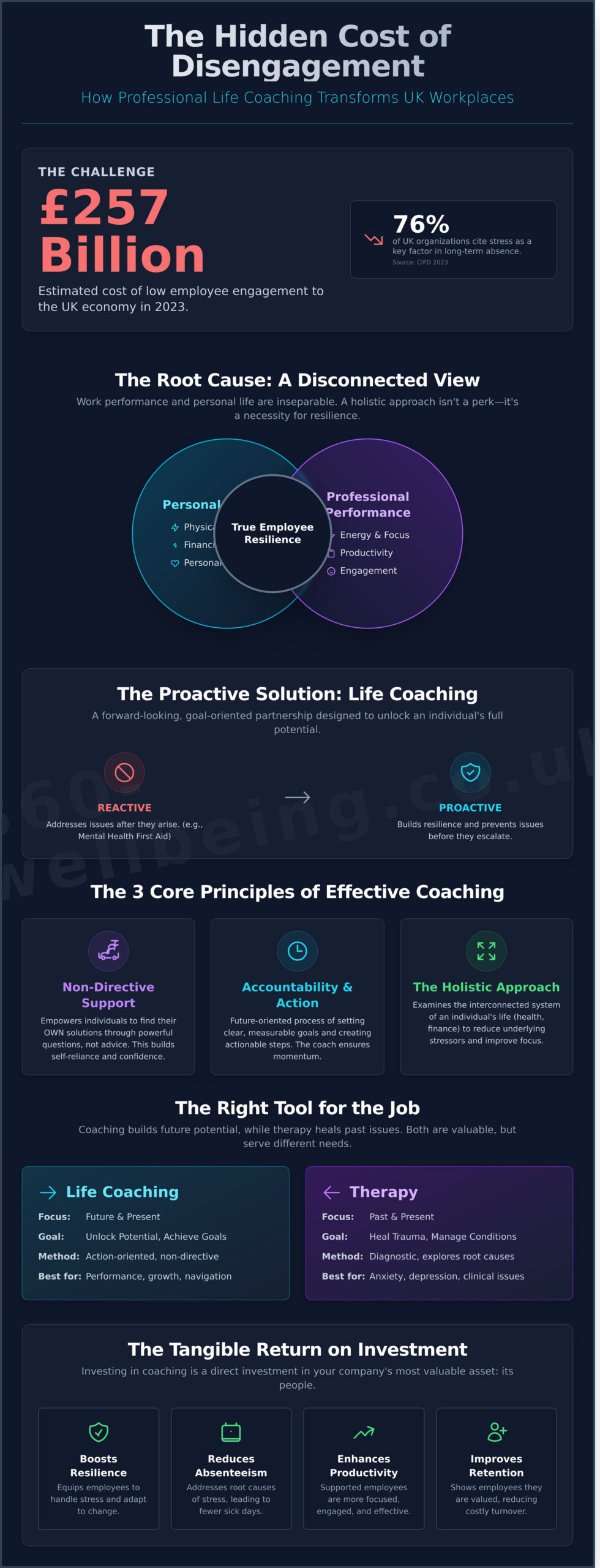
In 2023, low employee engagement cost the UK economy an estimated £257 billion, a figure projected to climb as we head into 2026. You’ve likely felt this pressure already in your own organisation. You see the subtle signs of burnout and the quiet disengagement that precedes high staff turnover, knowing that conventional wellness perks often fail to create lasting change.
This article moves beyond theory to offer a clear, strategic solution. We’ll show you exactly how professional life coaching serves as a powerful, proactive tool to build genuine employee resilience, boost productivity, and empower meaningful personal growth. You’ll gain a practical framework for implementation, a clear understanding of the return on investment, and a new perspective on how tailored support can transform your retention strategy for good.
Key Takeaways
- Understand why a proactive, 360-degree view of employee wellbeing-connecting personal life to professional output-is the new standard for high-performing UK teams.
- Discover the specific mechanisms through which professional life coaching builds employee resilience, mitigates the root causes of burnout, and fosters psychological safety.
- Clearly distinguish between coaching for building future potential and therapy for healing past issues to select the right support for your team’s unique needs.
- Learn to calculate the strategic ROI of coaching by weighing its benefits against the significant costs of employee absenteeism and non-compliance with ISO 45003 standards.
What is Life Coaching? Defining Proactive Support in 2026
At its heart, professional life coaching is a forward-looking, goal-oriented partnership designed to unlock an individual’s full personal and professional potential. It’s not therapy, which often looks backward to heal past trauma, nor is it mentoring, which involves giving direct advice. Instead, it operates on the principle of proactive development. While the broader discipline of What is coaching has existed for decades, its modern application focuses on empowering individuals to find their own answers. In essence, life coaching is a collaborative process for navigating transitions and achieving specific life outcomes.
The core of this approach is a powerful, 360-degree perspective: an employee’s personal life and their work performance are inseparable. You can’t simply “switch off” financial worries or relationship stress the moment you log on. In fact, the CIPD’s 2023 Health and Wellbeing at Work report found that stress was a significant factor in long-term absence for 76% of UK organisations. When an employee feels supported in their whole life, they bring a more focused, resilient, and engaged version of themselves to work. This understanding has driven a fundamental shift in workplace support, moving coaching from a benefit reserved for C-suite executives to a democratised tool for unlocking potential at every level of an organisation.
The Core Principles of Professional Coaching
A certified coach works within a clear ethical framework built on three foundational pillars. These principles ensure the process is both empowering and effective:
- Non-directive support: A coach’s primary tool isn’t advice; it’s powerful, open-ended questions. Instead of saying “You should do this,” they ask, “What options have you considered?” This Socratic method guides individuals to their own solutions, building self-reliance and confidence rather than dependency.
- Accountability and action: Coaching is fundamentally future-oriented. Sessions are structured around defining clear, measurable goals and creating actionable steps to reach them. The coach serves as an accountability partner, helping the individual track progress, navigate obstacles, and maintain momentum toward their desired results.
- The holistic approach: True performance isn’t just about professional skills. A coach helps individuals examine the interconnected system of their life, including physical health, financial stability, and personal relationships. By addressing challenges in these areas, employees can reduce underlying stressors and dramatically improve their focus and energy at work.
The Evolution of Coaching in the UK Workplace
The demands of the 2026 workplace require a more sophisticated approach to employee wellbeing than ever before. Reactive measures like mental health first aid, while valuable, are no longer sufficient. Today’s employees, particularly after the seismic shifts of the early 2020s, expect and deserve proactive, preventative support that addresses their entire wellbeing.
This has led to the rise of “whole-person” wellbeing as a standard expectation, not a luxury perk. It’s a strategic recognition that investing in an employee’s personal growth yields tangible business returns through higher engagement and retention. This proactive stance is why a growing number of UK businesses now see professional coaching not as a remedial fix, but as a cornerstone of a modern employee wellbeing platform, providing tailored support that builds resilience from the ground up.
How Life Coaching Drives Employee Resilience and Performance
True performance isn’t just about meeting targets; it’s about an individual’s capacity to adapt, grow, and thrive through challenges. Providing a dedicated, confidential space for personal development through coaching gives employees a powerful psychological asset. It’s a place where they can untangle complex professional challenges and personal stressors without fear of judgment, fostering a deep sense of security and support that directly translates into focus and engagement at work.
Often, the friction from our lives outside of work-from financial worries to caring for family-manifests in physical symptoms of stress like chronic fatigue, tension headaches, and poor sleep. A comprehensive approach to wellbeing understands that you can’t solve these issues with surface-level perks. Instead, life coaching addresses the root causes. By equipping employees with strategies to manage these underlying pressures, you mitigate the physical toll of stress, leading to fewer sick days and a more energised, present team. This isn’t just anecdotal; extensive research on coaching effectiveness published in The Journal of Positive Psychology demonstrates that coaching interventions significantly boost resilience, well-being, and goal attainment.
This process also serves as a powerful incubator for the soft skills that define modern leadership and collaboration. A coach can help an employee develop:
- Emotional Intelligence: By exploring reactions and triggers in a safe environment, individuals build the self-awareness needed to manage relationships constructively.
- Effective Communication: Coaching provides a practical forum for role-playing difficult conversations and learning to deliver feedback with clarity and empathy.
- Time and Energy Management: Rather than a one-size-fits-all approach, a coach helps an employee build a personalised system that aligns with their unique productivity patterns and priorities.
Coaching is particularly vital during major life transitions. An employee returning from parental leave, for example, is navigating a profound identity shift and immense new pressures. A coach provides tailored, non-judgmental support to help them rebuild professional confidence and integrate their work and home lives sustainably, a crucial factor in retaining top talent.
Preventing Burnout Before It Starts
A proactive culture catches the early warning signs of burnout-cynicism, exhaustion, and disengagement-before they take root. Coaching offers a confidential outlet to address these feelings, helping employees establish healthy boundaries and a sustainable work-life integration. This approach works in powerful synergy with professional mental health support, creating a comprehensive safety net that empowers employees to seek help early and effectively.
Supporting Career Development and Retention
When employees see a clear link between their personal values and the company’s mission, their loyalty deepens. Coaching facilitates this crucial alignment, helping individuals find greater purpose in their role. This directly impacts internal mobility, as coached employees are better equipped to identify their strengths and pursue new opportunities within the organisation. Data from the International Coaching Federation shows that companies offering coaching at all levels can see retention rates improve by over 20%.
By investing in the whole person, you’re not just improving performance; you’re building a more loyal, adaptable, and resilient workforce. Discover how our tailored corporate wellbeing programmes can integrate coaching into your company’s DNA.
Life Coaching vs. Therapy: Choosing the Right Support for Your Team
Understanding the distinction between life coaching and therapy isn’t just a matter of semantics; it’s fundamental to providing responsible and effective care for your team. A common misconception is that coaching is a “diet” version of therapy, but this couldn’t be further from the truth. The two disciplines operate with different goals, methodologies, and ethical boundaries. They are both powerful tools, but they are not interchangeable. A simple way to frame it is this: while therapy helps individuals move from dysfunction to function, coaching moves them from function to excellence.
Clinical vs. Non-Clinical Interventions
The primary difference lies in their focus. Therapy is a clinical intervention designed to diagnose and treat mental health conditions. A qualified therapist delves into an individual’s past to heal trauma, manage diagnosed conditions like depression or anxiety, and address deep-seated emotional and psychological issues. It is a regulated healthcare practice.
In contrast, coaching is a non-clinical, forward-looking process. A coach works with an individual who is mentally well but wants to optimise their performance, achieve specific goals, or unlock their potential. The conversation centres on the present and future, not the past. A robust wellbeing strategy requires a clear triage process. Your EAP providers must be equipped to assess an employee’s needs accurately. If an individual reports persistent low mood, signs of burnout, or overwhelming anxiety, the correct and ethical step is a referral to a therapist or a virtual GP, not a coach.
The Role of the Life Coach in Mental Wellness
While distinct from therapy, professional life coaching plays a vital, proactive role in a holistic mental wellness programme. It acts as a powerful preventative measure, equipping employees with the resilience, self-awareness, and coping strategies needed to manage non-clinical workplace stress before it escalates. For example, a coach can help an employee develop better time-management habits to reduce feelings of being overwhelmed.
Coaching can also beautifully complement clinical care. If an employee is seeing a therapist, a coach can help them integrate the therapist’s advice into their daily work life by focusing on habit formation and accountability. This synergy creates a comprehensive support system. The true Power of Workplace Coaching is realised when it helps good performers become great leaders. To ensure this ethical boundary is maintained, always verify a coach’s credentials. In the UK, look for accreditation from respected bodies like the International Coaching Federation (ICF) or the European Mentoring and Coaching Council (EMCC). These organisations require members to adhere to a strict code of ethics, which includes recognising the limits of their practice and referring clients to clinical professionals when necessary.
The Strategic Value: Calculating the ROI of Workplace Coaching
Viewing coaching as a simple “perk” misses its profound strategic impact. When you invest in your team’s wellbeing, you aren’t just spending money; you are making a calculated investment in resilience, productivity, and retention. The return on this investment is clear, tangible, and measurable, starting with one of the most significant hidden costs in any UK business: absenteeism.
According to the CIPD’s 2023 report, the median cost of employee absence now stands at an alarming £975 per employee per year. Compare this to the cost of a proactive coaching programme. The International Coaching Federation (ICF) reports that organisations can expect a median return of 7 times their initial investment in coaching. It’s a simple calculation: preventing even a few stress-related absences can fund a comprehensive support system for your entire team. This proactive stance also directly supports compliance with key workplace standards like ISO 45003, the global benchmark for managing psychological health and safety. Providing confidential life coaching demonstrates a concrete commitment to mitigating psychosocial risks, moving your business from a reactive to a preventative model of care.
Beyond compliance, this commitment becomes a powerful magnet for talent. As the UK’s job market tightens, top candidates will increasingly scrutinise what a company offers beyond salary. A robust package of small business employee benefits that genuinely supports mental and personal growth is a significant differentiator. It sends a clear message that you value your people as whole individuals. This also dramatically reduces the burden on your management team. When employees have a dedicated, confidential space to work through personal hurdles, managers are freed from the emotional labour of providing support they aren’t trained for. They can focus on leadership, strategy, and growth, preventing their own burnout and improving overall team effectiveness.
Measuring Success Beyond the Bottom Line
While financial ROI is compelling, the true value of coaching resonates throughout your company culture. We see this reflected in engagement surveys, where organisations often report a 15-20% uplift in metrics related to “feeling supported by my employer.” This feeling has a direct correlation with attendance. Access to confidential coaching consistently links to a reduction in short-term sickness leave, as employees develop better coping mechanisms. This builds a powerful employer brand, positioning you as an employer of choice in the competitive 2026 UK talent market.
Implementing Coaching for SMEs and Sole Traders
The “cost barrier” is no longer a valid reason to overlook employee wellbeing. Modern digital wellbeing platforms make comprehensive life coaching accessible and affordable, even for the smallest teams. For sole traders, this support is not a luxury; it’s a lifeline. Managing the immense pressure of self-employment alone can lead to burnout and isolation. Coaching provides a vital external perspective and accountability partner. Scalable models ensure there’s a fit for every business structure:
- 1-to-1 Sessions: For targeted, deep-level support on specific challenges.
- Group Coaching: A cost-effective way to build team resilience and address shared issues.
- Digital Resources: On-demand access to articles, webinars, and tools for self-guided growth.
This tiered approach ensures every individual receives the right level of support at the right time. By investing strategically in your people’s potential, you are building a more resilient, engaged, and successful business from the inside out. Discover how our tailored coaching programmes can deliver a clear return for your business.
Accessing Professional Life Coaching via 360 Wellbeing
Understanding the transformative power of coaching is the first step. The next is making it an accessible, integrated part of your company’s culture. At 360 Wellbeing, we’ve moved beyond fragmented perks and built a comprehensive ecosystem where professional support is not a luxury reserved for the C-suite, but a fundamental resource for every single employee. Our platform is designed around a simple, powerful idea: that mental, physical, and lifestyle health are deeply interconnected, and supporting them shouldn’t be complicated.
For too long, valuable tools like professional life coaching have been out of reach for the majority of the workforce. A 2022 Gallup poll found that only 24% of UK employees feel their organisation genuinely cares about their wellbeing. We are here to change that narrative. Our platform provides every team member, from the front desk to the boardroom, with direct access to confidential coaching sessions. Through a secure 24/7 digital portal, they can book remote appointments that fit around their lives, making support a practical reality for hybrid and remote teams across the UK.
A Unified Narrative of Wellness
Our approach ensures coaching doesn’t exist in a silo. It functions as a core pillar alongside our other services, including on-demand Virtual GP appointments and a curated Rewards marketplace. An employee struggling with work-life balance can speak with a coach, consult a doctor about stress-related symptoms, and use rewards to invest in a gym membership, all within one seamless platform. For SMEs, this means the end of juggling multiple vendors and unpredictable costs. A single, transparent subscription provides your entire team with a comprehensive toolkit for proactive health, delivered exclusively by UK-registered and accredited professionals.
Getting Started with Your 360 Strategy
Implementing a new wellbeing strategy should be energising, not exhausting. Our onboarding process is designed for simplicity and can be completed for a team of 50 in under 48 hours. To ensure high uptake, we recommend introducing the life coaching service as an empowerment tool. Frame it as a confidential space for personal and professional growth during a team-wide launch. Highlighting its role in building resilience and achieving goals will encourage your staff to see it as a powerful asset in their career journey. Ready to build a more resilient, engaged, and empowered team? Book a demo of the 360 Wellbeing platform today.
Invest in Your People: The Proactive Path to 2026
As we look toward 2026, it’s clear that reactive support is no longer enough to build the resilient, high-performing teams your business needs. Investing in professional life coaching is a strategic decision that delivers a measurable return by boosting employee engagement and retention. It provides a clear, future-focused path for personal and professional growth, empowering your people to navigate challenges with confidence before they become critical issues.
Since 2019, 360 Wellbeing has pioneered this proactive approach. We provide your team with confidential access to UK-registered professionals across coaching, mental health, and GP services. Our comprehensive 360-degree support goes further, including vital legal and financial aid to address the total spectrum of an employee’s wellbeing. Don’t wait for problems to arise; build the foundation for a thriving workforce today.
Empower your team with 360 Wellbeing Life Coaching and create a workplace that’s ready for anything.
Frequently Asked Questions About Life Coaching in the Workplace
Is life coaching the same as counselling or therapy?
No, they are distinct disciplines with different aims. Life coaching is a forward-looking process focused on helping individuals define and achieve specific personal and professional goals. In contrast, therapy and counselling often delve into past experiences to address and heal emotional challenges or mental health conditions. A coach acts as a strategic partner to unlock future potential, whereas a therapist provides clinical treatment for psychological wellbeing.
How many life coaching sessions do employees typically need to see results?
Employees often experience tangible progress and positive shifts within 4 to 6 dedicated sessions. A standard corporate package typically includes six one-hour sessions, scheduled every two to three weeks to allow for implementation between meetings. This structure provides a robust framework for setting clear objectives, developing actionable strategies, and embedding new, more effective habits. The journey is always tailored to the individual’s specific needs and pace of growth.
Can life coaching help with workplace stress and burnout?
Yes, life coaching is an exceptionally effective, proactive tool for managing workplace stress and building resilience against burnout. A coach partners with an employee to identify the specific triggers of their stress and co-create practical strategies for managing them. This often involves improving boundary-setting, enhancing time management skills, and aligning daily tasks with personal values, empowering the individual to regain control and find a healthier work-life integration.
Do life coaches need specific qualifications in the UK?
No, the coaching profession is not legally regulated in the UK, so there are no mandatory qualifications. However, a commitment to professional excellence is a key indicator of a quality provider. Reputable coaches will hold credentials from established bodies like the International Coaching Federation (ICF) or the Association for Coaching (AC). These accreditations ensure your coach adheres to a rigorous code of ethics and has proven expertise through assessed training.
Is life coaching confidential if provided by an employer?
Yes, all coaching sessions are completely confidential, even when funded by your employer. Professional coaches are bound by a strict ethical code that guarantees the privacy of your conversations. While your employer may receive anonymised, high-level data on uptake rates or common themes to inform their wellbeing strategy, the specific details of your individual sessions are never shared. This ensures a safe and trusted space for open exploration.
What are the most common topics covered in workplace life coaching?
Common topics include enhancing leadership skills, navigating career transitions, improving work-life balance, and managing stress. Employees also frequently use sessions to build confidence, refine communication techniques, and overcome procrastination. A skilled coach will tailor the focus to the individual’s unique circumstances, ensuring the workplace life coaching directly addresses the challenges and opportunities most relevant to their professional and personal growth.
How does life coaching fit into a standard Employee Assistance Programme (EAP)?
Life coaching serves as a proactive, developmental pillar within a comprehensive Employee Assistance Programme (EAP). While many EAPs traditionally focus on reactive support like counselling for acute issues, coaching offers a forward-looking path for employees who are not in crisis but want to grow. Integrating coaching transforms an EAP from a safety net into a launchpad for potential, supporting employees across the entire spectrum of their wellbeing journey.
Is life coaching suitable for junior employees or just managers?
Life coaching is a powerful development tool for employees at every level of an organisation, not just senior leaders. For junior team members, it can accelerate growth by building core skills like confidence, professional communication, and effective time management. For managers, it might focus on strategic thinking or inspiring teams. Offering coaching to all staff demonstrates a genuine investment in universal potential and fosters a culture of continuous growth.