
Is the rising tide of stress-related absenteeism impacting your team’s morale and your bottom line? Perhaps you’re navigating the complex maze of EAPs, Virtual GPs, and private therapy, uncertain of which path offers real value while remaining mindful of your legal duties under the Equality Act. If these challenges feel familiar, you are not alone. For many forward-thinking leaders, creating a robust system for mental health support for employees uk has shifted from a ‘nice-to-have’ to a critical business imperative.
This complete guide for 2026 is designed to provide clarity and confidence. We will walk you through a proactive, 360-degree framework that moves far beyond reactive measures. You will discover how to seamlessly integrate clinical expertise, financial wellness resources, and preventative care to build a genuinely resilient and productive workforce. It’s time to move past ticking boxes and start building a comprehensive support system where your people-and your organisation-can truly thrive.
Key Takeaways
- Understand why proactive mental health support has become a strategic necessity for UK talent retention in 2026, moving far beyond a simple company ‘perk’.
- Learn how affordable ‘Per-Employee-Per-Month’ (PEPM) models make comprehensive mental health support for employees uk accessible for SMEs, not just large corporations.
- Discover a practical 5-step framework for building a proactive wellbeing strategy, starting with auditing your current culture and securing leadership buy-in.
- See how a 360-degree approach that integrates clinical, financial, and physical wellbeing is the most effective way to build genuine workforce resilience.
The State of Mental Health Support for Employees in the UK (2026)
In 2026, the conversation around workplace mental health has fundamentally evolved. It’s no longer about a reactive, tick-box service tucked away in a handbook. Instead, comprehensive mental health support for employees in the UK is defined as a proactive and multi-channel strategy, integrating both expert clinical interventions and positive lifestyle support. For leading organisations, this has decisively shifted from a ‘nice-to-have’ perk to a strategic necessity, becoming a non-negotiable cornerstone of talent attraction and long-term retention.
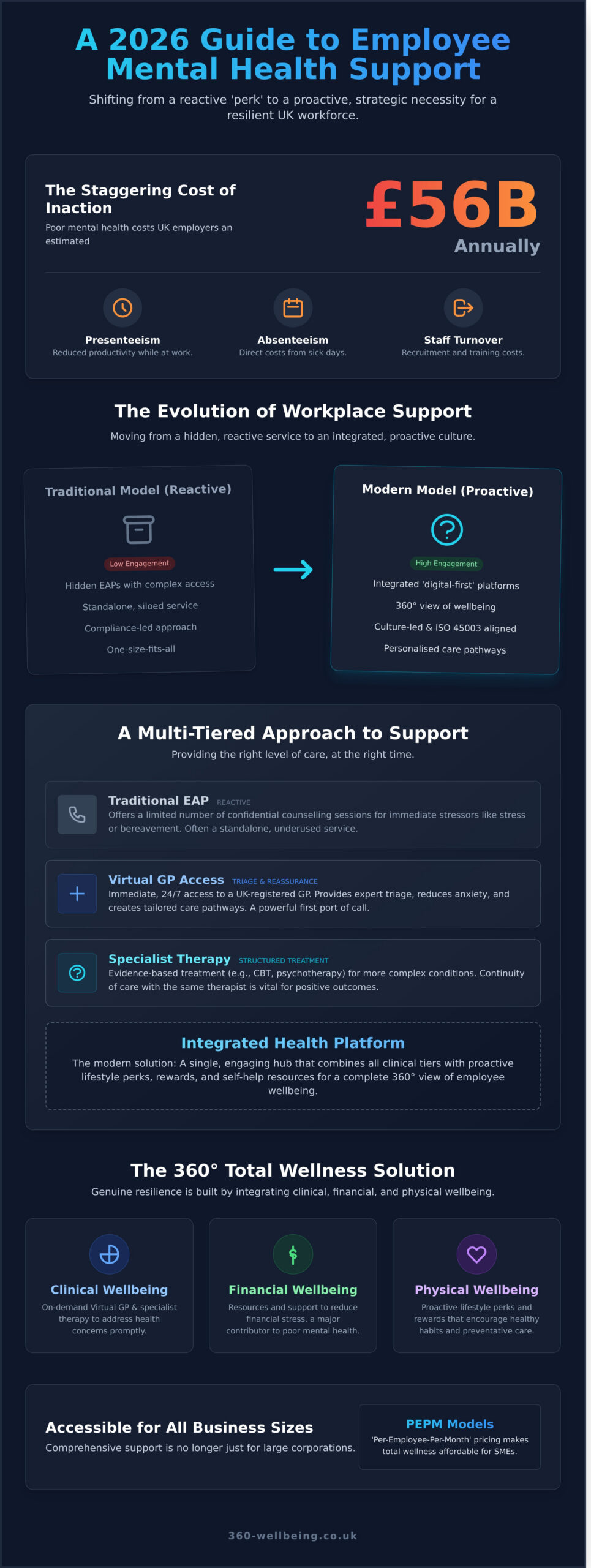
The cost of inaction is now too significant to ignore. Recent analysis from Deloitte estimates that poor mental health costs UK employers up to £56 billion annually, primarily through the hidden drain of presenteeism and the direct costs of absenteeism and staff turnover. This staggering figure underscores a critical truth that informs the state of mental health in the UK workforce: you cannot separate mental and physical wellbeing. This is the core of ‘Total Wellness’-a holistic approach recognising that a resilient mind and a healthy body are intrinsically linked, each directly impacting productivity, innovation, and engagement.
Why Traditional Support Models are Failing
Outdated, passive approaches are proving insufficient for the modern workforce. Many employees are unaware of or hesitant to use traditional ‘hidden’ Employee Assistance Programmes (EAPs) with complex access routes and low visibility. Furthermore, with significant NHS waiting lists for mental health services, relying solely on public healthcare can create prolonged periods of distress for employees and jeopardise business continuity. This reality, coupled with the rise of hybrid work, demands a ‘digital-first’ approach-offering accessible, on-demand support that fits seamlessly into an employee’s life.
The Employer’s Legal and Ethical Duty
Beyond the clear business case, employers have a foundational legal and ethical responsibility. While the Equality Act 2010 and a general duty of care provide a legal baseline, forward-thinking companies are moving from ‘compliance-led’ to ‘culture-led’ support. This means actively fostering psychological safety, a concept now globally standardised by the ISO 45003 framework. The ultimate goal is to create an environment where employee wellbeing is a shared, visible value, not just a policy buried in a folder.
Comparing Tiers of Support: EAPs, Virtual GPs, and Therapy
Understanding the different levels of mental health support is crucial for building a resilient workforce. A truly effective strategy isn’t about offering a single solution, but a comprehensive, tiered approach that meets employees where they are-from proactive self-help tools to intensive clinical intervention. This ensures that every individual receives the right level of care at the moment they need it, moving beyond a one-size-fits-all model.
Employee Assistance Programmes (EAPs) vs. Health Platforms
A traditional Employee Assistance Programme (EAP) typically offers a limited number of confidential counselling sessions for issues like stress or bereavement. While valuable, they are often a reactive, standalone service with historically low engagement rates. In contrast, modern integrated health platforms provide a 360-degree view of wellbeing. They combine clinical services with proactive lifestyle perks, rewards, and self-help resources, creating a single, engaging hub that employees are more likely to use regularly, providing a richer picture of workforce wellbeing.
The Clinical Edge: Virtual GPs and Specialist Therapy
The anxiety of waiting weeks for an NHS appointment can significantly worsen an employee’s condition. Providing immediate access to a UK-registered Virtual GP 24/7 is a powerful first port of call. This initial consultation provides reassurance and expert triage, reducing presenteeism and anxiety. From here, a GP can create a tailored care pathway, which may include a referral for structured mental health therapy. This is a key distinction in the mental health support for employees uk landscape; where EAP ‘counselling’ often addresses immediate stressors, specialist therapy like CBT or psychotherapy provides evidence-based treatment for more complex conditions. When an employee requires this structured support, the GP’s guidance can be complemented by external resources. For instance, the government’s Access to Work scheme can provide grants for practical adjustments, creating a truly holistic support network. Ensuring continuity of care, where an employee can see the same therapist through their journey, is vital for building trust and achieving positive clinical outcomes in a digital environment.
Addressing the #1 Objection: Is Mental Health Support Affordable for SMEs?
One of the most persistent myths in corporate wellness is that comprehensive mental health support is a luxury reserved for FTSE 100 companies with vast HR budgets. This is simply no longer the case. The landscape of mental health support for employees uk has been transformed by flexible, scalable solutions designed specifically for the agility and financial realities of small and medium-sized enterprises (SMEs).
Modern wellbeing platforms operate on a ‘Per-Employee-Per-Month’ (PEPM) subscription model. This means you pay a small, predictable fee for each team member, whether you have a team of three or three hundred. Consider this: the average cost of one month of sick pay for an employee on a £35,000 salary is nearly £3,000 in lost wages alone, not including recruitment or productivity costs. In stark contrast, a comprehensive wellbeing subscription can cost less than a weekly coffee for that same employee, providing proactive support that prevents absence in the first place.
SME-Specific Support Strategies
Even sole traders and micro-businesses can now access corporate-grade benefits. The most cost-effective approach is bundling services. By choosing a single platform that integrates on-demand GP access, mental health counselling, and employee rewards, you eliminate the expense and administrative burden of managing multiple providers. Furthermore, this private provision can work alongside government schemes like ‘Access to Work’ grants, which can help cover costs for employees with specific long-term mental health conditions.
Calculating the Real ROI of Wellbeing
The return on investment extends far beyond preventing sick days; it’s about cultivating a thriving workplace. This ‘Value on Investment’ (VOI) includes improved team morale, enhanced creativity, and a stronger company culture. While fulfilling the employer’s legal duty for mental health is the baseline, a proactive strategy delivers a tangible return. In fact, updated forecasts for 2025/2026 show that for every £1 invested in proactive mental health support, UK employers can expect an average return of £5.30 through reduced absenteeism and presenteeism. In a competitive job market, offering robust mental health support for employees uk is a powerful differentiator that strengthens your employer brand, helping you attract and retain the very best talent.
Building a Proactive Mental Health Strategy: A 5-Step Framework
Moving from a reactive, crisis-led approach to a proactive culture of care is the hallmark of a forward-thinking UK business. A reactive strategy waits for problems to emerge, often when they have already impacted performance and morale. A proactive one builds resilience and provides support before it’s critically needed. This structured, five-step framework provides a clear path to creating a workplace where your team can truly thrive.
An effective strategy for mental health support for employees uk is built on understanding, access, and trust. Follow these steps to build a comprehensive system that delivers real value.
- Step 1: Audit Your Current Culture. Begin with an honest assessment. Use confidential surveys, analyse absence data, and hold listening groups to identify ‘stress hotspots’ in the business. Understanding the root causes of pressure is the essential first step to addressing them.
- Step 2: Secure Leadership Buy-In. Frame wellbeing as a strategic performance driver, not just a cost. Present leaders with clear data linking employee mental health to productivity, talent retention, and innovation. A supportive culture must be championed from the top down.
- Step 3: Implement Accessible, 24/7 Digital Support. Modern teams need modern solutions. A comprehensive digital platform like 360 Wellbeing provides immediate, discreet access to clinical support, self-help resources, and expert guidance right from their pocket.
- Step 4: Train and Empower Your Managers. Equip your line managers to be the first line of support. They don’t need to be therapists, but confident ‘signposters’ who can spot early signs of distress and guide employees toward professional help without overstepping boundaries. Creating volunteer ‘Mental Health Champions’ within teams also helps to normalise these crucial conversations.
- Step 5: Continuously Promote the Service. A world-class platform is only effective if people use it. Launch your new service with a clear communication plan that tackles skepticism head-on by guaranteeing total confidentiality. To drive initial engagement, use integrated features like 360 Rewards as a positive hook to get employees into the app before they need clinical support, building familiarity and trust over time.
The 360-Degree Perspective: Why Total Wellness is the Solution
Often, what presents as a mental health challenge is a symptom of a deeper strain-be it physical discomfort, financial worry, or legal uncertainty. A reactive approach that only offers counselling can miss the root cause. True mental health support for employees uk businesses can provide must acknowledge that a person’s wellbeing is interconnected, with each element directly impacting the others.
This is why we built 360 Wellbeing. Our platform isn’t just another app; it’s a unified ecosystem for total wellness. We seamlessly integrate three critical pillars of support into a single, accessible service for your team:
- Virtual GP Access: Immediate medical advice to address physical health concerns that impact mood and energy.
- Mental Health Support: Confidential counselling and therapy for when it’s needed most.
- Financial & Legal Guidance: Practical tools to alleviate the real-world pressures that cause anxiety.
Beyond crisis intervention, we champion proactive resilience. Our Life Coaching services empower employees who aren’t struggling but want to build the skills to thrive, manage stress effectively, and achieve personal and professional goals.
Financial and Legal Support as Mental Health Care
The link between debt and depression is well-documented in the UK. Providing access to a confidential debt advice helpline is a powerful mental health tool. Similarly, offering complimentary will writing and legal support removes significant ‘life admin’ stress. This practical safety net shows your team you care about their whole life, not just their presence in the office, directly reducing a major source of workplace anxiety.
Getting Started with 360 Wellbeing
Implementing a comprehensive wellbeing strategy shouldn’t be complicated. Our onboarding process is designed for speed and simplicity, getting your team access in days, not months. With tailored packages available for sole traders, SMEs, and large corporations, we provide a scalable solution that delivers the holistic mental health support for employees uk teams deserve.
Ready to build a more resilient, present, and supported workforce? Book a demo or view our 360-degree packages today.
Embracing a Future of Total Wellness for Your Team
As we look towards 2026, it is clear that the conversation around workplace wellbeing has fundamentally shifted. A reactive approach is no longer sufficient; the path forward is a proactive, holistic strategy that recognises mental health is deeply connected to an individual’s total wellness. We’ve explored how comprehensive support is not only essential for building resilience and productivity but is now a genuinely accessible and affordable goal for SMEs.
Implementing a robust framework for mental health support for employees uk is the single most powerful investment you can make in your people and your company’s future. It’s about moving beyond basic provisions to an integrated solution that addresses the whole person. Our 360-degree wellbeing platform provides this complete care, with 24/7 access to UK-registered GPs, integrated mental health therapy, and vital financial and legal support included as standard.
Take the definitive step towards nurturing a workplace where your team doesn’t just work, but thrives. Protect your team with our 360-degree wellbeing platform.
Frequently Asked Questions About Employee Mental Health Support
What is the best mental health support for employees in the UK?
The “best” support is a comprehensive, tailored strategy rather than a single solution. It often combines an Employee Assistance Programme (EAP) for immediate, confidential counselling with proactive measures like manager training and wellbeing workshops. The most effective mental health support for employees UK businesses can offer is a multi-layered approach that addresses both reactive needs and preventative care, fostering a culture of psychological safety and resilience within the workplace.
Are employers legally required to provide mental health support?
UK employers have a legal ‘duty of care’ under the Health and Safety at Work Act 1974. This requires them to protect employees’ health, safety, and welfare, which explicitly includes mental health. While specific services like an EAP are not mandated, employers must assess and manage risks of work-related stress. They must also make ‘reasonable adjustments’ for employees with mental health conditions that qualify as a disability under the Equality Act 2010.
How much does an Employee Assistance Programme (EAP) cost per employee?
The cost of an EAP in the UK can vary based on the level of service and the size of your business. Typically, you can expect to invest between £5 and £15 per employee, per year. More comprehensive packages that include a wider range of services, such as face-to-face counselling sessions or financial advice, may be at the higher end of this range. It is a highly cost-effective way to provide foundational support for your team’s wellbeing.
Can small businesses afford private mental health support for staff?
Absolutely. Many modern wellbeing providers offer scalable and affordable solutions specifically designed for small and medium-sized enterprises (SMEs). Digital-first platforms, pay-as-you-go therapy sessions, and streamlined EAP packages make private support more accessible than ever. Investing in proactive mental health care is a strategic decision that can yield significant returns through reduced absenteeism and improved productivity, making it a viable and valuable choice for businesses of any size.
Is employee mental health support confidential from the employer?
Yes, confidentiality is a cornerstone of effective mental health support. Services like EAPs are strictly confidential, meaning the provider will not share any personal details about an employee’s usage with their employer. Employers may receive anonymised, aggregated data reports on overall usage trends to help inform their wider wellbeing strategy, but individual identities are always protected. This ensures trust and encourages people to seek help when they need it.
What is the difference between an EAP and a Virtual GP service?
An Employee Assistance Programme (EAP) is specifically designed for mental and emotional wellbeing, offering short-term counselling and advice on issues like financial stress or legal matters. A Virtual GP service, on the other hand, provides on-demand access to a qualified doctor for physical health concerns, prescriptions, and referrals. While some comprehensive wellbeing platforms integrate both, their core functions are distinct: EAPs focus on psychological support, while Virtual GPs address physical health.
How do I implement a mental health policy in my small business?
Start by creating a clear, written statement that acknowledges your commitment to employee wellbeing. Outline the support available, such as an EAP or designated Mental Health First Aiders, and explain how to access it. Define roles and responsibilities, ensure confidentiality, and communicate the policy to all staff. It is crucial to lead by example and regularly review the policy to ensure it remains effective and relevant to your team’s evolving needs.
What happens if an employee refuses mental health support?
An employee has the right to refuse support, and this decision must be respected. You cannot force anyone to use an EAP or attend counselling. Your responsibility as an employer is to make the support available, accessible, and to communicate it clearly without stigma. Continue to manage any performance or conduct issues through your standard procedures, while keeping the door open and gently reminding them that confidential support is available should they change their mind.