
What if the 18 week NHS waiting list target for talking therapies wasn’t your only path to professional recovery? You’re likely all too familiar with the frustration of being stuck in a clinical queue or feeling unsure whether a counsellor or a psychologist is the right fit for your specific challenges. It’s exhausting to feel like your wellbeing is on hold while you struggle to find mental health support that actually fits your life, especially when 39% of UK workers still worry that being honest about their stress might impact their career progression.
We understand that navigating these tiers of care can feel like a full time job. This guide will show you how to bypass the bottlenecks and access proactive care through a tailored approach that bridges the gap between private clinical expertise and workplace initiatives. We will break down the UK’s current support tiers, explain how to secure faster access to professional therapy, and help you build a resilient, personal plan for 2026.
Key Takeaways
- Understand why shifting from reactive crisis care to proactive resilience is essential for long-term stability in the 2026 UK landscape.
- Learn how to navigate the clinical gatekeeping system to access the right professional mental health support for your specific needs.
- Compare the speed and depth of NHS Talking Therapies against private options to make an informed decision for your personal or team care.
- Discover how to foster a workplace culture of psychological safety through the effective use of Mental Health First Aiders and Wellbeing Champions.
- Explore the 360-degree perspective that links mental wellbeing with financial and legal health to create a truly holistic support plan.
What is Mental Health Support and Why is it Essential in 2026?
Mental health support isn’t a single destination or a one-size-fits-all solution; it’s a dynamic framework of tools, interventions, and cultural shifts designed to protect our psychological wellbeing. In 2026, the definition has evolved from reactive crisis management to a proactive, preventative model. This means we no longer wait for a person to reach a breaking point before offering help. Instead, we provide a continuous safety net that scales according to individual needs.
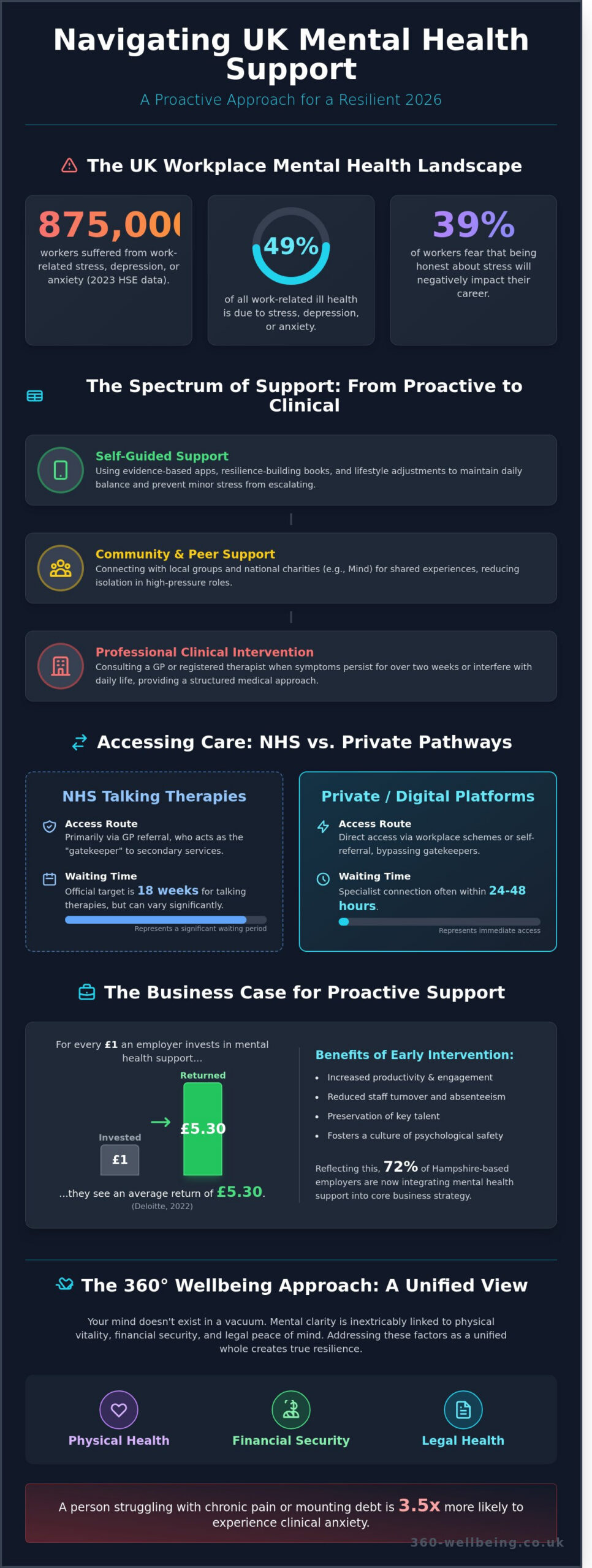
The UK has seen a profound shift in how we view our internal lives. Data from the Health and Safety Executive (HSE) in 2023 showed that 875,000 workers suffered from work-related stress, depression, or anxiety, accounting for 49% of all work-related ill health. By 2026, these figures have pushed 72% of Hampshire-based employers to integrate mental health support directly into their core business strategies. Understanding the broader context of Mental Health in the UK reveals that our modern workforce faces unique pressures, from digital fatigue to the lingering effects of global economic shifts.
We adopt a 360-degree view of health because your mind doesn’t exist in a vacuum. Physical vitality, financial security, and mental clarity are inextricably linked. A person struggling with chronic back pain or mounting debt is statistically 3.5 times more likely to experience clinical anxiety. By addressing these factors as a unified whole, we create a more resilient and harmonious environment for Farnborough’s professionals.
The Spectrum of Care in the UK
Effective support exists on a sliding scale, ensuring that every individual finds the right level of assistance at the right time. This spectrum includes:
- Self-guided support: This involves using evidence-based apps, resilience-building books, and lifestyle adjustments. These tools are excellent for maintaining daily balance and preventing minor stress from escalating.
- Community and peer support: Local grassroots groups and national charities like Mind offer a vital space for shared experience. Connecting with others who understand your specific challenges reduces the isolation often felt in high-pressure roles.
- Professional clinical intervention: When symptoms persist for more than two weeks or interfere with daily life, it’s time to consult a GP or a BACP-registered therapist. This provides a structured, medical approach to recovery and management.
Recognising the Need for Support
Identifying the early warning signs of a struggle is a vital skill for both managers and employees. Burnout often manifests as chronic exhaustion, a sense of detachment from one’s work, and a noticeable drop in professional efficacy. You might notice a colleague who was previously engaged becoming uncharacteristically quiet or irritable. It’s important to distinguish between “feeling low” after a difficult week and clinical depression, which involves a persistent loss of interest and pervasive low mood.
Early intervention remains the most effective way to prevent long-term absence. Deloitte’s 2022 mental health report highlighted that for every £1 spent on mental health support, employers see an average return of £5.30 through increased productivity and reduced staff turnover. Catching the signs early doesn’t just save costs; it preserves the human talent that drives our local economy forward.
Types of Professional Mental Health Support Available
The journey toward better wellbeing often begins in the consultation room of a local GP. In the UK, the General Practitioner serves as the primary gatekeeper for NHS mental health services. They provide the initial assessment required to access secondary care or specialist psychological therapies. While this traditional route remains a cornerstone of the healthcare system, the scale of demand is significant. Data from the 2022-23 NHS Mental Health Bulletin shows that 1.82 million people were in contact with secondary mental health services during that period. This volume often results in waiting lists that don’t always align with the urgent needs of a fast-paced workforce in Farnborough.
Digital health platforms have stepped in to bridge this gap, offering a more immediate connection to specialists. These services have transformed the way employees interact with healthcare by removing geographical and scheduling barriers. Accessing mental health support no longer requires taking a half-day off work to sit in a waiting room. Instead, proactive care is delivered through secure video links, often within 24 to 48 hours of the initial request.
Talking Therapies and Counselling
Cognitive Behavioural Therapy (CBT) is perhaps the most widely recognised talking therapy in the UK. It functions by identifying cycles of negative thoughts and behaviours, providing practical tools to break those patterns. It’s highly effective for anxiety and depression because it focuses on the “here and now.” For individuals seeking a space to explore their emotions without a specific agenda, person-centred counselling offers a non-judgemental environment. This approach prioritises the individual’s self-discovery and personal growth, which is essential for long-term emotional resilience.
In corporate environments, solution-focused therapy has seen a 25 percent increase in adoption over the last three years. This modality concentrates on a person’s strengths and future hopes rather than past problems, making it particularly useful for managing situational workplace stress. For those who want to explore self-help strategies alongside professional guidance, the NHS Every Mind Matters website provides excellent evidence-based resources to complement formal sessions.
Specialised Support Services
It’s vital to distinguish between life coaching and therapy to ensure the support matches your specific goals. Life coaching is generally future-oriented and focuses on performance, career transitions, or achieving specific life milestones. Therapy, conversely, is designed to treat clinical conditions and heal deeper psychological wounds. For individuals who have experienced significant adversity, trauma-informed care ensures that the support provided acknowledges the impact of past experiences on current mental states, avoiding re-traumatisation.
Virtual GP services are now a critical component of modern comprehensive wellbeing strategies. These platforms allow employees to bypass the typical 14-day wait for a standard appointment, providing rapid referrals to psychologists or psychiatrists. This speed is often the deciding factor in preventing a minor mental health concern from escalating into a long-term absence.
Safety and quality should always be the priority when selecting a provider. Always ensure your therapist is registered with an accredited body such as the British Association for Counselling and Psychotherapy (BACP) or the UK Council for Psychotherapy (UKCP). These organisations enforce strict ethical frameworks and continuing professional development requirements, ensuring you receive care that is both safe and scientifically grounded. This 360-degree approach to selection guarantees that the support provided is of the highest clinical standard.
NHS vs. Private Mental Health Support: Comparing Your Options
Choosing between public and private care is a pivotal decision for Farnborough’s professionals. While the NHS provides a vital safety net, the 2023 NHS Talking Therapies annual report reveals that 1.2 million people were referred for help last year. In certain regions, the “postcode lottery” remains a stark reality. This means that while your initial assessment might happen quickly, the gap between that first chat and your actual treatment can stretch for months. For a busy professional in Hampshire, these delays often make immediate mental health support through private channels a more viable path to recovery.
The NHS Pathway
You don’t need a GP appointment to start your journey. Most people can self-refer directly to NHS Talking Therapies (formerly IAPT) via their local trust’s website. After you submit your details, an assessment practitioner typically contacts you within 10 to 14 days to evaluate your needs. They use standardised tools like the PHQ-9 and GAD-7 scales to measure depression and anxiety levels. If your case is non-urgent, you’ll likely enter a tiered system. You might start with “low-intensity” interventions, such as guided self-help or online modules. The reality of waiting lists for high-intensity face-to-face therapy is more challenging; data from early 2024 suggests that in some areas, only 50% of patients complete their course of treatment within the expected timeframe due to these gaps.
The Corporate and Private Alternative
Private care offers a faster route, but the financial commitment is significant. Individual therapy sessions in the South East often cost between £75 and £160 per hour. This is where Employee Assistance Programmes (EAPs) become a strategic asset for the workforce. These workplace benefits provide confidential, 24/7 mental health support funded entirely by the employer. It’s an immediate bridge to professional help. Many Farnborough firms now also offer virtual GP services. These platforms often guarantee a video consultation within 6 to 24 hours. This speed is crucial when you need a private referral or a prescription adjustment without waiting weeks for a local surgery slot. Private Medical Insurance (PMI) takes this further by covering clinical psychiatric care, which differs from standard wellbeing apps that focus primarily on preventative resilience and habit tracking.
Forward-thinking businesses are moving toward hybrid models. They act as the “first line” of defence, catching stress and burnout before they escalate into a clinical crisis. By following official workplace mental health guidance, employers can create a structured environment that complements NHS services rather than replaces them. This proactive stance is becoming the gold standard. In fact, a 2023 Deloitte report found that for every £1 spent on employee mental health, businesses see an average return of £5.30 through reduced presenteeism and turnover. It’s a clear cost-benefit win. By providing early intervention tools, companies ensure their staff don’t have to rely solely on overstretched public waiting lists during a vulnerable time. This 360-degree approach balances the clinical expertise of the NHS with the agility of private, tailored care.
How to Build a Mental Health Support Plan at Work
Creating a robust plan isn’t about ticking boxes or hanging a few posters in the breakroom. It’s about building a 360-degree ecosystem where every individual feels seen and heard. In Farnborough’s competitive business landscape, from the aerospace hubs to the bustling tech parks, the pressure can be relentless. Leaders must move beyond reactive measures to foster true psychological safety. A proactive approach starts with appointing Mental Health First Aiders (MHFAs). These trained staff members act as a vital first point of contact, providing non-judgmental listening and immediate guidance. They aren’t therapists; they’re the essential bridge to professional mental health support services.
Alongside MHFAs, Wellbeing Champions can drive cultural change from the ground up. These individuals help normalise conversations about stress by sharing resources and organising low-pressure social interactions. To truly reduce workplace triggers, you must look at the physical and digital environment. High noise levels, vague job descriptions, and “always-on” email cultures contribute heavily to chronic anxiety. You can mitigate these risks by implementing “quiet hours” or reviewing workload distribution during monthly audits. Many firms provide an Employee Assistance Programme (EAP), yet national usage rates often hover around 5% to 10%. To use an EAP effectively, you must communicate its total confidentiality. It’s a vital tool that offers immediate counselling, bypassing the long NHS waiting lists often found in the South East.
For Employers: Supporting Your Team
The ISO 45003 standard provides the first global framework for managing psychosocial risks at work. It isn’t just a certificate; it’s a commitment to psychological health and safety. Managers should replace standard “task updates” with holistic check-ins. Ask how a person is actually doing, rather than just asking for a status report. The business case is undeniable. According to the 2024 Deloitte Mental Health Report, UK employers see an average return of £5.30 for every £1 invested in staff wellbeing. This ROI stems from reduced presenteeism and significantly higher staff retention rates in a tight labour market.
For Employees: Managing Your Own Wellbeing
You own your health journey, and setting boundaries is your most powerful tool. If your contract finishes at 5:30 PM, make a conscious effort to disconnect your work devices. It’s better to utilise your workplace benefits early rather than waiting for a crisis point. When you need to have a difficult conversation with your manager, preparation is key. Use “I” statements, such as “I’ve noticed I am feeling more fatigued by this specific deadline,” to keep the dialogue constructive. Remember that mental health support is a right, not a luxury, and seeking it early is a sign of professional resilience.
Ready to transform your workplace culture and protect your most valuable assets? Explore our comprehensive corporate health solutions to get started.
The 360 Wellbeing Approach: Holistic Support for a Modern World
Traditional healthcare models often wait for a crisis before they react. At 360 Wellbeing, we’ve designed a proactive ecosystem that identifies the early warning signs of burnout and anxiety. We prioritise immediate access to GPs and therapists because we know that delay is the primary enemy of recovery. When a staff member in Farnborough feels their resilience slipping, they shouldn’t have to wait weeks for a referral. Our model ensures that professional intervention happens in days, not months, which directly reduces long-term absence and preserves the human element of your workforce.
Our platform integrates 24/7 support to catch issues before they spiral into clinical depression or chronic stress. We’ve moved toward a future of Total Wellness for UK businesses, where health is viewed as a strategic asset. By providing a 360-degree perspective on care, we help individuals balance their physical, mental, and social health through a single, unified narrative. It’s about creating a culture where every employee feels seen, heard, and supported throughout their entire career journey.
Bridging the Support Gap
The 2024 NHS data shows that many patients face wait times exceeding 18 weeks for routine mental health referrals. This gap is where most workplace productivity is lost. Our 24/7 Virtual GP service provides a faster route to professional advice, allowing staff to speak with a doctor from the comfort of their home or office. This immediate connection often serves as the first step in a comprehensive mental health support plan. It removes the logistical hurdles that often prevent people from seeking help early.
We’ve also integrated life coaching into our service because we believe in helping staff thrive, not just survive. While therapy addresses clinical needs, life coaching focuses on personal growth, goal setting, and building daily resilience. Every staff member gains access to confidential, professional therapy sessions. We ensure these practitioners are highly vetted and matched to the individual’s specific needs, whether they’re dealing with bereavement, workplace conflict, or personal anxiety. This tailored approach ensures that the support provided is relevant and effective.
Beyond the Therapy Room
Mental health doesn’t exist in a vacuum. A 2024 report by the Money and Pensions Service found that 24% of UK employees struggle to focus at work because of financial worries. We address these root causes directly by including financial and legal support within our wellbeing toolkit. If an employee is stressed about debt or a housing dispute, a therapy session alone won’t solve the problem. By providing expert legal guidance and debt management tools, we tackle the external pressures that cause mental health to decline in the first place.
To encourage a proactive lifestyle, we’ve developed the 360 Rewards system. This programme promotes positive lifestyle choices by offering discounts on gym memberships, healthy food retailers, and leisure activities. It’s a tangible way to reward employees for looking after themselves. When people feel physically fit and financially secure, their mental resilience naturally increases. This holistic strategy transforms wellbeing from a corporate checkbox into a living part of your company culture. It’s time to move beyond basic perks and invest in a system that truly cares for the whole person.
Discover how 360 Wellbeing can transform your organisation’s mental health support and build a more resilient, productive workforce for the future.
Prioritising a Resilient Future with Proactive Care
As we navigate the complexities of 2026, it’s clear that mental health support is no longer a luxury but a fundamental right for every employee in the UK. You’ve seen how the landscape is shifting from reactive treatment to a 360-degree model that integrates physical, mental, and social health. Whether you’re comparing the immediate access of private care against traditional NHS routes or building a bespoke workplace strategy, the goal remains the same: fostering resilience and workplace harmony.
Our approach at 360 Wellbeing ensures your team isn’t left waiting. We provide 24/7 access to UK-registered GPs and sessions with BACP-accredited therapists to address challenges before they escalate. We also include holistic financial and legal support to tackle the external stressors that often impact internal peace. By treating wellbeing as a strategic asset, you’re investing in the long-term vitality of your entire organisation. It’s about creating a culture where everyone can thrive.
Explore our comprehensive mental health support packages for your team to start building a healthier, more balanced environment today. You’re not just choosing a service; you’re choosing a dedicated partner for your team’s journey toward total wellness.
Frequently Asked Questions
How do I get mental health support on the NHS?
You can access mental health support on the NHS by booking an appointment with your GP or by self-referring directly to an NHS Talking Therapies service. Your doctor acts as a gateway to specialist care, assessing your needs to determine if secondary care is required. In 2023, the NHS reported that 1.2 million people were referred to these psychological services. This path ensures you receive clinical guidance tailored to your specific symptoms within a structured framework.
Can I get therapy for free in the UK?
You can receive therapy for free in the UK through the NHS or via charitable organisations such as Mind and Rethink Mental Illness. Many employees in Farnborough also have access to free sessions through an Employee Assistance Programme (EAP) provided by their workplace. These programmes often provide between 6 and 8 sessions of counselling at no cost to the individual. This ensures that financial barriers don’t prevent you from seeking vital mental health support when it’s needed most.
What is the difference between a counsellor and a psychotherapist?
The primary difference lies in the depth of training and the focus of the treatment provided. Counsellors typically focus on specific life events or short-term issues, requiring a minimum of a Level 4 diploma to practice. Psychotherapists usually undergo a minimum of 4 years of postgraduate training to treat deeper, more complex psychological patterns. Both roles are essential components of comprehensive mental health support, providing a 360-degree approach to emotional resilience and long-term recovery.
How long are the waiting lists for mental health support in the UK?
Waiting times vary significantly by region, but the NHS target aims for 75% of people to start talking therapies within 6 weeks of referral. According to NHS England data from March 2024, approximately 90% of patients began treatment within 18 weeks. However, some specialist services for complex conditions can involve waits of 12 months or longer. Proactive employer-led schemes often bypass these delays, providing immediate intervention to maintain workplace harmony and individual vitality.
What should I do if I am in a mental health crisis right now?
You should contact the NHS 111 service or call 999 immediately if you are in an urgent mental health crisis. Alternatively, the Samaritans provide a 24-hour listening service reachable by calling 116 123 from any UK phone. Most local areas in Hampshire now operate 24/7 crisis lines specifically for mental health emergencies. Reaching out for this professional assistance is a vital first step in ensuring your immediate safety and long-term stability.
Does my employer have to provide mental health support?
Employers have a legal duty of care under the Health and Safety at Work Act 1974 to ensure the health, safety, and welfare of their staff. This includes protecting employees from manageable workplace stress and providing reasonable adjustments under the Equality Act 2010. While they aren’t strictly required to provide private therapy, 70% of UK businesses now offer some form of wellbeing benefit. Supporting your team isn’t just a legal obligation; it’s a strategic asset for productivity.
Can a Virtual GP prescribe medication for mental health?
A Virtual GP can prescribe many common medications for mental health, such as antidepressants, following a thorough video consultation. They provide a convenient way to access clinical expertise without the wait times often found at local surgeries. However, they don’t prescribe controlled drugs or initiate complex treatment plans that require physical monitoring. This service offers a modern, accessible bridge to recovery, ensuring your treatment is both scientifically grounded and tailored to your lifestyle.
How does an Employee Assistance Programme (EAP) work?
An Employee Assistance Programme (EAP) works as a confidential benefit funded by your employer to support your physical, mental, and social health. You can typically access a 24/7 helpline for immediate advice on issues ranging from financial stress to bereavement. Most EAPs offer a set number of structured counselling sessions, often starting within 5 working days of your initial call. It’s a proactive tool designed to build resilience and provide a clear path forward through life’s challenges.