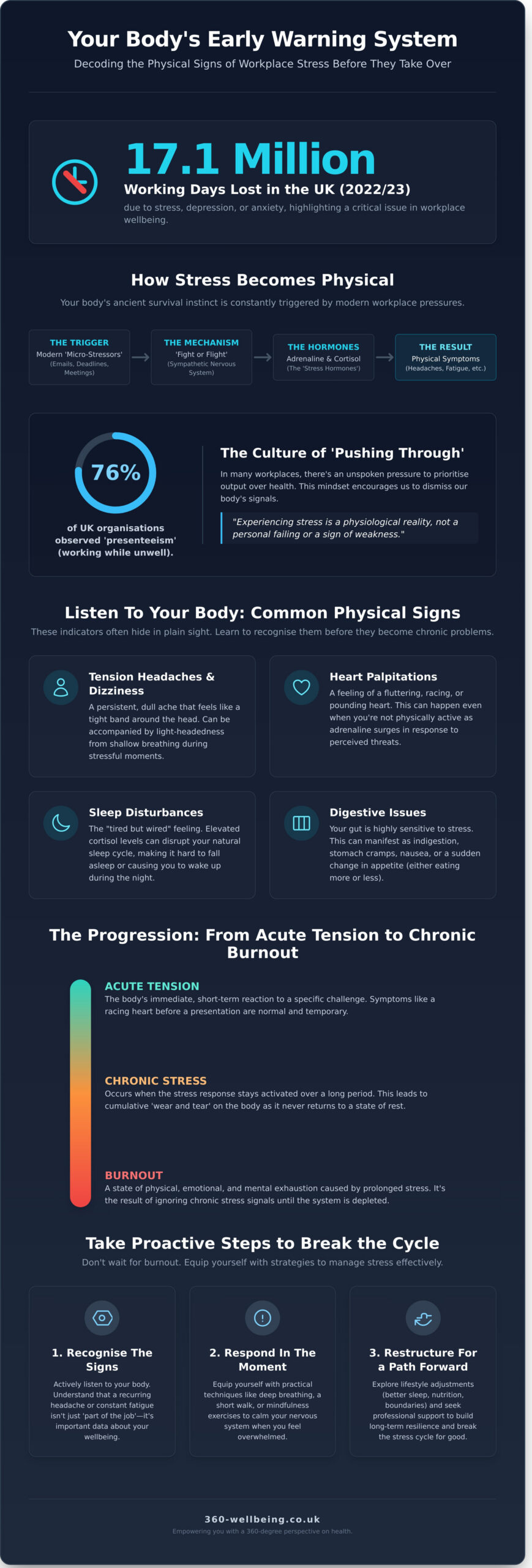
In the UK, stress, depression, or anxiety accounted for a staggering 17.1 million lost working days in 2022/23. But long before it impacts our work performance, stress sends quiet signals through our bodies. It’s all too easy to dismiss a recurring headache, a tight knot in your shoulder, or a sudden wave of fatigue as just ‘part of a busy life’. You’re not alone in feeling this way, especially when getting a timely GP appointment can feel like an uphill battle.
This guide is designed to empower you by decoding these early warning signals. You’ll learn how to confidently identify the common physical signs of stress and discover proactive, accessible steps you can take to reclaim your sense of balance and vitality. Together, we’ll explore a comprehensive list of symptoms, provide actionable self-care strategies, and show you how to access professional support right when you need it most.
Key Takeaways
- Understand how your body communicates distress by learning to recognise the most common physical signs of stress, from recurring headaches to digestive issues.
- Discover the crucial difference between temporary tension and the early stages of chronic burnout, and learn why early intervention is key to long-term health.
- Equip yourself with practical, in-the-moment techniques designed to calm your nervous system and immediately reduce the body’s physical stress response.
- Explore a proactive path forward with structured guidance on lifestyle adjustments and comprehensive support options to break the stress cycle for good.
Understanding the Body’s Early Warning System
Long before your mind registers the full weight of pressure, your body is already sending out signals. Think of it as an ancient, highly intuitive early warning system. This system is rooted in our evolutionary ‘fight or flight’ mechanism, a survival instinct designed to protect us from immediate, physical threats. The challenge is that in today’s high-pressure work environments, this same system is triggered not by predators, but by project deadlines, overflowing inboxes, and difficult conversations.
Your body often reacts physically before you consciously acknowledge the emotional strain. This disconnect is why paying attention to the physical signs of stress is so crucial for proactive wellbeing management. It requires a 360-degree perspective on health, one that understands the deep, undeniable connection between our physical state, our mental clarity, and our social interactions. Ignoring these physical whispers can lead to them becoming debilitating roars down the line.
The Science of the Stress Response
When you perceive a threat, your sympathetic nervous system springs into action. This is the ‘on’ switch that floods your body with hormones like adrenaline and cortisol, preparing you to react instantly. This intricate cascade is a core part of the body’s biological stress response, diverting energy to your muscles and sharpening your focus. While brilliant for short-term crises, modern ‘micro-stressors’ like constant notifications and back-to-back video calls can keep this system simmering all day. This sustained state of high alert prevents your body from returning to a state of rest and repair. Allostatic load is the cumulative wear and tear on the body that results from this chronic stress.
Why We Ignore the Signs
In many UK workplaces, a ‘push through’ culture still prevails. The CIPD’s 2023 Health and Wellbeing report found that 76% of organisations observed ‘presenteeism’ (working while unwell) in the last year, a clear indicator that we often prioritise output over our own health. This environment encourages us to dismiss tell-tale physical symptoms. A persistent headache is blamed on dehydration, stomach issues are attributed to a hasty lunch, and fatigue is just part of the job. By normalising the conversation, we can begin to see that experiencing stress is a physiological reality, not a personal failing or a sign of weakness.
10 Common Physical Signs of Stress to Watch For
Stress doesn’t just live in our minds; it speaks through our bodies. Long before burnout becomes a conversation, our physiology sends out clear distress signals. For managers and team members in the UK, learning to recognise these physical signs of stress is a proactive step toward building a more resilient and supportive workplace. These indicators often hide in plain sight, dismissed as everyday aches or tiredness, but they tell a deeper story about a person’s wellbeing.
By understanding what to look for, you can move from a reactive position to one of proactive care. Here, we’ve categorised the most frequent indicators found in UK professionals to help you spot the patterns before they become problems.
Head and Heart: The Immediate Indicators
The body’s initial response to pressure often targets the nervous and cardiovascular systems. These signs can appear suddenly and are frequently linked to specific, high-pressure moments in the workday.
- Tension Headaches and Dizziness: Do you notice a colleague consistently rubbing their temples during the 3 PM afternoon slump? A persistent, dull ache that feels like a tight band around the head is a classic tension headache. When stress causes hyperventilation (short, shallow breaths), it can also lead to feelings of light-headedness or dizziness, especially during intense meetings or before a major deadline.
- Heart Palpitations: It’s easy to blame a racing heart on that extra espresso. However, if a team member mentions feeling their heart ‘fluttering’ or pounding unexpectedly, it could be a stress response. Unlike a caffeine buzz, stress-induced palpitations can occur even when sitting still, as the body floods with adrenaline in a ‘fight or flight’ reaction to perceived threats, like an overflowing inbox.
- Sleep Disturbances: The “tired but wired” phenomenon is a key indicator. A colleague might complain of exhaustion yet admit they were wide awake at 3 AM, their mind racing with work worries. This is often caused by elevated cortisol levels disrupting the natural sleep cycle, making it difficult to fall asleep or stay asleep.
Gut and Muscle: The Chronic Manifestations
When stress becomes chronic, its effects embed deeper into our physiology, often leading to persistent and nagging health issues. These long-term symptoms reflect a system running on empty.
- Digestive Issues: The gut is often called our ‘second brain’ for good reason. Stress can disrupt gut health, leading to symptoms like indigestion, stomach cramps, or a sudden change in appetite. You might observe a colleague who always skips lunch when deadlines are tight or, conversely, relies heavily on sugary snacks from the vending machine for comfort.
- Muscle Tension and Back Pain: Notice the colleague who is permanently hunched over their keyboard, with shoulders raised towards their ears? This is a physical manifestation of carrying an emotional load. This chronic tension contributes significantly to the back pain experienced by nearly 50% of UK office workers. Look for more subtle signs too, like jaw clenching during concentration or someone constantly stretching their stiff neck. These chronic issues are often part of a wider pattern of the common signs and symptoms of stress that the NHS identifies, linking our physical state directly to our mental load.
- Weakened Immune Response: Ever wondered why you or a colleague always seems to get ill the moment a holiday begins? It’s not a coincidence. Sustained high levels of cortisol suppress the immune system. Once the pressure is off and cortisol levels drop, the immune system can rebound, sometimes over-reacting and making you susceptible to every passing cold. Frequent minor illnesses are a strong sign of an overloaded system.
Recognising these signals is the first step. Creating an environment where these issues can be safely discussed and managed is the next, and that’s where a truly comprehensive wellbeing strategy can make a tangible difference to your team’s health and productivity.
The Progression: From Acute Tension to Chronic Burnout
Stress isn’t inherently a villain. The rush of adrenaline before a major presentation or the focus that comes with a tight deadline is a form of ‘eustress’-a beneficial, short-term motivator that sharpens our senses and drives performance. The danger emerges when the pressure dial never turns down. Understanding the journey from a temporary state of tension to a chronic state of burnout is the first step in proactively protecting your team’s wellbeing. It’s a subtle shift, where the body’s emergency alert system gets stuck in the ‘on’ position, transforming helpful reactions into harmful health risks.
Acute vs. Chronic Stress
The body’s immediate reaction to a threat is a brilliant, primitive survival mechanism. But when that threat becomes the daily grind of back-to-back meetings and an overflowing inbox, the system begins to break down. We often see leaders mistake ongoing high performance for resilience, when in fact it might be masking a steady progression towards burnout. This is particularly true for ‘episodic acute stress’, where an employee lurches from one crisis to another, never truly entering a recovery phase. Over time, the body’s response can manifest in a wide range of physical symptoms of stress, often becoming so normalised that we fail to see the pattern. Unlike a sudden panic attack, chronic stress is often quiet and persistent, making it far more insidious.
| Acute Stress Response (Short-Term) | Chronic Stress Damage (Long-Term) |
|---|---|
| Sweaty palms, racing heart | Hypertension and increased risk of heart disease |
| Temporary muscle tension | Chronic migraines and musculoskeletal disorders |
| A brief spike in cortisol for energy | Weakened immune system and frequent illness |
| Sharpened, immediate focus | Digestive issues like IBS and acid reflux |
This prolonged state of alert is what leads to serious long-term conditions. According to the British Heart Foundation, around one in four adults in the UK have high blood pressure, and persistent stress is a significant contributing factor. Identifying these persistent physical signs of stress is crucial before they escalate into irreversible health problems.
The Productivity Tax
Chronic stress levies a heavy tax on your organisation’s productivity, often in ways that aren’t immediately obvious on a balance sheet. It fuels ‘presenteeism’, where employees are physically at their desks but mentally and emotionally checked out. The CIPD’s 2023 Health and Wellbeing at Work report found that 76% of organisations observed presenteeism in their staff over the last year. An employee suffering from a constant tension headache or digestive discomfort simply can’t engage in deep, strategic work. Their cognitive bandwidth is consumed by managing their physical pain.
This physical discomfort is directly linked to cognitive fog, poor concentration, and impaired decision-making. When the body is constantly releasing cortisol, it diverts resources away from the prefrontal cortex-the brain’s hub for executive functions. The result? More mistakes, missed deadlines, and a decline in innovation. This creates a ripple effect. One team member’s low energy and irritability can quickly erode team morale, increase interpersonal conflicts, and drag down the entire department’s output. It’s a clear example of how one individual’s wellbeing is a strategic asset for the whole team.
The ‘tipping point’ occurs when these symptoms are no longer occasional annoyances but daily realities. When an employee is consistently calling in sick with stress-related ailments, or when their performance decline is noticeable and sustained, it’s a clear signal that their coping mechanisms are overwhelmed. This is the moment where proactive, professional intervention isn’t just helpful; it’s essential for both the individual’s health and the organisation’s stability.
Taking Proactive Steps: How to Respond to Physical Stress
Recognising the physical signs of stress in yourself or your team is the critical first step. The next is to respond not with alarm, but with a proactive, structured plan. A comprehensive approach doesn’t just manage the symptoms; it addresses the root cause with compassion and strategy. This involves a dual focus: immediate techniques to regulate your body’s response in the moment, and long-term lifestyle adjustments to build lasting resilience.
Immediate Nervous System Regulation
When you feel a headache building or your shoulders tensing up before a difficult conversation, your sympathetic nervous system is in overdrive. You can consciously shift back into a state of calm with simple, discreet techniques. Box breathing, a method used by everyone from yoga practitioners to the Royal Marines, involves inhaling for four seconds, holding for four, exhaling for four, and holding again for four. It’s a powerful and immediate circuit-breaker for anxiety. Similarly, the 5-4-3-2-1 grounding technique (naming five things you see, four you can touch, three you hear, two you smell, and one you can taste) pulls your focus away from internal panic and back to your present environment. These tools are invaluable for managing acute stress during the workday.
Physical tension often gets stored in the neck, shoulders, and back. A simple ‘Desk Reset’ can make a significant difference. According to a 2022 study by the University of Leicester, just five minutes of targeted stretching can reduce perceived muscle tension by up to 40%. Try incorporating these into your day:
- Neck Rolls: Gently tilt your head from side to side, holding for 15 seconds each way.
- Shoulder Shrugs: Inhale and lift your shoulders to your ears, then exhale and release them completely.
- Wrist Flexes: Extend your arms and gently bend your wrists up and down to alleviate typing strain.
Finally, implement ‘digital detox’ intervals. Constant screen time contributes to eye strain and tension headaches. The Pomodoro Technique-working in a focused 25-minute block, followed by a 5-minute screen-free break-is an excellent way to protect your eyes and give your brain a necessary pause.
Addressing the Root Causes
While in-the-moment techniques are essential, they are only part of the solution. Truly resolving the physical manifestations of stress requires a 360-degree look at the underlying triggers. Is the persistent stomach unease linked to financial anxiety? The Money and Pensions Service 2023 report found that nearly 9 million adults in the UK have low financial resilience, a stressor that directly impacts physical health. Or perhaps that recurring jaw clenching is tied to a complex legal issue or personal conflict.
Identifying these core issues is the only way to create sustainable change. This is where professional support becomes a strategic asset. Our Life Coaching services, for example, provide a confidential space to untangle these complex challenges. A coach helps you develop practical frameworks for reframing problems and building the confidence to tackle them head-on. It’s an investment in developing the skills to manage not just current stressors, but future ones too.
Protecting your physical health also means setting firm boundaries. Learning to say ‘no’ to additional projects when your plate is full isn’t a sign of weakness; it’s a crucial act of self-preservation that prevents burnout. Clear boundaries protect your time and energy, reducing the chronic stress that leads to fatigue, weakened immunity, and other serious physical symptoms. Creating a Personal Wellbeing Plan is an effective way to monitor your unique triggers and proactively manage your response. To build a tailored strategy that addresses your specific challenges, connect with our team to explore our holistic wellbeing services.
Comprehensive Support: Navigating Health with 360 Wellbeing
Recognising the signs of stress is the first critical step. But providing a clear, immediate path to support is what transforms awareness into genuine care. When your team members experience concerning physical signs of stress, they need more than just acknowledgement; they need swift, expert reassurance and a tangible solution that addresses the root cause, not just the symptom. This is where a truly integrated wellbeing strategy becomes indispensable.
At 360 Wellbeing, we’ve built a comprehensive ecosystem designed to provide exactly that. We understand that an employee’s headache could be linked to financial anxiety, or that muscle tension might stem from a looming legal issue. By treating the whole person, we empower your team to break the cycle of stress before it takes a lasting toll. Our approach isn’t just about offering benefits; it’s about providing an interconnected pathway to total health, empowering your people to take charge of their journey with expert caregivers at their side.
Direct Access to Clinical Expertise
When an employee experiences a new physical symptom, the uncertainty can be a significant source of anxiety. The prospect of waiting for a GP appointment, a delay that affected over 5 million patients for more than 28 days in late 2023, only exacerbates the stress. Our 24/7 Virtual GP service eliminates this waiting game, providing immediate peace of mind. A virtual consultation with a UK-registered doctor can quickly help determine if a symptom is stress-related or points to another underlying condition. This direct access provides:
- Immediate Reassurance: Round-the-clock video or phone consultations mean your team can speak to a doctor in minutes, not weeks.
- Clinical Clarity: Expert medical advice helps rule out other causes for physical symptoms, reducing health anxiety.
- Seamless Convenience: Prescriptions can be sent directly to a local pharmacy and referrals issued, all from the convenience of a smartphone.
A Holistic Safety Net for Your Team
Addressing the physical manifestations of stress is only one part of the equation. The true solution lies in connecting the dots between mind and body. Our comprehensive Employee Assistance Programme (EAP) provides confidential Mental Health Support, giving employees the tools to manage the psychological triggers behind their physical symptoms. We also know that stress is rarely confined to health alone. That’s why our platform integrates financial and legal guidance, offering a true 360-degree safety net that tackles stress at its source, whatever it may be.
By encouraging proactive wellness through platforms like 360 Rewards, we help employees build positive lifestyle habits that foster mental and physical fortitude. Ultimately, resilience isn’t about enduring hardship alone; it’s about having the right support system in place to navigate life’s challenges. It’s about giving your team the resources they need to thrive, not just survive.
Listen to Your Body, Empower Your Team
Your body is a powerful communicator. Understanding its language-from persistent headaches to digestive issues-is the first step towards taking control. Recognising the early physical signs of stress isn’t just about managing symptoms; it’s about proactively preventing the slide from acute tension into chronic burnout. You don’t have to navigate this journey alone.
True resilience is built on comprehensive support. At 360 Wellbeing, we provide a complete health ecosystem designed specifically for UK SMEs and sole traders. Our platform offers 24/7 access to UK-registered GPs and holistic support that integrates your team’s Mental, Financial, and Physical health into one seamless strategy.
Discover how our 360-degree support platform protects your team’s health and build a more vibrant, resilient future for your business today.
Frequently Asked Questions
Can stress cause real physical pain?
Yes, stress can absolutely cause real physical pain. When your body is in a state of stress, it releases hormones that cause your muscles to tense up, preparing for a ‘fight or flight’ response. Prolonged tension can lead to chronic pain conditions like recurring tension headaches, a sore back, and even jaw pain from clenching. A 2021 study in the *Journal of Pain Research* confirmed a direct link between high cortisol levels and increased sensitivity to pain.
What are the most common physical signs of stress at work?
The most common physical signs of stress at work include persistent fatigue, frequent tension headaches, and digestive issues like an upset stomach. According to the UK’s Health and Safety Executive (HSE) 2023 report, stress, depression, or anxiety accounted for 49% of all work-related ill health. These physical symptoms are often the first indicators that pressure is becoming unmanageable, acting as your body’s early warning system that it’s time to take action.
How do I know if my symptoms are stress or a serious illness?
You can’t know for certain without professional medical advice, so it’s vital to consult a GP to rule out other conditions. While stress-related symptoms often worsen during periods of high pressure and ease when you relax, they can mimic more serious illnesses. New or severe symptoms, especially chest pain, sudden weight changes, or persistent stomach trouble, always require a professional diagnosis. Don’t guess with your health; seek a definitive and reassuring answer from a doctor.
Can stress cause long-term damage to the body?
Yes, chronic stress can cause significant and lasting damage to your body if it isn’t managed proactively. The constant exposure to stress hormones can elevate your blood pressure, weaken your immune system, and increase inflammation. The British Heart Foundation identifies long-term stress as a major risk factor for heart and circulatory diseases, which are responsible for over a quarter of all deaths in the UK. Managing stress is a critical component of your long-term physical health strategy.
How can a Virtual GP help with stress-related symptoms?
A Virtual GP offers a fast, confidential, and convenient way to get professional medical advice for your symptoms. You can secure a same-day video or phone appointment, allowing you to discuss your concerns without the stress of travelling to a clinic. The GP can help determine if your symptoms are stress-related, suggest tailored management techniques, provide a prescription if needed, or make a referral for further investigation, giving you a clear and proactive path forward.
What should I do if I notice a colleague showing signs of physical stress?
You should approach the conversation with care and discretion, focusing on support rather than diagnosis. Find a private moment and ask them how they’re doing, perhaps mentioning you’ve noticed they seem under pressure. Gently guide them towards company resources like an Employee Assistance Programme (EAP) or a designated Mental Health First Aider. Your role is to be a supportive ally and bridge them to the professional support systems your organisation has in place.
Is it possible to be stressed without feeling ‘worried’?
Absolutely. It’s very common for the body to react to pressure long before the mind consciously labels it as ‘worry’ or ‘anxiety’. You might not feel emotionally overwhelmed, but you could be experiencing physical signals like poor sleep, skin breakouts, or frequent colds. This disconnect happens because the body’s physiological stress response can operate independently of our emotional awareness. Recognising these physical cues is a vital part of a holistic approach to wellbeing.
How quickly can physical signs of stress improve once managed?
Physical symptoms can start to improve within days or weeks of implementing effective stress management strategies. Acute issues like a tension headache can sometimes ease within an hour of a relaxation technique. More chronic symptoms, such as digestive problems or high blood pressure, may take several weeks of consistent effort-like regular exercise and mindfulness-to show marked improvement. The key is consistency; building resilience is a gradual but highly rewarding process.