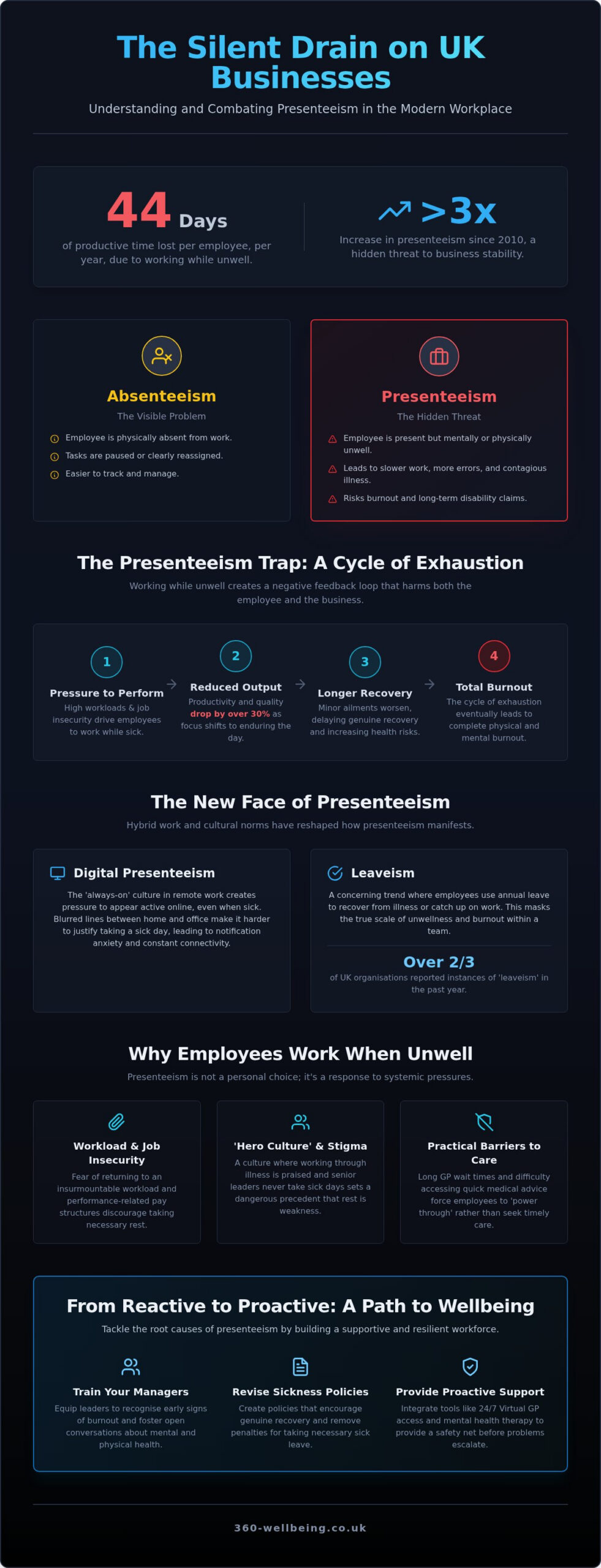
Did you know the average UK employee loses 44 productive days every year simply by showing up to work while they’re unwell? This hidden phenomenon, known as presenteeism in the workplace, has more than tripled since 2010, quietly draining business resources and exhausting even your most dedicated team members. It is a subtle but significant challenge that often goes unnoticed until it impacts your long-term stability and staff retention.
It’s easy to see why this happens. In an era of hybrid work and high workloads, many staff feel they must prove their commitment by logging on despite physical or mental health struggles. You’ve likely noticed the rising burnout or the difficulty in monitoring wellbeing when teams aren’t in the same room. We promise to help you identify these invisible drains and implement proactive health strategies that protect your team’s vitality and your business ROI. In this guide, we’ll explore the underlying causes of this trend and provide a clear, structured path toward a healthier, more genuinely productive workforce for 2026.
Key Takeaways
- Understand the vital distinction between absenteeism and presenteeism to see why working through illness is often the greater threat to your bottom line.
- Identify the cultural pressures that drive presenteeism in the workplace, including the hidden habit of ‘leaveism’ where staff work during their annual leave.
- Quantify the financial and human toll of a ‘powering through’ culture to move your team toward a more sustainable and balanced approach to productivity.
- Gain practical techniques for training managers to recognise early burnout signals and revising sickness policies to focus on genuine recovery.
- Explore how integrating 24/7 Virtual GP access and mental health therapy provides a proactive safety net for your employees before health challenges escalate.
Understanding Presenteeism in the Modern UK Workplace
To understand the health of a modern business, we must look beyond empty desks. While absenteeism is the visible act of staying home, presenteeism in the workplace is the hidden habit of showing up while physically or mentally unwell. It is a quiet drain on resources. If you want a foundational look at the history and measurement of this issue, you can explore what is presenteeism to see how it has evolved over decades. Today, it represents a far greater threat to ROI than total absence. When a person is absent, their tasks are often reassigned or paused. When they are present but unwell, they work slower, make more mistakes, and risk turning a minor ailment into a long term disability claim.
The Difference Between Dedication and Presenteeism
Managers often fall into the trap of praising an employee who logs on despite a fever or a period of intense anxiety. They see it as a sign of high engagement. In reality, this is rarely about dedication; it’s usually about pressure. In the competitive 2026 job market, many staff feel a psychological need to ‘show face’ to secure their position. The ‘presenteeism trap’ is a reality where an individual’s output quality drops by over 30% because their cognitive resources are focused on simply enduring the day rather than excelling at their tasks. This creates a cycle of exhaustion that eventually leads to total burnout.
Digital Presenteeism and the Hybrid Work Era
The rise of remote and hybrid models hasn’t solved the problem. It has simply changed its shape. Digital presenteeism is the new frontier. With the lines between home and office now blurred, employees find it harder to justify taking a sick day. They feel a heightened need to prove they are working by maintaining a ‘active’ status icon on communication platforms. Notification anxiety keeps people tethered to their laptops even when they are suffering from severe migraines or high levels of stress. They worry that an away status will be interpreted as a lack of commitment. This ‘always-on’ digital office culture means that presenteeism in the workplace is no longer just about being at a physical desk. It’s about the mental load of constant availability. Supporting your team requires a panoramic view of their digital habits just as much as their physical attendance.
The Root Causes: Why Employees Work When Unwell
Understanding why your team chooses to work while ill requires looking at the environment they operate in every day. It isn’t just a matter of personal choice. Often, it’s a response to structural pressures that make rest feel like a risk. Research into the causes and consequences of presenteeism suggests that firm-level factors, such as workload and sick pay structures, play a massive role in shaping these behaviours. When an employee feels they cannot step away, the result is a fragile workforce that prioritises attendance over actual health.
One of the most concerning trends emerging in 2026 is ‘leavism’. This practice involves employees using their scheduled annual leave to catch up on work or to hide the fact that they are unwell. More than two-thirds of organisations reported instances of leavism in the past year. This hides the true scale of presenteeism in the workplace, making it difficult for managers to see the real state of team wellbeing. Practical barriers also contribute to this problem. Long GP wait times often force people to ‘power through’ because they cannot get a professional consultation quickly enough to justify a day off. Providing a faster route to medical advice, such as a 24/7 Virtual GP, can remove this barrier and encourage earlier, more effective recovery.
Workload Pressure and Job Insecurity
When teams are run ‘lean’ with no built-in redundancy for illness, the fear of returning to an insurmountable mountain of emails often outweighs the need for rest. Performance-related pay structures can also inadvertently punish those who take time to recover. This creates a ‘hero culture’ where working through physical or mental pain is praised as a sign of strength. In reality, this approach only serves to deplete the long term durability of your staff.
The Stigma of Sickness in Corporate Culture
Despite progress, a stigma remains around mental health that makes it feel ‘harder’ to take a day off for stress than for a physical injury. This is often reinforced by senior leaders who never take sick days themselves, setting an unspoken standard that rest is a sign of weakness. This ‘presenteeism contagion’ spreads quickly. If one team member refuses to rest while ill, others feel a psychological pressure to do the same, even if they are struggling. Breaking this cycle requires a panoramic view of health where rest is seen as a professional necessity rather than a luxury.
The Economic and Human Impact of ‘Powering Through’
Choosing to “power through” a workday while ill might feel like a necessity, but it carries a heavy price for both the individual and the organisation. This habit is often the silent killer of business profitability. Unlike absenteeism, where a gap in the rota is visible and manageable, presenteeism in the workplace creates a fog of low productivity that is much harder to track. When an employee is physically present but cognitively impaired by illness or stress, they are prone to making costly data errors or, in physical roles, causing workplace accidents. The human cost is just as steep. One unwell employee can inadvertently lower the collective output of their entire team, as colleagues often have to spend time correcting mistakes or managing the friction that arises from a teammate’s diminished capacity.
The £100bn+ Drain on UK Productivity
The financial scale of this issue is staggering. Estimates from 2023 placed the cost of presenteeism to UK businesses at £103 billion, a significant £30 billion increase from just five years prior. Recent data from the Institute for Public Policy Research (IPPR) indicates that UK employees now lose an average of 44 productive days each year by working while unwell. These aren’t just abstract numbers; they represent a direct drain on your business ROI. High levels of presenteeism are also a leading indicator of staff turnover. When people feel they cannot rest, they eventually leave, forcing businesses to face the rising costs of recruitment and training. Reducing these pressures often starts with addressing the external factors that keep staff at their desks, such as financial anxiety. Providing Financial Support for Employees can be a vital tool in breaking the cycle of stress driven presenteeism.
From Acute Illness to Chronic Burnout
Ignoring early symptoms of ill health doesn’t make them disappear; it simply delays the inevitable. What begins as a minor acute illness can quickly spiral into long term sickness or permanent burnout if left unaddressed. There is a vicious cycle at play here. Chronic stress weakens the immune system, making employees more susceptible to further illness, which in turn leads to more presenteeism. This is particularly damaging for those managing existing chronic conditions. For instance, someone struggling with sciatica or PCOS needs a supportive environment that allows for flexible rest and treatment. Forcing a “business as usual” approach on these individuals doesn’t just lower their immediate output. It risks causing a flare up that could lead to a long term disability claim, impacting the durability of your workforce for years to come.
Actionable Strategies to Tackle Presenteeism
Addressing presenteeism in the workplace requires a shift from monitoring attendance to supporting actual health. It isn’t enough to simply tell employees to stay home when they’re unwell. You must create an environment where they feel safe doing so without fear of professional setback. This change starts at the very top. If directors and senior staff visibly take their sick leave and disconnect during recovery, it sends a powerful message that the organisation values durability over a hollow show of presence. Integrating regular wellbeing check-ins into performance reviews also helps normalise these conversations, ensuring that health is treated as a professional necessity rather than an afterthought.
Creating a ‘Health-First’ Absence Policy
Modern policies must reflect the realities of hybrid work. It’s a simple rule. If an employee is too unwell to come into the office, they are usually too unwell to work effectively from their sofa. By explicitly stating that ‘working from home while ill’ is counted as a full sick day, you remove the ambiguity that often leads to digital presenteeism. We also recommend moving away from punitive scoring systems like the Bradford Factor. These models often inadvertently punish staff for short term, legitimate illnesses, which only encourages them to work through the pain to avoid a ‘red flag’ on their record. Instead, consider offering ‘mental health days’ as a proactive measure. This allows staff to take a day of rest before a period of high stress turns into a long term absence.
Manager Training: Spotting the Subtle Signs
Your line managers are your first line of defence. However, they need specific training to identify the red flags of a struggling employee, especially in remote settings. Signs aren’t always as obvious as a cough or a fever. You should look for subtle shifts in behaviour, such as:
- Unusual irritability or a sudden drop in morale during team calls.
- Missed deadlines from previously reliable team members.
- An ‘always-on’ digital status at odd hours, indicating they’re struggling to keep up.
When these signs appear, managers should be empowered to have a compassionate, non-confrontational conversation. It’s about asking “How can we support you?” rather than “Why is this late?”. Managers should have the authority to ‘send’ staff offline when it’s clear they are struggling to function. To help your leadership team navigate these sensitive topics with confidence, implementing a structured Employee Assistance Programme (EAP) provides the professional framework needed to delegate wellbeing support safely and effectively.
Proactive Wellbeing: How 360 Wellbeing Addresses the Root Causes
Tackling presenteeism in the workplace requires more than just a policy change; it requires a practical, accessible safety net that employees trust. At 360 Wellbeing, we provide a unified platform that integrates physical, mental, and social health into a single narrative of total wellness. By giving your team the tools they need to address health concerns early, you move away from reactive crisis management toward a proactive vision of workplace harmony. We believe that wellbeing is a professional necessity and an essential human entitlement, and our platform is designed to make that a reality for every member of your staff.
24/7 Virtual GP: Removing Barriers to Care
The cornerstone of this approach is our 24/7 Virtual GP service. One of the primary reasons staff feel the need to ‘power through’ illness is the logistical hurdle of securing a traditional doctor’s appointment. Our platform removes this barrier by providing instant access to UK-registered GPs from the comfort of home or the quiet of a private office. This convenience factor is vital, as it allows for professional consultations without the added stress of travel time or long waiting room delays. Rapid diagnosis and professional medical reassurance significantly reduce the health-related anxiety that often drives employees to continue working when they should be resting. When a professional can provide immediate advice and a clear path to recovery, the impulse to hide symptoms and struggle in silence disappears.
Holistic Support: Beyond Physical Health
Presenteeism is rarely just about a physical virus; it’s often rooted in the psychological and social pressures that we’ve explored. Our Mental Health Support and Life Coaching services work to reduce the stigma of seeking help, providing confidential, external therapy and coaching sessions. These tools allow staff to address the early signs of burnout and stress before they manifest as physical illness. We also recognise that financial and legal worries are significant drivers of workplace pressure that keep people tethered to their screens. By including Financial Support & Debt Advice alongside Legal Support, we help resolve the external stressors that force people to stay at their desks when they are mentally at capacity.
Our Employee Assistance Programme (EAP) acts as a constant 24/7 safety net, offering a structured way for managers to delegate wellbeing support safely. It ensures that no matter the time of day or the nature of the challenge, your team has a clear, professional path forward. This panoramic approach ensures that every aspect of an employee’s wellbeing is supported, making 360 Wellbeing the essential partner for UK SMEs looking to build a resilient, durable workforce for 2026 and beyond.
Cultivating a Future of Genuine Vitality
Transitioning from a culture of constant attendance to one of true health is a strategic investment in your company’s durability. We’ve seen how presenteeism in the workplace silently erodes profitability and team morale, but these challenges are manageable with the right foresight. By shifting your focus toward supportive policies and empathetic manager training, you can protect your staff from the cycle of burnout and long term disability. It’s about creating a space where recovery is valued as much as results.
The path forward involves integrating expert care directly into the daily lives of your team. It’s about accessibility. Our affordable SaaS model for UK SMEs ensures that your business can provide 24/7 access to UK-registered GPs and comprehensive Mental Health Support without a heavy administrative burden. This panoramic approach to wellbeing ensures your employees feel empowered to prioritise their recovery before minor concerns escalate. Protect your team and your bottom line with 360 Wellbeing. We’re here to act as your knowledgeable partner in building a healthier, more engaged workforce that is ready to thrive.
Frequently Asked Questions
What is the main difference between absenteeism and presenteeism?
The primary difference lies in visibility; absenteeism is the act of staying away from work, while presenteeism is the act of working while unwell. While you can plan for a missing team member, it’s much harder to manage the hidden productivity loss of someone who is physically present but mentally disengaged. This hidden nature makes it a more complex challenge for modern managers to solve effectively.
How much does presenteeism cost the UK economy in 2026?
Presenteeism costs the UK economy over £100 billion each year, representing a significant increase from previous decades. This staggering figure reflects the combined impact of lost productivity, increased workplace errors, and the long term health decline of staff who don’t take time to recover. It highlights why proactive health strategies are now a financial necessity for SMEs rather than just a cultural preference.
Is presenteeism actually worse for a business than absenteeism?
Presenteeism is often considered more damaging because it creates a contagion effect, where one unwell employee lowers the collective output of their entire team. Unlike absenteeism, which is a clear break in service, presenteeism results in a slow drain on resources through mistakes and delayed recovery times. It often leads to more severe, long term absences that are much costlier for a business to manage.
How can I tell if my remote employees are practicing digital presenteeism?
You can identify digital presenteeism by monitoring for “always-on” status icons at unusual hours or an employee being hyper-responsive to messages despite being ill. You might notice staff logging on from home while they should be resting, or a sudden dip in the quality of their digital contributions. These subtle cues suggest that your remote team feels a psychological pressure to prove their activity through constant availability.
Can an Employee Assistance Programme (EAP) help reduce presenteeism?
An Employee Assistance Programme (EAP) helps by providing a confidential space for staff to address the mental and emotional stressors that drive presenteeism in the workplace. By offering 24/7 access to counseling and life coaching, an EAP gives employees the tools to manage their wellbeing before it impacts their performance. It acts as a vital safety net that encourages staff to seek help early rather than powering through their struggles.
What are the common signs of presenteeism in a team member?
Common signs include a noticeable drop in work quality, increased irritability, and a general sense of fatigue or lack of focus. You might also see a team member who is usually proactive becoming distant or struggling to meet deadlines that they would normally handle with ease. These shifts in behavior are often the first indicators that someone is pushing themselves beyond their current physical or mental capacity.
Is working from home while sick considered presenteeism?
Yes, logging on from home while unwell is a form of digital presenteeism because it prevents the body from achieving the full rest required for recovery. Many employees feel that working from their sofa is a middle ground, but it often results in subpar work and a longer illness duration. True recovery requires a complete disconnect from professional duties to ensure long term health and durability.
How do I encourage my staff to take sick leave when they actually need it?
You can encourage rest by removing punitive attendance triggers and ensuring that senior leadership visibly takes time off for their own health. It’s essential to communicate that rest is a professional entitlement rather than a luxury. By fostering a culture that values durability over a show of presence, you can break the cycle of presenteeism in the workplace and build a more resilient team.