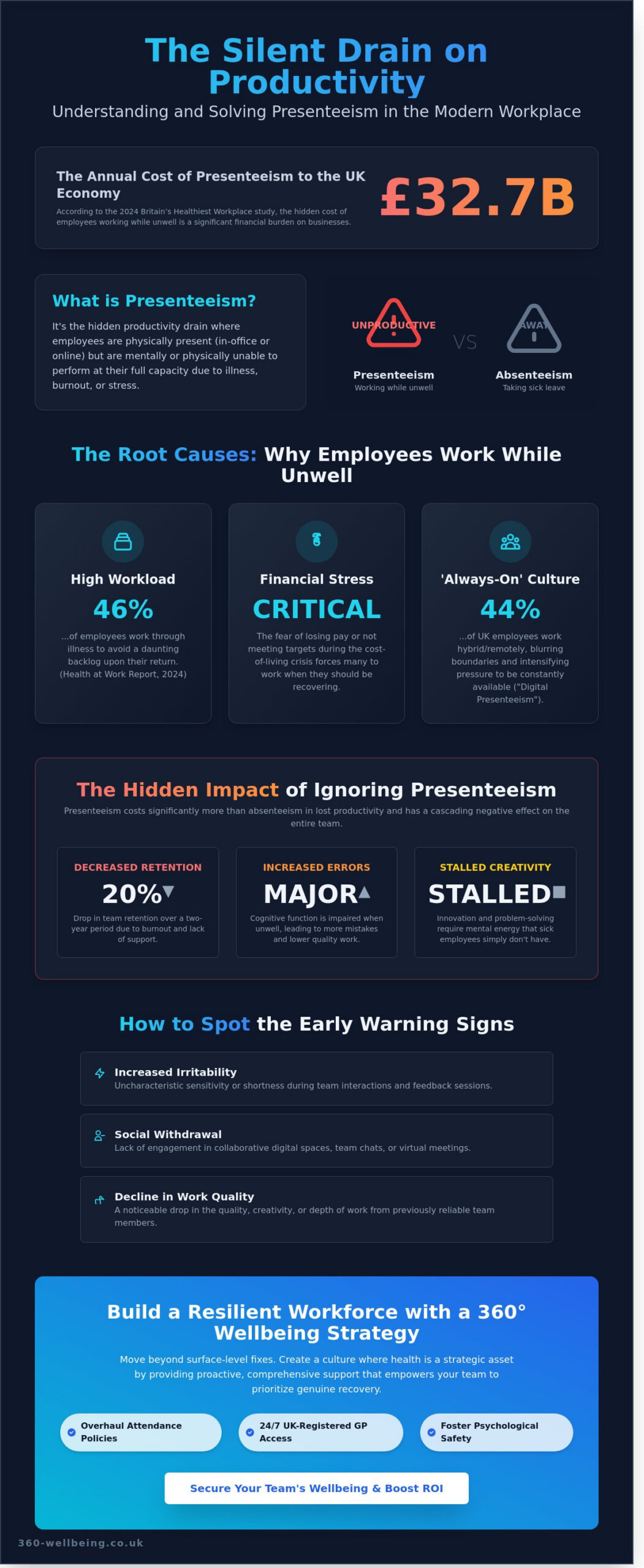
Did you know that presenteeism costs the UK economy an estimated £32.7 billion every year, according to the 2024 Britain’s Healthiest Workplace study? It’s a staggering figure that highlights a quiet crisis within modern offices. You see your team logged on and desks occupied, yet you can feel the collective energy dipping and morale beginning to fray. It’s frustrating to manage a team that’s physically there but mentally miles away. Finding effective presenteeism in the workplace solutions is no longer just a HR checkbox; it’s a vital strategic necessity for any business looking to thrive in 2026.
We understand that the shift to hybrid work has only made these hidden absences harder to track and resolve. You’re likely looking for a way to support your people without overcomplicating your operations. This guide provides a clear framework to identify the early warning signs of burnout and implement proactive, 360-degree wellbeing strategies that actually stick. We’ll show you how to move beyond surface-level fixes to create a culture where health is a strategic asset. By the end of this article, you’ll have a structured path to improve employee engagement and secure a tangible ROI on your wellbeing spend.
Key Takeaways
- Understand why “showing up” while unwell is often more damaging than staying home and how to recognize the hidden productivity drain within your organization.
- Identify the modern drivers of presenteeism, such as financial anxiety and workload pressure, to better support your employees’ journey back to full health.
- Learn how to implement effective presenteeism in the workplace solutions by overhauling attendance policies to reward genuine recovery over mere physical presence.
- Discover the strategic advantage of a 360-degree wellbeing platform that provides 24/7 UK-registered GP access to build a more resilient, proactive workforce.
- Uncover why presenteeism costs businesses significantly more than absenteeism and how to prevent the “contagion effect” from impacting your entire team’s vitality.
What is Presenteeism and Why is it Rising in 2026?
Presenteeism isn’t just about showing up with a common cold; it’s a complex health challenge where employees are physically present but mentally or physically unable to function at full capacity. According to the foundational definition of presenteeism, this phenomenon occurs when illness, injury, or other medical conditions prevent a worker from being fully productive. While absenteeism is easy to track through empty desks and HR logs, presenteeism is a silent, invisible drain on vitality. By 2026, the focus for leadership has shifted from merely tracking hours to understanding the quality of those hours. Finding effective presenteeism in the workplace solutions requires a 360-degree view of employee health that looks far beyond the surface of a “logged-in” status.
The rise of “Digital Presenteeism” is a hallmark of the 2026 workforce. With 44% of UK employees now working in hybrid or remote models, the pressure to appear constantly available via messaging apps has intensified. Many team members feel they must respond to notifications instantly to prove their value, even when they’re struggling with burnout or minor illnesses. This confusion between mere presence and actual output creates a cycle of exhaustion that undermines long-term resilience. It’s a proactive challenge for employers to decouple “green light” status from genuine performance.
The Hidden Cost of the ‘Always-On’ Culture
The blurring of boundaries in hybrid environments means recovery time is often sacrificed for a perceived need to stay connected. A 2025 wellbeing study found that 68% of employees worked while unwell because they felt their workload was too high to step away. This isn’t just a personal health issue; it’s a strategic risk for the business. When people don’t rest, their errors increase and their creativity stalls, leading to a 20% drop in overall team retention over a two-year period. Presenteeism is a productivity drain that costs UK businesses billions annually.
Spotting the Signs in Your Team
Managers need a tailored approach to identify “lethargic presence,” where high performers suddenly produce work that lacks its usual spark or depth. Identifying these shifts early is essential for maintaining workplace harmony. Look for psychological indicators such as:
- Increased irritability or uncharacteristic sensitivity during feedback.
- Social withdrawal and a lack of engagement in collaborative digital spaces.
- A noticeable decline in the quality of work from previously reliable staff.
In a remote environment, these signs are easily missed because a digital status icon can mask a struggling individual. Effective presenteeism in the workplace solutions start with compassionate, structured check-ins that prioritize human wellbeing over a digital status light. By fostering an environment of psychological safety, you empower your team to prioritize recovery, ensuring they return to work with the energy and focus required for true success.
The Root Causes: Why Employees Work While Unwell
Most employees don’t show up to work while ill because they’re overly dedicated; they do it because they feel they have no other choice. Research into presenteeism at the workplace suggests that the economic cost of working while unwell often exceeds the cost of absenteeism. In 2026, the drivers are more complex than ever, rooted in a mix of economic pressure and systemic health challenges.
A 2024 Health at Work report highlighted that 46% of employees felt the need to work through illness due to high workloads. When a “mountain of work” awaits their return, many choose to “soldier on” rather than face a daunting backlog. This is often reinforced by a company culture that views sickness as a weakness. If leadership doesn’t model healthy boundaries, staff will mirror that behavior. Finding effective presenteeism in the workplace solutions starts with acknowledging that a culture of “always on” is actually a culture of diminishing returns.
Financial Stress as a Driver of Presenteeism
Financial anxiety is a primary catalyst for sickness presence. During the ongoing cost-of-living crisis, the fear of losing pay or falling behind on performance targets creates a cycle of persistent stress. Debt and financial insecurity make the prospect of taking unpaid or reduced sick leave impossible for many households. Employers can break this cycle by offering a proactive Financial Support for Employees strategy. Providing financial education and support helps build the resilience needed to prioritize physical and mental health when it matters most.
The GP Access Crisis and Workplace Health
Healthcare barriers also play a significant role in why people work while unwell. With NHS waiting lists for some treatments exceeding 18 weeks, many staff find it nearly impossible to secure a timely GP appointment for acute issues. This delay causes minor, treatable symptoms to escalate into chronic conditions. Searching for sustainable presenteeism in the workplace solutions requires addressing these systemic barriers to medical care.
24/7 access to a Virtual GP can reduce the time staff spend “working poorly” by providing instant clinical guidance and reassurance. When professional medical advice is just a click away, employees feel empowered to take the rest they need. Implementing these types of comprehensive health benefits ensures your team feels supported from every angle, creating a safer, more productive environment for everyone.
Evaluating the Impact: Productivity Loss vs. Absenteeism
While an empty desk is easy to spot, the cost of a desk occupied by an unwell employee is far more damaging to your bottom line. Data from recent 2024 and 2025 economic reports shows that presenteeism costs UK employers approximately 3.5 times more than absenteeism. By 2026, this gap has widened as hybrid working models often mask the struggle of employees who are “logged on” but mentally absent. When we look for presenteeism in the workplace solutions, we must first acknowledge that showing up while ill isn’t a sign of commitment. It’s a precursor to exhaustion.
The “Contagion Effect” presents a dual threat. Physically, a single sick person can contaminate 50% of shared office surfaces by lunchtime, according to University of Arizona research. Emotionally, the impact is just as viral. Low morale and reduced cognitive function spread through a team, dragging down collective output. In high-stakes environments like healthcare or engineering, the risk is even higher. Industry surveys from 2025 indicated that 12% of workplace accidents were linked to staff working while unwell. Ignoring these minor symptoms often leads to “Total Incapacity.” This is where a manageable cold or mild anxiety spirals into a six-month leave of absence because the body was never allowed to recover.
The ROI of Proactive Wellbeing Intervention
Investing in a comprehensive wellbeing platform is a financial safeguard. Early intervention through 24/7 GP access or mental health support stops minor ailments from becoming acute crises. Research suggests that for every £1 spent on proactive wellbeing, companies see a return of roughly £4.70 in recovered productivity. Resilience building helps your workforce bounce back, ensuring health remains a strategic asset rather than a liability. It’s a shift from reactive fire-fighting to a 360-degree view of employee vitality.
Measuring the Unmeasurable: Presenteeism Data
Traditional attendance trackers fail to capture “Workability.” To get the full picture, employers are now using tools like the Stanford Presenteeism Scale or tailored employee surveys. These metrics only work if there’s deep psychological safety within the team. If staff fear judgment for being honest about their health, the data stays hidden. Creating a culture where it’s safe to say “I’m not at 100% today” is the first step toward finding effective presenteeism in the workplace solutions that actually work for your people.
Effective Presenteeism in the Workplace Solutions
Solving presenteeism requires a shift from monitoring to mentoring. It’s about building a system where people feel safe being human. Presenteeism isn’t a sign of commitment; it’s a symptom of a culture that prioritizes presence over performance. To implement effective presenteeism in the workplace solutions, you must start with structural change. First, overhaul your sickness policy. Traditional models, like the Bradford Factor, often penalize short-term absences, which forces 46% of employees to work while unwell according to 2023 industry data. Instead, reward recovery by removing punitive triggers and focusing on health outcomes.
- Implement a 360-degree wellbeing platform: Your strategy must address physical, mental, and financial health simultaneously to provide a true safety net.
- Train managers for radical rest: Managers should be taught to recognize the “glazed eye” look of burnout and actively encourage employees to log off.
- Provide 24/7 Virtual GP access: Removing the 10-day wait for a local doctor’s appointment ensures employees get professional advice before a minor issue becomes a chronic condition.
- Lead by example: When leadership visibly takes time off to recover from illness, it grants the rest of the team the psychological safety to do the same.
Creating a Culture of Permission
Communicating that health comes first doesn’t mean performance targets have to suffer. A 2022 Deloitte analysis found that for every £1 spent on proactive wellbeing, employers see a £5.30 return through increased productivity. You can destigmatize leave by appointing Mental Health Champions who act as peer-to-peer support. These champions bridge the gap between HR and the shop floor. Furthermore, replace the standard return-to-work interview with a “Return to Peak” programme. This focuses on phased reintegration and rehabilitation rather than just checking a box for attendance.
Leveraging Technology for Employee Support
Digital tools are essential for scaling presenteeism in the workplace solutions across remote or hybrid teams. An Employee Assistance Programme (EAP) provides immediate, confidential mental health support, which is vital since 76% of professionals observed presenteeism in their workplace last year. Digital lifestyle rewards can also boost morale by encouraging breaks and movement, breaking the “grind” mentality. Integrating life coaching into your benefits package helps employees manage the root causes of workload-related stress. This proactive guidance ensures your team stays resilient and energized.
Ready to transform your company culture and boost productivity? Explore our comprehensive wellbeing solutions today to support your team’s total health.
Building a Resilient Workforce with 360 Wellbeing
Effective presenteeism in the workplace solutions require more than just policy changes; they demand a fundamental shift in how we support the human being behind the job title. The 360 Wellbeing platform is designed to bridge the gap between noticing a struggle and providing a professional intervention. By offering a 360-degree perspective on health, we help organisations move from reactive management to a proactive culture of vitality.
Our platform addresses the core drivers of presenteeism through a unified digital ecosystem. When an employee feels unwell but shows up anyway, it’s often because they feel they lack the time or resources to seek help. We remove those barriers by providing:
- 24/7 UK-Registered GP Access: Your entire team can speak with a doctor at any time, day or night. This immediate access reduces the anxiety of waiting for local appointments and ensures medical advice is just a tap away.
- Holistic Support Pillars: We combine mental health therapy with legal and financial guidance. Stress doesn’t exist in a vacuum; often, a dip in productivity is caused by external pressures like debt or family legal matters.
- Corporate-Grade Benefits for All: We’ve democratised high-level wellness. Whether you are a sole trader or an SME with a team of 50, you can now access the same quality of clinical support that was once reserved for global corporations.
Tailored Support for the Modern UK Business
Data from the 2023 CIPD Health and Wellbeing at Work report indicates that presenteeism remains a significant challenge, yet only 37% of organisations are taking active steps to discourage it. 360 Wellbeing changes this narrative by making health access effortless. Our per-employee subscription model is built for simplicity, allowing your benefits package to grow exactly as your team does. There are no hidden complexities, just a straightforward path to protecting your most valuable asset.
UK organisations choose us because we understand the local healthcare landscape. We don’t just provide an app; we provide a partnership. Our proactive health access has been shown to reduce the time employees spend working while unwell, as they feel empowered to take the necessary time to recover with professional backing.
Take the First Step Toward a Healthier Culture
True resilience isn’t about how much stress a team can endure; it’s about how well they are supported to avoid burnout. When you integrate 360 Wellbeing into your business, you’re gaining the peace of mind that comes from knowing your team is truly supported, not just physically present at their desks. It’s an investment in the long-term vitality of your company culture.
We invite you to see how our tools can fit into your specific business structure. You can explore our platform features or book a personal consultation to see the impact firsthand. Don’t wait for burnout to signal a problem when you can build a foundation of health today.
Transforming Productivity Through Proactive Care
Addressing the hidden drain of employees working while unwell is no longer optional for forward-thinking leaders. Research from Deloitte’s 2024 Mental Health report indicates that presenteeism costs UK employers approximately £2,500 per employee every year, a figure that’s become a critical metric for 2026. By shifting focus from mere attendance to genuine vitality, you’ll reduce the risk of burnout and long-term health decline. Implementing sustainable presenteeism in the workplace solutions starts with cultural change and ends with providing the right tools for recovery.
At 360 Wellbeing, we’ve partnered with SMEs and large UK organisations to provide a safety net that truly works. Our members benefit from 24/7 access to UK-registered GPs and comprehensive Mental Health and EAP support, ensuring help is available whenever it’s needed. It’s about creating a culture where people feel empowered to prioritize their health without fear of falling behind. You’ve got the power to build a more resilient, engaged team by making wellness a strategic priority. Let’s work together to create a workplace where everyone can truly thrive.
Empower your team with 360-degree wellbeing support today
Frequently Asked Questions
What is the main cause of presenteeism in the UK workplace?
Heavy workloads and the fear of falling behind are the primary drivers of presenteeism across the UK. According to the 2023 CIPD Health and Wellbeing at Work report, 76% of respondents observed presenteeism in their workplace over the previous year. This often stems from a culture where employees feel they can’t take time off without facing negative consequences. We believe a proactive approach to workload management is essential for long-term employee resilience.
How much does presenteeism cost businesses compared to absenteeism?
Presenteeism costs UK businesses approximately 3.5 times more than absenteeism. Deloitte’s 2022 Mental Health and Employers report found that while absenteeism costs around £6.1 billion, presenteeism costs reached £28 billion. This disparity exists because reduced productivity while working is harder to track than a physical absence. Implementing effective presenteeism in the workplace solutions helps recover these hidden costs by ensuring staff are truly fit for work.
Can a Virtual GP service really help reduce presenteeism?
A Virtual GP service reduces presenteeism by providing employees with immediate medical consultations, often within 24 hours. Instead of waiting weeks for a local appointment, staff get professional advice and prescriptions quickly. This speed prevents minor issues from becoming chronic conditions that drain productivity. It’s a tailored way to support a 360-degree perspective on health, making medical care accessible without the stress of travel or long waits.
Is presenteeism a sign of a hardworking employee?
Presenteeism isn’t a badge of honor or a sign of dedication; it’s a signal of workplace insecurity or impending burnout. While it might look like hard work, a 2022 study in the Journal of Occupational Health Psychology shows that working while ill leads to long-term exhaustion and more errors. We view true commitment as the ability to rest when needed so you can return with full vitality and focus.
How can I identify presenteeism in a remote or hybrid team?
You can identify presenteeism in remote teams by monitoring digital patterns like emails sent at 11 PM or employees logging on during scheduled annual leave. Since you can’t see them physically, look for a 20% drop in response quality or missed deadlines from previously high performers. Regular check-ins that focus on energy levels rather than just task lists are vital. These conversations create a safe space for employees to admit they’re struggling.
What are the best employee benefits to tackle presenteeism?
The most effective benefits include comprehensive Employee Assistance Programs (EAPs) and private medical insurance that features mental health pathways. Providing access to presenteeism in the workplace solutions, such as 24/7 counseling or physiotherapy, addresses the root physical and mental causes of the issue. When employees feel supported by a robust safety net, they’re less likely to push through illness. This proactive investment builds a more resilient and balanced workforce.
What happens if presenteeism is left unaddressed in a small business?
If left unaddressed, presenteeism leads to a 25% increase in staff turnover and higher rates of workplace contagion in small teams. In a tight-knit business, one sick employee can quickly infect the entire office, leading to a total operational shutdown. It also erodes morale, as healthy staff often have to pick up the slack for those who are physically present but mentally absent. Small businesses must prioritize health to maintain their competitive edge.
How do I create a policy that discourages working while sick?
Create a policy that explicitly encourages staff to log off when they’re unwell, regardless of their location. Define wellbeing as a strategic asset and set clear expectations that no one should respond to messages while on sick leave. Managers should lead by example; if a leader works through the flu, the team will feel pressured to do the same. A compassionate policy prioritizes long-term health over short-term, low-quality output.