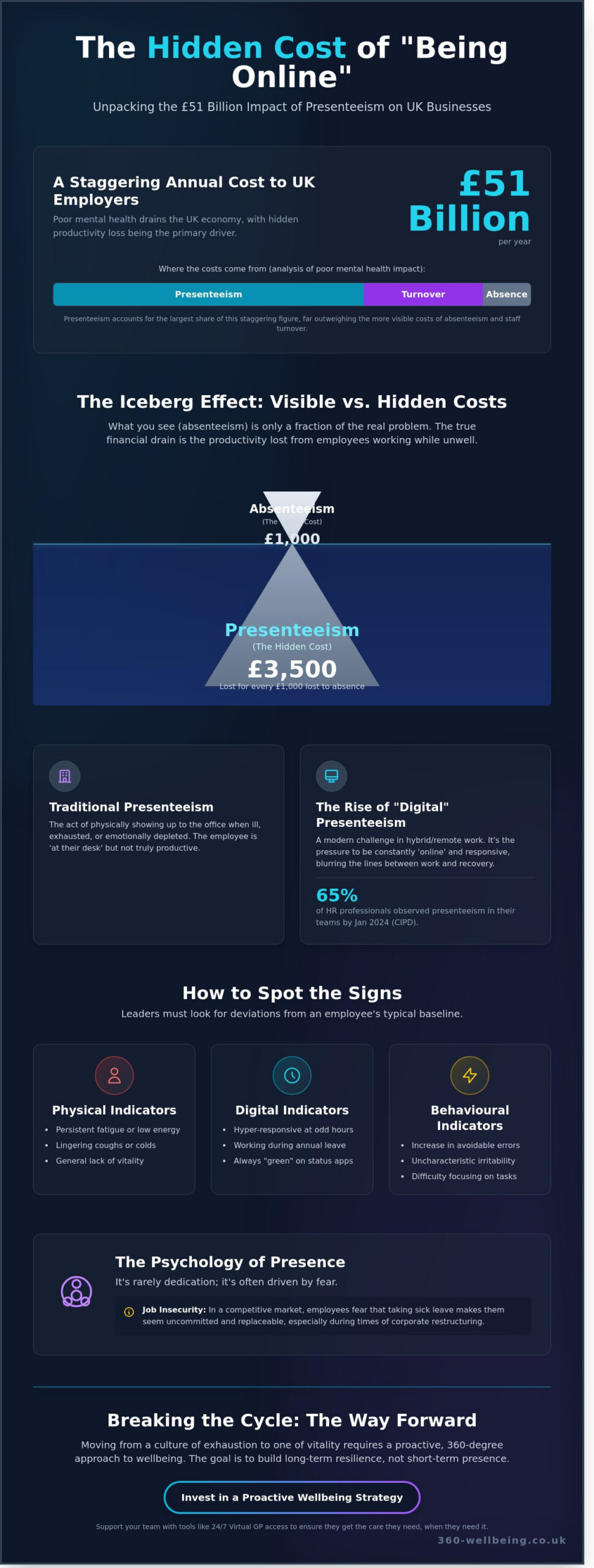
The cost of poor mental health to UK employers has reached £51 billion annually, with presenteeism accounting for the largest share of that staggering figure. You’ve likely noticed the symptoms in your own teams; colleagues who are “online” but clearly struggling, or staff who push through illness only to see their productivity and morale plummet. It’s a difficult balance to strike, especially when remote and hybrid setups make it harder than ever to spot when someone is truly thriving or just performing presence. We believe that health is a fundamental right, and you shouldn’t have to choose between a high-performing business and a healthy workforce.
Discover how to move beyond these challenges with a proactive strategy designed to identify, measure, and eliminate the hidden factors that drain your team’s energy. This article provides a clear, 360-degree framework for building a more resilient culture that delivers a measurable return on your wellbeing investment. You’ll learn the specific steps to transition from a culture of exhaustion to one of genuine vitality and sustainable success.
Key Takeaways
- Understand how presenteeism has evolved into a digital phenomenon and learn to recognize the subtle signs of employees working while physically or mentally unwell.
- Uncover the psychological drivers, such as job insecurity and the “Hero Complex,” that compel your team to prioritize presence over recovery.
- Quantify the multi-billion pound impact of hidden productivity loss on the UK economy and see why addressing it is a vital strategic asset for your business.
- Gain a practical roadmap for auditing your workplace culture and training leaders to proactively support staff in taking the time they need to heal.
- Explore how a 360-degree wellbeing approach, including 24/7 Virtual GP access, can break the cycle of burnout and build long-term workforce resilience.
What is Presenteeism? Redefining Workplace Presence in 2026
In 2026, the traditional definition of workplace attendance is obsolete. We’ve moved beyond simple clock-watching to a more nuanced understanding of how health impacts output. To grasp what is presenteeism, we must look at the gap between being “online” and being “effective.” It’s the act of showing up for work when you’re physically ill, mentally exhausted, or emotionally depleted. While the person is technically at their station, their capacity to perform is compromised, leading to a shadow version of productivity that hurts both the individual and the business.
The shift to hybrid working models has transformed this challenge. By January 2024, data from the CIPD indicated that 65% of HR professionals had observed presenteeism within their teams. As we move through 2026, this has evolved into “digital presenteeism.” This isn’t just about sitting at a desk with a cold; it’s about the pressure to remain “green” on messaging apps while battling burnout. The lines between recovery and duty have blurred, making it harder for employees to switch off and heal properly. We view wellbeing as a strategic asset, and when employees work through illness, that asset depreciates.
Workplace presence is no longer a binary state of being there or not. It’s a spectrum of engagement. A proactive approach to 360-degree wellness acknowledges that a person’s physical, mental, and social health are interconnected. When one area fails, the others inevitably follow. If an employee feels they can’t take a day to recover, they often end up needing a week to recuperate later, creating a cycle of diminishing returns that threatens long-term resilience.
Presenteeism vs. Absenteeism: The Real Cost Difference
Managers often focus on absenteeism because it’s visible. A person isn’t there, their tasks are unassigned, and the gap is clear. Presenteeism is the “invisible” counterpart that carries a much heavier price tag. Analysis from Deloitte’s 2024 Mental Health and Employers report suggests that for every £1,000 lost to absenteeism, UK businesses lose approximately £3,500 to presenteeism. This is the “Iceberg Effect.” The visible 10% of costs are the sick days, while the underlying 90% is the lost productivity from those struggling while they work.
Measuring this loss requires looking beyond the timesheet. When an employee is present but unwell, their decision-making slows down and their creativity wanes. In a professional consultation, we’d identify this as a risk to workplace harmony. It’s not just about one person’s output; it’s about the drag they inadvertently place on the whole team. Addressing this requires a tailored strategy that prioritizes genuine recovery over performative presence.
Signs of Presenteeism in Your Team
Identifying these patterns requires an observant and empathetic eye. Because the signs are often subtle, leaders must look for deviations from an employee’s typical baseline. These indicators fall into three clear categories:
- Physical indicators: You might notice persistent fatigue, a lingering cough that hasn’t cleared in three weeks, or a general lack of vitality in their interactions.
- Digital indicators: Look for “hyper-responsiveness,” such as sending emails at 11:45 PM or replying to messages during scheduled annual leave or weekends.
- Behavioural indicators: A 15% increase in avoidable errors, uncharacteristic irritability, or a sudden inability to focus on complex tasks are all red flags.
Recognising these signs early is a fundamental right for every employee and a necessity for every business. By spotting these trends, you can step in with a supportive and empowering conversation before a minor health issue spirals into a long-term crisis. It’s about building a culture where health is a foundation for success, not an obstacle to it.
The Psychology of Presence: Why Employees Work While Unwell
Understanding why an employee chooses to log on while battling a migraine or a period of low mood requires looking beyond simple work ethic. According to the 2023 CIPD Health and Wellbeing at Work report, 76% of respondents observed presenteeism in their workplace over the previous 12 months. This isn’t usually a sign of dedication; it’s often a response to job insecurity. In a competitive UK market where the cost of living remains a primary concern, the fear of being deemed replaceable drives individuals to prove their worth through physical or digital presence. They worry that an empty desk signifies a lack of commitment, making them vulnerable during periods of corporate restructuring.
Some employees fall into the “Hero Complex” trap. They believe their specific role is so critical that the entire department will stall without them. This mindset is reinforced by heavy workloads; a 2022 study found that 46% of UK workers felt their workload was the biggest trigger for work-related stress. They don’t take time off because they dread the mountain of emails and tasks waiting for them upon their return. When leadership rewards those who “power through” illness, they inadvertently cement a culture where recovery is seen as a weakness. A proactive approach to managing and preventing presenteeism involves shifting this narrative toward long-term resilience rather than short-term output. It’s about recognizing that a rested employee is more productive than one who is physically there but mentally absent.
Mental Health Stigma and Presenteeism
Employees are significantly more likely to hide a mental health struggle than a physical ailment. Research from 2021 indicated that while 1 in 4 people in the UK experience a mental health problem each year, many still feel more comfortable claiming they have the flu. This leads to “masking,” where an individual exerts immense energy pretending to be fine while their internal capacity is depleted. This exhaustion accelerates burnout and long-term sickness absence. Breaking this cycle requires 360-degree support systems that normalise mental health leave as a valid part of a comprehensive wellness strategy. When employees see leaders talking openly about their own challenges, the pressure to mask begins to dissolve.
The Role of Management Style
“Command and control” management styles are major drivers of this issue. When managers focus solely on rigid KPIs and “eyes-on” supervision, employees feel they must be seen to be valued. This environment lacks psychological safety. A 2020 report by the City Mental Health Alliance highlighted that 52% of employees wouldn’t tell their manager about a mental health issue for fear of being judged. Managers must be trained to value recovery and set realistic expectations, ensuring that health choices aren’t dictated by fear of a performance review. Transitioning to a style that prioritizes outcomes over hours spent at a desk creates a safer, healthier workplace for everyone.
The Business Case: Measuring the Impact on Productivity and ROI
The economic weight of a workforce that’s physically present but mentally or physically unwell is staggering. Recent 2024 data from the IPPR reveals that the total cost of sickness to the UK economy has climbed to £138bn per year, a rise of £30bn since 2018. While absenteeism is easy to track, this hidden drain on your bottom line is far more insidious. Research from the CIPD confirms that working while unwell is now prevalent in over 80% of UK workplaces, creating a drag on national productivity that stalls growth and erodes profit margins.
Beyond the balance sheet, there’s a tangible “Contagion Risk” that leaders can’t afford to ignore. When an individual brings a viral infection into a shared office, they aren’t being a “team player”; they’re risking a departmental epidemic. This ripple effect extends to mental health too. A culture that rewards struggling through burnout creates a toxic atmosphere of collective exhaustion, leading to a decline in morale and creative output across the entire team.
When an employee ignores a minor ailment to stay at their desk, they often inadvertently trade a two-day recovery period for a chronic condition that lasts months. This progression increases the costs of sickness presenteeism by necessitating more complex clinical interventions later. For the employer, this translates to higher turnover rates and a damaged brand. Top-tier talent in 2024 and beyond prioritises holistic support. If your culture demands presence over performance, your most resilient and skilled workers will likely seek a more empathetic environment elsewhere.
Digital Presenteeism and the “Always-On” Culture
The shift toward hybrid working has birthed a new challenge for 2026: the pressure to log on from home despite being genuinely unwell. Because the commute is gone, many employees feel they’ve lost the permission to rest. This digital habit erodes the boundary between life and work, leading to a severe efficiency drop-off. Studies show that a sick employee working from their laptop often operates at less than 40% capacity, making their output prone to errors that take longer to fix than the original task took to complete.
Calculating the ROI of Healthy Absence
UK businesses lose an average of 35 working days per employee to presenteeism annually. This figure dwarfs the impact of standard absenteeism and represents a massive lost opportunity for growth. Calculating the ROI of healthy absence involves comparing the cost of one day of total rest against two weeks of low-productivity “drifting.” Proactive wellbeing platforms help bridge this gap by offering early clinical support. By addressing symptoms before they escalate, these tailored strategies reduce long-term disability claims and ensure your team returns to full strength faster, protecting both the individual’s vitality and the company’s strategic goals.
Managing and Preventing Presenteeism: A Practical Roadmap
Dismantling the culture of working through illness requires a structural shift. It starts by auditing your internal culture to identify the “unwritten rules” that praise an “always-on” mentality. If your employees feel they must answer emails at 9:00 PM to be seen as dedicated, they’ll likely work through a fever to maintain that image. A 2022 Deloitte report found that poor mental health costs UK employers £56 billion annually, yet many organisations still reward the physical presence of unwell staff over actual productivity.
Manager training is your first line of defence. Leaders need the confidence to spot the “working wounded” and the authority to send them home. A 2023 survey by the CIPD revealed that only 38% of UK managers receive formal training on how to support employees with mental or physical health issues. Training should focus on empathetic communication and spotting subtle signs of burnout. When a manager says, “You don’t look well, please take the day to recover,” it validates the employee’s health as a priority.
Policy revision makes this permission explicit. Update your employee handbook to include “wellbeing days” or “recovery leave” alongside traditional sick pay. This removes the stigma of being “weak” and replaces it with a proactive focus on resilience. Providing the right tools is equally vital. Move from reactive fixes to proactive health support by offering 24/7 virtual GP access or mental health apps. These tools empower staff to manage their health before it reaches a crisis point, ensuring they return to work with full capacity.
Leading by Example: The Executive Role
CEOs must be visible in their own recovery. If a leader works through a flu, they inadvertently set a standard that rest is secondary to output. When a CEO takes a full week off for recovery or mental health, they communicate that rest is a strategic business asset. Publicly celebrating balance over “hustle culture” shifts the internal narrative. It proves that the organisation values long-term vitality over short-term, low-quality output. This top-down permission is the fastest way to reduce presenteeism across all levels.
The 360-Degree Wellbeing Audit
Uncovering hidden presenteeism requires a deep dive into your data. Use anonymous surveys to ask staff if they’ve worked while unwell in the last 12 months. The 2023 CIPD Health and Wellbeing at Work report found that 76% of respondents observed this behaviour in their workplace. Integrate survey results with productivity metrics and staff turnover rates to see the full picture. A tailored action plan for each department ensures support is relevant; a logistics team needs different physical health support than a remote-based finance team.
Take the first step toward a healthier, more productive workforce by exploring our tailored corporate wellbeing solutions today.
The 360 Wellbeing Solution: Breaking the Cycle with Proactive Care
Addressing the hidden drain of presenteeism requires more than a standard sick pay policy or an annual health check. It demands a shift from reactive management to a culture of proactive, continuous care. When employees feel they must “power through” illness to prove their worth, the long-term cost to your business often exceeds the price of a short-term absence. Our approach focuses on removing the obstacles that prevent people from seeking help early, ensuring your team remains resilient rather than just present.
Virtual GP: The First Line of Defence
In the UK, the average wait time for a routine GP appointment can now stretch beyond two weeks. This delay often forces staff to remain at their desks with worsening symptoms, leading to “performative presence” where very little actual work is achieved. By providing 24/7 Virtual GP access, you remove the logistical barriers to medical advice. Employees can speak to a clinician from their home or a private room at the office within hours, not weeks. This rapid intervention stops minor ailments from evolving into chronic conditions that require months of recovery. You can learn more about our 24/7 Virtual GP services to see how this immediate care model protects your bottom line.
Early diagnosis is the most effective way to reduce the £51 billion annual cost of poor mental health and physical illness in the UK workplace. Our Virtual GP service provides:
- Private prescriptions delivered to the employee’s door or local pharmacy.
- Sick notes and specialist referrals provided without the NHS backlog.
- Peace of mind that reduces “health anxiety” and keeps the mind focused on the task at hand.
Holistic Support for a Resilient Workforce
True workplace harmony isn’t just about physical health. It’s about the psychological safety that allows an employee to say, “I’m not okay today.” According to recent 2023 data, 55% of UK workers feel they can’t take time off for mental health reasons, leading to “masking” and eventual burnout. Our Employee Assistance Programme (EAP) provides a confidential space to manage stress before it becomes a crisis. Whether it’s through life coaching or structured counselling, we help your team build the tools to manage the pressures of modern life.
A 360-degree perspective is essential because life doesn’t happen in a vacuum. Financial worries or legal disputes are major drivers of presenteeism; a distracted mind is rarely a productive one. We empower your staff with dedicated financial and legal support, providing the practical peace of mind they need to stay engaged. By combining mental health support, physical therapy, and life coaching into one unified strategy, you create a workplace where employees feel valued as individuals. This comprehensive care model transforms wellbeing from a corporate buzzword into a strategic asset. You can protect your team and your productivity with 360 Wellbeing by implementing a solution that looks at the whole person, not just the employee.
Choosing a proactive path isn’t just a kind gesture. It’s a calculated investment in your company’s future. When you replace the culture of “showing up at all costs” with a system of genuine support, you don’t just reduce sickness; you ignite vitality across your entire organisation.
From Passive Presence to Proactive Performance
The landscape of 2026 demands a shift from simply filling desks to fostering genuine vitality. Research from the Deloitte 2024 Mental Health and Employers report highlights that presenteeism costs UK businesses roughly £24 billion every year in lost productivity. This figure proves that having staff physically present but mentally or physically unwell is a significant financial drain. Organizations that prioritize a 360-degree approach to health don’t just see fewer sick days; they build resilient teams capable of sustained high performance. By integrating clinical expertise with compassionate support, you can turn health from a hidden liability into a strategic asset.
Your people deserve more than a reactive safety net. They need a partner who understands that wellness is a continuous journey. 360 Wellbeing provides 24/7 access to UK-registered GPs and comprehensive Mental Health and EAP support, a combination already trusted by UK SMEs and large corporations to safeguard their most valuable assets. Don’t wait for burnout to signal a problem when proactive care is within reach. Transform your workplace culture with 360 Wellbeing and ensure your organization thrives throughout 2026 and beyond.
Frequently Asked Questions
What is the main cause of presenteeism in the UK?
High workloads and job insecurity are the primary drivers of this trend across British workplaces. According to the CIPD Health and Wellbeing at Work 2022 report, 46% of employees reported working while unwell because they felt their workload was too heavy to manage otherwise. It’s a cultural challenge where staff feel they can’t step away without falling behind on their targets.
Is presenteeism worse than absenteeism for business productivity?
Yes, presenteeism costs UK businesses significantly more than absenteeism each year. Deloitte’s 2022 Mental Health Report found that presenteeism costs employers roughly £28 billion annually, while absenteeism costs only £6 billion. Working while ill can reduce an individual’s productivity by 33% and often leads to longer recovery times, which impacts the bottom line more than a short, restorative break.
How can I tell if my remote employees are practicing digital presenteeism?
You can identify digital presenteeism by monitoring response times outside of standard hours and visible active statuses late at night. A 2021 study by Aviva found that 43% of remote workers felt they had to be always on to prove their worth to their managers. Look for staff members who consistently send emails after 8 PM or log on during their scheduled annual leave, as these are clear indicators of a struggle to disconnect.
Can an Employee Assistance Programme (EAP) actually reduce presenteeism?
An Employee Assistance Programme directly targets the root causes of workplace illness by providing 24/7 access to mental health support and financial advice. Research from the Employee Assistance Professionals Association suggests that for every £1 spent on an EAP, UK employers see an average return of £7.27 through improved productivity. These proactive services help employees resolve personal issues before they manifest as reduced performance at their desks.
What are the legal implications of employees working while unwell?
Employers have a legal duty of care under the Health and Safety at Work Act 1974 to ensure the wellbeing of their staff. If you subtly encourage unwell employees to work, you could face personal injury claims or even constructive dismissal cases. If a worker’s condition worsens because they didn’t rest, the company might be held liable for breaching statutory health and safety obligations and failing to provide a safe working environment.
How do I encourage staff to take sick leave without affecting deadlines?
You can manage deadlines effectively by implementing a buddy system where at least two people are trained to perform any critical task. This ensures that 100% of essential functions continue even when someone is recovering at home. When your team knows their absence won’t cause a project crisis, they’re more likely to take the time they need to heal properly and return at full capacity.
What is the role of a Virtual GP in reducing workplace presenteeism?
A Virtual GP service reduces workplace presenteeism by providing staff with immediate medical consultations, often within 2 hours of booking. This removes the stress of waiting weeks for a local appointment or sitting in a surgery waiting room while ill. By getting a professional diagnosis and treatment plan early, employees don’t have to struggle through symptoms for days, which keeps your workforce resilient and healthy.
Does presenteeism lead to higher staff turnover?
Presenteeism is a major predictor of burnout, which directly results in higher staff turnover rates. The 2022 Vitality Britain’s Healthiest Workplace study showed that employees who practice presenteeism are twice as likely to leave their roles within 12 months compared to their healthier peers. When you address the culture of working while ill, you build a supportive environment that retains talent and protects your most valuable strategic asset.