
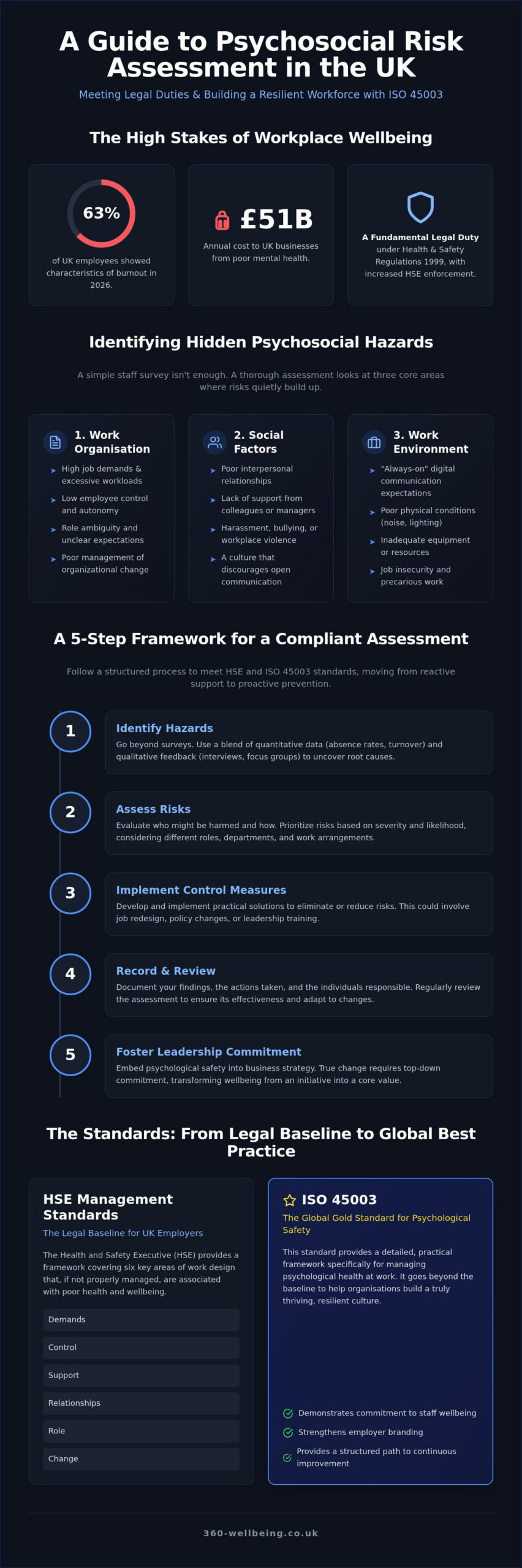
With 63% of UK employees showing characteristics of burnout in 2026 and poor mental health costing businesses £51 billion annually, the stakes for workplace wellbeing have never been higher. You might feel the pressure of rising absences or worry about the Health and Safety Executive’s increased focus on mental health enforcement this year. Conducting a thorough psychosocial risk assessment uk is no longer a luxury or a simple wellness perk; it’s a fundamental legal requirement under the Management of Health and Safety at Work Regulations 1999 that ensures your team remains safe and productive.
It’s understandable if you feel overwhelmed by the technical jargon or the fear of getting a compliance check wrong. Most leaders genuinely care about their staff but struggle to distinguish between general work stress and systemic psychological hazards. This guide provides a clear, compassionate roadmap to implementing the ISO 45003 framework. You’ll learn how to identify hidden risks, meet your legal obligations, and build a culture where your people can truly thrive. We will explore the step-by-step process of assessment, the practicalities of the ISO standards, and how a proactive approach leads to a healthier, more resilient workforce.
Key Takeaways
- Understand the three core categories of psychological hazards and why a simple staff survey isn’t enough to uncover hidden cultural risks.
- Follow a structured five-step framework to complete a psychosocial risk assessment uk that satisfies both the HSE and the ISO 45003 global standard.
- Discover the critical role of leadership commitment in transforming mental health from a “bottom-up” initiative into a strategic business pillar.
- Learn how to quantify the ROI of psychological safety by tackling the root causes of presenteeism and costly staff turnover.
- Identify the essential support and mitigation infrastructure your business needs to protect your staff and ensure long-term operational resilience.
What is a Psychosocial Risk Assessment in the UK?
A psychosocial risk assessment uk is a structured process designed to identify and evaluate aspects of work that have the potential to cause psychological or physical harm. While traditional safety checks look for loose floorboards or faulty wiring, this assessment looks deeper into the way work is organised and the social dynamics of the office or remote workspace. Psychosocial risk is the intersection of job design, social context, and individual wellbeing. In 2026, the regulatory environment has moved away from merely managing stress after it occurs. Instead, the focus is now on proactive risk prevention, ensuring that the work environment itself doesn’t become a source of injury.
Identifying Psychosocial hazards involves looking at how employees interact with their tasks and each other. These hazards include excessive workloads, lack of control over how work is done, and poor interpersonal relationships. By assessing these factors, you aren’t just ticking a legal box. You’re building a panoramic view of your organisation’s health. This foresight allows you to create a more durable and resilient workforce that can handle the complexities of modern business without sacrificing their mental health.
The Legal Framework: HSE Standards and Duty of Care
Under the Management of Health and Safety at Work Regulations 1999, every UK employer has a clear legal duty to assess all risks to their employees’ health. This includes mental health. The Health and Safety Executive (HSE) has made it clear that psychological risks must be treated with the same rigour as physical ones. If you fail to conduct a formal assessment, you risk enforcement action and potential legal claims. The HSE Management Standards provide a framework covering six key areas: demands, control, support, relationships, role, and change. These standards serve as the benchmark for a safe workplace, helping you move from reactive support to a structured path of prevention.
ISO 45003: The New Gold Standard for Psychological Safety
While the HSE provides the baseline, ISO 45003 has emerged as the global guidance standard for managing psychological health at work. It’s important to understand the distinction between standards. ISO 45001 focuses on general occupational health and safety systems, but ISO 45003 specifically addresses psychological health and safety. It provides a more detailed, practical framework for identifying and managing risks. Many UK businesses are now adopting ISO 45003 to strengthen their employer branding and demonstrate a genuine commitment to staff vitality. It shows that your organisation views wellbeing as a professional necessity and an essential human entitlement rather than a luxury.
Identifying Psychosocial Hazards in Your Organisation
Uncovering the root causes of workplace stress requires a shift in perspective. You can’t rely solely on a standard annual survey to capture the nuances of your team’s mental state. Hazards are generally categorised into three main areas: work organisation, social factors, and the work environment. To be effective, a psychosocial risk assessment uk needs to go deeper than surface-level data. Hazards are often hidden in “normal” business processes like over-communication, where constant notifications can quietly erode an employee’s focus and peace of mind. By taking this panoramic view, you can identify risks before they escalate into significant health issues.
A truly comprehensive approach blends quantitative data with qualitative feedback. Looking at absence rates or staff turnover gives you a starting point, but it doesn’t tell the whole story. You need to hear the human side through one-to-one interviews or focus groups to understand the culture’s pulse. This dual approach ensures your psychosocial risk assessment uk is both scientifically grounded and deeply personal, reflecting the actual lived experience of your staff.
Work Organisation: Job Demands and Control
In many UK workplaces, the lines between professional and personal life have blurred. High job demands, coupled with “always-on” digital expectations, can lead to chronic exhaustion. When employees feel they have little autonomy or control over their tasks, their risk of burnout increases significantly. Role ambiguity is another silent hazard. When expectations aren’t clear, it creates a persistent sense of anxiety. Following the ISO 45003 guidance helps you structure these observations into a manageable plan that protects your team’s vitality and ensures long-term durability.
Social Factors: Relationships and Workplace Culture
The quality of workplace relationships is a cornerstone of psychological safety. Issues like bullying, harassment, or a lack of peer support can quickly poison a company culture. Leadership styles also play a massive role. A supportive, empathetic manager can act as a protective buffer, while an overly critical one can exacerbate stress. It’s also vital to recognise that external pressures don’t stop at the office door. Issues such as financial anxiety can make existing workplace psychosocial risks feel much more intense. Providing a safety net through a comprehensive Employee Assistance Programme can help mitigate these risks before they lead to long-term absence.
Implementing ISO 45003: A 5-Step Framework for UK SMEs
Adopting international standards often feels like a daunting task for smaller businesses. The ISO 45003 framework simplifies this by using the Plan-Do-Check-Act (PDCA) cycle, tailored specifically for mental wellbeing. You aren’t creating a new system from scratch. Instead, you’re integrating psychological health into your existing health and safety culture. This integration ensures that mental safety is viewed with the same importance as physical safety across the entire organisation. It’s vital to remember that ISO 45003 is a journey of continuous improvement, not a one-time fix.
Leadership must lead from the front. If the management team doesn’t visibly support these changes, the initiative will likely fail to gain traction. This isn’t just about being “nice” to staff. It’s about building a durable organisation where people feel safe to do their best work. When leadership treats wellbeing as a professional necessity, it sets a tone of trust and reliability that resonates through every department.
Step 1 & 2: Planning and Risk Assessment
Start by securing buy-in from your senior team. Show them the data on how a psychosocial risk assessment uk can reduce the significant costs associated with poor mental health in the workplace. Use anonymous staff surveys and focus groups to map out where your team feels the most pressure. Once you have this panoramic view, prioritise the risks. Focus on hazards that are both frequent and high-impact, such as role ambiguity or a lack of support during peak periods. This methodical start ensures your resources are directed where they’ll have the most significant impact on employee vitality.
Step 3, 4 & 5: Action, Review, and Improvement
Next, implement your interventions. This could mean adjusting workloads, redesigning job roles, or introducing a 24/7 Employee Assistance Programme to provide immediate support. Don’t just set it and forget it. Measure your success using KPIs like reduced absence rates and improved staff retention. Regular reviews are the final piece of the puzzle. By tracking these metrics, you create a feedback loop that informs future planning. As your organisation evolves, so will your risks, so keep your assessment updated to reflect your current reality. This structured path forward creates a sense of safety and order for everyone involved.
The ROI of Psychological Safety: Beyond Compliance
Investing in a psychosocial risk assessment uk is often viewed as a defensive move to avoid HSE intervention. However, the most resilient organisations in 2026 recognise it as a strategic blueprint for high performance. When your team feels psychologically safe, they’re more likely to share innovative ideas, admit mistakes early, and collaborate without the fear of judgment. This creates a culture of vitality where employees aren’t just surviving the week but are actively thriving and contributing to your company’s growth. By moving beyond simple compliance, you’re building a foundation of trust that supports long-term operational durability.
One of the most significant hidden costs in modern business is presenteeism. This occurs when employees are physically at their desks but are mentally disengaged due to stress or poor wellbeing. It’s a silent drain on productivity that’s often more expensive than absenteeism because it’s harder to measure and address. A proactive approach to managing psychological hazards ensures your team is fully present and engaged. This foresight allows you to identify systemic issues before they lead to a total breakdown in team harmony or a surge in staff turnover.
Reducing Absenteeism and Presenteeism Costs
The financial impact of mental health in the workplace is staggering. Deloitte’s 2024 research highlights that poor mental health costs UK employers approximately £51 billion annually. This figure includes the direct costs of sick days and the indirect costs of lost productivity. For every £1 you invest in workplace mental health, you can see an average return of £4.70 to £5.30. Proactive risk management prevents short-term stress from spiralling into long-term burnout. When employees feel supported, they’re less likely to take extended leave, which keeps your projects on track and reduces the pressure on the rest of the team.
Attracting and Retaining Talent in 2026
The recruitment landscape has changed. In 2026, Gen Z and Millennial workers frequently prioritise psychological safety and a supportive culture over salary alone. They want to know that their employer views mental health as an essential human entitlement rather than a luxury. Aligning your business with the ISO 45003 framework acts as a powerful badge of honour in your recruitment marketing. It demonstrates a genuine commitment to staff wellbeing that makes your organisation stand out. Protecting your team’s health is not just an ethical duty; it’s a competitive advantage that helps you retain your best people and reduce the high costs of recruitment.
To start building a safer, more productive workplace for your team, explore our comprehensive mental health support pathways today.
Operationalising ISO 45003 with 360 Wellbeing
Identifying hazards through a psychosocial risk assessment uk is a vital first step, but the true value lies in how you respond. ISO 45003 isn’t just about documentation; it’s about providing tangible pathways to help. 360 Wellbeing acts as your dedicated infrastructure for fulfillment, turning your risk assessment findings into a lived experience of support. We help you move beyond the “what” of your risks to the “how” of your solutions, ensuring your team feels heard and protected. Our platform provides the essential support and mitigation layers that transform a standard policy into a proactive culture of care.
Our 24/7 Virtual GP service is a cornerstone of this proactive approach. By giving staff instant access to medical professionals, you reduce the health-related anxiety that often accompanies workplace stress. This immediate care means fewer hours lost to traditional GP appointments and a faster route to recovery, directly supporting your organization’s operational durability. It provides employees with the reassurance that their health is a priority, which is a key component of psychological safety in the workplace.
Immediate Support for Psychosocial Hazards
When your assessment identifies specific job demands or social factors as hazards, our platform provides the direct mitigation layer needed. Mental Health Support through therapy sessions offers a safe space for employees to process workplace stressors before they lead to burnout. Simultaneously, Life Coaching empowers individuals to develop the foresight and coping strategies essential for modern professional life. Our Employee Assistance Programme (EAP) ensures that support is always within reach, whether the challenge is professional conflict or personal struggle, bridging the gap between identifying a problem and solving it.
A Holistic View of Total Wellness
A complete approach to wellness must consider the whole person. We integrate Financial Support & Debt Advice alongside Legal Support to address the external pressures that often heighten workplace psychosocial risks. This all-encompassing care reflects the core philosophy of ISO 45003: that social and financial health are inseparable from mental safety. To enhance the positive social factors in your organisation, 360 Rewards helps build a culture of appreciation and balance, making wellbeing an essential human entitlement rather than a luxury. This unified narrative of total wellness ensures your strategy is scientifically grounded and deeply personal.
Discover how 360 Wellbeing helps you meet ISO 45003 standards today.
Building a Future of Workplace Harmony
Moving beyond mere compliance transforms your workplace into a sanctuary of productivity and trust. By identifying hidden hazards and embracing the ISO 45003 framework, you’ve taken the first step toward a more resilient business culture. You now have the tools to shift from managing crisis to fostering genuine vitality. A robust psychosocial risk assessment uk isn’t just a regulatory hurdle; it’s a commitment to the people who drive your success every day. This proactive approach ensures that wellbeing is treated as a professional necessity rather than a luxury.
The path to total wellness requires more than just a written policy; it requires active, accessible support. Our platform provides the essential infrastructure to turn your safety goals into reality. With 24/7 Virtual GP access, direct pathways to UK-registered mental health specialists, and holistic financial and legal support, you can offer your team the protection they deserve. It’s about providing a safety net that feels both scientifically grounded and deeply personal, ensuring your organization remains durable in a changing market.
Protect your team with 360 Wellbeing’s comprehensive platform and start your journey toward a healthier, more harmonious workplace today. You don’t have to navigate this transition alone. We’re here to partner with you in creating a space where every employee feels safe, valued, and empowered to thrive.
Frequently Asked Questions
Is ISO 45003 a mandatory requirement for UK businesses?
ISO 45003 is a guidance standard rather than a mandatory legal requirement. However, conducting a psychosocial risk assessment uk is a legal obligation under the Management of Health and Safety at Work Regulations 1999. While you aren’t legally forced to follow the ISO framework specifically, using it provides a clear, globally recognised method to demonstrate that you’re fulfilling your statutory duty of care to protect employee mental health.
What is the difference between ISO 45001 and ISO 45003?
ISO 45001 is the primary international standard for occupational health and safety management systems, which organizations can be formally certified against. ISO 45003 is a supporting guidance standard that specifically addresses psychological health, safety, and wellbeing at work. Think of ISO 45001 as the broad foundation for all workplace safety, while ISO 45003 provides the specialist detail needed to manage social and mental hazards effectively.
How often should a psychosocial risk assessment be carried out?
You should review your assessment at least once a year to ensure it remains accurate. It’s also vital to update the assessment whenever significant changes occur, such as a company restructure, the introduction of new technology, or a noticeable increase in staff turnover. Regular updates ensure your wellbeing strategy stays durable and responds to the actual pressures your team faces in real time.
Can a small business with under 10 employees use ISO 45003?
Yes, the framework is entirely scalable and can be adapted for micro-businesses and SMEs. Smaller teams often experience unique psychosocial risks, such as role blurring or high individual pressure, which makes a structured approach even more beneficial. Implementing these principles early helps you build a culture of psychological safety that supports your team’s vitality as the business grows.
What are the main psychosocial risks in a hybrid or remote team?
Hybrid and remote workers often face risks like social isolation, blurred boundaries between home and work life, and reduced access to immediate support. These factors can lead to a feeling of being “always on,” which increases the risk of burnout. Your psychosocial risk assessment uk should specifically evaluate how digital communication and remote management styles impact the mental wellbeing of staff working outside the traditional office.
Does having an EAP mean I already comply with ISO 45003?
An Employee Assistance Programme (EAP) is a vital tool for support and mitigation, but it doesn’t constitute full compliance on its own. ISO 45003 requires you to identify and manage hazards at their source through job design and organizational culture. While an EAP helps an employee once they’re struggling, the ISO standard focuses on the proactive prevention of those struggles by improving the work environment itself.
Who should lead the psychosocial risk assessment: HR or Health & Safety?
The most successful assessments are a collaborative effort between HR and Health and Safety professionals. HR teams often have a better understanding of social dynamics and employee feedback, while Health and Safety leads bring the technical expertise in risk management frameworks. Combining these viewpoints ensures a panoramic approach that covers both the technical aspects of work and the human relationships within the team.
How do I measure the ROI of implementing psychological safety standards?
You can quantify the impact by tracking key performance indicators such as reduced absenteeism, lower staff turnover, and higher levels of employee engagement. According to Deloitte’s 2024 research, UK employers see an average return of approximately £4.70 to £5.30 for every £1 invested in workplace mental health. Monitoring these metrics over time allows you to see the direct link between psychological safety and your organisation’s financial health.