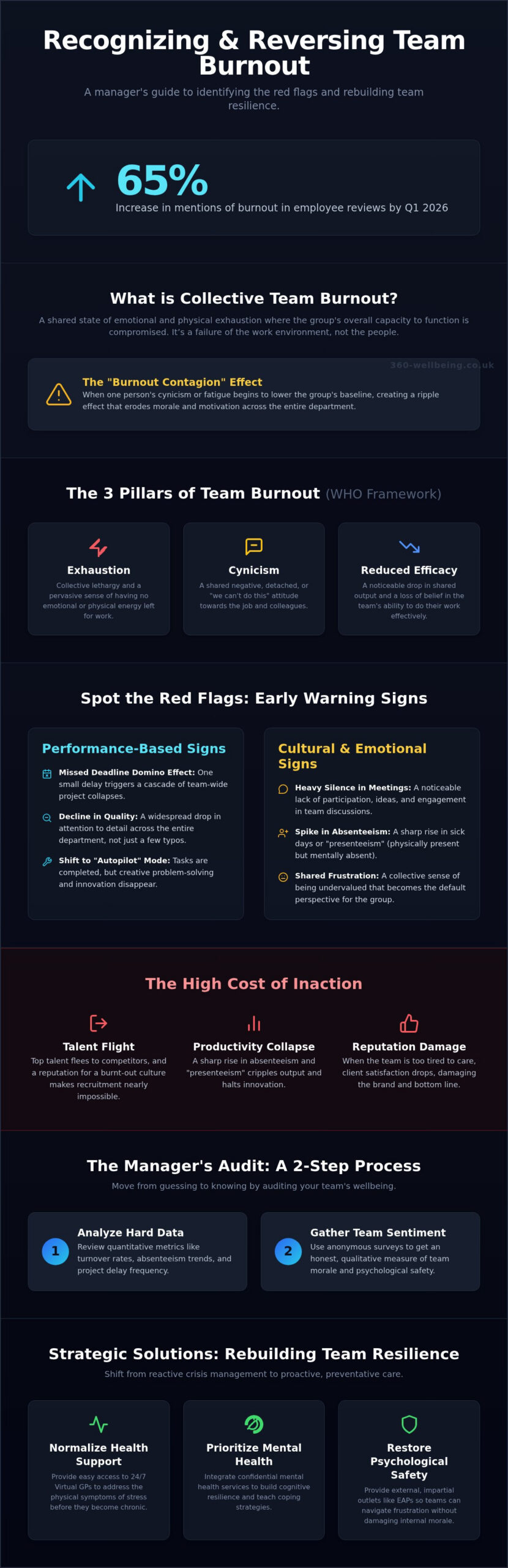
By the first quarter of 2026, mentions of burnout in employee reviews had climbed by a staggering 65% compared to the previous year. If you’ve noticed a heavy silence in your weekly meetings or a sudden spike in absenteeism, you aren’t just imagining a shift in the atmosphere. These are the telltale signs of a burnt-out team, a collective exhaustion that can’t be fixed by a simple long weekend or a one-off wellness workshop. When high-performing talent begins to disengage or consider leaving for competitors, it’s a signal that the systemic health of your workplace needs urgent, compassionate attention.
We understand that as a manager, you carry the weight of both your team’s productivity and their personal wellbeing. It’s a delicate balance to strike, especially when you’re trying to prevent a total collapse without overextending your own internal resources. This guide will help you move from reactive worry to proactive care by providing a clear checklist of red flags to watch for. You’ll learn how to intervene effectively with actionable steps and discover how to integrate professional, holistic support that restores vitality to your workplace culture.
Key Takeaways
- Learn to identify the collective signs of a burnt-out team by looking beyond individual fatigue to see how shared cynicism impacts the group’s baseline.
- Understand the performance-based red flags, including the “Missed Deadline Domino Effect” that often signals a department-wide decline in work quality.
- Discover a two-step auditing process that combines hard data like turnover rates with anonymous surveys to accurately measure team sentiment.
- Explore strategic interventions, such as normalising 24/7 Virtual GPs and mental health support, to move from reactive crisis management to proactive care.
- Learn how to restore psychological safety by providing external outlets like EAPs, allowing teams to navigate frustration without damaging internal morale.
Beyond Individual Stress: What Is Collective Team Burnout?
While we often view Occupational burnout as an individual’s struggle, it’s increasingly becoming a collective experience. Collective team burnout is a shared state of emotional and physical exhaustion where the group’s overall capacity to function is compromised. Recognising the signs of a burnt-out team early is the first step toward restoring workplace harmony. In 2026, we see this manifest as the “Burnout Contagion” effect. This happens when one person’s cynicism or fatigue begins to lower the group’s baseline, creating a ripple effect that erodes morale across the entire department. If one team member feels chronically undervalued, their frustration can quickly become the default perspective for the whole group.
Spotting these red flags is significantly more challenging in our current hybrid and remote workplace landscape. Without the physical presence of a shared office, the subtle cues of exhaustion, like slumped shoulders or a lack of eye contact, are filtered through screens. Digital fatigue adds another layer of complexity. If you’re noticing a pattern of missed deadlines or a lack of participation in virtual chats, you’re likely seeing the early signs of a burnt-out team. It’s vital to distinguish between a high-pressure “sprint,” which has a clear end date and recovery period, and chronic, unmanaged team strain that feels like a never-ending treadmill. A sprint can build camaraderie, but chronic strain destroys it.
The WHO Framework for 2026 Teams
The World Health Organization identifies three pillars of burnout: exhaustion, cynicism, and reduced professional efficacy. When applied to a group, these pillars look like collective lethargy, a “we can’t do this” attitude, and a noticeable drop in shared output. Often, what managers label as “Quiet Quitting” is actually a collective symptom of systemic burnout rather than a lack of individual motivation. It’s a defensive mechanism used by teams to survive an unsustainable pace. Team burnout is a failure of the work environment, not the people.
The Cost of Ignoring the Signs
The financial and cultural price of overlooking these red flags is high. In the competitive UK market, a reputation for a burnt-out culture makes recruitment nearly impossible and causes top talent to flee to competitors who prioritise durability. This exhaustion leads to a sharp rise in absenteeism and “presenteeism,” where staff are physically at their desks but mentally absent. Beyond the internal metrics, the lack of vitality eventually reaches your clients. When a team is too tired to care, client satisfaction drops, leading to long-term damage to your brand’s reputation and bottom line.
Performance-Based Signs of a Burnt-Out Team
Identifying the signs of a burnt-out team often starts with a shift in the quality of work. It isn’t just a few typos; it’s a widespread decline in attention to detail across the entire department. You might notice the “Missed Deadline Domino Effect,” where one small delay in a project triggers a team-wide collapse. This happens because the collective buffer for stress has evaporated, leaving no room for the usual adjustments that high-performing groups handle with ease. When the group’s capacity is stretched thin, the work becomes reactive rather than proactive.
Cognitive performance and physical health are deeply linked. The WHO defines burnout as a syndrome resulting from chronic workplace stress that hasn’t been successfully managed, leading specifically to reduced professional efficacy. When teams reach this point, they shift into “autopilot” mode. They complete tasks to get them done, but the creative problem-solving that drives innovation disappears. This lack of engagement is a protective measure, as the brain prioritises basic completion over high-level thinking.
The Decline in Collective Efficacy
It’s easy to mistake a performance drop for a skill gap, but the two are very different. While a skill gap requires training, a burnout-related drop requires restoration. You’ll notice that your most talented people stop challenging the status quo. They no longer suggest new ideas in brainstorming sessions because they simply don’t have the mental energy to defend or implement them. Supporting these individuals through a holistic wellbeing platform can provide the necessary resources to rebuild that cognitive resilience before the decline becomes permanent.
Erratic Communication Patterns
Communication is often the first casualty of team-wide exhaustion. In modern digital workflows, this manifests as “Radio Silence” in remote or hybrid environments. A sudden drop in Slack or group chat engagement is a major red flag for any manager. When collaboration turns into “blame-shifting” within project management tools, it’s a sign that the psychological safety of the group is fractured. Recognizing these digital signs of a burnt-out team allows you to intervene before the silence leads to total disconnection. Instead of solving problems together, team members begin to protect themselves, further isolating the group and deepening the cycle of fatigue.
The Cultural and Emotional Red Flags
Beyond productivity metrics, the most telling signs of a burnt-out team often live in the group’s “emotional climate.” You might notice a rise in collective cynicism. It’s that moment when “we can’t do this” replaces “how can we solve this?” in every meeting. This isn’t just negativity; it’s a shared defensive posture. Interpersonal conflict often follows because psychological safety has eroded. Team members who once supported each other now snap over minor details or retreat into silos to avoid further friction. When the “vibe” of the team shifts from collaborative to combative, the underlying cause is rarely a personality clash; it’s usually collective exhaustion.
Watch for the “Friday Afternoon Silence.” In healthy teams, there’s usually a natural social ebb and flow, even in digital spaces. When that non-work interaction disappears, it’s a sign that social cohesion is breaking down. On video calls, emotional exhaustion becomes visible. You’ll see more cameras turned off and a flat affect in those who do appear. These aren’t just technical preferences or Zoom fatigue. They’re indicators that the team no longer has the emotional energy to perform “presence” for one another. They’re retreating into themselves to preserve what little capacity they have left.
The Erosion of Team Spirit
Cynicism often acts as a protective mechanism against further disappointment. If the team expects failure or overwork, they don’t have to face the emotional hit of unmet goals. This leads to a total loss of “discretionary effort.” Instead of going the extra mile, the group does the bare minimum required to survive another day. This is the “withdrawal” stage of team burnout. It’s a quiet, heavy state where the team’s spirit has essentially gone into hibernation. They’re physically present but emotionally disconnected from the mission and each other.
Health and Wellbeing Indicators
Keep a close eye on the team’s physical health trends. A sudden surge in minor illness-related absences, such as recurring headaches or seasonal colds that won’t shift, often points to a compromised collective immune system due to chronic stress. You’ll see visible fatigue during virtual meetings, with team members appearing drained or distracted. Providing access to a Virtual GP can be a vital first step in your intervention strategy. It allows employees to address these physical stress markers early and privately, helping you move from managing a crisis to fostering a proactive culture of durability and care.
The Manager’s Checklist: Auditing Your Team’s Wellbeing
While cultural shifts provide a qualitative view, a structured audit is necessary to confirm the signs of a burnt-out team using hard evidence. Moving from observation to analysis allows you to build a proactive safety net for your staff. This checklist helps you identify where the pressure points are most acute, ensuring your intervention is both precise and compassionate. By combining quantitative metrics with the qualitative red flags discussed earlier, you create a panoramic view of the signs of a burnt-out team before the situation reaches a breaking point.
- Step 1: Review Quantitative Data. Look for spikes in absenteeism, increased staff turnover, and consistent overtime hours that suggest an unsustainable pace.
- Step 2: Conduct Anonymous Wellbeing Pulses. Use short, frequent surveys to gauge the team’s current stress levels and psychological safety without the pressure of attribution.
- Step 3: One-to-One Check-ins. Schedule dedicated time to discuss the person, not the task, focusing on their energy levels rather than just their output.
- Step 4: Assess Workloads. Perform a “Real-World” vs. “On-Paper” audit to see if the actual time required for tasks matches the capacity assigned to them.
- Step 5: Evaluate Support Systems. Review the usage rates and effectiveness of your current health benefits and Employee Assistance Programmes.
Effective One-to-One Strategies
To bypass the standard “I’m fine” reflex, you need to ask questions that invite honest reflection. Instead of asking “How is your workload?”, try “What’s the one thing making your week feel heavier than it should be?”. Active listening is your most powerful tool here; it validates the team’s collective struggle and builds the trust necessary for them to be vulnerable. Remember that a manager’s role is to facilitate professional support, not to act as a clinical therapist. Your goal is to guide them toward the right resources while maintaining a supportive partnership.
Utilising Data to Spot Trends
Data allows you to spot clusters of stress-related illnesses within specific departments, which often indicates a systemic issue rather than an individual one. You should also track “out-of-hours” communication metrics to see if digital boundaries have dissolved, as this is a primary driver of chronic fatigue in hybrid teams. Showing the ROI of wellbeing, such as reduced recruitment costs and lower absenteeism, helps justify a long-term investment in a comprehensive employee assistance programme. This analytical approach ensures your strategy is scientifically grounded while remaining deeply personal.
Strategic Solutions: Rebuilding Team Resilience
Once you’ve identified the signs of a burnt-out team, the focus must shift from observation to active restoration. Rebuilding resilience isn’t about a single grand gesture; it’s about weaving a “Health-First” culture into the very fabric of your daily operations. This means normalising the use of professional tools like Virtual GPs and mental health support so they become as standard as a laptop or a desk. When these resources are visible and encouraged, you remove the stigma of “struggling” and replace it with a proactive commitment to durability and collective care.
Structural changes to your workflow are equally vital for long-term recovery. High-intensity projects are often unavoidable in a competitive market, but they must be balanced with intentional “Recovery Periods.” This allows for cognitive rest and prevents the chronic strain that leads to the collective exhaustion we’ve explored in previous sections. Empowering your staff through Life Coaching and professional development also shifts the narrative from survival to growth. It gives team members a sense of agency over their careers, which acts as a powerful antidote to the helplessness often felt during periods of high stress.
Holistic Health as a Business Strategy
Integrating 24/7 access to a UK-registered GP does more than just treat physical symptoms; it significantly reduces the “health-anxiety” burden that weighs on a stressed workforce. When employees know they can speak to a professional at any time, they feel supported on a deeply personal level, which reduces absenteeism. Similarly, professional mental health therapy provides the tools for individuals to navigate their own emotional landscapes, which directly improves team cohesion and psychological safety. By positioning 360 Wellbeing as your comprehensive partner, you provide your organisation with a structured, scientifically grounded path toward recovery and sustained vitality.
Practical Steps for Immediate Relief
Sometimes, the team needs immediate breathing room to stop the cycle of fatigue. Declaring “Meeting-Free” days can provide the necessary space for deep work and cognitive rest, reducing the constant “switch-tasking” that drains mental energy. You should also encourage the use of financial and legal support helplines. These external stressors often bleed into the workplace, and providing a way to resolve them can lift a massive weight off your team’s shoulders. Finally, create a long-term wellbeing roadmap that evolves with your team. This ensures that your support isn’t just a one-off response to the signs of a burnt-out team, but a permanent pillar of your professional culture that protects your most valuable asset: your people.
Cultivating a Sustainable Future for Your Team
Recognizing the signs of a burnt-out team is the first step toward building a more resilient and harmonious workplace. It’s about looking at the panoramic view of your department and understanding that collective exhaustion requires a systemic, health-first solution. By auditing both hard data and subtle cultural shifts, you can intervene before burnout leads to permanent turnover or a total loss of morale. Transitioning from a reactive stance to a proactive health strategy doesn’t just protect your staff; it ensures the long-term durability and success of your business.
You don’t have to navigate this journey alone. Protect your team’s vitality with 360 Wellbeing’s comprehensive platform. Our service provides 24/7 Virtual GP access, professional mental health therapy, and life coaching, all backed by UK-registered clinical expertise. This holistic approach empowers your managers to provide meaningful support without overextending internal resources. Together, we can restore workplace harmony and build a culture where every team member feels valued, supported, and ready to thrive.
Frequently Asked Questions
What is the difference between individual burnout and team burnout?
Individual burnout is a personal struggle with exhaustion, while team burnout is a collective cultural phenomenon where the group’s shared capacity and morale collapse. When burnout is individual, one person might be struggling while others compensate. In a team setting, the “contagion” effect means cynicism and fatigue become the group’s default baseline. It’s a systemic failure of the work environment rather than a series of isolated personal issues.
How can I tell if my team is burnt out or just lazy?
“Laziness” is often a label for a lack of motivation, but burnout is a state of physical and emotional depletion that prevents someone from functioning. If a once high-performing group suddenly shows signs of a burnt-out team, such as missed deadlines or a lack of creative problem-solving, it isn’t a character flaw. Burnout involves a loss of capacity, whereas laziness implies a choice. Look for patterns of exhaustion and cynicism to distinguish between the two.
Can a team recover from burnout without changing the manager?
Yes, a team can recover without a change in leadership if the manager is willing to implement structural changes and provide professional support. Recovery requires a shift from a “sprint” mentality to a “durability” mindset. By normalising the use of Mental Health Support and EAPs, a manager can rebuild trust and psychological safety. It’s about the manager facilitating a healthier environment and acknowledging the collective strain rather than simply being the source of it.
What are the first physical signs of stress I should look for in my staff?
Managers should watch for persistent minor illnesses, such as recurring headaches, digestive issues, or seasonal colds that the team can’t seem to shake. Physical fatigue is often visible during video calls through flat affects or slumped posture. You might also notice a spike in absenteeism due to these “minor” health complaints. These are often the body’s way of signalling that the collective stress load has exceeded the team’s ability to recover.
How does a Virtual GP service help with workplace burnout?
A Virtual GP service provides 24/7 access to clinical expertise, reducing the “health-anxiety” that often accompanies chronic workplace stress. It allows employees to address physical symptoms quickly and privately, preventing minor issues from escalating into long-term absenteeism. By offering this as a standard benefit, you provide a proactive safety net. It helps employees manage the physical toll of burnout while feeling supported by their employer’s commitment to their total wellbeing.
Is it possible to prevent burnout in a high-pressure industry?
Prevention is possible through the intentional design of “Recovery Periods” and the use of professional support systems. High pressure doesn’t have to lead to burnout if the intensity is balanced with periods of cognitive rest and deep work. Implementing a “Health-First” culture where life coaching and mental health resources are readily available helps build collective resilience. It’s about ensuring the work environment is durable enough to withstand industry demands without breaking the people within it.
What should I do if my boss ignores the signs of team burnout?
If your leadership ignores the signs of a burnt-out team, focus on presenting the quantitative impact, such as rising turnover rates or the cost of absenteeism. Use the ROI of wellbeing to show that chronic stress is a financial risk to the organisation. You can also advocate for external support like an EAP, which provides a professional outlet for team frustration. Highlighting these risks as business challenges often makes the case for intervention more persuasive.
How often should I conduct a wellbeing audit for my team?
You should conduct a formal wellbeing audit at least once a quarter, though “Wellbeing Pulses” can happen more frequently. Regular audits allow you to spot trends in absenteeism or overtime before they become systemic failures. These check-ins shouldn’t just focus on tasks; they must evaluate the person’s energy and the effectiveness of current support systems. Frequent, small-scale audits create a sense of safety and ensure your strategy evolves with the team’s changing needs.