
A discount on the weekly shop is a thoughtful gesture, but it doesn’t help an employee navigating a mental health crisis or a complex physical injury. While many UK organisations turn to perks-based platforms to boost morale, many are now discovering specific reward gateway limitations that hinder long-term wellness. With 51% of employees reporting they aren’t happy at work in 2026, the gap between surface-level rewards and genuine clinical support is becoming harder to ignore. You want your team to feel truly cared for, not just ‘engaged’ through a screen.
We understand the frustration of managing complex modules only to find that employees are suffering from login fatigue or that the support they need is tucked behind transaction limits. This article provides an objective analysis of where these platforms reach their operational boundaries and where a clinical wellbeing approach offers a more reliable path forward. You’ll gain a clear framework to decide if your business needs a perks-based system or a health-based partner. We’ll show you how to reduce administrative friction while ensuring your staff have direct access to virtual GPs and professional therapy, moving beyond transactional benefits toward a culture of lasting vitality.
Key Takeaways
- Understand the distinction between transactional retail discounts and transformative clinical care, such as 24/7 Virtual GP access and professional mental health therapy.
- Identify specific reward gateway limitations, including spending caps and order frequency restrictions that can create unexpected friction for your employees.
- Evaluate why enterprise-level engagement systems may be too complex for UK SMEs and how a clinical-first model reduces your administrative burden.
- Learn how to bridge the gap between surface-level wellness content and the direct medical support required to address acute health issues effectively.
- Use our 4-point checklist to determine if your organisation’s current needs are best met by a rewards-heavy platform or a holistic clinical wellbeing partner.
Understanding Reward Gateway Limitations: A Balanced Overview
Reward Gateway has long been a heavyweight in the world of employee recognition systems, providing a robust “Engagement Operating System” for some of the world’s largest brands. Their platform excels at delivering high-volume retail discounts and structured peer-to-peer awards. However, as we move through 2026, the needs of UK employers are evolving. A simple discount voucher no longer satisfies a workforce that prioritises genuine health and clinical support. This shift has brought several reward gateway limitations into sharper focus, particularly for smaller teams that require agility over enterprise-level complexity.
To understand if this model fits your business, we need to look at three specific areas where restrictions often appear:
- Operational: The administrative weight of managing a modular system that wasn’t originally designed for small teams.
- Financial: Transactional caps and tiered pricing structures that can complicate the user experience.
- Clinical: The absence of direct, 24/7 access to registered medical professionals within the core platform.
The Difference Between Engagement and Wellbeing
High engagement scores are often seen as the gold standard, but they can be misleading. An employee might log in daily to claim a supermarket discount while simultaneously struggling with untreated burnout. This creates a risk of “perk-washing,” where superficial rewards mask a lack of fundamental health support. It’s essential to decide if these reward gateway limitations align with your long-term strategy. At 360 Wellbeing, our philosophy of “Panoramic Care” moves beyond these transactional interactions. We believe that true wellness isn’t found in a coupon code; it’s found in the peace of mind that comes from knowing a Virtual GP or a mental health therapist is only a click away.
Who is the Enterprise Model Really Built For?
The Reward Gateway architecture is designed for massive scale. While this is a strength for global corporations, it often creates a “Login Fatigue” paradox for UK SMEs. When a platform offers dozens of modules, the administrative burden of onboarding and maintenance can become a full-time job. Nearly 1 in 5 job ads in 2026 now promote legal entitlements as “perks,” showing how diluted the concept of a benefit has become. For a small team, the tipping point occurs when the complexity of the “Operating System” outweighs its actual utility. You need a partner that feels like a supportive extension of your team, not a complex software package that requires months of implementation.
Transactional Restrictions and Hidden Operational Friction
A platform designed to alleviate financial stress shouldn’t add to an employee’s mental load. While the promise of instant savings is appealing, the daily reality of using these systems often reveals specific reward gateway limitations that can dampen enthusiasm. When an employee tries to manage a weekly shop or a large household purchase, they may encounter digital barriers that turn a benefit into a chore. These frictions often represent the dark side of employee engagement, where the focus on transactional volume outweighs the actual ease of use for the individual.
For many UK staff, the primary appeal of a rewards platform is the ability to save money instantly at the checkout. However, several operational restrictions can get in the way:
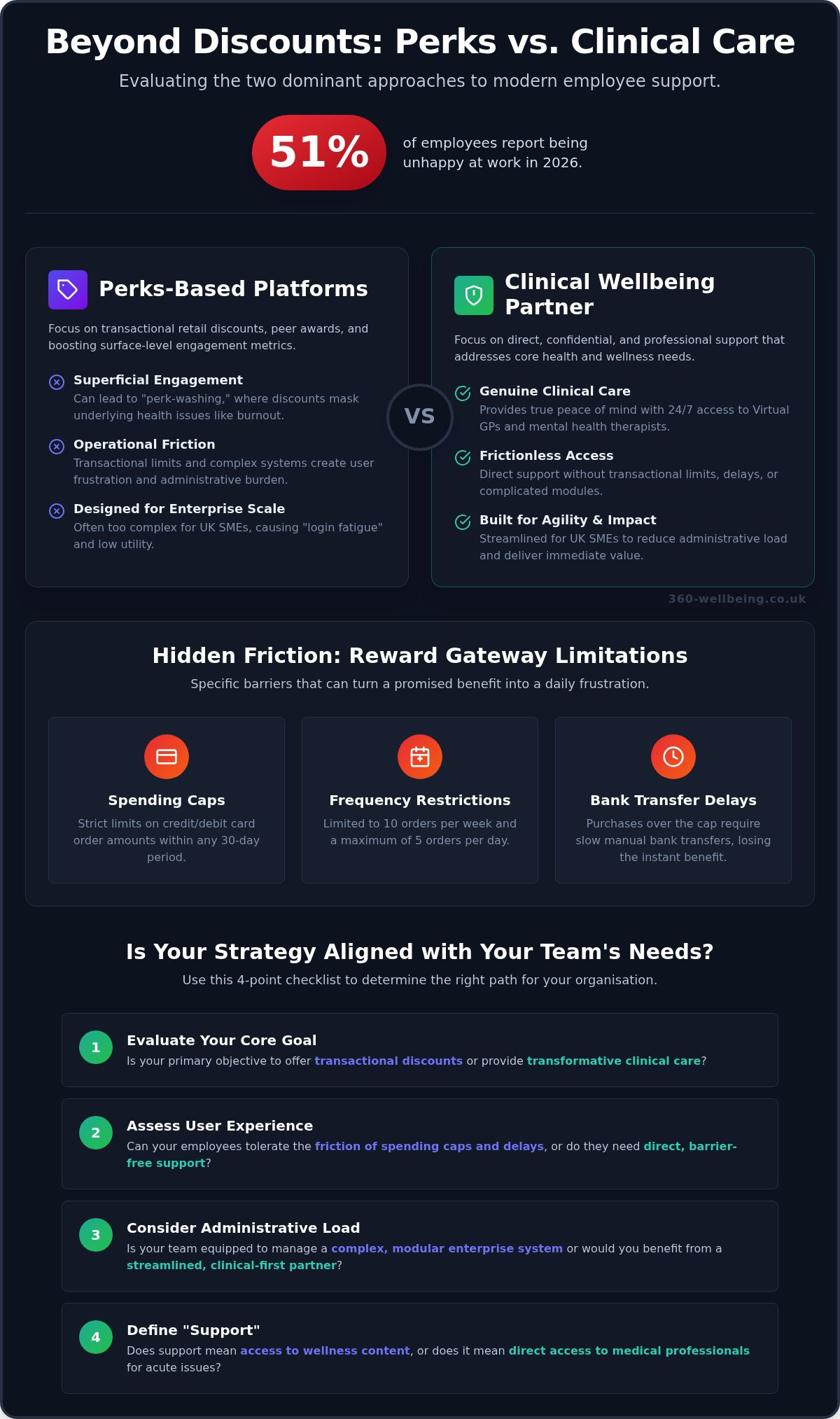
- Spending Caps: There are strict limits on the amounts that can be ordered using a credit or debit card within any 30-day period.
- Frequency Restrictions: Members are currently limited to 10 orders every seven days and a maximum of five orders per day.
- The Bank Transfer Delay: For amounts exceeding card limits, users must pay via bank transfer. This removes the “instant” nature of the voucher, as users must wait for manual confirmation before receiving their code.
Voucher and Card Ordering Limits
The restriction of 10 orders per week might seem generous at first glance, but it can quickly become a bottleneck. Imagine an employee trying to buy multiple small items from different retailers or managing a complex family budget. If they hit their limit, they’re locked out of savings until the rolling period resets. This is often compounded by “Invalid Code” errors at the till, which require the employee to manually check balances or contact support. When these micro-frictions accumulate, employees often suffer from “platform fatigue” and simply stop using the service altogether.
Payment and Delivery Hurdles
While debit card transactions are typically free, many employees prefer using premium credit cards to earn their own points. In these cases, additional credit card fees can eat into the very savings the platform is supposed to provide. This creates a confusing experience where a “free benefit” starts costing the employee extra. In contrast, health-focused services like a 24/7 Virtual GP provide direct, frictionless access to care without transactional caps or hidden surcharges. For an SME, choosing a partner that prioritises clinical reliability over complex voucher rules can lead to much higher long-term satisfaction and a healthier workforce.
The Gap Between Employee Perks and Clinical Support
While a library of wellness videos or a meditation guide can be a helpful addition to a healthy lifestyle, they’re often insufficient when an employee faces a genuine medical crisis. One of the most significant reward gateway limitations is the heavy reliance on content-based wellbeing rather than direct clinical intervention. In 2026, UK workers are looking for more than just self-help tips; they need a partner who can provide a diagnosis, prescribe medication, or offer professional mental health therapy in real-time. Without this clinical backbone, a platform risks becoming a collection of “nice-to-haves” that fail when the stakes are highest.
Lifestyle Content vs. Clinical Intervention
Consider the difference in return on investment between a subscription to a sleep app and immediate access to a 24/7 Virtual GP. While an app might offer general advice, a GP can identify an underlying health condition, provide a specialist referral, and offer the reassurance that only a registered medical professional can give. This is where the persona of an expert caregiver becomes vital. Employees don’t just want a portal; they want to feel that their health is being looked after by someone with clinical authority. We define Clinical Wellbeing as a measurable medical support system that provides tangible health outcomes rather than just passive content consumption.
Many organisations overlook the legal and compliance considerations involved in relying on non-clinical platforms for employee health. If a platform lacks 24/7 access to UK-registered doctors, it places a heavier burden on the employer to find supplementary services. A panoramic approach to wellness ensures that mental health support isn’t just a “wellbeing app” but a pathway to structured therapy sessions with qualified professionals who can guide an individual through recovery.
The Role of Financial and Legal Advocacy
Financial wellbeing is another area where the gap between perks and support is most visible. Cashback and retail discounts are helpful for the daily budget, but they don’t address the root causes of financial anxiety, such as debt or legal disputes. There is a direct, proven link between financial stress and workplace absenteeism in the UK; when an employee is worried about their mortgage or a legal issue, their productivity inevitably drops. Providing deeper security through complimentary will writing and debt helplines offers a level of protection that simple rewards cannot match.
For a more detailed look at how to build a robust strategy, you can read our Financial Support for Employees: A Comprehensive Guide for UK Employers in 2026. By moving beyond transactional perks, you create a safety net that supports the whole person, ensuring they have the legal and clinical resources needed to navigate life’s challenges with confidence.
Why Large-Scale Platforms Can Struggle to Support UK SMEs
Enterprise-grade software is often built with layers of hierarchy and complex approval workflows that assume a large HR department is at the helm. For a UK SME, these features can quickly become a hindrance rather than a help. One of the primary reward gateway limitations for smaller organisations is the sheer scale of the implementation process. When you have a team of 20 or 30 people, you need a solution that works from day one, not a modular system that takes weeks to configure and a dedicated project manager to maintain. In 2026, agility is the greatest asset for a small business, and “plug-and-play” clinical support often provides more value than a high-maintenance rewards ecosystem.
Administrative Burden for Small HR Teams
Managing salary sacrifice schemes and eligibility approvals requires time that many small business owners simply don’t have. If a platform requires constant manual intervention to update employee lists or approve specific vouchers, the administrative cost often outweighs the benefit. Sole traders and micro-businesses often find enterprise platforms inaccessible because they’re built for volume, not for the personal touch. A fixed per-employee fee model provides the predictable budgeting that SMEs need to maintain foresight in their financial planning. It removes the guesswork and ensures that every penny spent translates directly into accessible care for the team.
Integration vs. Isolation
While global corporations might require complex API integrations for their ERP systems, most UK small businesses just need something that works alongside their basic payroll. Forcing a small team to navigate a separate, isolated “Engagement OS” creates friction and leads to the “Login Fatigue” we discussed earlier. A wellbeing partner should feel like a natural extension of your team, providing a panoramic view of employee health without the technical overhead. When a platform becomes too big, support responsiveness often suffers. There’s a profound difference between a global help center and a dedicated UK-based partner who understands the specific pressures of the local market.
The risk of account deprovisioning is another factor to consider. When an employee leaves, you need to know their data is handled with clinical precision and that the transition is seamless for your remaining staff. At 360 Wellbeing, we simplify the user journey for both the employer and the employee by focusing on direct clinical access rather than complex software management. If you are looking for a platform that prioritises health over administrative complexity, you can explore our clinical-first wellbeing solutions here. By choosing a partner tailored to your scale, you ensure that your team receives the expert care they deserve without the enterprise-level friction.
Choosing the Right Wellbeing Partner for Your Organisation
Deciding on a benefits platform is a significant commitment to your team’s future. While we’ve explored various reward gateway limitations, it’s vital to remember that the “right” fit depends entirely on your specific organisational goals. If you lead a global corporation with thousands of employees where high-volume retail recognition is the primary objective, an enterprise-scale system may serve you well. however, if you’re a UK SME looking to foster a culture of genuine health and resilience, you need a partner that prioritises clinical intervention over transactional perks.
To help you find clarity, we suggest using this 4-point checklist during your evaluation:
- Clinical Depth: Does the platform provide direct access to 24/7 Virtual GPs and professional mental health therapy, or just lifestyle content?
- Administrative Agility: Is the system “plug-and-play” for small HR teams, or does it require extensive modular management?
- Holistic Security: Does it include essential life supports like legal advocacy, debt advice, and complimentary will writing?
- User Experience: Will your employees use the platform for their health, or will they succumb to login fatigue and spending restrictions?
The 360 Wellbeing Alternative
We believe that wellbeing is a professional necessity and an essential human entitlement. Our platform is built on the pillars of 24/7 Virtual GP access and structured Mental Health Support, ensuring your team has a safety net that works every hour of every day. We don’t believe you should have to choose between savings and support; our 360 Rewards marketplace combines retail discounts with the clinical care your staff actually needs. This panoramic approach integrates physical, mental, and social health into a single, unified narrative. Our professional yet empathetic tone resonates with UK staff because it treats them as individuals with complex lives, not just users in a recognition database.
Next Steps: Auditing Your Current Benefits
The most effective way to move forward is to ask your team what they actually value. You might find that while a supermarket discount is appreciated, the ability to speak to a doctor at 10:00 PM on a Sunday is what truly reduces their stress. Transitioning to a clinical-first platform is simpler than you might think, especially when the system is designed to remove administrative friction rather than create it. We invite you to move away from surface-level engagement toward a proactive vision of workplace harmony. You can Explore our all-encompassing wellbeing platform to see how a health-first strategy can transform your business in 2026.
Prioritising Lasting Vitality for Your Team
Choosing the right path between surface-level perks and genuine medical support is a vital step for any UK business. We’ve examined how transactional barriers and the absence of direct clinical care represent significant reward gateway limitations for growing teams. Your employees deserve more than just a discount code; they need the reassurance that professional help is available the moment a health challenge arises.
Our clinical-first approach removes the administrative friction that often plagues smaller organisations. We provide 24/7 Virtual GP access for all staff and include professional mental health therapy as standard, ensuring your team receives expert care without the need for complex implementation. By integrating physical, mental, and social support into one clear narrative, you create a workplace where everyone has the opportunity to thrive.
Book a demo of our clinical-first employee wellbeing platform
We’re here to help you build a healthier, more resilient future for your organisation.
Frequently Asked Questions
What are the specific spending limits on Reward Gateway vouchers?
Members are currently restricted to 10 orders every seven days and a maximum of five orders per day. There are also specific 30-day limits on the total amount you can spend using a credit or debit card. For larger purchases exceeding these caps, employees must pay via bank transfer, which can delay the delivery of instant vouchers while the payment is confirmed.
Does Reward Gateway offer direct access to a UK-registered GP?
No, the native wellbeing modules on the platform primarily focus on lifestyle content such as sleep, nutrition, and fitness videos. While they provide an Employee Assistance Programme through a third-party partnership, they don’t include a built-in 24/7 Virtual GP service. This is one of the key reward gateway limitations for employers who prioritise immediate medical intervention over passive wellness articles.
Can small businesses or sole traders use Reward Gateway?
Yes, there’s a version of the platform specifically for businesses with fewer than 100 employees. However, many micro-businesses and sole traders find the administrative requirements and modular complexity difficult to manage without a dedicated HR department. Smaller teams often find more value in a streamlined, clinical-first approach that requires less maintenance and provides more direct health support for every staff member.
What are the common complaints about Reward Gateway’s mobile app?
Users frequently report login fatigue and frustration with the time it takes to generate vouchers at the point of sale. There are also occasional reports of invalid codes occurring at the till, which requires the employee to manually check their balance or contact support. These micro-frictions can sometimes lead to lower engagement over time as employees find the process more cumbersome than they expected.
How does the ‘Clinical Wellbeing’ model differ from a ‘Rewards’ model?
A Rewards model focuses on transactional engagement, such as retail discounts, cashback, and peer-to-peer recognition. In contrast, the Clinical Wellbeing model provides direct medical support, including 24/7 Virtual GP appointments and professional mental health therapy. While rewards are a thoughtful benefit, clinical support addresses acute health issues that directly impact workplace attendance and the long-term vitality of your workforce.
Are there hidden fees for employees when using discount platforms?
While debit card transactions are typically free, employees using premium credit cards may be subject to additional surcharges. These fees can sometimes diminish the actual value of the savings the employee is trying to achieve. It’s also worth noting that certain features, like the full Employee Assistance Programme or whistleblowing services, are often priced as optional add-ons for the employer rather than being part of the core platform.
What happens to an employee’s rewards if they leave the company?
Access to the platform and any unspent rewards or discounts is typically tied to the employee’s active contract with the company. Once an account is deprovisioned by HR, the employee usually loses access to the portal and any remaining benefits. This is why many businesses prefer health-first models where the focus is on providing durable physical and mental support that benefits the individual throughout their tenure.
How long does it take to implement a wellbeing platform for an SME?
Implementation times vary significantly depending on the platform’s complexity and the number of modules chosen. Large-scale enterprise systems can take weeks or even months to configure correctly, especially when integrating with complex payroll software. A clinical-first platform is designed for much greater agility, offering a plug-and-play experience that allows small businesses to provide expert care to their staff almost immediately without a heavy administrative burden.